
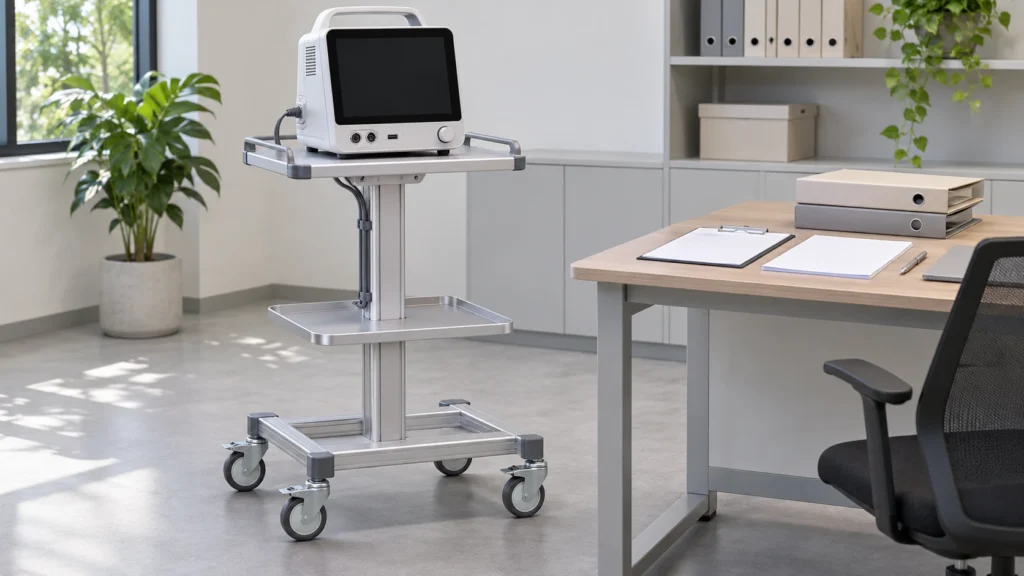
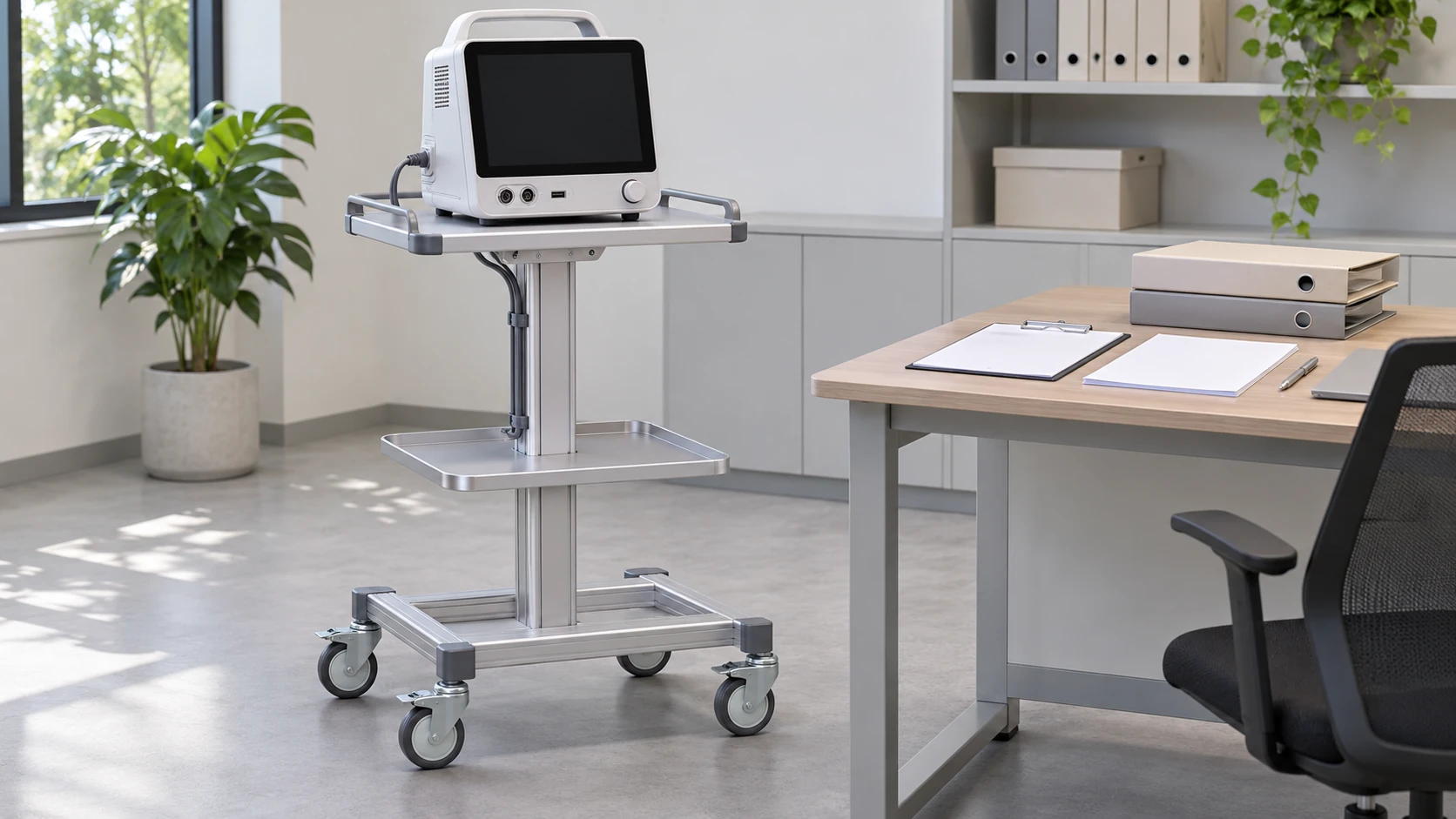
A medical cart repeat order should reference an approved configuration revision, not just a familiar model name. Record the device, drawing, bill of materials and accepted sample together, then review any proposed substitution before accepting it. This helps purchasing teams distinguish an unchanged reorder from a configuration that needs another fit review.
This guide concerns mechanical equipment-support carts. It is not a clinical-use protocol, an electrical-safety assessment or evidence of certification.
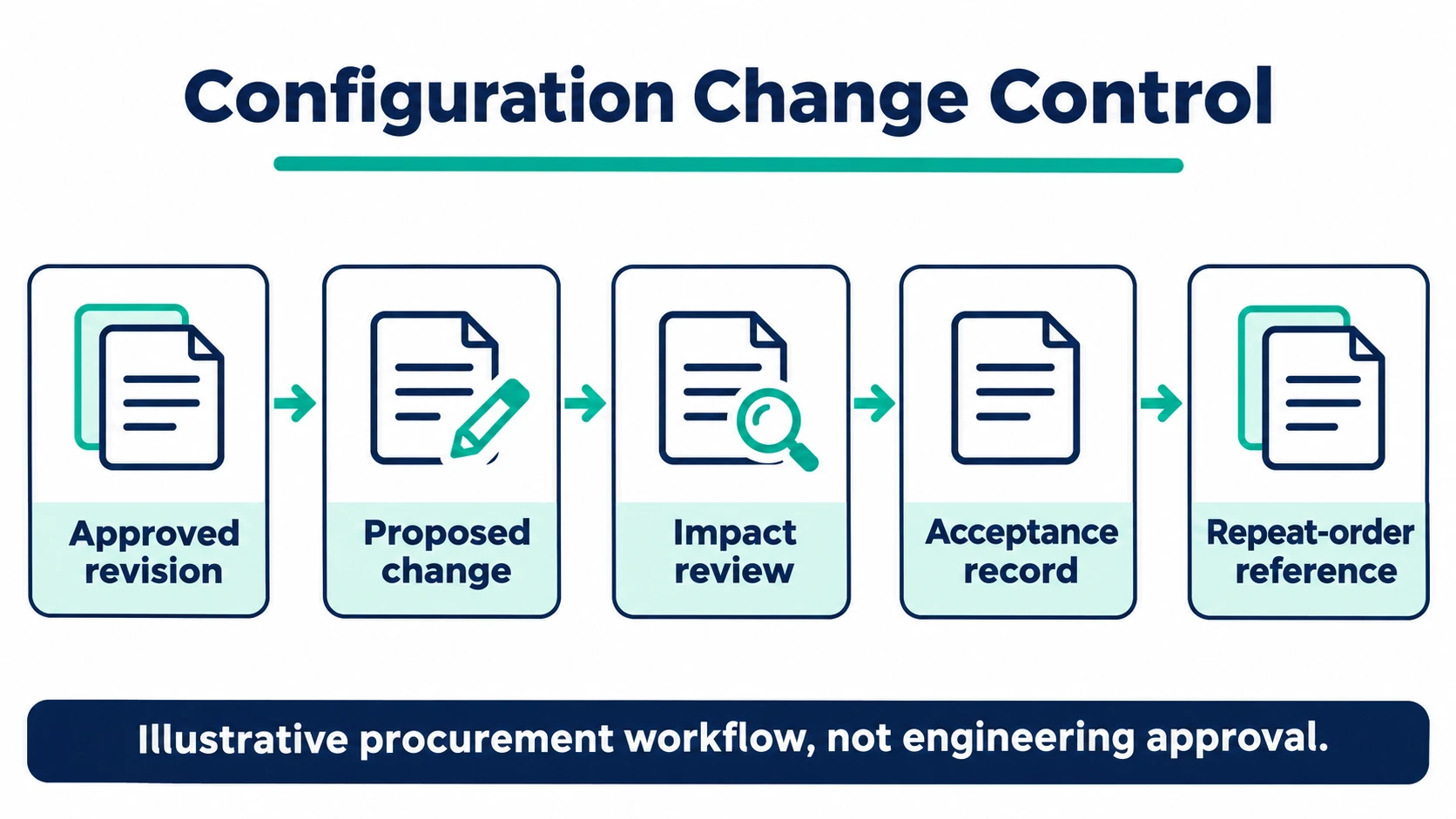
Why a model number is not a complete configuration
The CRF CA13Z004 four-wheel medical equipment cart provides a real product reference for an OEM configuration discussion. Its current product page identifies a four-wheel aluminum alloy equipment-support cart and requires device-specific review. It does not establish that every accessory, caster or equipment interface is interchangeable.
A purchasing reference can remain unchanged while a device connector moves, a peripheral grows or the destination site’s workflow changes. Treat these as inputs to a change review rather than assuming that an earlier acceptance covers them.
Create one configuration baseline
Link the drawing to the installed equipment
Record the cart model, drawing revision, equipment manufacturer and model, equipment revision where relevant, and the accessories included in the evaluation. Add annotated photographs showing the accepted arrangement. Photographs identify a configuration; they do not replace dimensions or a controlled drawing.
Separate confirmed items from open questions
Include a bill of materials with part identifiers and agreed specifications. If a caster, fixing or finish remains unconfirmed, mark it as unresolved rather than giving it a guessed specification. Keep commercial options separate from the accepted standard configuration.
Identify the acceptance record
Give the sample review a date and reference. Record who reviewed mechanical fit, what equipment was fitted and any limitations. Do not describe a fit review as load testing, electrical approval or regulatory certification unless the relevant evidence actually exists.
Compare an unchanged reorder with a proposed change
| Situation | Record to check | Suggested purchasing decision |
|---|---|---|
| Same approved device and unchanged cart parts | Current drawing, bill of materials and sample reference | Confirm the supplier is quoting the same revision |
| Replacement caster or mounting fastener | Part specification and affected interfaces | Hold acceptance until the substitution is reviewed |
| New device or accessory | Device dimensions, weight and attachment requirements | Reopen affected fit and configuration checks |
| Different site or cleaning requirements | Site constraints and approved maintenance information | Request a specific review rather than transferring assumptions |
| Packaging-only change | Packing specification and part protection | Review the affected packaging requirements separately |
These are review categories, not a universal approval procedure. The responsible engineering and quality teams should define the actual checks.
Ask suppliers to describe the difference, not just the replacement
A useful change request identifies the original item, proposed item, reason for change and affected documents. Ask whether dimensions, contact surfaces, adjustment travel, cable clearance, service access or maintenance instructions differ. “Equivalent” without supporting information is not enough to close a technical question.
For a four-wheel model, a different base layout is not a minor visual substitution. Three-, four- and five-wheel designs should retain their own configuration records. An equipment cart is not a walking aid, and this workflow does not authorize that use.
Build a repeat-order checklist
Before releasing a repeat-order purchase specification:
- Reference the accepted drawing and bill-of-materials revisions.
- Confirm the exact device and accessory set.
- List accepted deviations, if any, with their approval records.
- Ask for written disclosure of proposed substitutions.
- Define the records expected with the delivered configuration.
- Keep unresolved changes outside the approved baseline.
No inspection sample size, acceptance threshold or torque value is supplied here. Those belong in the project-specific agreement and applicable instructions.
Limits of a documentation review
A complete document set does not prove stability, load capacity, cleaning resistance or electrical compatibility. Changes affecting these characteristics may require further evaluation by qualified personnel. Never transfer a test result from a different cart or equipment arrangement without establishing its applicability.
For the wider project process, see CRF’s medical equipment cart OEM project guide. This article focuses specifically on preserving the accepted configuration after sample approval, not replacing the initial OEM design process.
Repeat-order change register template
Use a separate register for each repeat order rather than assuming the original sample closes later questions. Useful fields are the purchase-order reference, baseline drawing and parts-list revisions, proposed replacement identity, affected orders or inventory, review owner, required evidence, disposition and final order reference. Leave unknowns open; this template does not supply acceptance criteria.
| Handover point | Record to retain | Unresolved state |
|---|---|---|
| Supplier reports a substitution | Old and proposed part identity and reason | Change not yet accepted |
| Buyer assigns impact review | Affected configuration and responsible reviewer | Evidence still required |
| Repeat order is released | Agreed revision and any recorded limitations | Exclude unaccepted substitutions |
This transaction record complements the mounting-interface drawing guide, which addresses the mating geometry rather than the repeat-order handover.
FAQ
Can the same model name cover different accessory configurations?
It may. Ask for the drawing and bill of materials associated with the quoted configuration rather than relying on the name alone.
Does every change require a full new prototype?
Not necessarily. The responsible reviewers should assess what the change affects and specify the evidence needed. Do not assume that an apparently small change requires no review.
Can a photograph serve as the approved specification?
Use photographs alongside controlled documents. They rarely identify hidden fixings, exact interfaces or material specifications sufficiently by themselves.
Request a configuration-specific RFQ
Send CRF your existing model reference, device details, accepted drawing revision, accessory list, proposed changes, quantity and destination market through the CRF contact page. Ask for a configuration-specific quotation and identify the records needed before repeat-order approval. Availability, specifications and commercial terms must be confirmed in the quotation.
Request a B2B RFQ for the exact configuration and documentation scope. Images are AI-generated generic concepts, not exact CRF models, customer installations, approved procedures or performance evidence.