
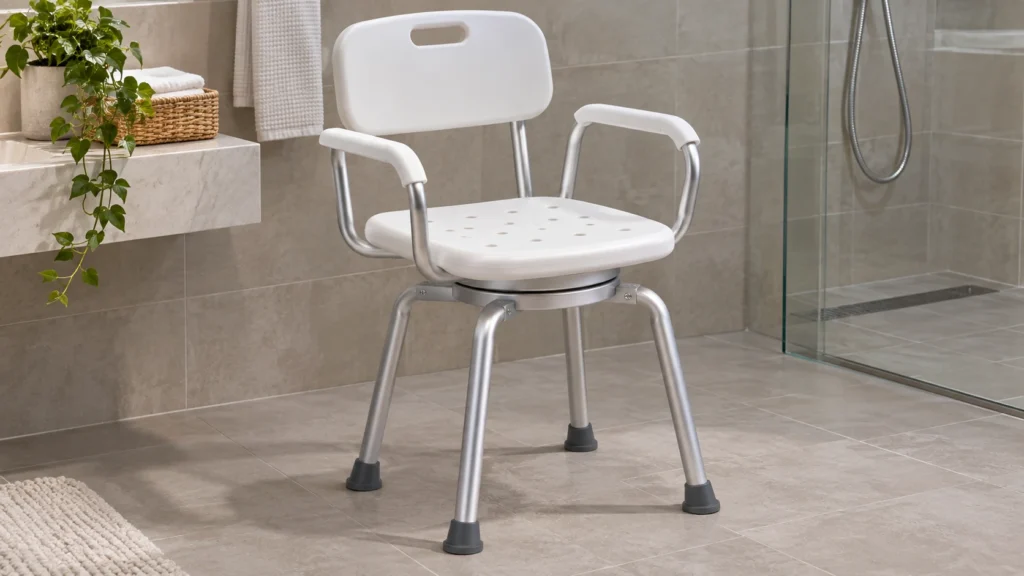
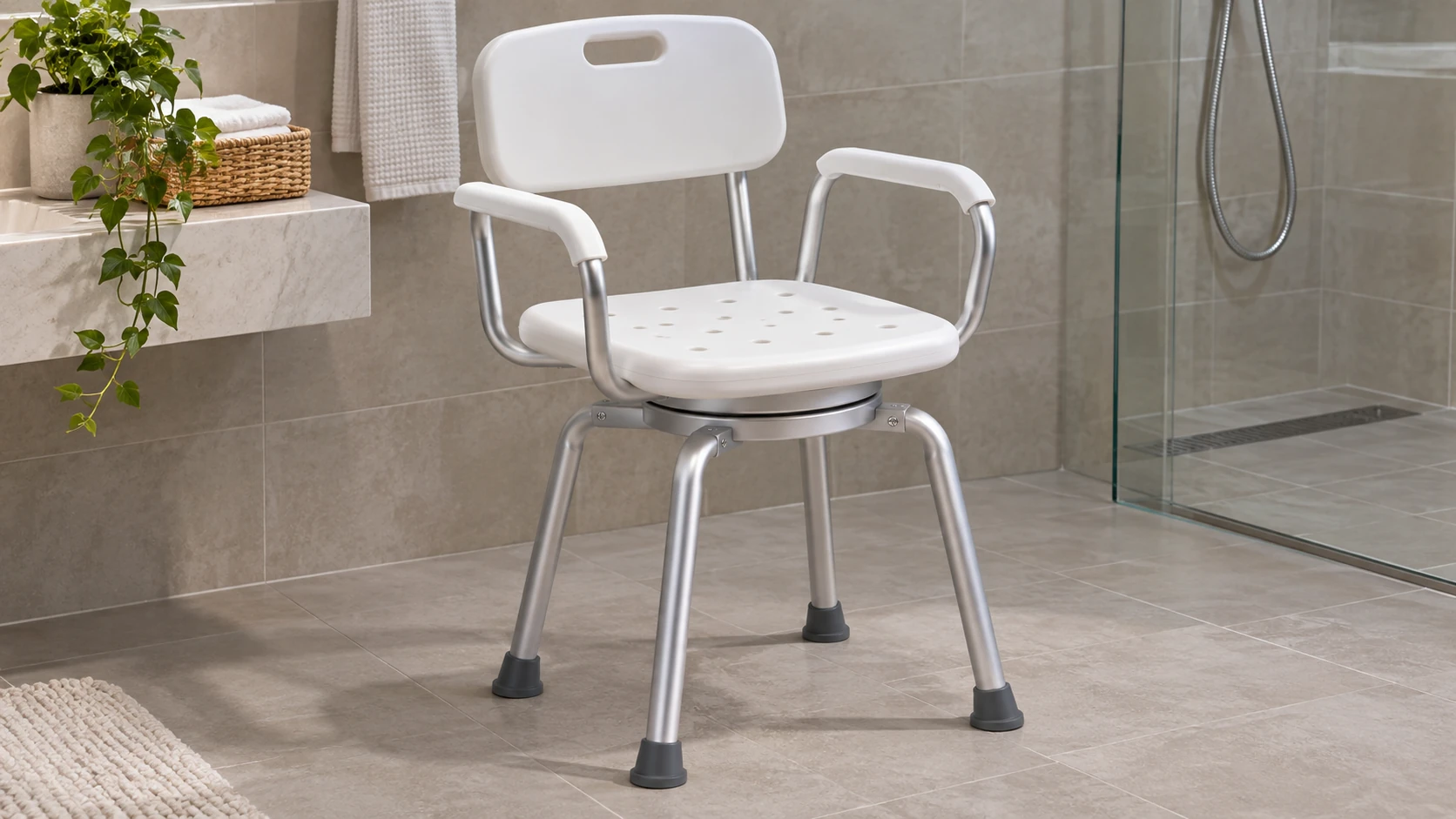
A swivel shower chair listing does not, by itself, confirm whether the seat locks, how the release operates or which positions are permitted for use. Before sourcing, request the exact model’s mechanism description, instructions and configuration-specific evidence. Treat seat rotation, armrest movement and frame folding as separate functions; one does not prove the others.
This is a B2B specification review, not bathing, transfer or medical advice. A qualified care professional should determine suitability for an individual, and use must follow the exact product instructions.
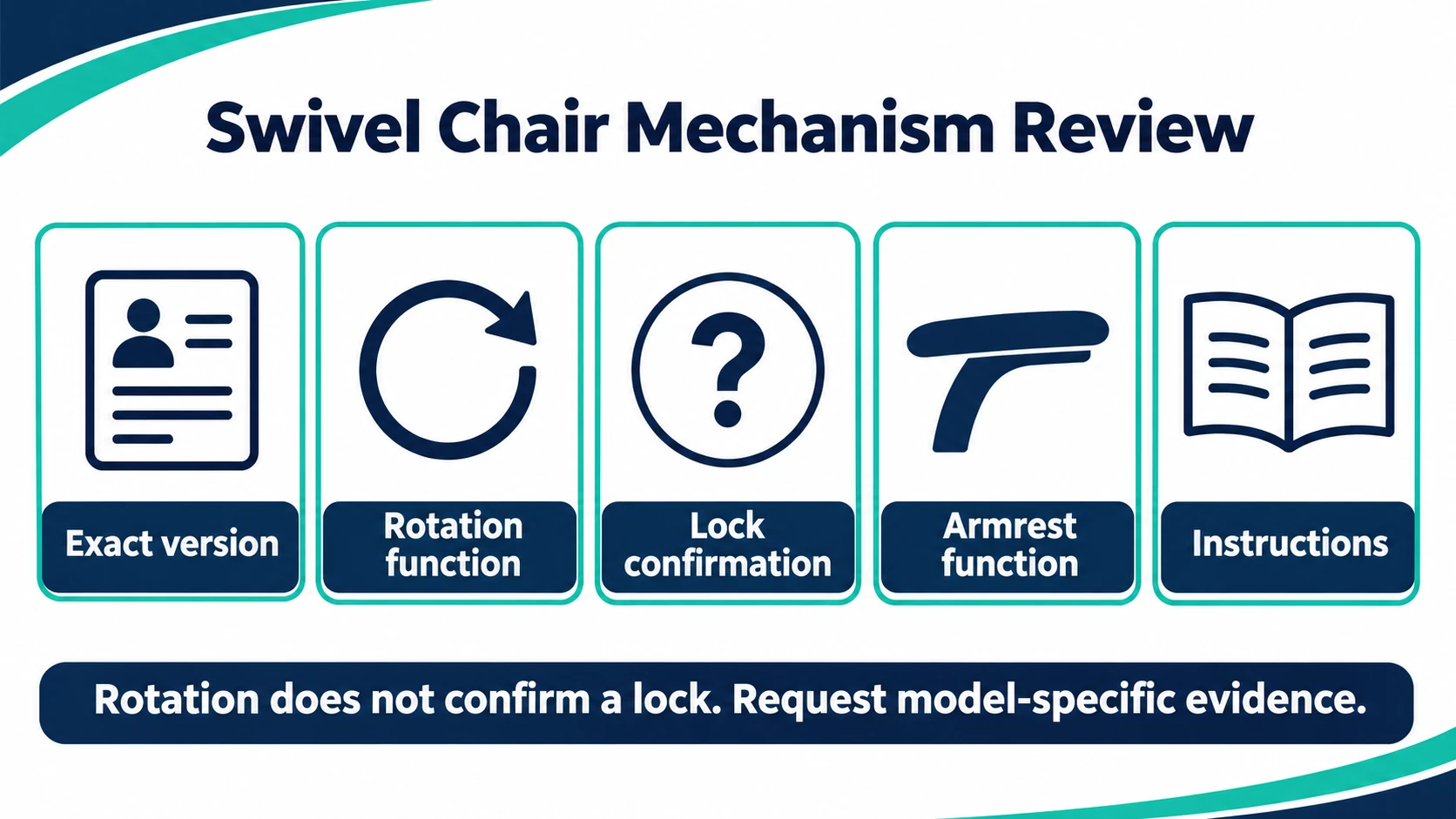
What the CRF product evidence establishes
The CRF CY0043-2 folding aluminum swivel shower chair is listed with a supplier-described aluminum frame, white seat and backrest, arm supports and a swivel design. Its page explicitly asks buyers to confirm the swivel and locking mechanism and final configuration before ordering.
The listing therefore supports a sourcing discussion about a swivel chair. It does not establish a confirmed lock interval, release type, load rating or clinical suitability. Do not copy those specifications from another manufacturer’s rotating stool, even when the products look similar.
Identify the supplied configuration first
Include model CY0043-2, a dated reference image and the proposed bill of materials in the enquiry. Ask which parts rotate, which arm supports move and whether “folding” describes the armrests, frame or another component. Keep the response linked to the exact quotation revision.
If a supplier uses one title for several versions, ask for the image and instructions corresponding to the version being quoted. A feature visible on a related version is not sufficient evidence for the supplied chair.
Separate rotation from locking
A rotating seat and a seat lock are different specifications. Ask CRF to state whether a lock is included and, if so, its operating principle, permitted positions and release control. If the mechanism does not lock, that must be stated clearly in the specification rather than obscured by general “swivel” language.
| Question | Evidence to request | Do not assume |
|---|---|---|
| What rotates? | Annotated drawing or model-specific demonstration | That the whole chair rotates with the seat |
| Is a seat lock included? | Written mechanism description and instructions | That every swivel seat locks |
| Which positions are permitted? | Model-specific operating instructions | A rotation angle or interval taken from a competitor |
| How is release controlled? | Exact control location and instructions | That an apparent lever controls the seat lock |
| Are armrests independently secured? | Separate armrest instructions | That a seat lock also secures movable armrests |
Ask for understandable operating information
For a locking configuration, request instructions explaining how the intended operator identifies the locked and released states. Ask whether any indicator or other confirmation feature exists; do not imply one is supplied before it is documented.
The supplier should explain operating restrictions, inspection requirements and what to do when a mechanism does not behave as described. These belong in the model’s instructions and technical support materials. This article does not offer a generic release sequence because mechanisms differ and using the wrong sequence could be unsafe.
Keep demonstrations within the approved scope
A video can help identify components and show the supplier-prescribed sequence. Request a clear view of the model reference, relevant control and the resulting component position. It is not a substitute for applicable test evidence, a risk assessment or the written instructions.
Do not ask an unqualified person to demonstrate transfers, improvise occupied-chair tests or verify a lock by applying unspecified force. Agree any sample evaluation with the manufacturer and appropriate competent reviewers.
Review armrest and folding functions separately
Movable armrests may have their own controls or retention details. Ask which armrest version is included, whether it moves and how its intended position is secured. Do not describe an armrest as a lifting point or transfer support unless the exact product instructions permit that use.
Likewise, request clarification of what folds and in which state. A folding armrest is not evidence of a folding main frame. The CY0043-2 page leaves final configuration confirmation to the quotation and approved sample; keep that limitation visible in purchasing documents.
This article focuses on mechanism specification, not storage dimensions or a comparison of general shower-chair manufacturers.
Assemble the procurement evidence package
Before approving the specification, request:
- Exact model, version and included armrest arrangement.
- Seat rotation and locking description, including any confirmed limitations.
- Separate descriptions for movable armrests and any folding components.
- Current operating, inspection and maintenance instructions.
- The supplier’s stated intended use and relevant restrictions.
- Applicable product evidence and market documentation for competent review.
- Sample identification and a record of unresolved questions.
Ask for evidence relevant to the actual configuration and destination requirements. Do not treat a generic certificate, an unlabelled video or a product-family photograph as proof of a particular locking function. No certification, load capacity, fall-prevention result or medical benefit is claimed here.
Maintain a clear change record
If the swivel mechanism, release control or armrest hardware changes, update the drawing and instructions review. Record whether the change affects the quoted configuration and whether the sample evidence must be repeated. Keep commercial approval separate from technical approval while unresolved mechanism questions remain.
For distributors, align catalogue descriptions with the confirmed evidence. Wording such as “locks at fixed intervals” should appear only when the exact intervals and mechanism are documented for the supplied product. Do not convert a supplier’s unconfirmed feature proposal into a public specification.
Frequently asked questions
Does every swivel shower chair have a locking seat?
No such assumption is justified. Confirm whether the exact configuration includes a lock and obtain its instructions before describing its operation.
Can I use another chair’s instructions for a similar-looking model?
No. Use instructions specific to the supplied model and revision. Similar appearance does not prove identical mechanisms or permitted use.
Does a swivel seat make the chair a transfer device?
Not automatically. Intended use must be established by the manufacturer and assessed by appropriate care professionals. Rotation alone does not establish transfer suitability.
What locking interval does CY0043-2 provide?
The reviewed CRF product page does not confirm an interval. Request the model-specific mechanism details from CRF rather than inserting an unsupported number.
Request the model-specific specification
Use the CY0043-2 product RFQ to request the exact seat mechanism, armrest configuration, instructions and sample-review scope. Include your intended market and purchasing requirements. Contact sales@szcrftech.com for a B2B enquiry; suitability and technical details remain subject to documented review.
Request a B2B RFQ for the exact configuration and documentation scope. Images are AI-generated generic concepts, not exact CRF models, customer installations, approved procedures or performance evidence.