
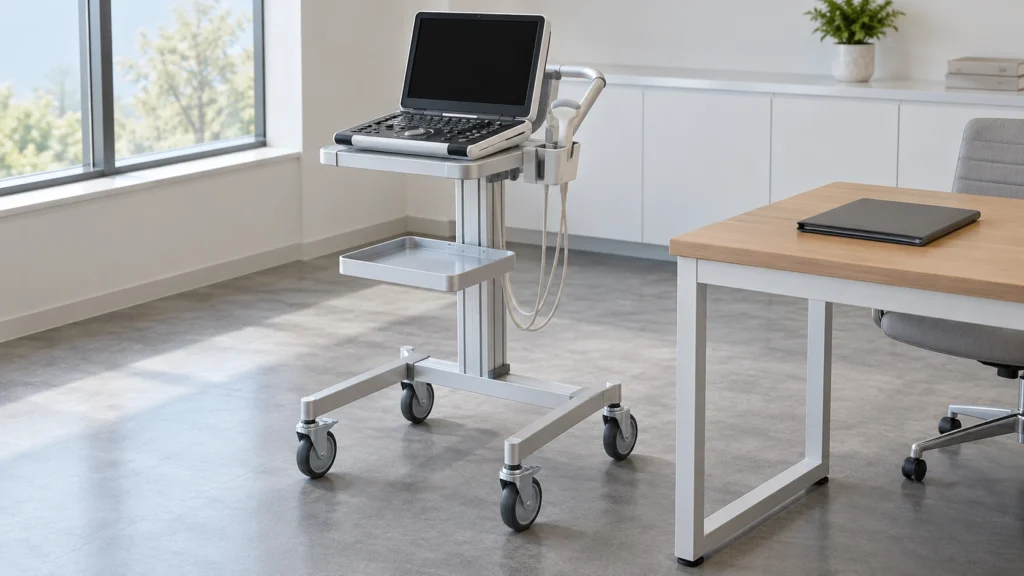
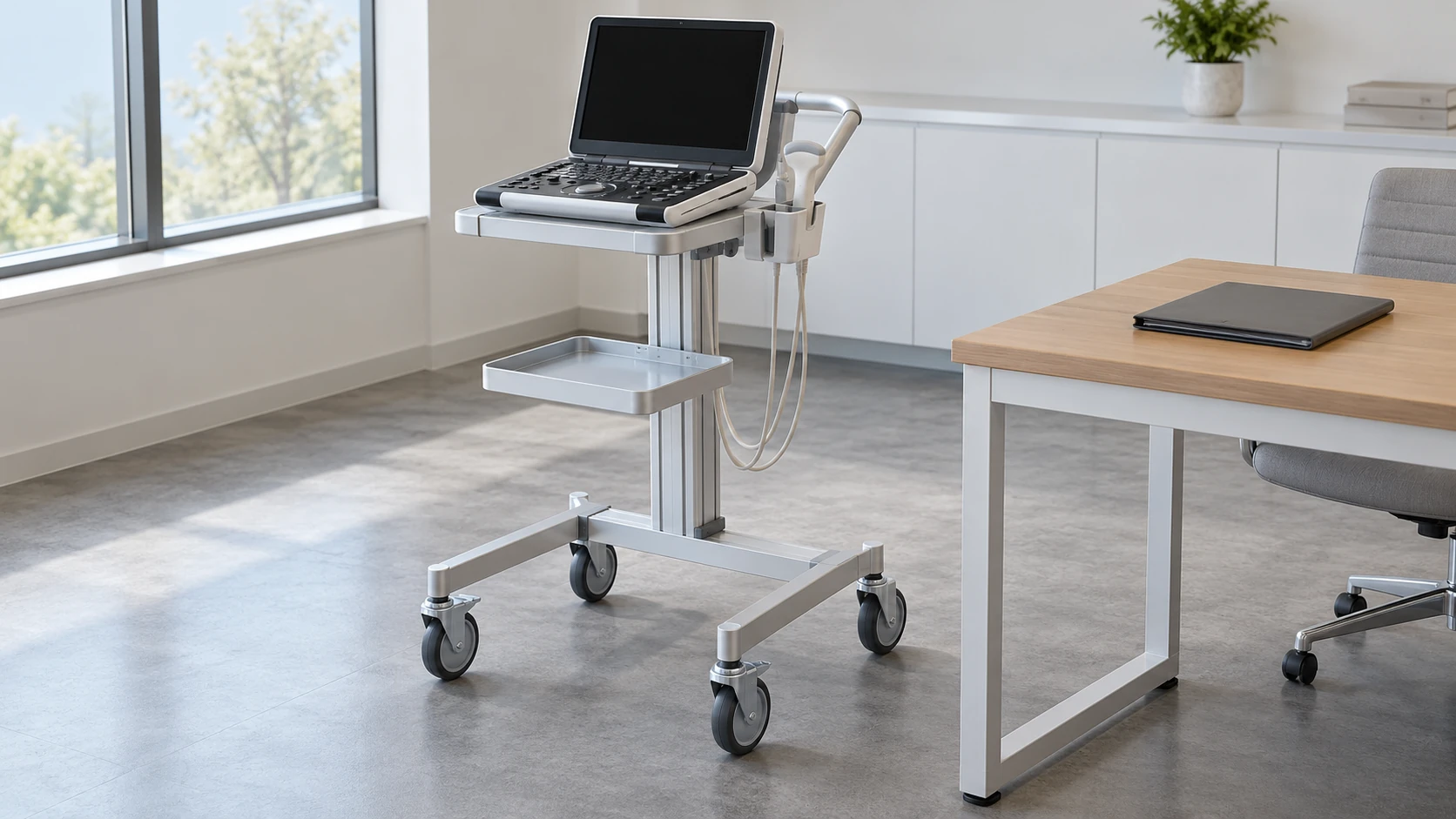
A medical cart mounting interface should be approved from a controlled drawing that identifies the exact device, mating parts, geometry, fastening requirements and revision—not from a product photograph or the word “universal.” When the device or cart interface changes, buyers should identify the affected configurations and obtain the responsible engineering approval before treating the new combination as interchangeable.
This is a procurement documentation guide, not an installation procedure, test specification or medical recommendation. It focuses on interface handover and changes after initial selection; broader prototype acceptance is covered in CRF’s custom medical cart prototype review checklist.
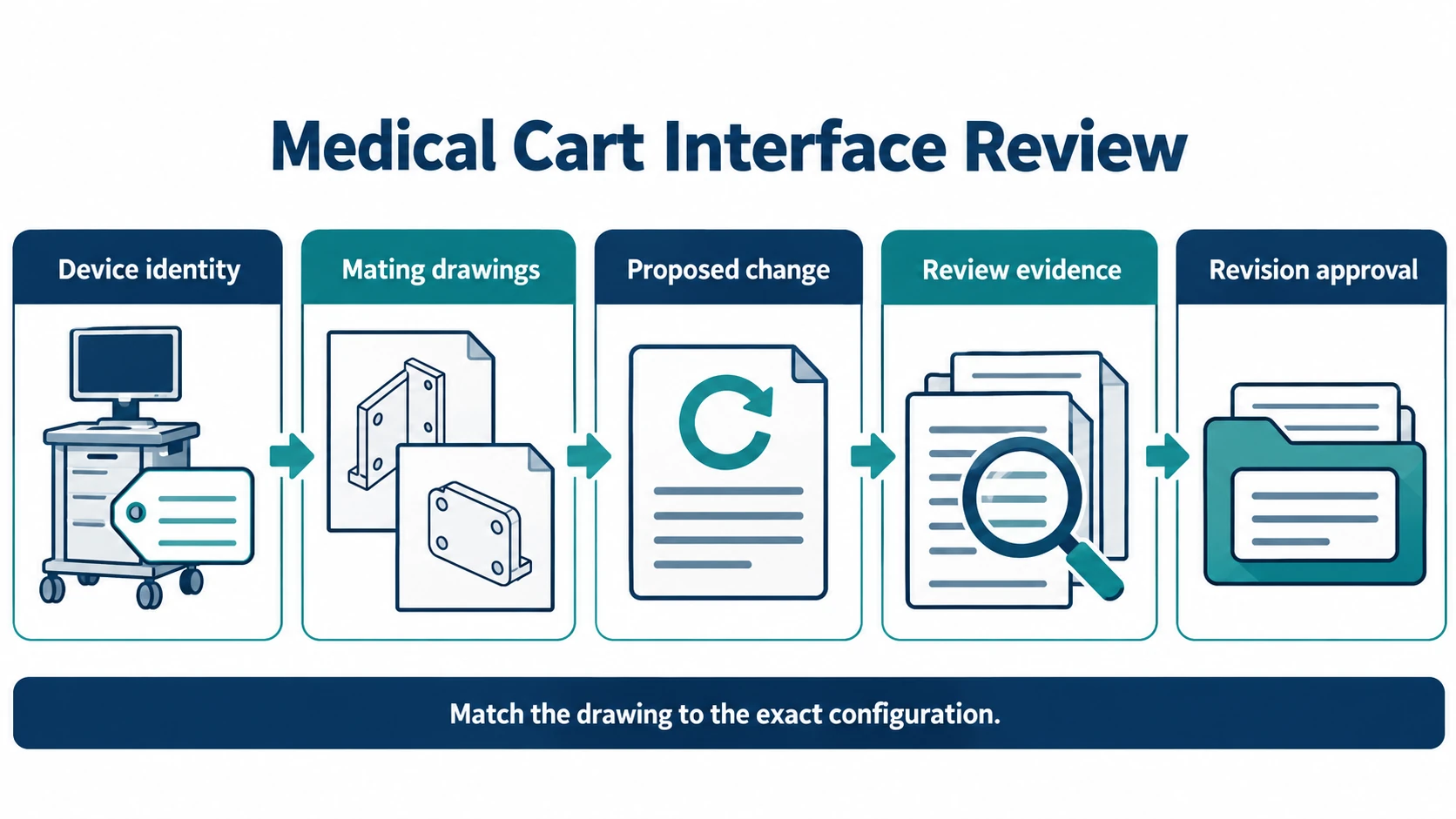
Start with a specific device and cart combination
CRF’s CA13Z004 four-wheel aluminum alloy equipment cart is a mechanical support platform for reviewed ultrasound or ECG applications. The current product page explicitly requires assessment of device dimensions, mounting interface, equipment weight and cable routing. It does not establish compatibility with every scanner or ECG machine.
Record the device manufacturer, model, hardware revision and intended orientation alongside the cart model and configuration. Name any adapter between them. The device, adapter and cart can each have separate revisions; a familiar model name does not prove that all three interfaces remain unchanged.
CRF’s wider range includes three-, four- and five-wheel base structures. A three-wheel equipment cart is not a walker or mobility aid. A base change also needs its own review rather than being hidden inside an interface substitution.
What belongs in the interface drawing package?
Mating geometry and reference surfaces
Request the responsible design owner’s dimensioned interface drawing. It should define reference surfaces, mounting locations, orientation, available envelope and relevant tolerances. Where a hole pattern is described by a familiar name, obtain the actual specification rather than assuming the label resolves every dimension.
Separate device-to-adapter dimensions from adapter-to-cart dimensions. Photograph references can clarify orientation but cannot replace controlled measurements. Mark unavailable dimensions as open items; do not estimate them from perspective images.
Retention, fasteners and access
Identify the retention method, fastener specification, engagement requirements and access needed for approved installation and removal. These values must come from the responsible design documentation. This article supplies no generic torque, thread engagement or load limit.
The package should also state which party supplies each part. A bracket pictured with a device is not evidence that the device, fasteners or adapter are included in the order.
Clearance and configuration boundaries
Document connector, ventilation and service clearance requirements from the device owner. Include the positions of nearby trays, handles and accessories that could affect access. If adjustment is permitted, identify the reviewed positions and limits rather than presenting one photograph as proof of every setting.
Interface fit alone does not establish loaded-cart stability, electrical safety or cleaning compatibility. These remain separate finished-configuration review responsibilities.
Compare documentation options before approving a substitution
| Available evidence | Useful for | Limitation |
|---|---|---|
| Catalog photograph | Identifying visible features | Cannot establish hidden geometry or tolerances |
| Supplier dimensional drawing | Comparing defined interface dimensions | Must match the supplied part and revision |
| Physical sample fit record | Documenting the reviewed assembly | Does not automatically cover later revisions |
| Controlled drawing plus approved change record | Linking fit decisions to configuration | Requires responsible owners and traceability |
Do not confuse a quotation description with a released drawing. Commercial agreement and technical approval answer different questions.
Use a focused change-control checklist
Before accepting a changed bracket, tray interface or device revision:
- Identify the old and proposed part numbers and revisions.
- Describe what changed and why, including affected mating surfaces.
- List every device/cart combination potentially affected.
- Compare geometry, retention, access and assembly responsibilities.
- Ask the responsible engineering team which verification must be repeated.
- Record approval, rejection or unresolved conditions against the exact configuration.
- Align the drawing, bill of materials, quotation and assembly documentation before ordering.
Do not label a substitute “equivalent” while its material, geometry or fastening requirements remain unresolved. If existing inventory contains both revisions, define how receiving and assembly teams distinguish them.
FAQ
Is a universal medical cart compatible with any device?
No. A product label does not replace review of the specific device interface, weight, clearances and finished configuration.
Can a photograph be used instead of a mounting drawing?
It can support identification and orientation. It is not reliable evidence of tolerances, hidden features or fastening requirements.
Does successful mounting prove cart stability?
No. Mechanical fit is one review item. Loaded stability, movement and other applicable requirements need their own qualified review.
What should buyers send CRF?
Send the device identity and revision, controlled interface information, intended equipment configuration, quantity and destination requirements. Flag missing documents explicitly.
Request an interface review
Use CRF’s RFQ contact page to request a configuration review. Reference CA13Z004 or your selected cart model, attach the available interface drawing and identify proposed changes. CRF can review feasibility and quotation requirements; compatibility, included parts and commercial terms must be confirmed for the agreed configuration.
Request a B2B RFQ for the exact configuration and documentation scope. Images are AI-generated generic concepts, not exact CRF models, customer installations, approved procedures or performance evidence.