

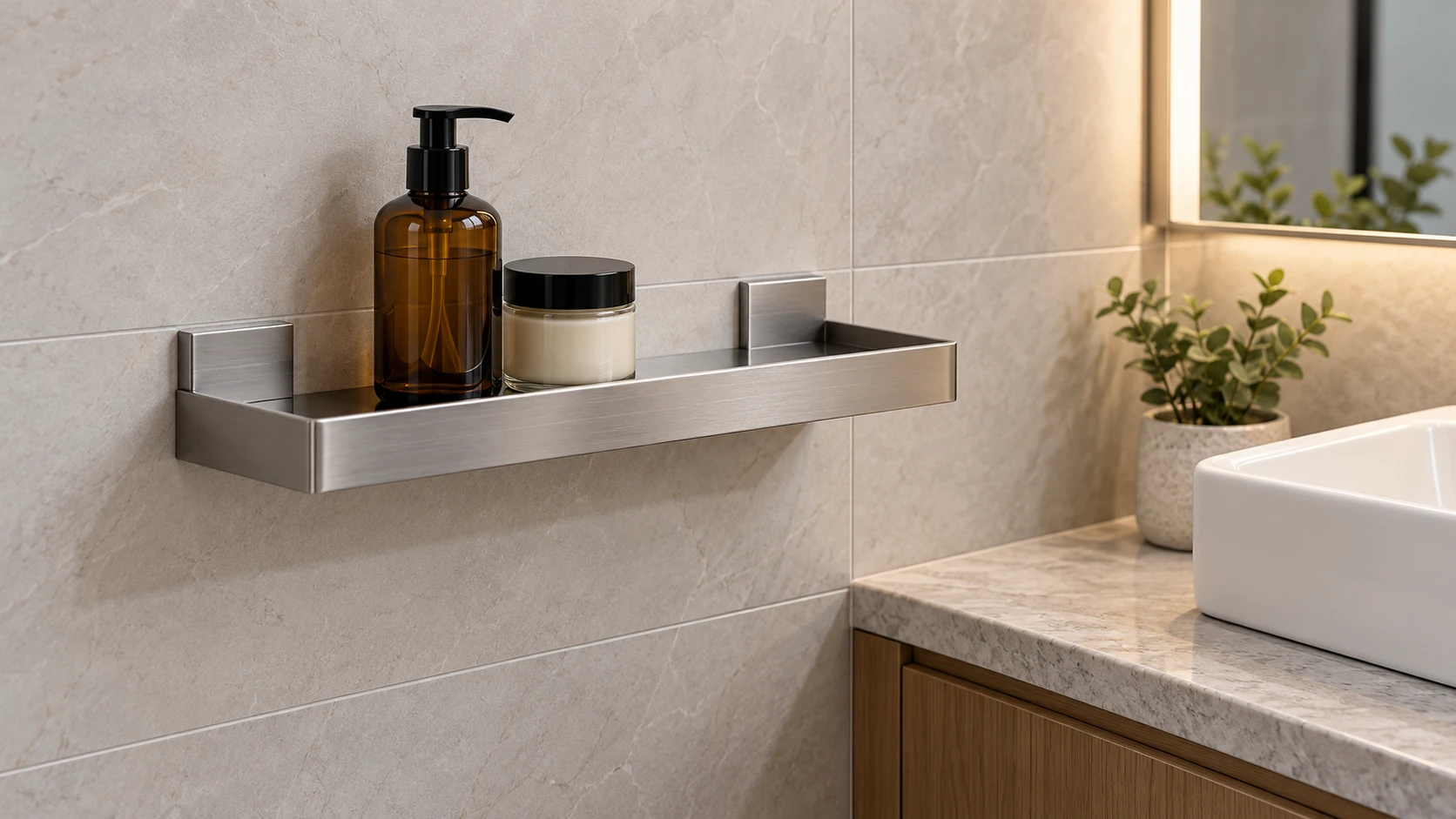
Choose a bathroom shelf fixing method by reviewing the exact shelf variant, mounting kit, wall construction and intended use—not by treating “no-drill” as a universal installation promise. Adhesive and drilled options need different evidence, and neither should be approved from a product photograph alone. Obtain the selected kit’s instructions and a site-specific installation review before ordering.
This is a purchasing and documentation guide, not a drilling tutorial or a structural design specification. A storage shelf is not a grab bar or body-support device.
Start with a real product and a defined variant
The CRF stainless steel corner and rectangular bathroom shelf family includes triangular corner and rectangular wall-mounted variants. Its product page reports drilled and adhesive/no-drill options in supplier information, with suitability dependent on the selected kit and wall surface. It does not provide a rated load for every option or guarantee that any installation method will work on every wall.
For a quotation, identify the shelf shape, material option, finish and dimensions separately from the fixing method. The family page lists both 201 stainless steel and SUS304 options; that does not make every shelf SUS304. Current model-specific documentation is necessary where material verification is required.
Do not substitute one variant’s image or mounting instructions for another. A corner shelf’s wall geometry also needs review; nominally similar bathrooms can have different corners, surface finishes and available fixing positions.
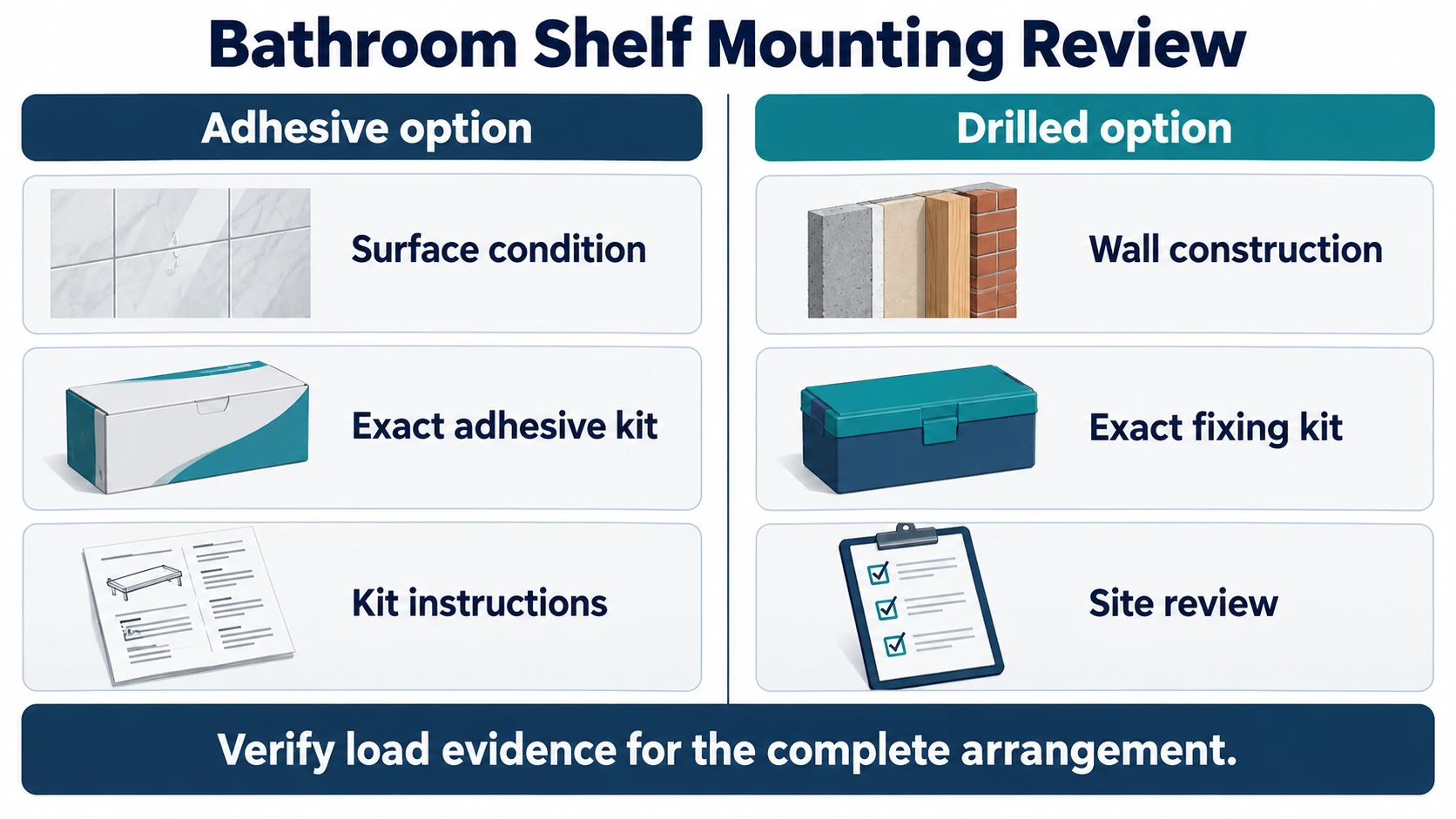
Adhesive and drilled mounting: compare the evidence
| Review point | Adhesive/no-drill option | Drilled option |
|---|---|---|
| Wall information | Surface material, finish, condition and compatibility with the selected adhesive system | Wall construction, suitable fixing locations and compatibility with the selected anchor system |
| Kit identity | Exact adhesive, bracket and supplied components | Exact bracket, fastener and anchor components |
| Installation documentation | Preparation, application, curing and environmental restrictions stated by the kit supplier | Approved installation requirements, including substrate and waterproofing considerations |
| Load evidence | Documentation for the complete shelf-and-fixing arrangement | Documentation for the complete shelf-and-fixing arrangement |
| Removal and maintenance | Kit-specific instructions and potential surface effects | Fixing inspection, removal and reinstatement requirements |
This table is a review framework. It is not a claim that CRF has validated a particular kit for a particular site.
What “no-drill” does not tell you
Surface suitability is still a requirement
A no-drill label does not identify which tile, coating or wall condition is acceptable. Obtain the exact supplier instructions and exclusions. Do not infer that a system intended for one smooth surface will also be suitable for rough, coated or otherwise different surfaces.
Curing instructions are system-specific
Do not copy a curing time from an unrelated adhesive product or an online installation video. Ask for the instructions applicable to the purchased kit, including when the installed shelf may be put into use and any conditions that affect that instruction.
A mounting method is not a load rating
“No-drill” is a method description. It does not tell the buyer how much the installed shelf can support. The shelf, bracket, adhesive system and wall interface need to be considered together. No rated load is asserted here for the CRF shelf family.
What drilled installation needs before purchase
The visible tile finish does not, by itself, establish the underlying wall construction or correct anchor selection. Ask the installer or responsible project professional to confirm the proposed fixing arrangement and its effect on the wall assembly. Wet-area waterproofing, hidden services and site restrictions require appropriate review rather than generic instructions from a shelf article.
Clarify whether the quoted hardware is intended for the actual substrate. “Screws included” is not equivalent to “all anchors suitable for this building included.” Record what CRF supplies and what the installer must select or provide.
Prepare a site-and-kit approval sheet
A concise approval sheet helps procurement, the supplier and the installer discuss the same arrangement:
- Selected product variant and current drawing or image reference.
- Shelf shape, finish and material documentation required for the project.
- Wall construction, surface condition and proposed installation location.
- Exact fixing kit and an itemized list of supplied components.
- Intended stored items and the project’s load requirements, without assuming an unverified capacity.
- Current installation instructions and environmental restrictions.
- Required installation review and any agreed sample evaluation.
- Inspection, removal and replacement instructions, where supplied.
- Unresolved items and the person responsible for approving them.
Keep approval attached to the specific combination. Changing an adhesive, anchor, bracket, surface or shelf variant may require another review. Do not let a successful sample in one room become an undocumented guarantee for every site in a rollout.
Limits and purchasing mistakes to avoid
Do not describe the shelf as a safety rail, handhold or support for a person. Bathroom storage and body-support products have different intended uses. Avoid using a photograph of toiletries on a shelf as proof of tested capacity, durability or installation suitability.
Also avoid unsupported “rust-proof” or blanket material claims. The selected material and finish need confirmation, while the installation method requires its own evidence. This guide intentionally does not reproduce source-listing prices, stock levels, domestic delivery estimates or unverified international lead times.
If instructions or mounting evidence are missing, mark the configuration unapproved rather than choosing an arbitrary fixing method to complete the order.
Frequently asked questions
Is adhesive mounting always better for tiled bathrooms?
No. Suitability depends on the exact system, surface, environment and intended load. Review the selected kit’s documentation and site conditions; avoiding holes is only one project consideration.
Are screws supplied with a shelf automatically suitable for the wall?
No. Confirm the supplied components and whether the fixing arrangement is appropriate for the actual wall construction. Additional site-specific hardware may be needed, subject to professional review.
Can the same approval cover corner and rectangular shelves?
Not automatically. Their geometry and wall interfaces differ. Approve the exact variant and fixing arrangement instead of extending approval from the family name alone.
Does the CRF product page prove a rated installed capacity?
No. The page expressly asks buyers to confirm load limits and installation instructions and makes no rated load claim. Request the evidence required for your selected configuration.
Send a mounting-specific RFQ
Submit your shelf variant, wall information, required fixing method, intended use, quantities, packaging needs and destination through the CRF inquiry page. Request the exact mounting kit, supplied-component list, applicable instructions and written limitations. Treat material, fixing suitability and commercial terms as separate items to confirm before ordering.
Request a B2B RFQ for the exact configuration and documentation scope. Images are AI-generated generic concepts, not exact CRF models, customer installations, approved procedures or performance evidence.