
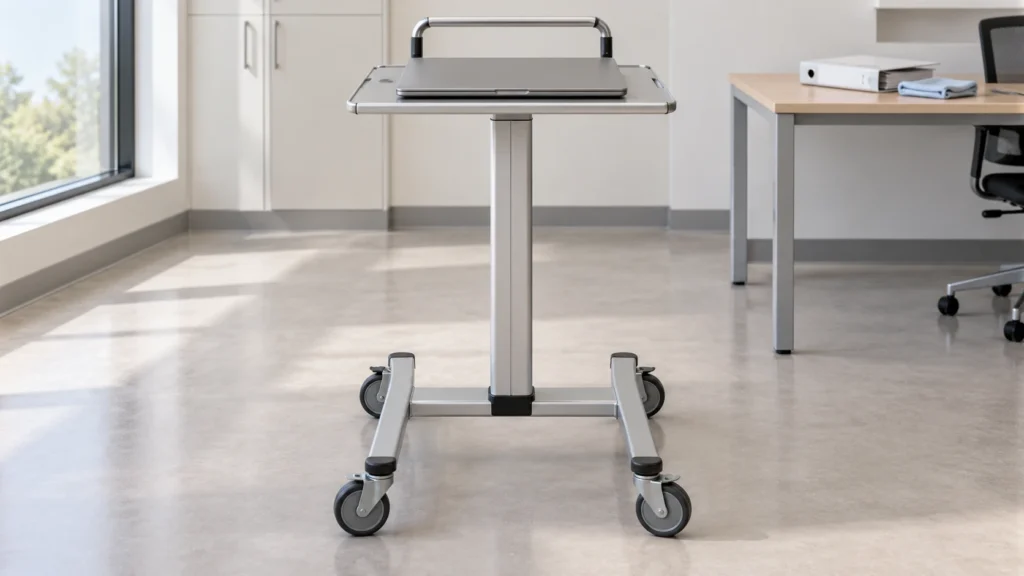
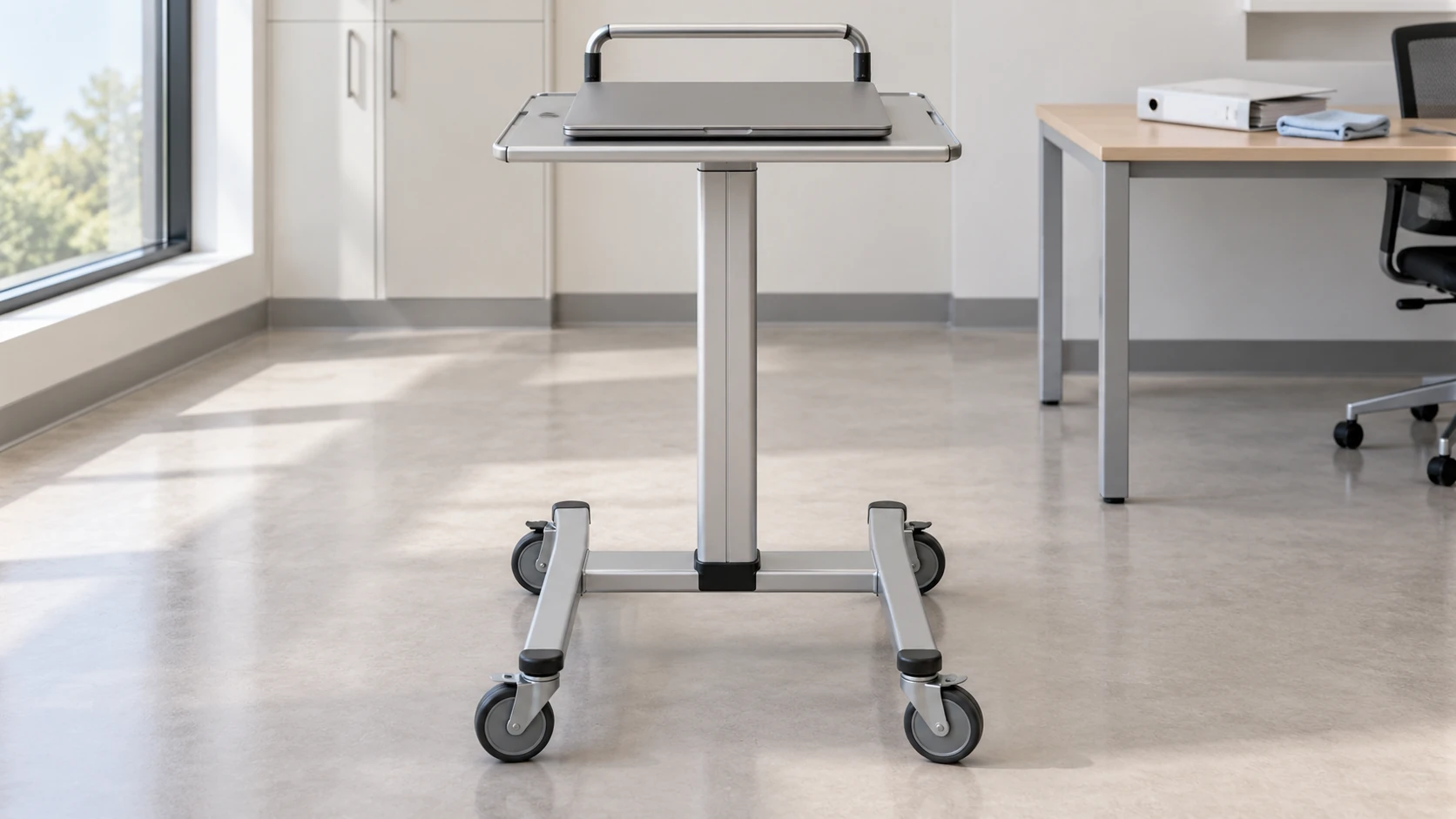
An aluminum medical equipment cart is not automatically compatible with every hospital cleaning agent. Before ordering, buyers should obtain model-specific care instructions, identify the surfaces and components in the approved configuration, and review the proposed cleaning process with the cart supplier, the mounted-device manufacturer and their facility’s infection-prevention team. Metal type alone cannot establish chemical resistance or disinfection effectiveness.
This guide is a procurement documentation checklist, not a clinical cleaning protocol. It does not prescribe disinfectants, concentrations, contact times or cleaning frequency.
Why cleaning compatibility belongs in the OEM specification
A cart purchase may start with equipment dimensions and mounting requirements. Cleaning introduces a separate question: can the complete configuration tolerate the facility’s intended process without unacceptable damage or interference with its use?
The CRF CA13Z004 four-wheel medical equipment cart is described as an aluminum alloy mechanical support product. Its current product page expressly leaves material grade, finish and cleaning-agent resistance subject to documentation and relevant tests. The page does not establish universal disinfectant compatibility. It is not an ultrasound scanner, ECG device or walking aid; diagnostic equipment is not included unless confirmed in the quotation.
Treat the product page as a starting point for an inquiry, not a substitute for approved care instructions.
Separate material identity from process compatibility
Review the whole bill of materials
Ask the supplier to identify the components that will be exposed to the intended process. Depending on the selected configuration, these may include the tabletop, frame, finish, handles, caster materials, labels, cable clips and supplied accessories. Do not assume that all parts are aluminum because the product family is described as an aluminum cart.
Record the finish and component revisions alongside the model. A compatibility statement for an earlier configuration should not silently carry over to a changed surface or accessory.
Define the proposed cleaning process precisely
Provide the supplier with the actual product name and current manufacturer instructions for the proposed cleaning agent. Include the process conditions your facility intends to use, rather than asking only whether the cart is “easy to clean.” The supplier and responsible facility team should determine what evidence is needed.
Do not translate a competitor’s chemical list into a CRF approval. Other manufacturers’ instructions are model-specific and can differ substantially. Likewise, a quick inspection of a small area cannot establish repeated-exposure durability or infection-control performance.
Compare the three documentation boundaries
| Item being reviewed | Documentation needed | What it does not establish |
|---|---|---|
| Cart frame and supplied accessories | Instructions and compatibility evidence for the approved CRF configuration | Compatibility of every future accessory |
| Mounted scanner, monitor or computer | That device manufacturer’s care instructions | Permission to use its process on the cart |
| Facility cleaning workflow | Review by the responsible infection-prevention and equipment teams | A supplier guarantee of clinical effectiveness |
If these documents conflict, resolve the conflict before approval. Do not assume that a process suitable for the work surface can also be applied to a screen, connector, printer or probe.
A practical pre-order evidence checklist
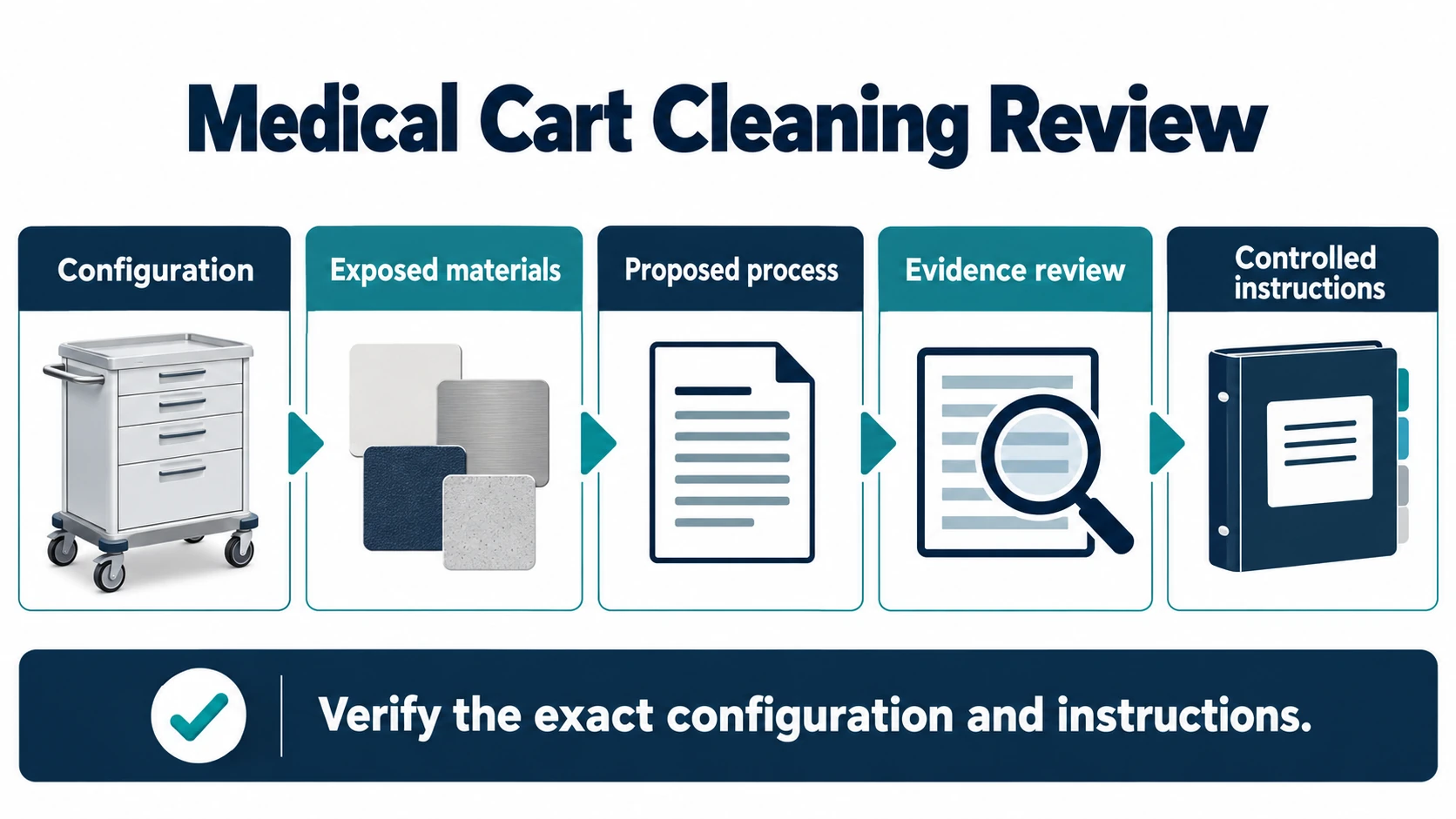
- Freeze the configuration. Record model, drawing revision, supplied accessories and any customer-mounted devices.
- List exposed materials and finishes. Ask which components have model-specific evidence and which remain unverified.
- Submit the intended process. Supply the agent documentation and proposed application conditions for review.
- Agree an evaluation plan. Define the evidence, sample configuration, acceptance criteria and responsible reviewer before evaluating a sample.
- Record limitations. State exclusions and processes that have not been assessed. An unanswered field must not become an assumed approval.
- Release controlled instructions. Identify who approves the care document and how configuration changes trigger reassessment.
This is a proposed purchasing workflow, not a statement that CRF has completed these evaluations for the model shown.
What to look for in an evaluation record
The record should identify the sample and configuration, the process assessed and the observations required by the agreed plan. Potential observations can include finish changes, damage to labels or accessory materials, and any effect on moving or locking components. The evaluation method and criteria must be appropriate to the actual project; this article does not supply a test standard or pass/fail threshold.
Separate appearance observations from functional review and from infection-control claims. A surface that appears unchanged has not thereby been proven to provide effective disinfection. A chemical supplier’s efficacy information does not, by itself, establish cart durability.
Limits buyers should preserve in the RFQ
Avoid unsupported terms such as “chemical-proof,” “antimicrobial,” “sterilizable” or “compatible with all hospital wipes.” Do not request a marketing statement where a controlled instruction and evidence record are needed. Also distinguish cleaning from maintenance: cleaning instructions do not authorize caster replacement, tightening or modification of equipment interfaces.
If the intended process cannot be supported for a chosen configuration, request a reviewed alternative or keep the project on hold. Do not change chemicals or care procedures without the appropriate manufacturer and facility review.
Frequently asked questions
Does aluminum mean a cart is disinfectant-resistant?
No. Compatibility depends on the exact alloy, finish, other exposed components and process conditions. CRF’s referenced product page does not claim universal resistance.
Can a mounted device and cart use the same instructions?
Only if their respective instructions and responsible reviewers support the intended process. Review the cart and device separately, then resolve their combined workflow.
Is a sample wipe test enough to approve a fleet?
Not automatically. Evidence must address the agreed configuration, process and acceptance criteria. Do not treat an informal spot check as proof of repeated-exposure durability or clinical effectiveness.
What should an OEM buyer send CRF?
Send the model, approved equipment layout, exposed accessory list, proposed cleaning-agent documentation, target market and required evidence. Ask which items are supported and which need project-specific review.
Request a configuration-specific review
Use the CRF inquiry page to submit your cart configuration and documentation requirements. Ask for model-specific care information and written limitations before approving the sample or placing a production order. Compatibility, test scope and commercial terms remain subject to written confirmation.
Request a B2B RFQ for the exact configuration and documentation scope. Images are AI-generated generic concepts, not exact CRF models, customer installations, approved procedures or performance evidence.