
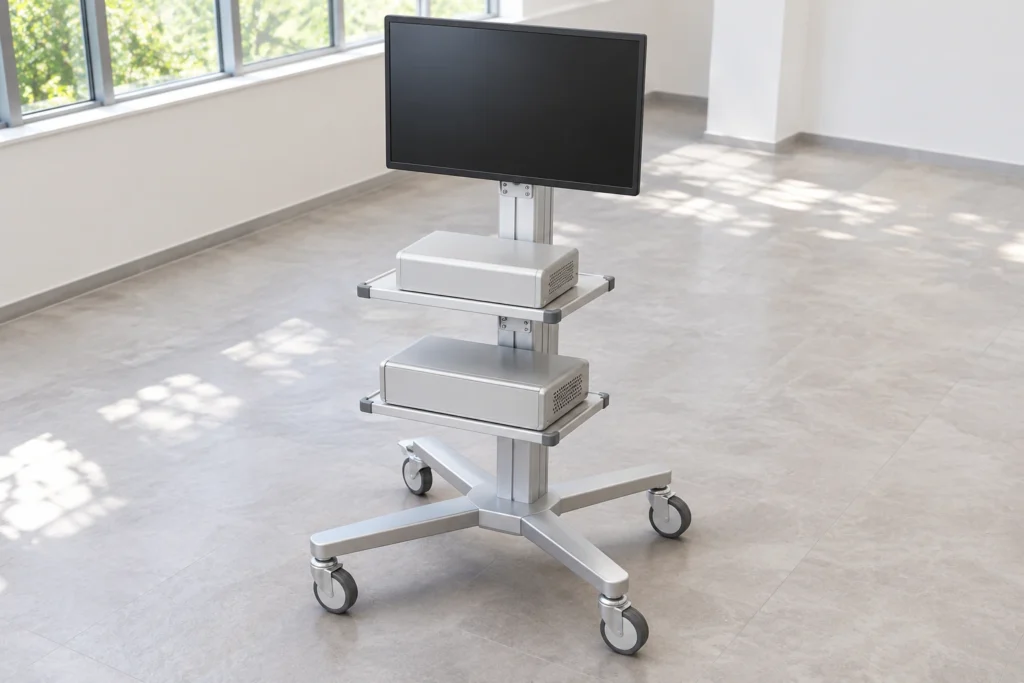
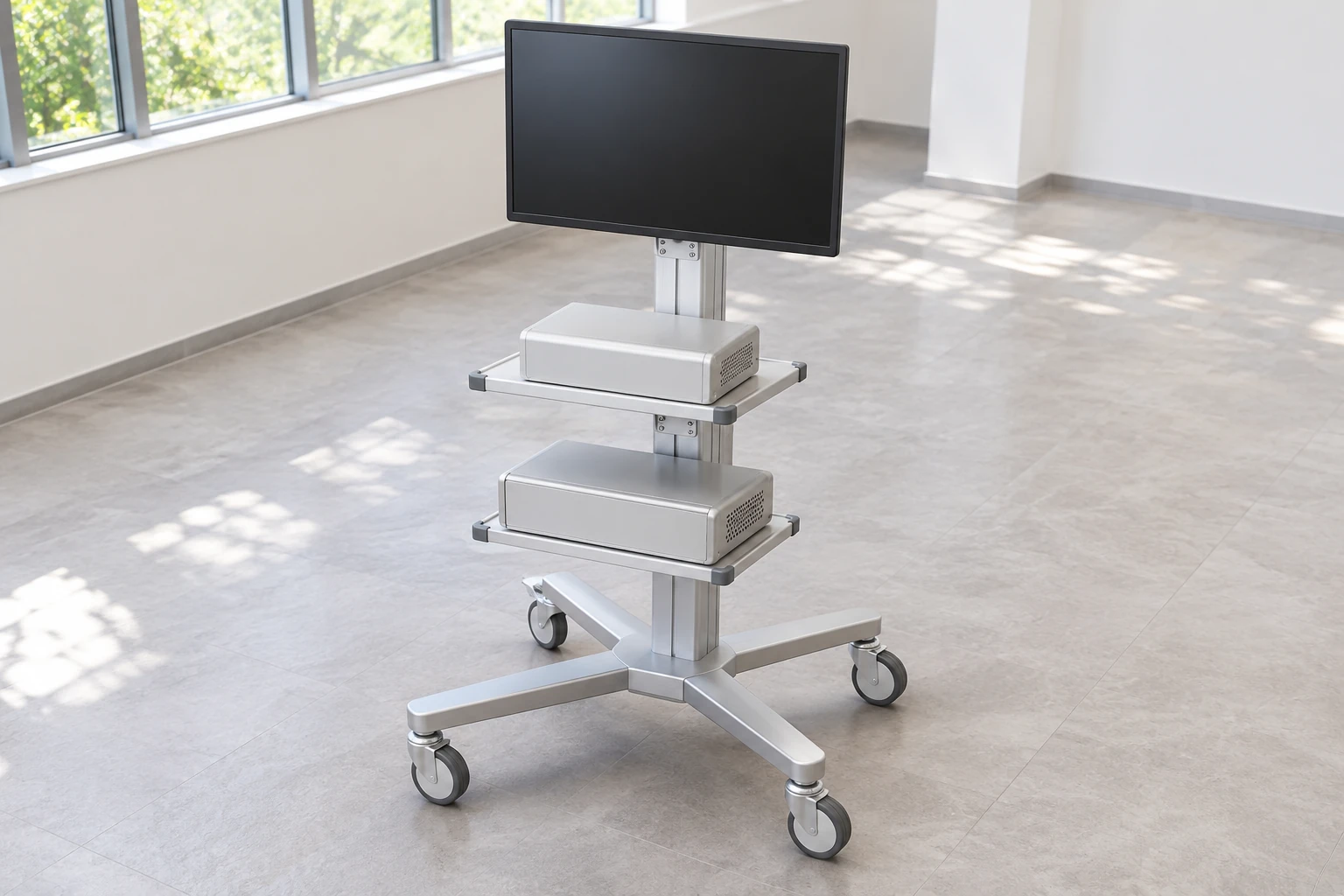
A travel endo workstation should be reviewed for the complete journey as well as the destination layout. Compare a procedure-room cart, a transport-first configuration and a combined workstation against the actual equipment and route. A cart that organizes equipment well in one room does not automatically suit repeated movement between locations, and equipment that fits during use may need a different retained arrangement for travel.
Here, “endo” refers to endoscopy equipment support, not an endodontic instrument organizer. This guide concerns mechanical purchasing and configuration questions. It does not establish clinical suitability, endoscope reprocessing requirements, electrical integration or a safe method for transporting contaminated equipment.
Resolve what travel means in your project
Begin with the start and finish points. Movement within one room, movement between rooms and longer internal routes impose different practical constraints. Identify doors, turns, lifts, parking locations and shared spaces. Do not use the word portable to imply that the cart is suitable for stairs, outdoor travel or shipment while loaded.
List the equipment that must remain together and what is removed before movement. Include the actual processor, display, accessory equipment and any approved storage components. Identify the instructions and responsible parties for each item’s handling. A general cart supplier cannot replace the equipment manufacturer’s handling requirements or the site’s procedures.
Define the destination task separately. Does the cart remain the working platform, or does it deliver items to another setup? That distinction determines whether the buyer needs a workstation or a transport solution. Avoid paying for a large operating layout when the actual task is delivery, but do not assume a small transport footprint can support the destination workflow.
Compare three architecture choices
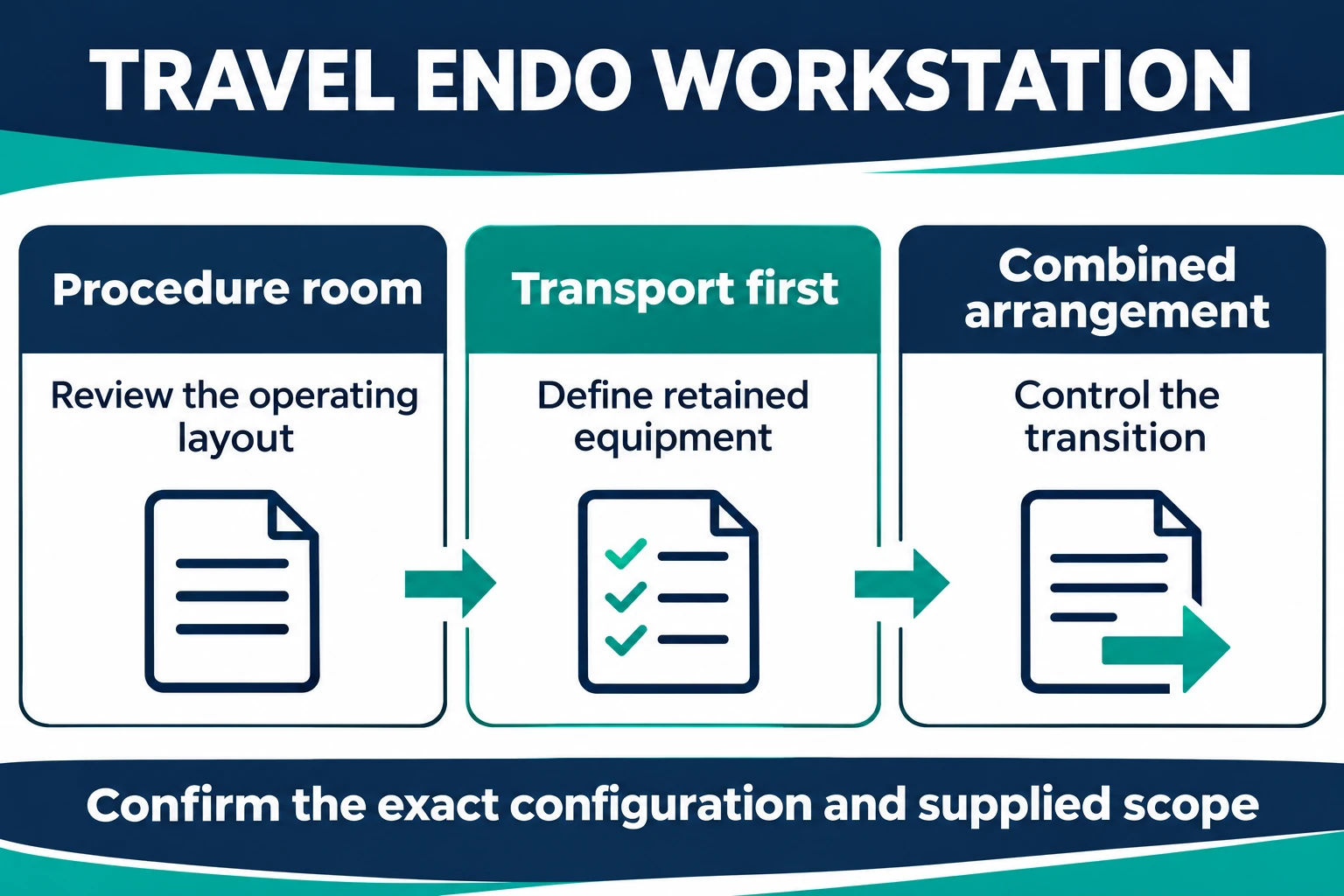
A procedure-room cart organizes the intended device set around its operating positions. It can be a sensible starting point where most work occurs in one defined space. Its limitation for travel may be the projecting display, shelves or accessories. Review those features in a defined travel state rather than assuming they can remain extended.
A transport-first configuration prioritizes the retained arrangement and travel envelope. It is relevant when moving the equipment set is the principal problem. Confirm what setup is needed at the destination and who performs it. A compact travelling arrangement does not prove that the equipment can be operated safely without repositioning.
A combined travel-and-workstation arrangement aims to serve both states. Compare how it transitions between them. Added movement, folding or removable interfaces can create more configuration decisions, not fewer. Treat every permitted arrangement as part of the controlled specification.
| Architecture | Main question | Purchasing risk to resolve |
|---|---|---|
| Procedure-room cart | Does the operating layout suit the destination? | Projecting equipment may change the travel envelope |
| Transport-first arrangement | What must remain retained during movement? | Destination setup may require separate interfaces or handling |
| Combined arrangement | Can the approved transition be carried out consistently? | Uncontrolled accessory positions can invalidate the reviewed configuration |
These are comparison categories, not statements that CRF supplies every architecture or offers a powered drive. Confirm availability and scope against actual products and a quotation.
Freeze the equipment register before choosing shelves
For each installed item, record the model, dimensions, mass, support points, connectors and applicable access requirements. Separate items supplied with the cart from buyer-supplied equipment. A shelf count is not a complete specification because two units may occupy the same nominal space but need different connector and ventilation clearance.
Map equipment removal paths as well as installation positions. A device can fit on a shelf while being impossible to remove without disturbing another unit. The same problem can appear when replenishing consumables or accessing a service cover.
Do not treat a generated scene as a configuration record. Its equipment is illustrative, not proof that a specific processor, display, storage accessory or electrical component is supplied or compatible. Use controlled drawings and traceable product evidence for those decisions.
Review movement and parking with the loaded arrangement
Define a controlled evaluation route with the site’s responsible team. Use the intended equipment or an approved representative arrangement, following applicable handling instructions. A demonstration with an empty cart does not establish the maneuvering behavior of the finished configuration.
Record the travel envelope, not just the base width. Displays, handles, connectors and retained accessories may project beyond the structure. Review corners and parking locations as well as straight passages. A cart that passes through a doorway can still be inconvenient to turn or park at the destination.
Wheel count alone cannot decide the issue. Base geometry, equipment position, caster arrangement and braking access must be reviewed together. Do not conduct improvised tipping, overload or incline trials. Assign formal verification requirements to qualified responsible parties using appropriate controlled procedures.
Where a powered-drive option is proposed by a supplier, identify its exact operating scope, documentation and verification requirements. Do not transfer a competitor’s powered-drive capabilities to another cart or assume that onboard equipment power includes a drive system.
Control cables and storage without inventing a clinical procedure
Identify which connections remain installed during movement and which are disconnected under the applicable instructions. Review plug access, storage position and the available cable path in both operating and travel states. Do not create an electrical connection or disconnection procedure from a purchasing illustration.
Separate mechanical storage questions from infection prevention requirements. A basket, hook or closed compartment does not by itself establish a suitable clean or contaminated equipment transport method. Have the responsible clinical and infection-prevention teams define those requirements and assess the specific solution.
For cables and accessories, inspect the actual set rather than an empty holder. Check whether the agreed placement conflicts with wheels, doors, adjustment controls or another device. Any cable-management revision should be recorded on the approved layout so repeated orders reproduce the reviewed arrangement.
Compare destination setup and service access
At the destination, review display position, equipment controls, frequently used accessories and access for normal service tasks. The travel arrangement and operating arrangement may differ; identify the required transition and the party responsible for it.
Check whether access depends on removing equipment that must remain installed. A lower shelf that cannot be reached with the main unit in place may be unsuitable even if the overall cart is compact. Review cleaning instructions for the cart materials and the installed equipment independently rather than assuming one cleaning method covers the whole system.
A combined workstation may need a more detailed configuration record than a stationary setup. Keep the permitted positions, retained contents and changeover conditions together with the approved drawing and sample revision. If equipment changes, review both travel and use states again.
Build a purchasing comparison that remains meaningful
Ask suppliers to quote the same device and accessory scope. Identify the base, shelves, mounting interfaces, retention components and assembly work included. Keep electrical components, equipment and any drive mechanism explicit. A lower total for an empty structure is not a comparable offer to a complete defined arrangement.
Record unresolved issues separately from preferences. An open retention or interface question should not disappear into a general score for appearance. Assign an owner and required evidence for each item before accepting the final configuration.
CRF’s endoscopy cart integration guide is a starting point for the mechanical equipment register. Browse the endoscope medical cart collection for real product references, then confirm the exact travel and destination requirements with the quotation. CRF’s aluminum-alloy medical cart structures do not, by themselves, establish a completed endoscopy system’s regulatory or clinical acceptance.
FAQ
Is a travel endo workstation the same as an endoscopy procedure cart?
Not always. A procedure cart may focus on the operating layout, while a travel configuration must also address retained equipment, route and destination setup. Confirm the intended states rather than relying on the name.
Can any endoscopy cart be moved while fully loaded?
Do not assume so. Follow the cart and equipment instructions and review the exact retained arrangement, handling requirements and verification scope with the responsible parties.
Does travel mean the cart is suitable for outdoor use or shipping?
No. Internal mobility, outdoor transport and freight shipment are different conditions. Each requires an explicit scope and appropriate evidence.
Does a travel workstation need a powered drive?
That depends on the proposed route and configuration. If a supplier offers one, assess its documented scope. A drive system is not implied by the term workstation or by equipment power.
Can the cart’s storage replace site infection-prevention procedures?
No. The responsible team must define handling and segregation requirements. A general-purpose shelf, basket or compartment is not evidence of a suitable reprocessing or contaminated-equipment transport method.
Discuss the complete journey
Please send an RFQ with the equipment register, start and finish locations, route constraints, destination layout, required retained contents, quantity and destination market. State whether you are comparing a procedure-room cart, transport-first arrangement or combined workstation. Please contact us to confirm the actual available configuration and supplied scope.