
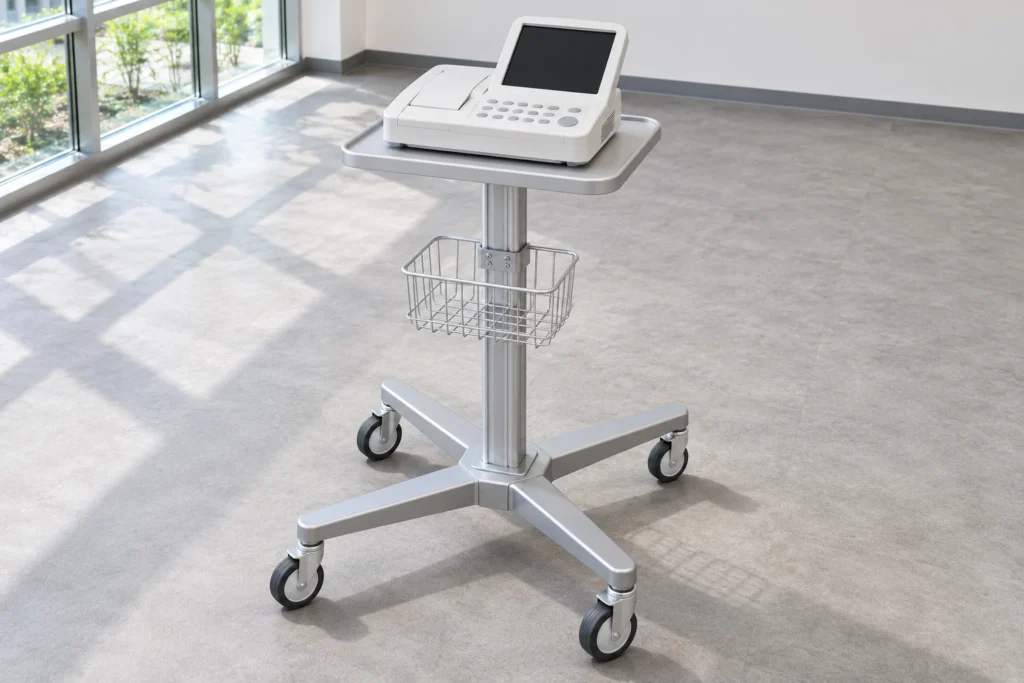
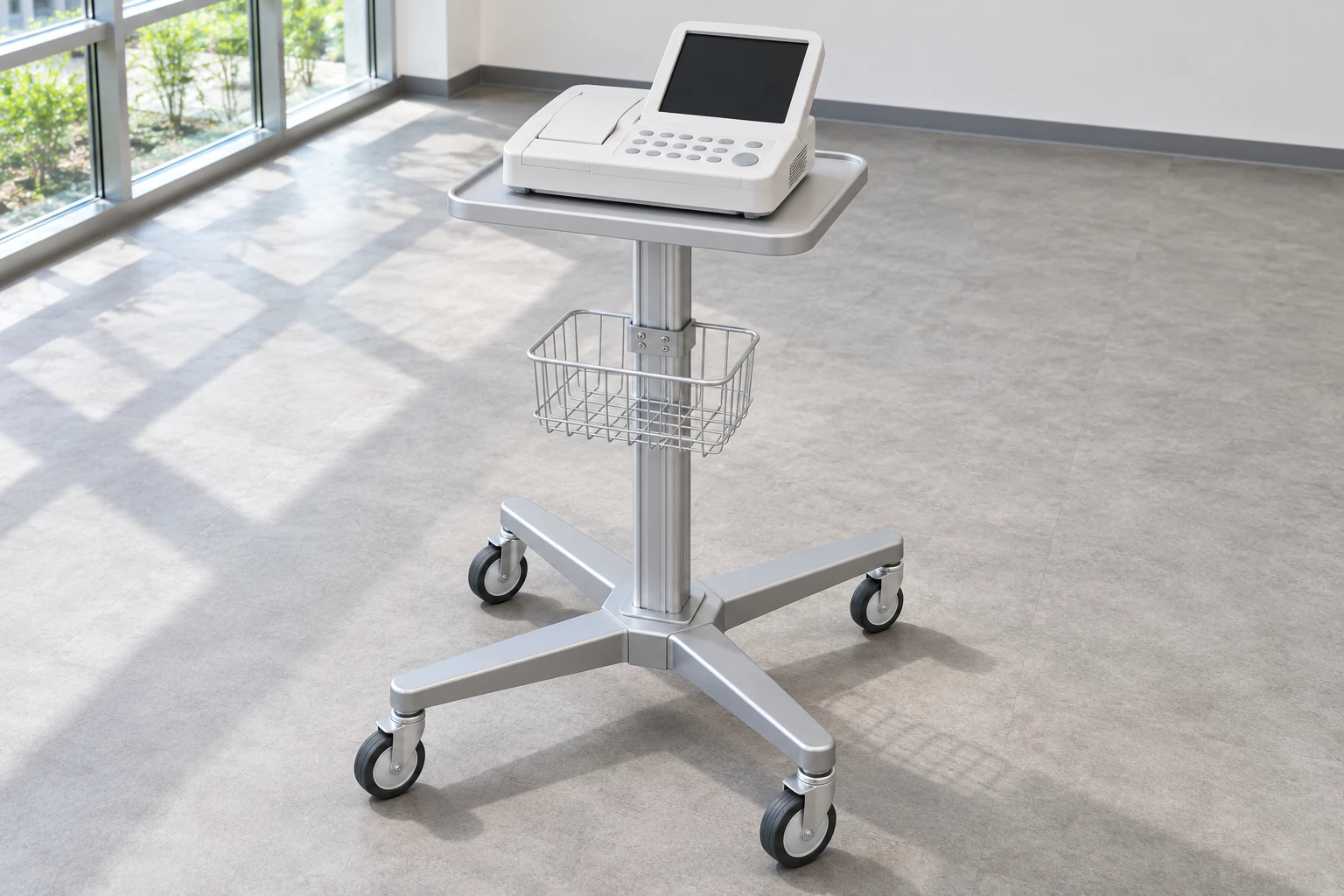
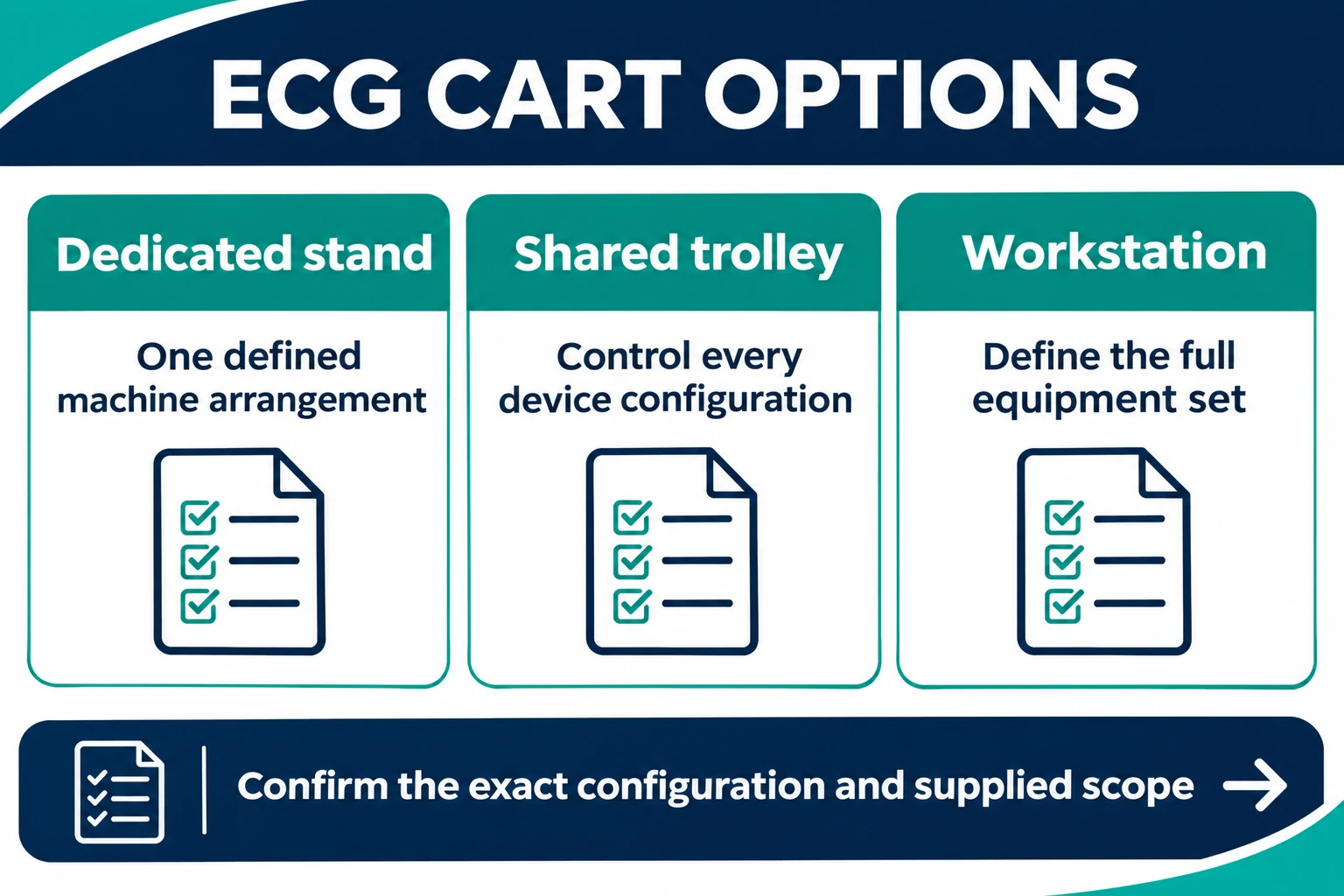
An ECG cart should be selected around the ECG machine and the way the team prepares, records, prints and moves between locations. For purchasing, compare a dedicated machine stand, a shared equipment trolley and a larger workstation before selecting a configuration. The most elaborate cart is not automatically the most useful: accessories that are not needed can increase the travel envelope and make cleaning or equipment removal less convenient.
This is a mechanical procurement comparison, not a guide to acquiring or interpreting an ECG. Clinical practice, electrical safety and completed-system obligations remain with the responsible qualified parties. No cart architecture alone establishes a clinical outcome or compatibility with a particular machine.
First distinguish the equipment being supported
An ECG machine, a patient monitor and a computer used to review information can have different support and access needs even when all three appear on similar carts. Identify the actual equipment model and the task rather than relying on “ECG trolley” as a complete specification.
Provide the unit’s footprint, mass, support points, connector locations and applicable instructions. State whether the cart is dedicated to that unit or intended to be shared. A shared cart needs an explicitly reviewed device set; “universal” is not a substitute for interface evidence.
Also identify the supplies and accessories that must move with the machine. Separate equipment permanently installed from items carried temporarily. Keep supplier-supplied contents separate from equipment supplied by your organization. A photograph showing a machine or lead set is not a packing list.
Compare three practical architectures
Dedicated ECG machine stand
A dedicated stand can keep the main unit and a limited accessory set in one controlled arrangement. Its value is a focused layout rather than a long list of features. It is a relevant starting point where the team wants a consistent machine position and does not require a general computer workstation on the same structure.
Review the support surface, retention arrangement, control access and removal path. If the machine includes a printer, inspect access to its paper compartment using the actual unit. A stand that fits the machine’s outer dimensions may still block a connector or cover.
Shared equipment trolley
A shared trolley is worth considering when the project genuinely requires more than one reviewed device arrangement. Compare how the unit is installed, removed and identified. The convenience of moving equipment between locations should not depend on improvised fixing or a loosely defined accessory position.
A flat shelf is not evidence that any machine may safely be placed there. Confirm the intended equipment arrangement, support zones and retention requirements. If multiple configurations are approved, document each rather than assuming a single drawing covers every combination.
ECG and documentation workstation
A workstation may be relevant where a separate display, computer or input devices form part of the defined task. It adds mounting, cable, power and service interfaces. Do not add that complexity merely because a cart with a screen looks more capable.
Define which computer and display are actually needed and who is responsible for the completed system. The cart supplier’s mechanical review does not establish software operation, network suitability, electrical integration or clinical acceptance.
| Architecture | Purchasing advantage to investigate | Main limitation to examine |
|---|---|---|
| Dedicated machine stand | Consistent layout for one controlled device arrangement | May not accommodate future devices without a new review |
| Shared trolley | Can support an explicitly defined set of configurations | Changeover, retention and configuration identification need discipline |
| Documentation workstation | Can bring defined computing equipment into the same layout | Larger equipment set creates more interfaces and travel constraints |
Decide what belongs beside the machine
List the actual contents for each holder, basket or tray. An empty basket can hide a poor layout because it does not show the reach needed to retrieve the intended supplies. Use representative contents in a controlled sample review and follow the applicable handling requirements.
Distinguish lead organization from a claim that the cart supplies or protects a particular lead set. Check where cables are placed during use, movement and storage, using the equipment manufacturer’s instructions. Avoid sharp bends, trapping or improvised suspension arrangements, but do not invent cable limits from appearance.
Review which items must be reached frequently and which can remain in storage. If a drawer or basket blocks the machine’s paper access, changing its position may be more useful than adding another holder. Confirm the revised position on the approved configuration rather than relying on a verbal request.
Evaluate the work position and travel position separately
The most convenient operating arrangement may have a wider envelope than the travel arrangement. Identify what must be stowed, retained or repositioned before movement. Follow the cart and equipment instructions; this article does not prescribe a universal travel position.
Use a controlled route that represents the intended doors, turns, parking areas and shared spaces. Review the complete cart with the intended machine and accessories, not just an empty frame. Keep patient information out of photographs or evaluation records.
Base design and wheel count should be considered with the complete arrangement. A three-, four- or five-wheel base is not inherently the best ECG cart. Ask for the base outline, caster specification and configuration-specific verification scope. Do not perform improvised overload or tipping demonstrations to settle a purchasing question.
Review access that is easy to overlook
Inspect the machine’s connectors while the unit is supported in the proposed position. A plug may require space beyond the equipment case, and a connector that can be inserted before installation may become inaccessible afterwards. Check service covers and any normal replacement or replenishment operation.
Review adjustment controls where an adjustable structure is proposed. The user must be able to follow the instructions without releasing an unsupported assembly or colliding with the device. A catalog’s adjustment range does not establish how the complete installed machine behaves.
Cleaning access should include the areas around retention points, holders and storage. Request applicable product cleaning instructions and have the site’s responsible team assess compatibility with its methods. Aluminum-alloy construction does not establish the chemical compatibility of every surface, coating or accessory.
Freeze the quoted configuration before comparing prices
Ask each supplier to identify the cart, equipment support, retention components, holders, storage and any assembly work included. Keep the machine itself, computing equipment and power components explicit. Two similar photographs can represent different supplied scopes.
Compare drawings and sample revisions before comparing totals. Identify open items separately from confirmed features. For example, an unresolved machine retention interface is a configuration issue, not a minor cosmetic preference that a lower price resolves.
Document ownership of verification and change control. If the ECG unit changes after sample approval, review the support, connectors, paper access and loaded arrangement again. A previous approval should not silently migrate to a different machine.
Start from real CRF references
CRF manufactures aluminum-alloy medical equipment cart structures. Its ECG cart integration guide provides a starting point for defining the equipment and interfaces. The medical equipment collection helps buyers identify relevant real structures for a configuration discussion.
Confirm the exact model, supplied accessories and drawings with the quotation. Neither an educational illustration nor a related product’s description establishes machine compatibility, load, certification or stock for the cart you intend to order.
FAQ
Is an ECG cart the same as a patient monitor cart?
Not necessarily. Similar structures may support different equipment, but the machine interface, controls, supplies and workflow still need their own review. Do not transfer compatibility between devices based on appearance.
Should we choose a dedicated stand or a general trolley?
A dedicated stand is a useful starting point for one consistent machine arrangement. A shared trolley can be appropriate for an explicitly controlled device set. Compare the actual changeover and access requirements rather than assuming either is universally better.
Does an ECG cart include the machine and leads?
Only when the agreed quotation explicitly includes them. List the mechanical cart, equipment, accessories and power components separately, including items supplied by the buyer.
Can a larger basket solve every storage issue?
No. Compare the contents, retrieval path and interference with equipment controls and service access. Additional storage can enlarge the travel envelope or obstruct another function.
What should change when the ECG machine model changes?
Recheck dimensions, support points, retention, connectors, paper or cover access, cable placement and the loaded arrangement. Preserve the new approved configuration and its evidence.
Request an ECG cart configuration review
Please send an RFQ with the ECG machine model, drawings, equipment dimensions and mass, required storage, intended operating positions, route constraints, quantity and destination market. State whether you need a dedicated stand, a shared trolley or an integrated workstation, and identify the exact supplied scope you want reviewed.