
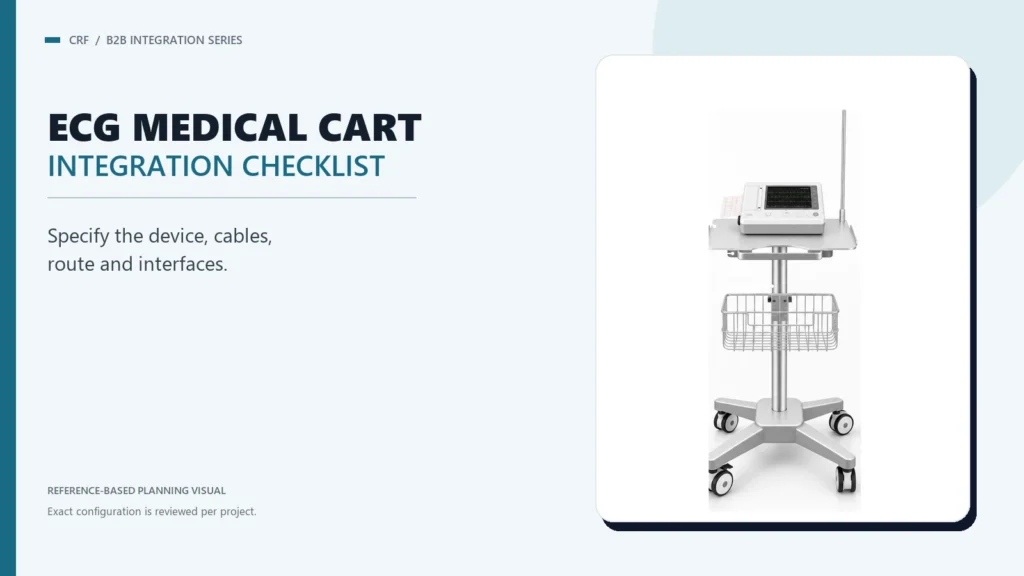
An ECG medical cart should be selected around the exact ECG device, its accessories and the route it must travel—not from a generic trolley feature list. Before requesting a quotation, document the device footprint, cable and lead workflow, accessory storage, pushing and braking needs, cleaning process, doorway and lift constraints, and every required interface. The final cart configuration should then be confirmed by drawing and sample review.
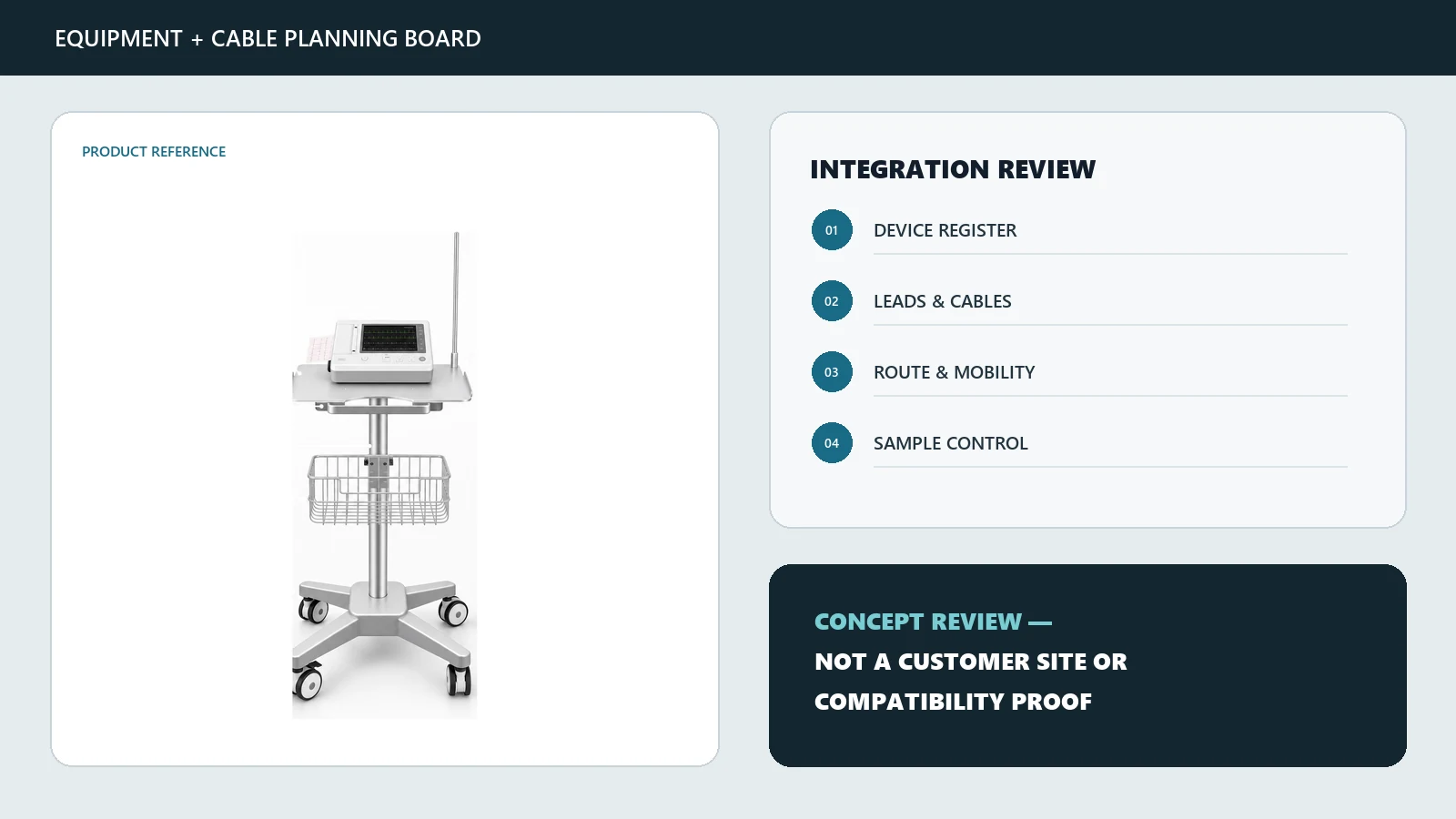
CRF’s CA13Z130 ECG medical cart is a real four-caster aluminum-alloy reference for this planning process. It is a mechanical support product; an ECG machine is not automatically included, and compatibility with any device must be verified for the proposed configuration.
Start With the ECG System, Not the Cart
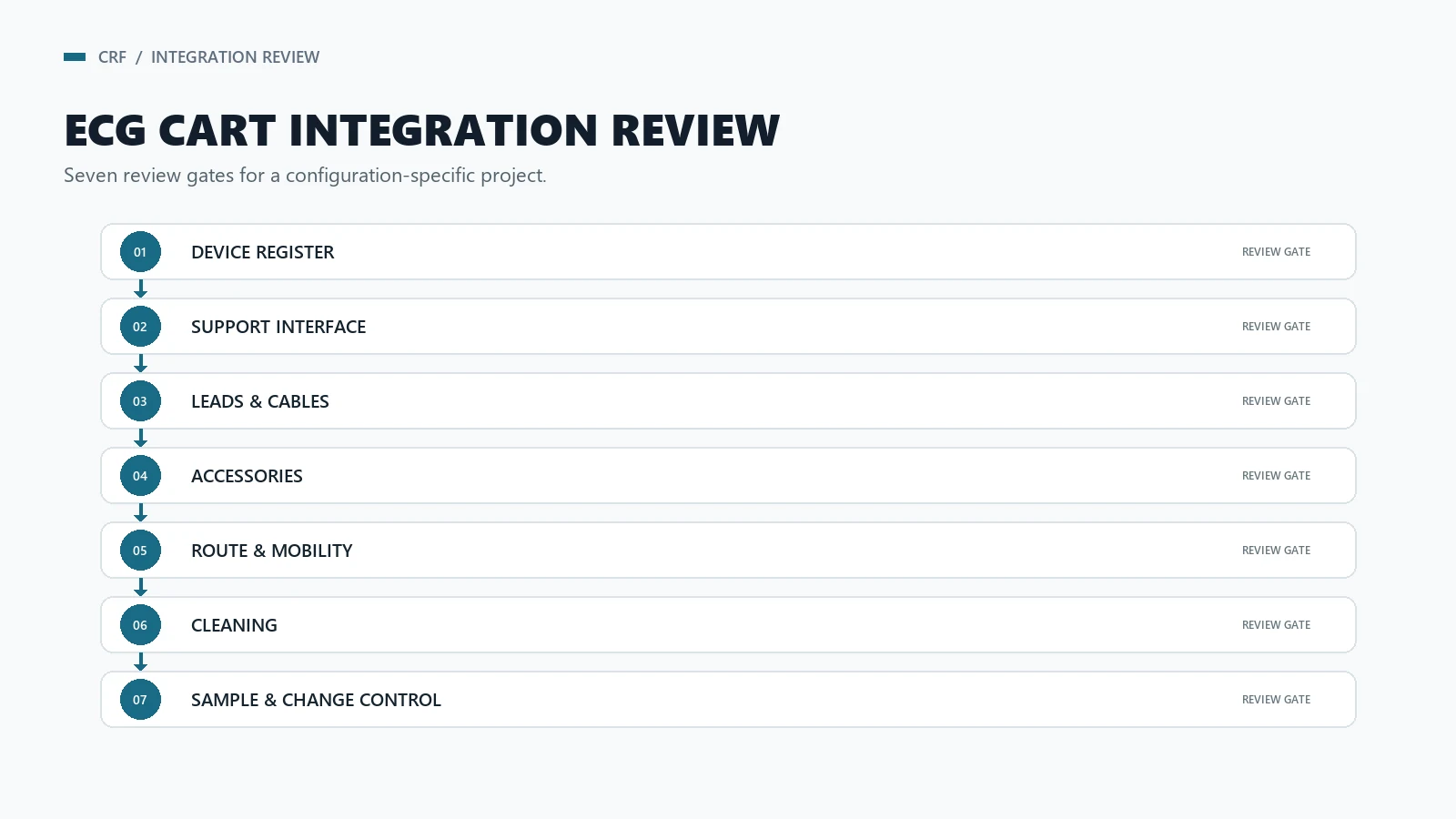
The cart and ECG unit form one working configuration. A tabletop that looks large enough may still conflict with feet, vents, cable exits, paper doors, controls or carrying handles. Begin the project with a device register that identifies:
- exact ECG manufacturer and model;
- overall device width, depth and height;
- device weight and center-of-mass information if available;
- position of feet, ventilation openings and service panels;
- power inlet, data ports and cable exits;
- paper loading and printer-clearance direction;
- lead set, patient cable and power-cord arrangement;
- accessories that must move with the device;
- whether the device needs a dedicated bracket, restraint or only a flat platform.
Do not infer fit from a product name or a photograph. Request the current equipment drawing and compare it with the proposed cart drawing. If the ECG model changes, reopen the compatibility review.
Define the Support Interface
Tabletop Footprint and Access
The usable support area is more important than the nominal tabletop size. Mark the device outline, control-access zone, paper-door sweep, ventilation clearance and any cable bend space on one drawing. Keep frequently used controls visible and reachable in the intended operating position.
Retention Without Blocking Service
A lip, strap, bracket or custom locating feature may help keep equipment positioned, but it must not cover vents, controls, labels or service access. The appropriate restraint depends on the exact device and movement conditions. Treat every retention method as configuration-specific rather than universal.
Interface Change Control
Record the approved dimensions, hole pattern, fasteners, bracket geometry and supplied hardware. A small change to the ECG enclosure or cart platform can invalidate the fit. Revision-controlled drawings reduce the risk of approving one arrangement and receiving another.
Map ECG Leads, Power and Accessories
ECG workflows involve more than placing a machine on a shelf. Lead sets, electrodes, paper, power cords and cleaning items need planned locations.
Cable and Lead Routing
Cable management should keep leads available without creating pinch points, sharp bends or loops near casters. Review routing while the cart is stationary, while it turns, and while it crosses thresholds. Confirm that any hooks or holders suit the connector and cable geometry rather than relying on an assumed universal fit.
Storage and Accessory Zones
Separate items by workflow: leads and patient cable, spare electrodes, paper, power accessories and routine supplies. A basket can support organization, but basket size and position should be checked against device access, pushing posture and cleaning reach. Do not add accessories solely because they appear on another cart model.
Power Is a Separate Requirement
If a buyer needs a powered cart, integrated outlets, a battery or cable reel, define that as a separate electrical integration project. A non-powered mechanical cart must not be described as a powered system. Electrical components, market requirements and documentation need their own review and approval.
Review Mobility as a Complete Configuration
Caster count alone does not prove stability or maneuverability. The final result depends on base geometry, equipment mass and location, accessories, floor transitions and user handling.
Route Survey
Measure the narrowest doorway, lift entrance, corridor turn, bedside gap, ramp or threshold on the intended route. Compare those limits with the complete cart envelope, including protruding baskets, handles, leads and mounted equipment—not only the bare base.
Push, Turn and Park
Review handle position and pushing direction with the actual equipment installed. Test straight travel, tight turns, reversing and positioning next to the patient area. Confirm how the brakes are reached and whether applying them leaves the equipment accessible.
Stability Verification
A wider base or additional caster does not automatically guarantee that a particular loaded arrangement is safe. The proposed cart, device and accessories should be evaluated together under an agreed verification plan. Load capacity, tipping resistance and threshold behavior must not be assumed from appearance.
Compare Generic and Device-Specific ECG Cart Approaches
| Decision area | Generic flat-platform cart | Device-specific configuration |
|---|---|---|
| Initial flexibility | May accept different footprints after review | Built around one defined device or family |
| Retention | Usually requires project-specific solution | Can use a dedicated locating or mounting interface |
| Change risk | Higher when devices vary | Lower if device revision is controlled |
| Accessory layout | Adaptable but must be defined | Can be arranged around a fixed workflow |
| Validation | Required for each installed configuration | Still required, but scope can be clearer |
Neither approach is universally better. A generic platform may suit buyers managing several device variants, while a dedicated design may simplify repeat projects. The decision should follow the device roadmap and change-control process.
Cleaning and Service Review
Provide the cleaning agents, concentration, contact time and frequency expected by the facility. Ask the supplier to identify materials and finishes for the proposed configuration, then agree how compatibility will be documented or tested. Do not infer chemical resistance from the word “medical.”
Inspect gaps around brackets, platform edges, basket joints and cable holders. Components that are difficult to reach can complicate routine cleaning. Also confirm how casters, brakes, baskets and mounting parts can be inspected, tightened or replaced without dismantling the entire system.
RFQ Checklist for an ECG Medical Cart
Send the supplier a controlled requirement pack containing:
- ECG manufacturer, exact model and revision.
- Device drawing, footprint, weight and cable-exit locations.
- Required tabletop, bracket or restraint concept.
- Lead, cable, paper and accessory inventory.
- Intended pushing direction and handle preference.
- Route limits, including doorway, lift and threshold dimensions.
- Required storage items and their approximate sizes.
- Cleaning agents and cleaning frequency.
- Destination market and applicable buyer requirements.
- Packaging, labeling and assembly expectations.
- Requested drawings, sample plan and acceptance evidence.
- Quantity forecast and configuration-change process.
For CRF, use the medical cart category to compare real base and accessory arrangements, but request confirmation for the exact model rather than combining features from different product pages.
Sample Approval and Change Control
A sensible sample review checks the complete configuration. Confirm device placement, access to controls and paper loading, lead routing, basket access, pushing posture, turns, brakes, thresholds, cleaning reach and packaging protection. Record photos and measured results against the approved checklist.
After approval, freeze the drawing, bill of materials, finish, accessory locations, packaging and labeling. Define which changes require buyer approval. This is particularly important when the supported ECG device or connector layout may be updated during the purchasing program.
Limitations Buyers Should Keep Visible
- The cart does not diagnose, monitor or treat a patient.
- An ECG device is not included unless the quotation expressly says so.
- Compatibility is not universal and must be confirmed for the exact device.
- Published dimensions from a reference product are not a substitute for an approved project drawing.
- Load, stability, cleaning resistance and transport performance require configuration-specific evidence.
- Final commercial terms, quantity, packaging and delivery are quotation-specific.
FAQ
What is an ECG medical cart?
It is a mobile mechanical support platform configured to carry and organize an ECG device and related accessories. It is not the ECG device itself.
Can one ECG cart fit every ECG machine?
No. Footprint, enclosure feet, vents, controls, paper access, connectors and weight distribution differ. Verify the exact device against the proposed cart.
Is a four-caster base always the right choice?
No. Base selection depends on the full equipment configuration, route, maneuvering needs and verification results. Caster count by itself is not proof of suitability.
What information is most important for a custom quotation?
Send the device drawing and model, support interface, accessory list, route constraints, cleaning process, destination requirements and requested acceptance plan.
Should buyers request a sample?
For a new device-cart combination, a sample or equivalent documented verification is a practical way to review fit, access, mobility, cleaning and packaging before a larger order.
Request an ECG Cart Configuration Review
Share the ECG model, device drawing, accessory list, intended route, cleaning requirements, destination market and quantity with CRF. Request an RFQ and configuration review so the cart can be evaluated around the real system rather than an assumed universal fit.