
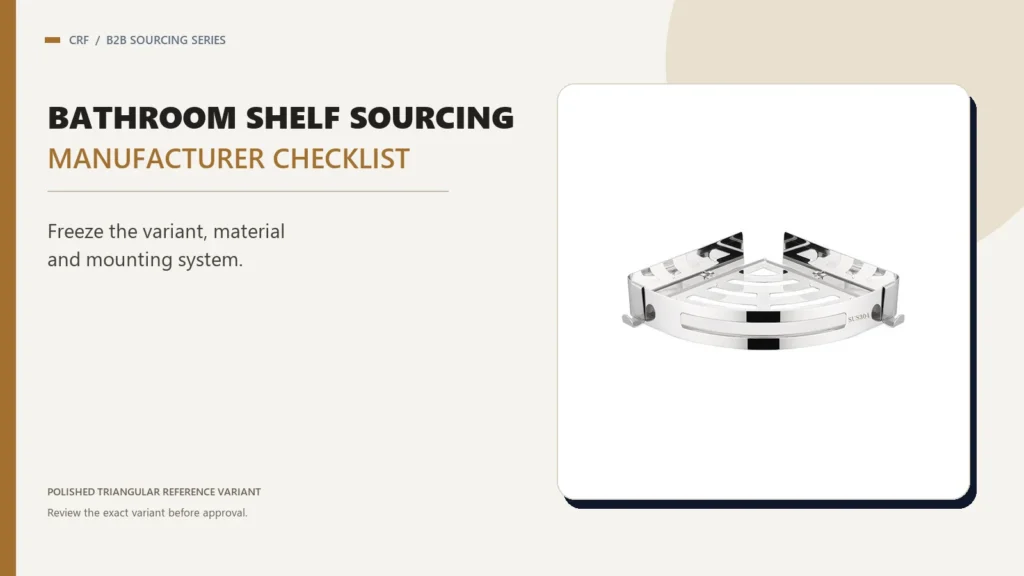
A stainless steel bathroom shelves manufacturer should be evaluated on more than shelf shape and finish. B2B buyers need to control the exact variant, wall interface, material evidence, dimensions, included mounting kit, drainage geometry, finish consistency, sample approval and packaging. The right first step is a model-specific specification sheet and installation drawing—not a generic promise that every shelf fits every bathroom wall.
CRF’s stainless steel corner and rectangular bathroom shelves provide a real product reference. The family includes open-wire triangular and rectangular variants. Supplier-listed material and installation options vary by selected SKU, so they must be frozen in the quotation and approved drawing.
Freeze the Exact Shelf Variant
A product family can contain several combinations that look similar in thumbnails but are not interchangeable. Create a variant code that identifies:
- triangular corner or rectangular wall shelf;
- overall width, depth and front-edge height;
- wire or frame arrangement;
- listed stainless-steel grade for that SKU;
- polished, bright, black or other approved finish;
- drilled or adhesive/no-drill mounting kit;
- number and position of wall-contact points;
- included brackets, pads, fasteners and instructions;
- unit packaging and labeling.
Do not approve a family-level collage as the production standard. Use one set of photos, one dimensioned drawing and one bill of materials for each ordered variant.
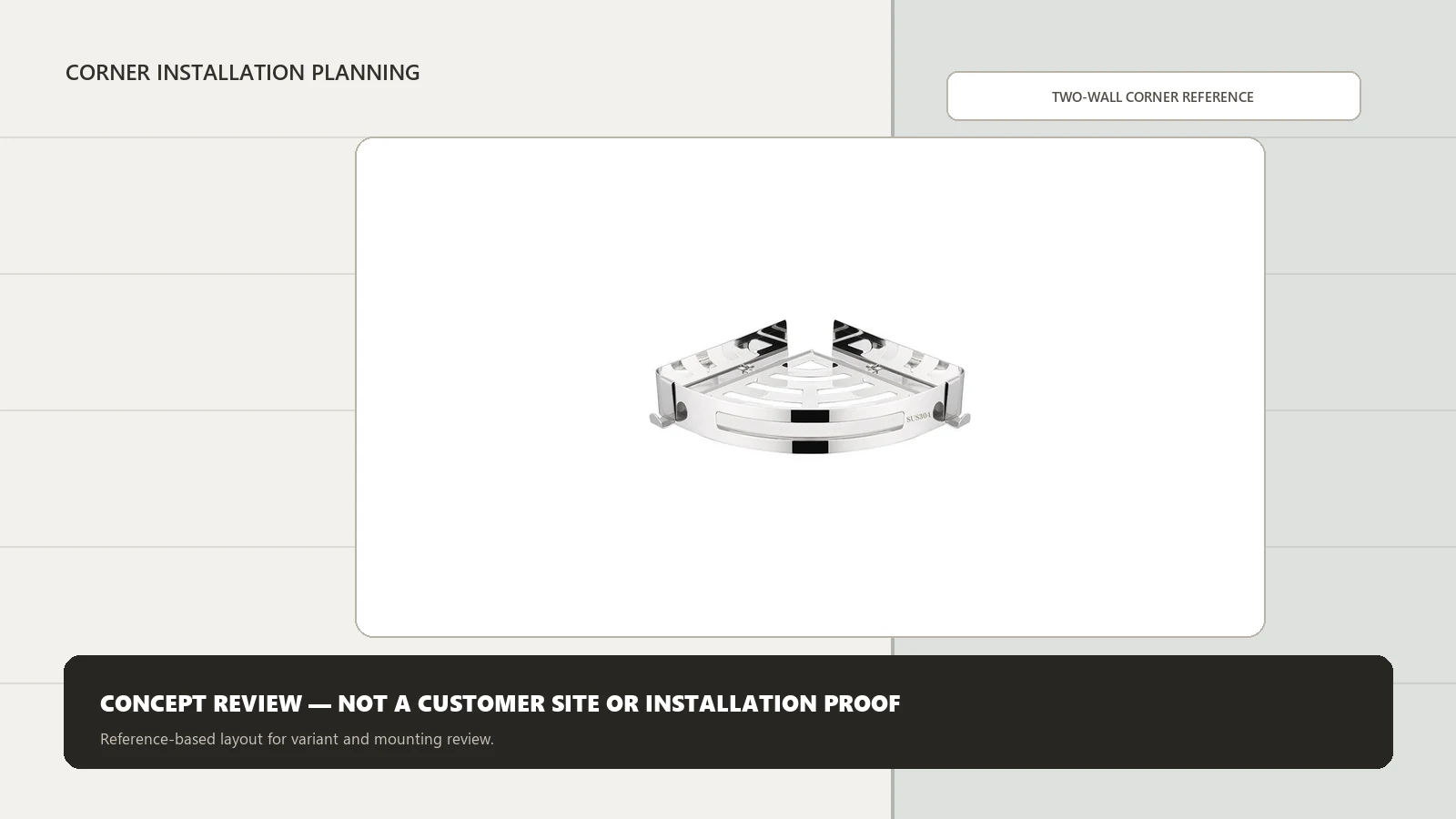
Match Shape to the Installation Surface
Corner Shelves
A triangular corner shelf is intended for a suitable corner, but actual walls may not form a perfect 90-degree angle. Tile buildup, grout lines, corner trim and uneven surfaces can affect contact. Buyers should define the target corner condition and review the shelf’s wall-contact geometry before approving the installation method.
Rectangular Shelves
A rectangular model mounts on a flat wall and needs enough clear area for the shelf body and mounting points. Check nearby fittings, shower controls, mirrors, doors and other accessories. The installation drawing should show the complete envelope and fastener positions.
Do Not Treat the Shelf as Universal
Suitability depends on wall construction, surface condition, installation method, environment and intended use. A shelf shown on tile is not automatically suitable for every tile, board, masonry or composite surface. The project specifier or installer should approve the substrate and installation method.
Compare Drilled and Adhesive Mounting
| Review point | Drilled mounting | Adhesive/no-drill mounting |
|---|---|---|
| Wall penetration | Requires holes | Avoids holes when the approved system permits |
| Substrate review | Fastener and anchor must match wall | Adhesive must match surface and environment |
| Installation control | Hole positions and sealing need control | Cleaning, preparation, cure time and pad contact need control |
| Removal | May leave holes | May leave residue or affect finishes |
| Evidence needed | Fastener, anchor and substrate requirements | Adhesive identity, preparation and curing instructions |
Neither method is universally preferable. The manufacturer should clearly identify what is included and what remains the installer’s responsibility. Do not substitute adhesives or anchors without review, and do not publish a load claim unless it is tied to the exact shelf, installation system, substrate and test method.
Verify Material Claims by SKU
The CRF reference family lists both 201 stainless steel and SUS304 options depending on the selected variant. That does not mean every variant uses the same material. Require the quotation, sample label and production specification to identify the material for the exact SKU.
If a project requires a specific grade, request current model-specific documentation and agree on an incoming inspection method. “Stainless steel” alone is too broad for controlled sourcing, while an unverified grade claim should not be converted into a corrosion-performance promise.
Finish and Appearance
Define the finish using an approved physical sample or measurable standard where practical. Review brightness, polish direction, color, edge appearance, weld areas and consistency between visible parts. For black variants, confirm the coating or finishing specification and the agreed visual acceptance criteria without assuming performance that has not been tested.
Review Open-Wire Geometry and Daily Use
Open-wire construction can support drainage and ventilation, but the real user experience depends on spacing, frame geometry and item size. Review:
- whether intended bottles or containers can stand without tipping;
- gaps that might allow small items to fall through;
- front-edge geometry and usable depth;
- drainage paths and areas that may retain residue;
- wire ends, joints and accessible edges;
- reach and cleaning access around wall contacts.
The shelf should be evaluated with representative items during sample review. Do not infer suitability for heavy, fragile or unusually shaped items from a general product image.
Manufacturer Evaluation Checklist
1. Product Definition
Ask whether each shape, dimension, finish and mounting method has a distinct SKU or controlled variant code. Confirm which photographs correspond to the quoted model.
2. Drawing Control
Require a drawing showing overall dimensions, wall-contact points, mounting-hole or adhesive-pad positions, wire arrangement and included parts. Record a drawing revision in the purchase documents.
3. Material Evidence
Confirm the listed material for the exact variant. If grade evidence is commercially required, define the acceptable document or inspection rather than accepting a generic family statement.
4. Sample Quality
Inspect form, symmetry, wire spacing, joints, edges, finish, wall contact and completeness of the mounting kit. Test installation only on a representative, approved substrate and follow the supplied instructions.
5. Packaging
Metal shelves can scratch or deform if parts rub in transit. Review individual protection, separation of hardware from finished surfaces, carton arrangement, labels and instruction placement. Simulated shipment or agreed packaging checks may be appropriate for the project.
6. Change Control
Define whether a change in material source, wire diameter, bracket geometry, finish process, adhesive, fastener, packaging or factory location needs notification and approval. A shelf that retains the same sales name may still change in ways that matter to installation.
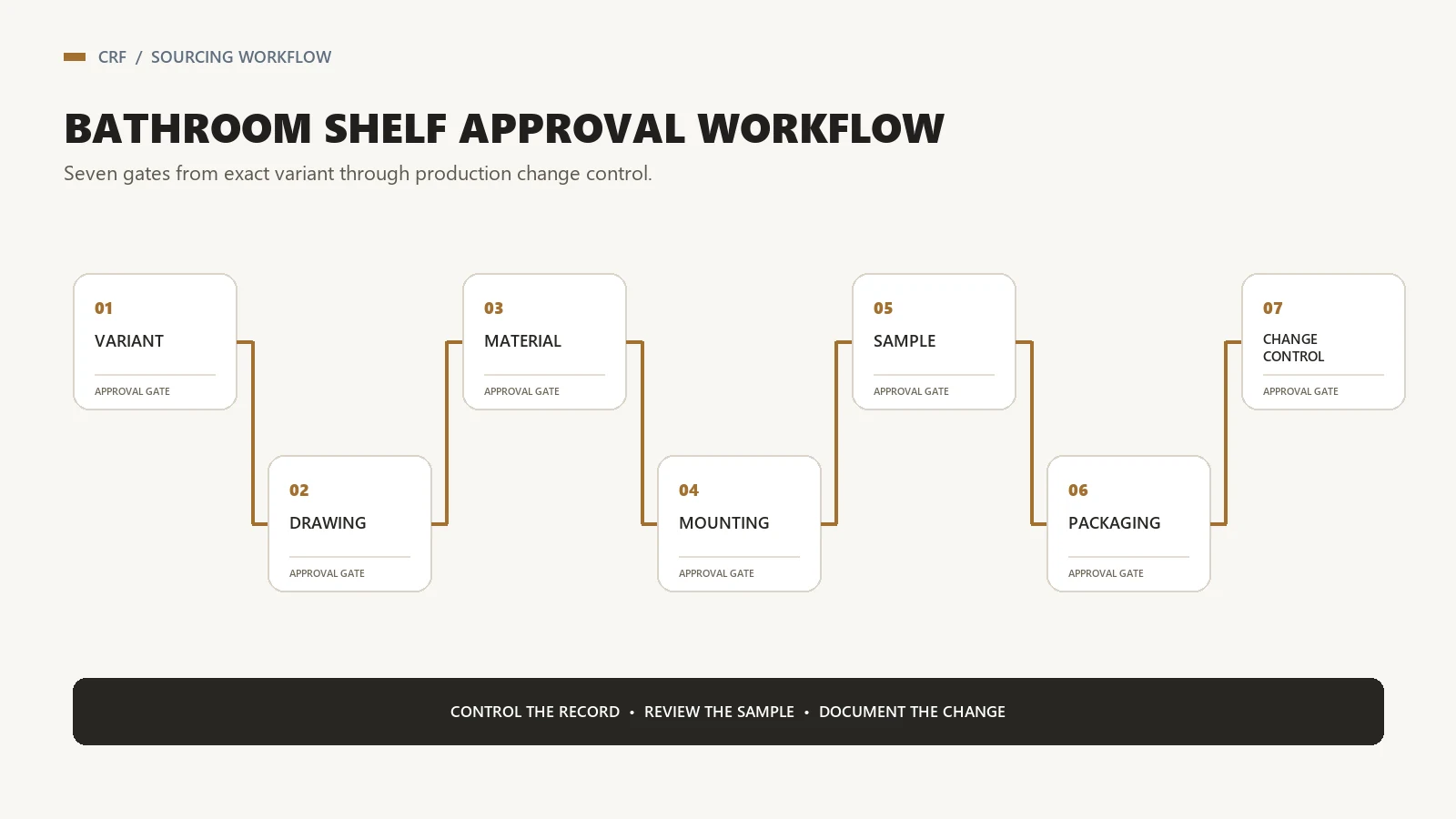
Sample Approval Workflow
Use a controlled approval sequence:
- Confirm the exact variant and destination requirements.
- Review the drawing, bill of materials and mounting kit.
- Receive a labeled sample that matches the quoted SKU.
- Measure the shelf and compare it with the drawing.
- Inspect edges, joints, wire spacing and finish under agreed lighting.
- Trial the installation on a representative approved wall system.
- Review cleaning access and representative stored items.
- Approve packaging, labels and instructions.
- Freeze the approved sample and document revisions.
A sample is evidence only for the configuration actually reviewed. It does not prove that every family variant or every wall installation will perform the same way.
RFQ Checklist for Bathroom Metal Shelves
Include the following in your request for quotation:
- required shape and variant code;
- dimensioned drawing or target envelope;
- listed material requirement and evidence needed;
- finish and approved color reference;
- drilled or adhesive mounting preference;
- target wall/substrate information for compatibility review;
- required included hardware and instructions;
- representative stored items and use environment;
- packaging and label requirements;
- destination market and buyer compliance requirements;
- sample quantity and approval tests;
- order quantity forecast;
- change-notification requirements.
CRF’s product page lists selected triangular dimensions of approximately 26 × 19 × 3.8 cm and larger listed triangular variants around 29 × 21.5 × 4.5 cm, but those figures should be treated as variant-specific supplier information. Confirm the current drawing for the exact SKU before ordering.
Common Sourcing Mistakes
- Mixing photos and dimensions from different variants.
- Assuming every product in the family is SUS304.
- Treating adhesive and drilled kits as interchangeable.
- Selecting mounting hardware without reviewing the wall substrate.
- Publishing a load figure without a defined installation and test method.
- Approving finish from a screen image instead of a physical sample.
- Omitting small hardware or instructions from the packaging review.
- Allowing material, adhesive or bracket changes without notification.
Limitations Buyers Should State Clearly
- Installation suitability depends on the exact wall and mounting system.
- Material grade and finish vary by selected variant unless frozen in writing.
- A product photograph is not an installation drawing.
- No load, corrosion-life or adhesive-performance claim should be assumed without configuration-specific evidence.
- The scene of use must not be represented as a customer installation unless it truly is one and permission exists.
- Final price, quantity, packaging and delivery terms are quotation-specific.
FAQ
What should I ask a stainless steel bathroom shelf manufacturer first?
Ask for the exact SKU, current drawing, material listing, finish, mounting method, included hardware and sample plan.
Is SUS304 standard for every bathroom shelf?
No. The verified CRF family lists both 201 stainless steel and SUS304 depending on the variant. Confirm the exact SKU and evidence required.
Is adhesive mounting suitable for every bathroom wall?
No. Suitability depends on the approved adhesive system, surface, preparation, environment, contact area and curing process. The installer must follow the reviewed method.
Are corner shelves always designed for a perfect 90-degree corner?
They are intended for suitable corners, but real wall angles and finishes vary. Compare the product geometry with the actual installation condition.
Why approve packaging for a simple shelf?
Finished metal surfaces can scratch, hardware can mark the shelf, and frames can deform in transit. Packaging is part of the delivered configuration.
Request a Model-Specific Quote
Send CRF the shelf shape, dimensions, material requirement, finish, wall condition, mounting preference, packaging needs, destination market and quantity. Request a model-specific RFQ and sample review so the exact variant—not a mixed product family—is controlled from quotation through production.