
A folding shower chair manufacturer should be evaluated against a controlled product configuration, target user and bathroom environment—not a catalog image or an unsupported load claim. Before requesting a quote, define the chair type, intended assistance level, seat and overall dimensions, height range, arm and back support, swivel and fold functions, floor contact, cleaning requirements, labeling, packaging and the evidence required for your destination market.
CRF lists a real folding aluminum swivel shower chair that can serve as a sourcing reference. This article is procurement guidance, not medical advice, fall-prevention assurance or proof that one chair suits every user. Qualified buyers and responsible professionals must assess the intended user, environment and applicable requirements.
Start with the use case, not the feature list
The first sourcing question is not “Does it fold?” It is “Who will use it, in what bathroom, with what assistance and transfer method?” Record:
- walk-in shower, wet room, tub or other environment;
- available floor area and entry clearance;
- intended seated use and transfer approach;
- user dimensions and needs assessed by the responsible party;
- caregiver access, if applicable;
- backrest and arm-support requirements;
- fixed, adjustable or rotating seat requirement;
- folding purpose: storage, shipping or daily deployment;
- floor slope, joints and surface condition;
- cleaning and drying process; and
- destination-market documentation and labeling needs.
A chair with useful features can still be unsuitable if its footprint does not fit, its arms obstruct a transfer plan, or its rotating seat lacks an approved locking state.
Distinguish the product functions clearly
Folding frame or folding armrests
“Folding” can describe different components. Ask the supplier to identify exactly what folds, how it is released, its open and stored envelope, whether it locks, and where pinch zones exist. A folding armrest does not mean the complete chair folds for storage.
Swivel seat
A rotating seat may change how a user approaches or transfers, but rotation alone does not prove safe transfer. Request the permitted positions, locking method, release control, stop behavior and inspection points. Confirm whether rotation is available in the quoted version rather than inferred from a family description.
Height adjustment
Record the available settings, adjustment method, leg engagement and visible confirmation that all legs are set as intended. The selected seat height must be assessed for the actual user and environment; a broad adjustment range is not a universal fit guarantee.
Detachable parts
Backrests, armrests, seats, pins and feet may be removable for packing or configuration. Ask whether tools are required and how incomplete or incorrect assembly is prevented and inspected.
Compare supplier information with a configuration matrix
| Area | Information to request | Why it matters |
|---|---|---|
| Product identity | Model, revision, photos and controlled drawing | Prevents mixing specifications from different variants |
| Dimensions | Seat, overall footprint, arm spacing, height range and folded envelope | Confirms user and bathroom fit inputs |
| Materials | Frame, seat, fasteners, feet and surface finish | Supports cleaning, corrosion and durability review |
| Mechanisms | Fold, swivel, height adjustment and locks | Defines moving interfaces and inspection points |
| Floor contact | Foot geometry, replaceable tips and adjustment | Must match the intended wet-floor environment |
| Assembly | Parts list, fasteners, tools and instructions | Controls setup errors and missing parts |
| Verification | Test methods, sample criteria and reports required by buyer | Replaces unsupported marketing claims with project evidence |
| Packaging | Packed state, protection, carton data and labeling | Affects freight, damage risk and receiving inspection |
| Change control | Approved sample, drawing revision and substitution rules | Prevents silent component changes |
Do not accept material, capacity, corrosion, certification or test claims that cannot be tied to the quoted model and revision.
Review the frame and wet-area interfaces
Check the complete footprint
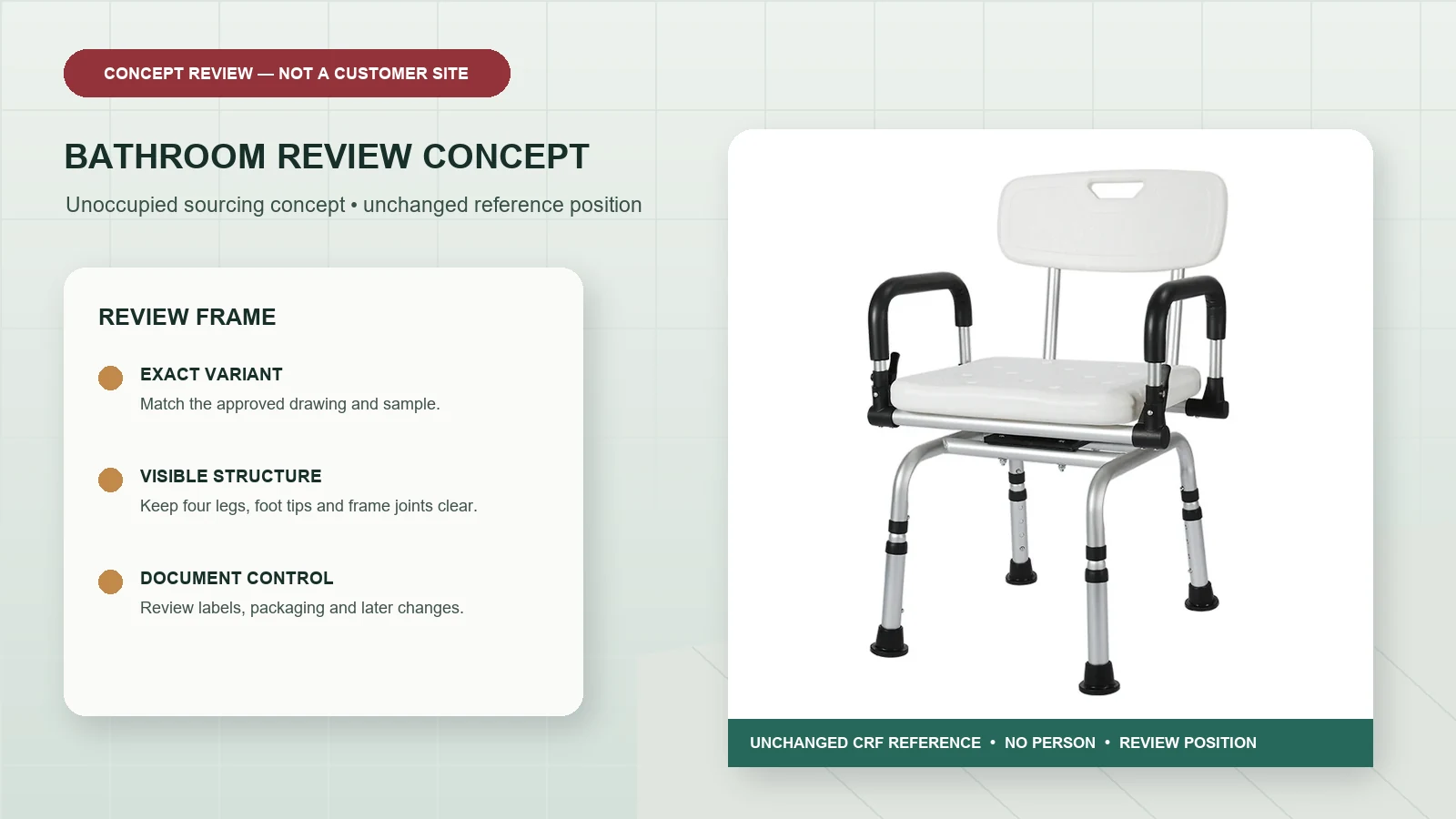
Measure the chair at floor, seat and armrest levels. Include feet and adjustment hardware. Compare those dimensions with the actual shower entrance, interior floor area, wall projections and drainage features.
Inspect the floor-contact system
All feet should contact the intended surface in the approved configuration. Document foot material and geometry, replacement method and adjustment engagement. A catalog claim of “non-slip” does not replace a configuration-specific review on the intended surface and condition.
Identify water traps and cleaning access
Review seat drainage, joints, tubes, hinges, fasteners and interfaces where water or residue can remain. Request cleaning instructions and material compatibility evidence appropriate to the buyer’s process. Do not assume that “aluminum” proves the performance of the complete chair, fasteners or finish.
Keep moving parts inspectable
Fold, swivel and adjustment mechanisms need visible inspection and service access. The supplier should identify wear parts, loose-part checks and replacement components rather than treating the mechanism as permanently maintenance-free.
Validate the swivel and folding mechanisms
A sample review should include every permitted state.
Open and deployed state
Confirm that the chair reaches its intended deployed configuration, all locks or engagement features operate as documented, the seat and arms are correctly positioned, and no component depends on an improvised setup.
Transition state
Observe hand positions, pinch zones, unexpected movement and the force needed to release or rotate components. Document the intended sequence instead of relying on intuition.
Folded or packed state
Check whether parts remain retained, whether surfaces can be damaged, and whether the stored footprint matches the shipping and storage plan. A compact carton is not useful if receiving staff cannot identify the correct assembly state.
Repeated-operation review
The buyer should define cycle, inspection and acceptance requirements appropriate to the project. Do not copy a cycle count or load value from another product family.
Build a responsible sample-approval plan
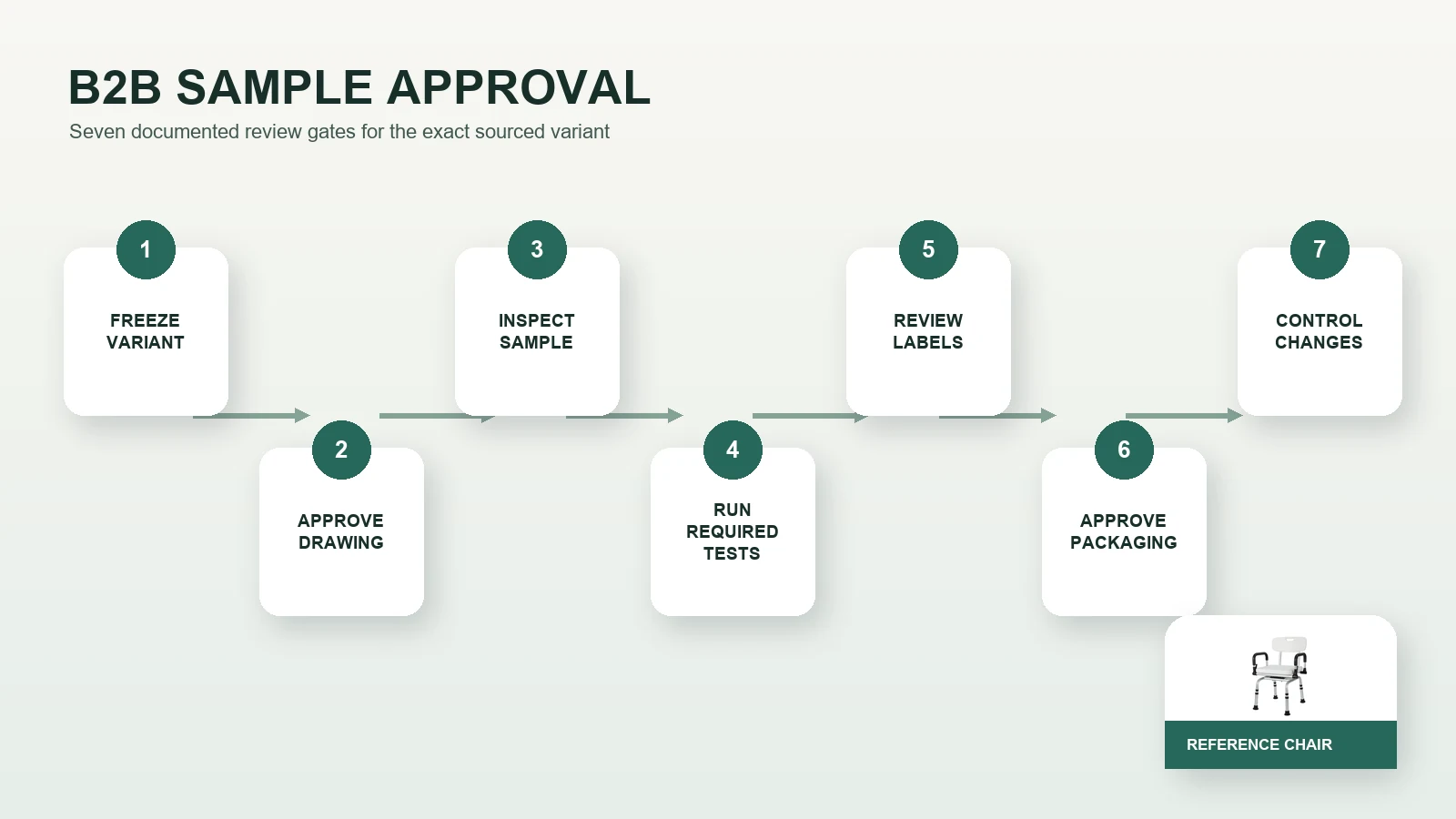
1. Freeze the quoted variant
Approve the model, revision, frame, seat, arms, back, feet, mechanisms and included parts.
2. Approve a controlled drawing
Include all critical dimensions, adjustment positions, interfaces and part identifiers.
3. Inspect a representative sample
Verify dimensions, assembly, folding, rotation, adjustment, floor contact, drainage and cleaning access.
4. Conduct required testing
The buyer and qualified parties should define applicable structural, stability, durability, material, usability and market-specific evaluations. Record methods and results against approved criteria.
5. Review instructions and labels
Check assembly, adjustment, use, inspection, cleaning, warnings, model identity and traceability content required for the project.
6. Approve packaging and receiving checks
Confirm carton contents, protection, packed dimensions, identifiers and the incoming inspection plan.
7. Control production changes
Require approval for substitutions to frame parts, fasteners, feet, mechanisms, seat, packaging or instructions where they can affect the approved configuration.
RFQ checklist for folding shower chair manufacturers
Send each prospective supplier:
- target product type and intended environment;
- target user and transfer requirements defined by the responsible party;
- required seat, overall and arm-spacing dimensions;
- required height settings and adjustment method;
- backrest and armrest configuration;
- exact folding and swivel functions;
- floor-contact and drainage requirements;
- frame, seat, fastener and finish requirements;
- cleaning process and required compatibility evidence;
- applicable testing, documentation and labeling requirements;
- approved-sample and change-control expectations;
- spare or replacement-part needs;
- packing method, carton marking and inspection plan;
- quantity, destination market and trade assumptions; and
- requested tooling, sample and production schedule, to be quoted rather than assumed.
Ask quotations to separate the base product, options, tooling, samples, tests, documents, packaging, spare parts and exclusions.
A real CRF folding shower chair reference
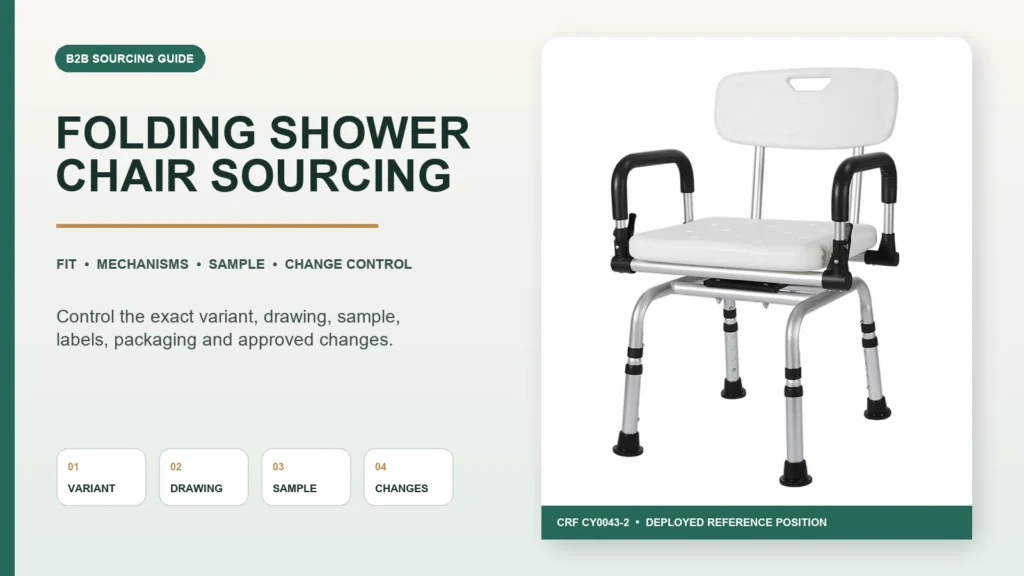
The CRF CY0043-2 folding aluminum shower chair is a real product reference with a backrest, arm supports, a supplier-listed swivel design and an adjustable configuration. The public page includes supplier-sourced dimensions and explicitly asks buyers to confirm the swivel and locking mechanism, armrest configuration, seat-height range, seat material, frame finish and included hardware.
Use this page to start a model-specific discussion, not to infer universal load performance, suitability or compliance. Final requirements belong in the quotation, controlled drawing and approved sample.
Buyers may also browse the CRF shower chair category for currently listed variants, while verifying every selected page and configuration independently.
Limitations
This guide does not prescribe a user assessment, transfer technique or installation. It makes no universal claim for load, stability, slip resistance, corrosion resistance, cleaning-agent compatibility, certification, medical outcome, fall prevention, price, MOQ, stock, warranty or lead time. Any such requirement must be tied to the exact model, destination market, documented method and approved evidence.
FAQ
What should a B2B buyer ask a folding shower chair manufacturer first?
Ask for the exact model and revision, controlled drawing, complete dimensions, material and mechanism breakdown, included-parts list, sample process, test evidence relevant to your requirements, packaging and change-control procedure.
Does a swivel seat make every shower chair easier to transfer onto?
No. The user, bathroom, assistance plan, rotation range, locking positions, armrests and floor contact must be assessed together by responsible parties. A swivel feature is not a universal suitability claim.
Is an aluminum frame enough to prove wet-area durability?
No. The complete product includes finishes, fasteners, joints, feet, seats and mechanisms. Buyers should define the environment and cleaning process, then request appropriate model-specific material and test evidence.
Should folding shower chairs be approved from product photos?
No. Photos cannot verify dimensions, mechanism engagement, floor contact, materials, assembly, instructions or test results. Use controlled documents and a representative sample.
Discuss a folding shower chair project with CRF
Review the CY0043-2 product reference and submit an RFQ through the contact page or the product page, or email info@szcrftech.com. Include target dimensions, configuration, fold and swivel requirements, bathroom and user-assessment inputs, destination market, quantity, packaging and required sample/testing scope. CRF can identify missing sourcing inputs before quotation.