

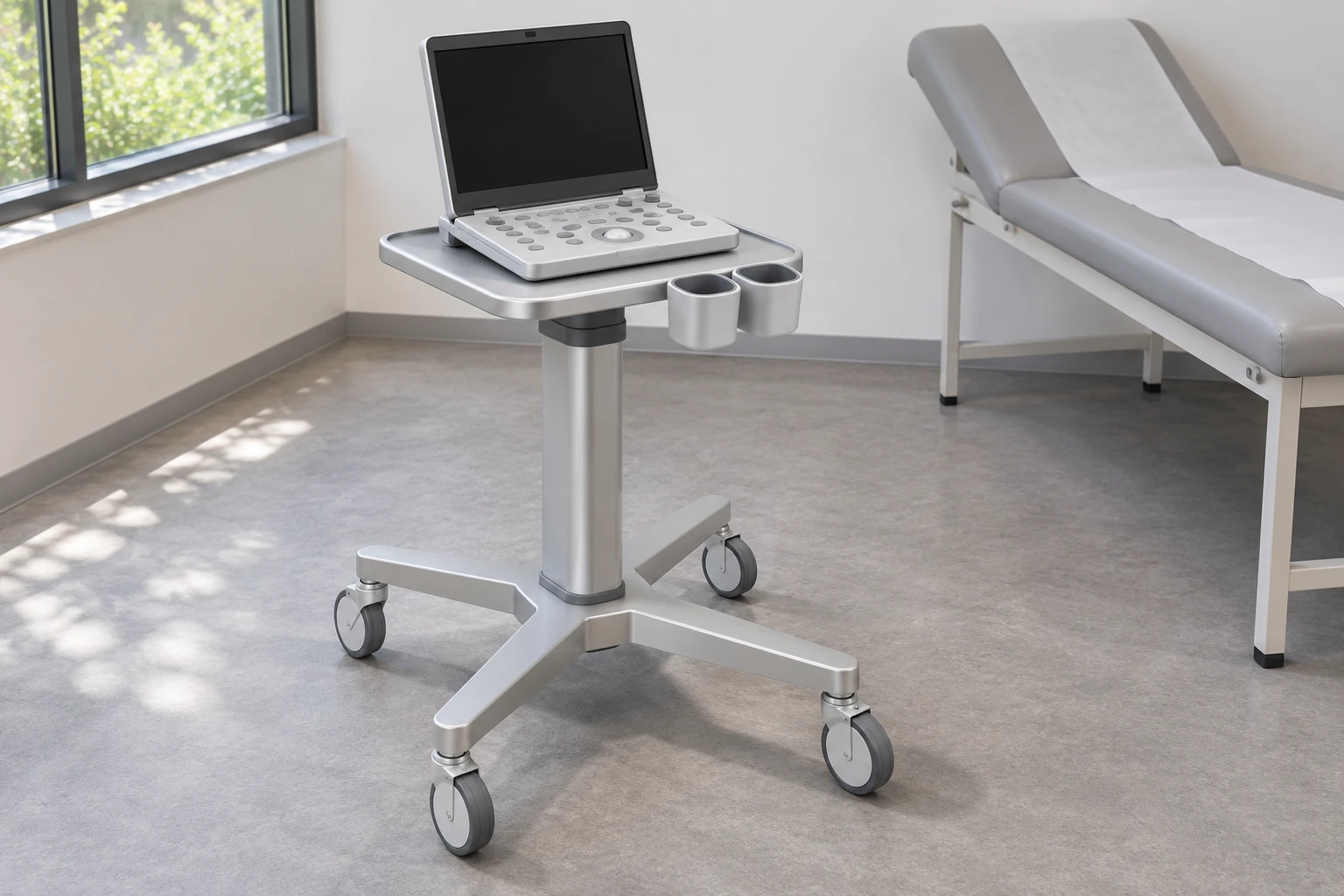
An adjustable height ultrasound cart should let the operator position the equipment for the intended examination and transport workflow without creating new problems for probe cables, controls or device retention. Before ordering, identify exactly what changes height: the whole device platform, an independent display, an accessory support or a combination. A moving display alone does not make the ultrasound unit’s controls adjustable, and a moving worktop does not automatically position a separate screen correctly.
Start with the actual ultrasound unit and probe set, then compare the full movement envelope on a representative sample. This guide concerns mechanical purchasing decisions. It does not recommend examination technique, establish diagnostic performance or certify a completed system.
Compare the adjustment architectures
Buyers often ask for an adjustable cart without specifying the moving assembly. That leaves several materially different products under the same description.
A moving device platform changes the height of the ultrasound unit and anything retained on that platform. It may be relevant when the unit’s own controls and screen need to move together. Check the complete device, including the open screen, connector plugs and attached cables, at both ends of the agreed range. Do not infer that a device may be lifted or retained by an arbitrary casing surface.
An independent display support changes viewing position separately from the main device. It is relevant only where the intended system includes an appropriate display and verified mounting interface. It does not resolve access to controls on a lower device platform. A cart image showing a monitor is not evidence that a monitor is supplied or compatible.
A combined adjustable workstation has more than one moving interface. It can offer more positioning choices, but the buyer must review those movements together. A display arm, worktop, probe holders and cables may each be clear individually while colliding in a particular combination.
| Architecture | What the buyer must define | Main sample question |
|---|---|---|
| Moving device platform | Exact ultrasound unit, support points and retained contents | Can the complete unit move through the agreed range without blocked controls or cable interference? |
| Independent display adjustment | Actual display, mounting interface and system connections | Does display positioning leave the device controls accessible? |
| Combined moving assemblies | Allowed movements and accessory positions for the complete configuration | Are the permitted combinations usable without collisions or unintended cable tension? |
If the unit and display remain fixed, confirm whether the adjustment claim refers only to another accessory. Do not assume the main device platform moves because a product listing uses “height adjustable.”
Define the height references before requesting a quote
Ask the supplier to identify the measurement reference for every quoted height. The top of the work surface, the device control plane and the display center are different references. A range measured to an unloaded platform does not directly describe where the operator reaches the installed device’s controls.
Provide the intended operating positions and the locations of the relevant controls on the actual unit. Review the proposed range with representative users and the responsible site team. A single preferred height cannot represent every user or every seated and standing task.
Also define the travel position separately from the operating position. Equipment that is convenient to use when raised may require a different arrangement for movement or parking. Follow the product’s applicable instructions and the approved configuration; do not invent a universal travel height.
Record the agreed reference and measurement method on the controlled drawing. If the sample changes, update that record rather than keeping a range copied from a visually similar cart.
Compare adjustment methods without assuming a winner
A manual locking arrangement, a counterbalanced mechanism and a powered mechanism involve different controls and review requirements. The appropriate choice depends on adjustment frequency, installed equipment, user access and the supplier’s actual design.
For a manual arrangement, review whether the intended user can reach and operate the control without interfering with the device or other accessories. Follow the instructions for supporting and adjusting the assembly. Do not assume a knob can safely be released under any load.
For a counterbalanced arrangement, request the applicable supported configuration and adjustment instructions. A mechanism that behaves well with one unit may behave differently after the equipment set changes. Do not use a demonstration with an empty platform as proof of behavior with your device.
For a powered arrangement, define the supply scope and responsible parties for the electrical system. Powered height adjustment is not the same as onboard power for the ultrasound equipment. The quotation must distinguish those functions, and this guide does not establish either electrical capability.
Review probe storage throughout the movement
Probe holders can be fixed to the moving platform, fixed to the column or attached to another assembly. Identify which arrangement is being quoted. Then examine how the probes are inserted, removed and stored at the agreed operating positions.
Use the actual connector and cable geometry in the review. A cable may be clear at the upper position but enter the base or caster area when the platform is lowered. Conversely, a short available cable path may become tight at the upper position. Avoid bending-radius or cable-force assumptions; follow the equipment manufacturer’s applicable information.
Check more than the number of cups. Confirm the probe shapes and storage instructions, separation needs, removal path and whether holders interfere with controls. A cup that appears to fit in a photograph does not establish suitability for a particular transducer or cleaning process.
For a broader device-and-accessory checklist, see CRF’s ultrasound cart integration guide. The height-adjustment review should add the moving conditions to that equipment register, not replace it with a generic platform dimension.
Verify the platform, base and retention as one configuration
Height adjustment changes the equipment position relative to the base. The stability and handling of the completed arrangement require configuration-specific review; neither a low base nor a higher caster count proves suitability across the range.
Ask for a drawing showing the proposed base and all installed assemblies. Identify device support points and the agreed retention method, including how the unit is removed for service. The device manufacturer’s restrictions and the responsible integrator’s requirements take precedence over improvising clamps around accessible casing features.
Do not perform improvised tipping or overload demonstrations. Agree the necessary verification scope with qualified responsible parties and use the appropriate controlled procedures. A smooth adjustment demonstration or workflow trial is not a stability certificate.
At the lowest and highest agreed positions, check that device covers, connectors, controls, storage and adjustment mechanisms remain accessible. Repeat the access check after any change to the device, basket, probe holders or shelf positions.
Build a sample review that can be repeated
Prepare a short record with the exact cart revision, device model, probes, accessories and supplier instructions. State which components are supplied by each party. Photograph the agreed operating and travel arrangements without patient information.
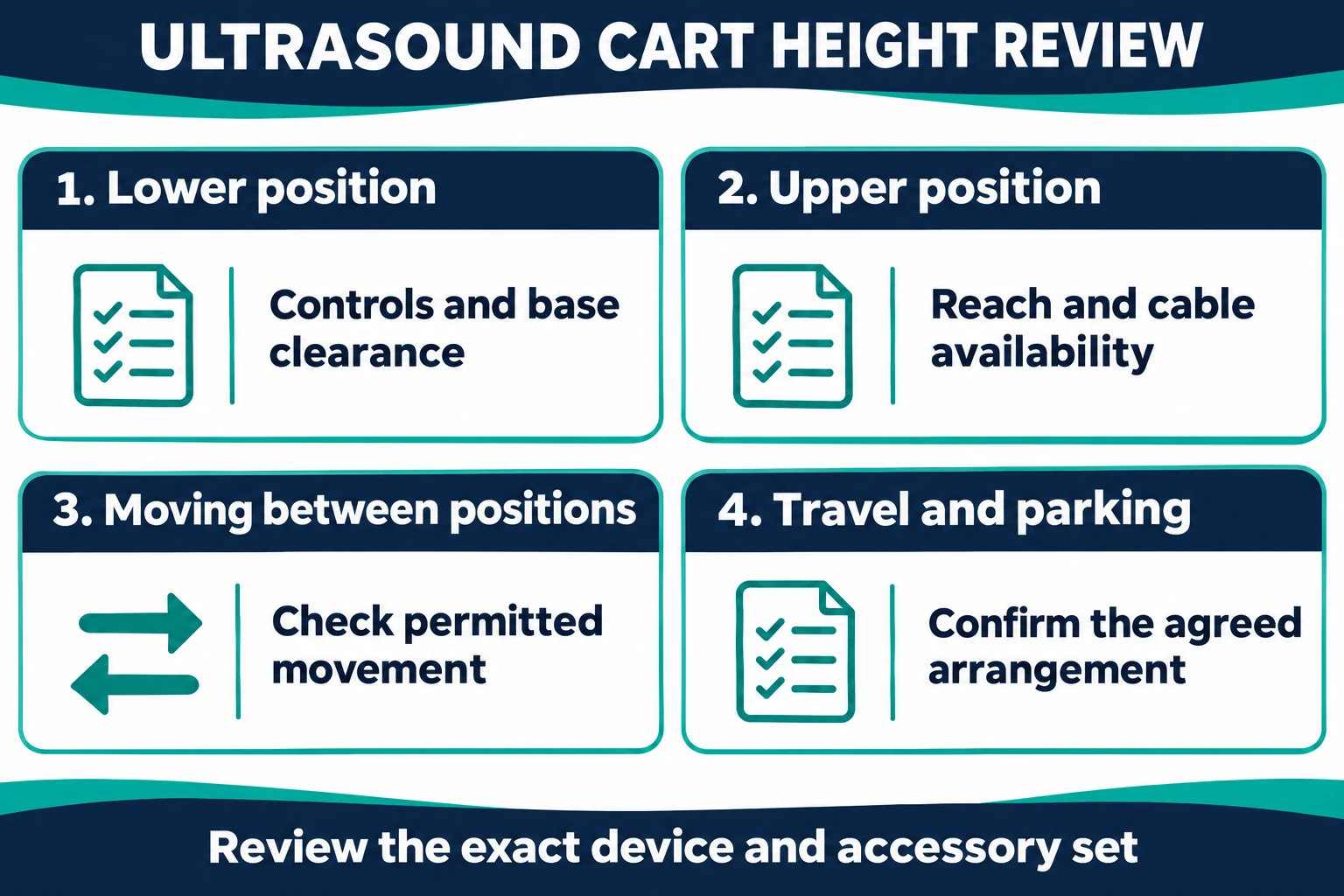
Review four conditions:
- Lower operating position: control access, probe access and clearance to the base or lower accessories.
- Upper operating position: viewing, reach, cable availability and the configuration-specific verification requirements.
- Adjustment transition: control access and possible interference through the permitted movement, following the instructions.
- Travel and parking position: retained contents, cable placement and the complete envelope on the intended controlled route.
For each issue, record the observed condition, supporting evidence, owner and required resolution. An observation such as “the probe cable crosses the agreed wheel-clearance zone at the lower position” gives the supplier a concrete revision task. “Make the cart more ergonomic” does not.
Do not approve a configuration after removing an accessory that is required in service. If the sample lacks an item, record the review as incomplete for that item instead of assuming it will fit later.
Use CRF product references accurately
CRF offers aluminum-alloy medical equipment cart structures, including ultrasound-cart configurations. Browse the ultrasound medical cart collection to select a relevant real starting point for a quotation discussion.
Confirm the adjustment architecture, applicable range, supplied accessories and device interfaces for the exact selected product. The existence of a cart collection does not establish that every model is adjustable, that one model’s dimensions apply to another, or that the illustrated equipment is included.
A generated application scene can explain the topic but cannot prove an adjustment mechanism, working range, probe compatibility, supplied contents or load capability. Use the controlled product specification and approved sample for those decisions.
FAQ
What does adjustable height mean on an ultrasound cart?
It means an identified assembly changes height. Confirm whether that assembly carries the ultrasound unit, a display or an accessory. Ask for the reference point, range and instructions for the exact configuration.
Is a moving display enough for an adjustable ultrasound workstation?
Not when the task also requires the ultrasound unit’s own controls to move. Review the device control position and the display position separately, then check their combined use.
Is a gas-assisted mechanism always better than a manual lock?
No. Compare the actual mechanism, supported equipment arrangement, adjustment frequency and user task. The applicable instructions and representative sample matter more than the mechanism’s label.
Can the probe holders remain fixed while the platform moves?
That depends on the specific layout and equipment. Review probe access and cable clearance over the full permitted range. Do not assume that a fixed holder or a moving holder is universally preferable.
Does powered height adjustment power the ultrasound unit?
Not necessarily. Height-adjustment power and equipment power are separate functions and must be explicitly included in the agreed scope. Neither should be inferred from appearance.
Request the right configuration
Please send an RFQ with the exact ultrasound unit, probe list, support drawings, required operating positions, preferred adjustment approach, accessories, quantity and destination market. Include the height reference you want reviewed and any existing cable or access problems. Confirm the final drawing, supplied scope and representative sample before ordering.