

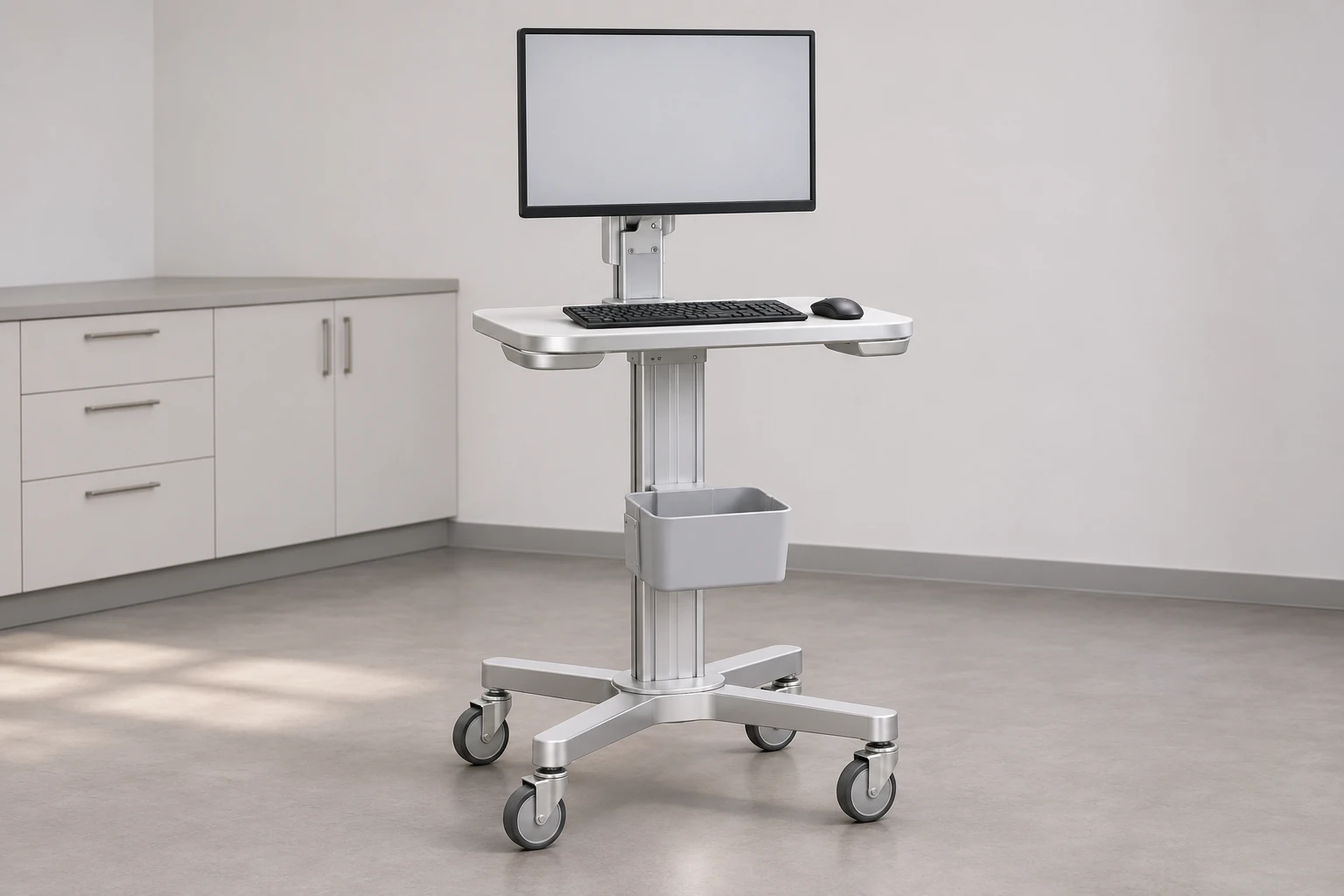
The best custom medical cart for a new device is the least complex platform that can meet the defined equipment, workflow and verification requirements without hiding unresolved risks. An existing cart, an adapted platform and a clean-sheet design are different development routes. None is automatically best simply because it is called custom.
Choose the route according to what is stable in the device design, what must change on the cart, and who will verify the completed assembly. This article compares those development choices. It does not claim universal compatibility, a fixed development schedule or certification of any proposed device-and-cart system.
Begin with device maturity, not a styling sketch
If the device enclosure, mass, connection locations and mounting interface are still changing, a highly specific cart may become obsolete before sample approval. Identify stable requirements and unresolved interfaces separately. A provisional device envelope can support an early discussion, but it should not be presented as a final production drawing.
List the hardware versions expected during development. Identify the owner and date of each interface update. Ask the cart supplier to state which assumptions the proposal depends on. A good early concept makes those dependencies visible rather than presenting a polished image as proof that the engineering is complete.
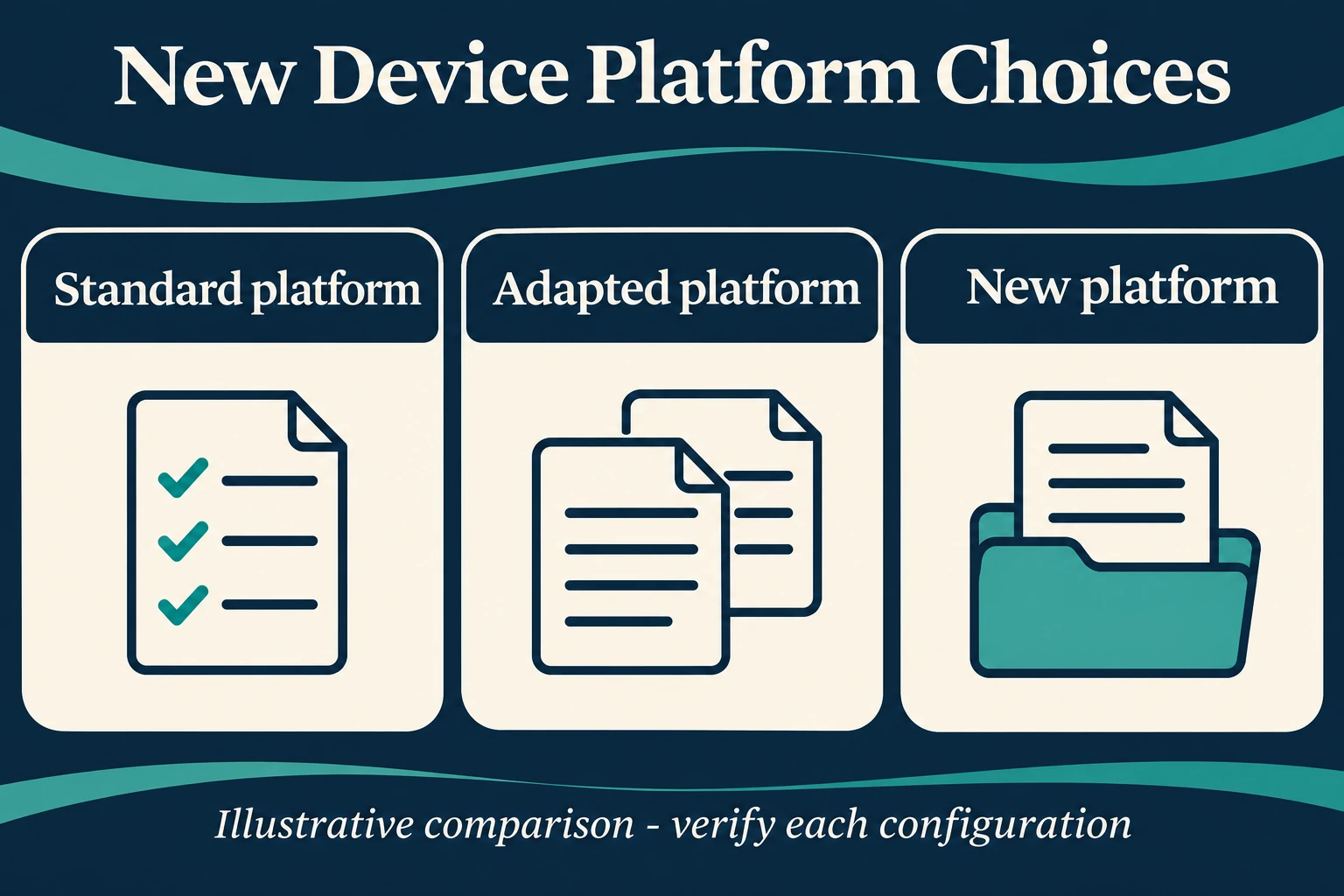
Compare three platform routes
| Route | When it may be worth reviewing | Main question | Evidence needed before committing |
|---|---|---|---|
| Existing platform | Device fits an established arrangement with limited changes | Can the full equipment layout work without compromising access? | Exact configuration, interfaces and assembled review |
| Adapted platform | Core structure is useful but a mount, worktop or storage element must change | Which modifications affect other interfaces? | Revised drawings, change scope and verification plan |
| New platform | Existing arrangements cannot meet the defined requirements | Is the additional development scope justified and owned? | Requirements, design responsibilities, sample plan and acceptance criteria |
This is a decision framework, not a promise that any route is available for every project. A supplier may recommend a different approach after reviewing the actual device and its intended use.
Route one: use an existing platform deliberately
An established platform can provide a concrete starting point. Buyers can review physical dimensions, component locations and existing assembly information rather than beginning with an abstract concept. The advantage is only meaningful if the device actually fits the assembled arrangement.
Check more than the main support surface. Review connectors, service panels, equipment removal, user interaction and any required storage. Do not treat an adapter plate as a complete integration solution if other parts obstruct access. A proposal that needs several improvised additions may no longer be a simple existing-platform purchase.
CRF’s medical equipment cart range provides examples of equipment and workstation configurations for discussion. The category describes customization of dimensions, mounting interfaces, storage, casters and accessories. Confirm the specific starting platform and available changes in the project quotation rather than transferring specifications between products.
Route two: adapt a platform with clear change boundaries
An adapted platform can retain useful structural elements while addressing a device-specific interface. State what remains unchanged and what is redesigned. This helps both teams understand which existing evidence still applies and which aspects need a new review.
For example, changing a worktop or adding a device bracket can alter access, equipment position or the assembled travel envelope. That does not automatically make the proposal unsuitable, but it does mean the changed assembly must be assessed. Do not describe a modification as minor merely because the new part looks small.
Use a change table with columns for requirement, affected part, linked interfaces, drawing revision and required review. Keep the table focused on meaningful dependencies. It should help the project make decisions, not create a paperwork exercise disconnected from the actual equipment.
Route three: develop a new platform only for a defined reason
A new platform may be appropriate when existing arrangements cannot accommodate the required equipment architecture, user interaction or deployment constraints. Before selecting this route, identify the specific unmet requirements. “We want something unique” does not explain the engineering or commercial trade-off.
Define who owns requirements, mechanical design, equipment integration, electrical work where relevant, testing, documentation and change approval. Confirm intellectual-property and drawing-access terms in the commercial agreement. Do not assume that a custom quotation includes every development activity or that the manufacturer takes responsibility for the medical device itself.
Set decision points before committing to broader production. Each point should have a clear artifact: an agreed requirement set, a reviewed layout, an identified sample or an approved production configuration. These are proposed project controls, not a promised CRF process duration or contractual deliverable unless separately agreed.
Keep the device and cart verification responsibilities connected
A cart can meet its mechanical drawing while the full system remains unresolved. Device retention, access, cleaning requirements and movement should be reviewed in the assembled configuration. Powered systems introduce additional responsibilities that cannot be inferred from a frame or concept rendering.
Ask the device manufacturer and relevant qualified reviewers which requirements apply to the intended system and destination. Do not borrow a certificate from another device, platform or market. This is a procurement and development discussion, not regulatory or clinical advice.
For a general whole-cart comparison, see how to choose a medical equipment cart. For supplier-route questions, compare the commercial scope separately from the technical platform decision. Both decisions matter, but they are not the same decision.
Define the next useful deliverable
At the concept stage, the next deliverable may be a reviewed equipment layout rather than a production price. With a stable device interface, it may be a dimensioned adaptation proposal. For an approved arrangement, it may be a representative sample and a list of production acceptance checks.
Record open questions with an owner and the evidence needed to resolve them. If the device changes after sample approval, assess the effect before reusing the old acceptance. An unchanged product name does not mean the physical interface has remained unchanged.
FAQ
Is a fully custom cart better than an adapted platform?
Not automatically. Compare how well each route meets the requirements and what development, verification and service obligations it introduces.
Can we request a quote before the device design is final?
Yes, as an early scope discussion. Identify provisional information and ask which assumptions could change the proposal. An early quotation is not proof of final compatibility.
Does an existing platform remove the need for assembled review?
No. The selected device, accessories and mounting arrangement still need review together. Existing platform information has a defined scope.
What information should we provide first?
Provide the application, device outline, interface information, equipment list, estimated quantities and development stage. Please contact us to confirm what additional information is needed for the proposed route.
Discuss the right platform route
Send your device-stage information through the B2B RFQ form. Ask for a clear distinction between an existing configuration, a proposed adaptation and new development. The objective is an appropriate, reviewable platform decision—not the maximum number of custom parts.