
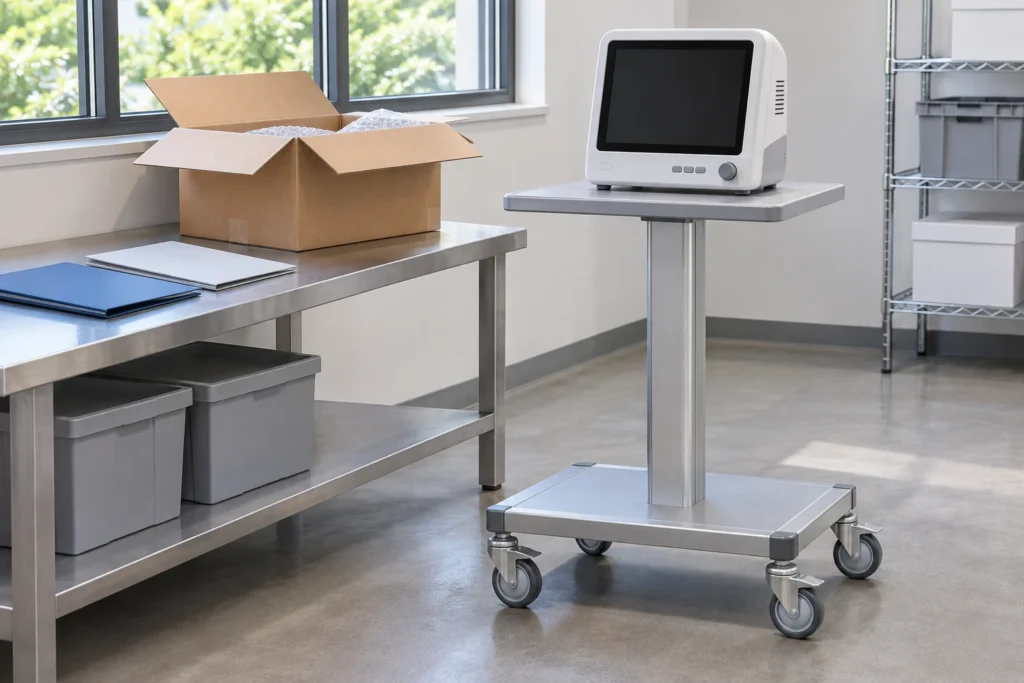
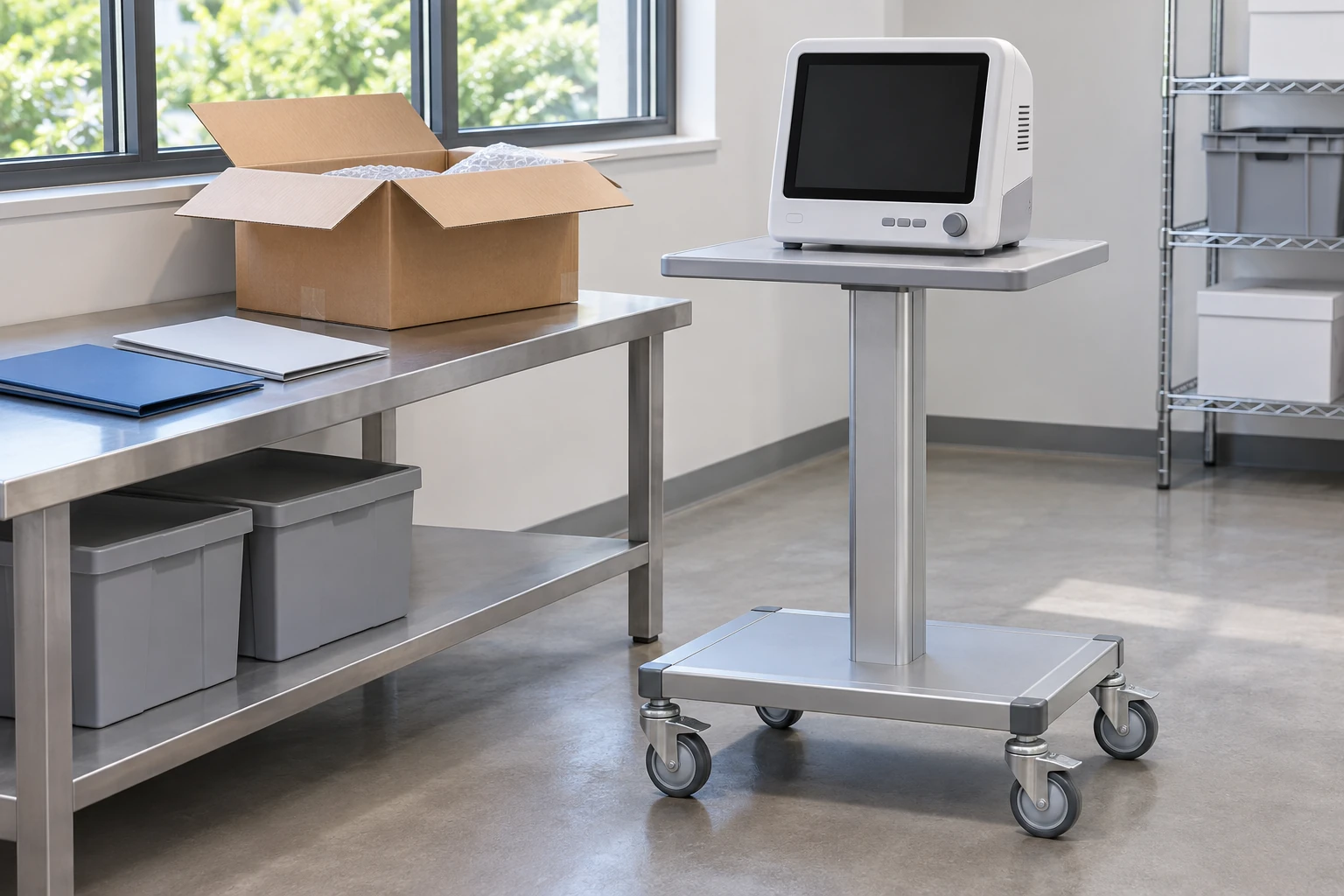
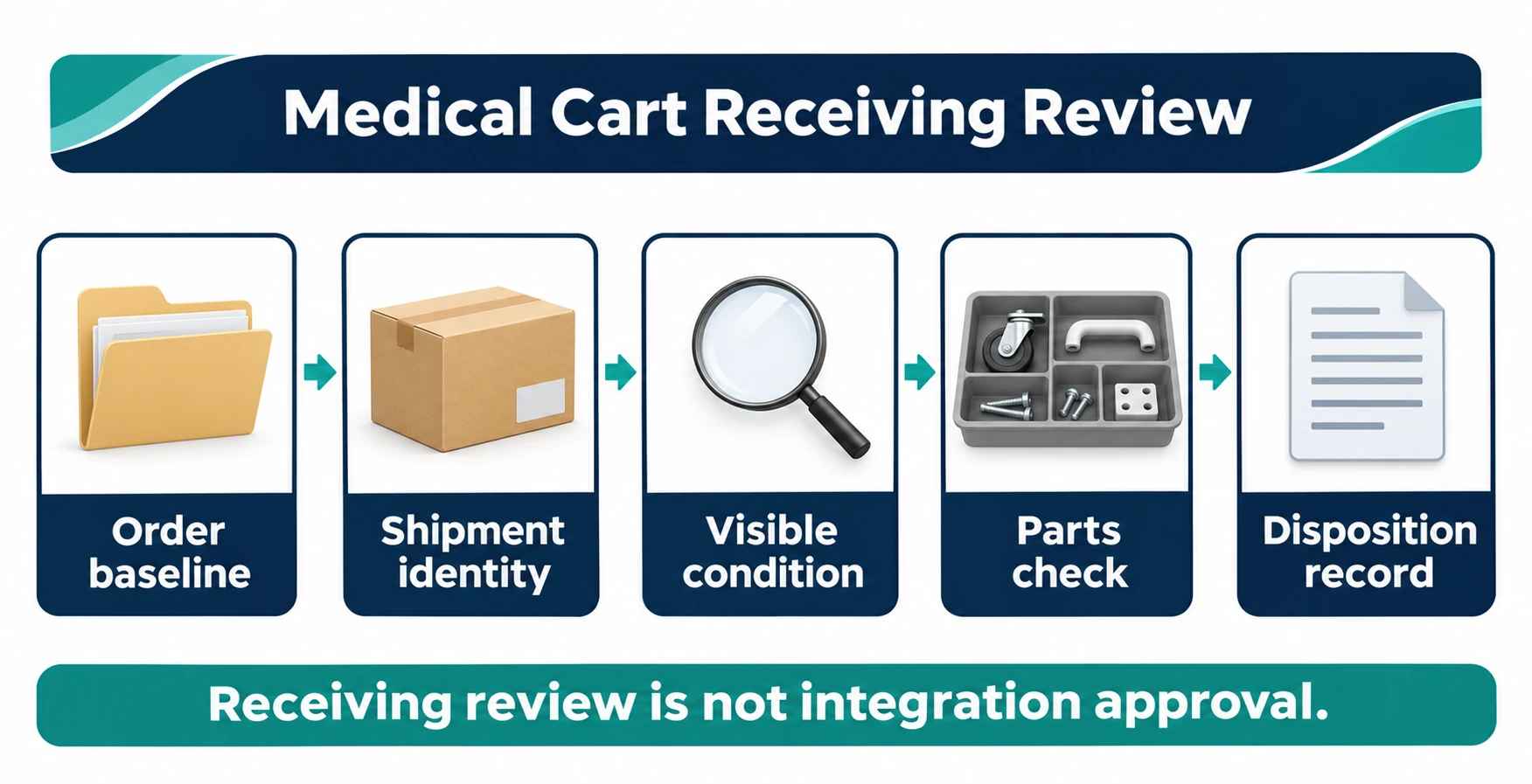
Inspect a delivered medical equipment cart against the approved purchase order, configuration drawing and packing list before releasing it for integration. Record shipment identity, visible condition, included parts and unresolved differences. Receiving acceptance is not proof of device compatibility, stability, electrical safety or readiness for patient use.
This checklist helps OEM buyers and distributors define a documented receiving review. It is not a clinical inspection protocol or a substitute for manufacturer instructions and professional assessment.
Start with an agreed acceptance baseline
A product name alone is not enough to identify a custom cart. Before shipment, agree which drawing revision, accessory list and packaging specification define the order. Identify who can accept a deviation and how suspect units are held out of the integration workflow.
The CRF CA13Z004 four-wheel medical equipment cart is a mechanical equipment support product. Its suitability depends on the proposed device and approved configuration. Do not treat a generic ultrasound or ECG application description as compatibility approval.
Keep three decisions separate
Receiving review asks whether the ordered goods arrived complete and without apparent damage. Assembly review asks whether the cart was assembled according to the correct instructions. Integration approval asks whether the complete equipment configuration meets the project requirements. One signature should not silently stand for all three decisions.
Use a receiving checklist tied to the exact configuration
| Review area | Evidence to record | If something differs |
|---|---|---|
| Shipment identity | Purchase order, carton reference and product identification where provided | Hold uncertain items for identification |
| Packaging condition | Photographs of affected cartons and protective packaging | Follow the agreed freight and supplier reporting process |
| Cart configuration | Drawing revision, base arrangement and ordered accessories | Compare with the approved bill of materials |
| Visible condition | Observable deformation, damaged finish or loose components | Record the location; do not improvise repairs |
| Included parts | Parts and documents against the packing list | Request clarification for missing or extra items |
| Assembly information | Applicable instructions and revision | Stop assembly if the instructions do not match |
| Release decision | Reviewer, date, disposition and open issues | Obtain authorized resolution before release |
Avoid numerical limits that were never agreed. This article does not specify acceptable scratches, fastener torque, rated load or sampling levels. Those criteria belong in project documentation.
Check mechanical identity without inventing a performance test
Review whether the supplied base, casters, trays and accessories correspond to the approved order. For a four-wheel configuration, an illustration of a five-wheel version is not an acceptable reference just because both share a product family name.
Where a movement or brake check is required, use the manufacturer’s applicable procedure in an appropriate controlled area. A visual check cannot establish tipping resistance. Do not place an expensive device on a suspect cart merely to see whether it fits.
Record observations, not conclusions beyond the evidence
Write “visible damage at the tray edge” rather than “unsafe alloy.” Write “accessory identification differs from packing list” rather than assuming the wrong material was used. Clear observations make supplier review more efficient and reduce avoidable disputes.
Compare shipment acceptance with sample approval
An approved sample records a reviewed configuration at a particular time. It does not prove that every delivered unit is identical, and it does not remove the need for the receiving process agreed in the purchase order.
For a repeat order, compare identifying features and documented revisions rather than memory. For a changed order, obtain the updated configuration record before applying an old checklist. The medical equipment cart OEM integration guide covers the broader equipment-fit questions that should precede shipment acceptance.
Build a useful discrepancy report
Include the order reference, affected item identification, quantity observed, photographs and a neutral description. State whether goods remain packaged, have been assembled or have entered integration. Retain relevant packaging while the responsible parties review the issue, following applicable agreements.
Do not assume that cosmetic damage, missing parts and a configuration mismatch require the same remedy. Ask for written disposition and identify who is responsible for any authorized action. Do not modify the cart in a way that obscures the original issue.
For the earlier document-package request, see the assembly documentation checklist. This receiving checklist instead records what actually arrived, observed differences and shipment disposition.
FAQ
Does passing incoming inspection mean the cart is ready for clinical use?
No. Device integration, applicable safety assessment, assembly checks and organizational release procedures remain separate. Receiving review does not validate medical performance.
Should buyers inspect every cart or use sampling?
Agree the inspection scope with the supplier and your quality team before ordering. Product risk, contract terms and applicable requirements influence that decision; no universal sampling level is prescribed here.
Can a catalog photograph replace an approved drawing?
A photograph can help identify appearance but usually cannot define every interface, included component or revision. Use the agreed configuration documents and request clarification when references conflict.
Request a configuration-specific RFQ
Send CRF your equipment model, interface drawing, requested base configuration, accessories, receiving documentation needs, quantity and destination. Ask which inspection records and instructions can be included in the quotation. Contact sales@szcrftech.com, call +86 18938846756, or submit a B2B inquiry. Final specifications, testing scope and commercial terms require project confirmation.
Request a B2B RFQ for the selected configuration and documentation scope. Images are AI-generated generic concepts, not exact CRF models, customer installations, approved procedures or performance evidence.