

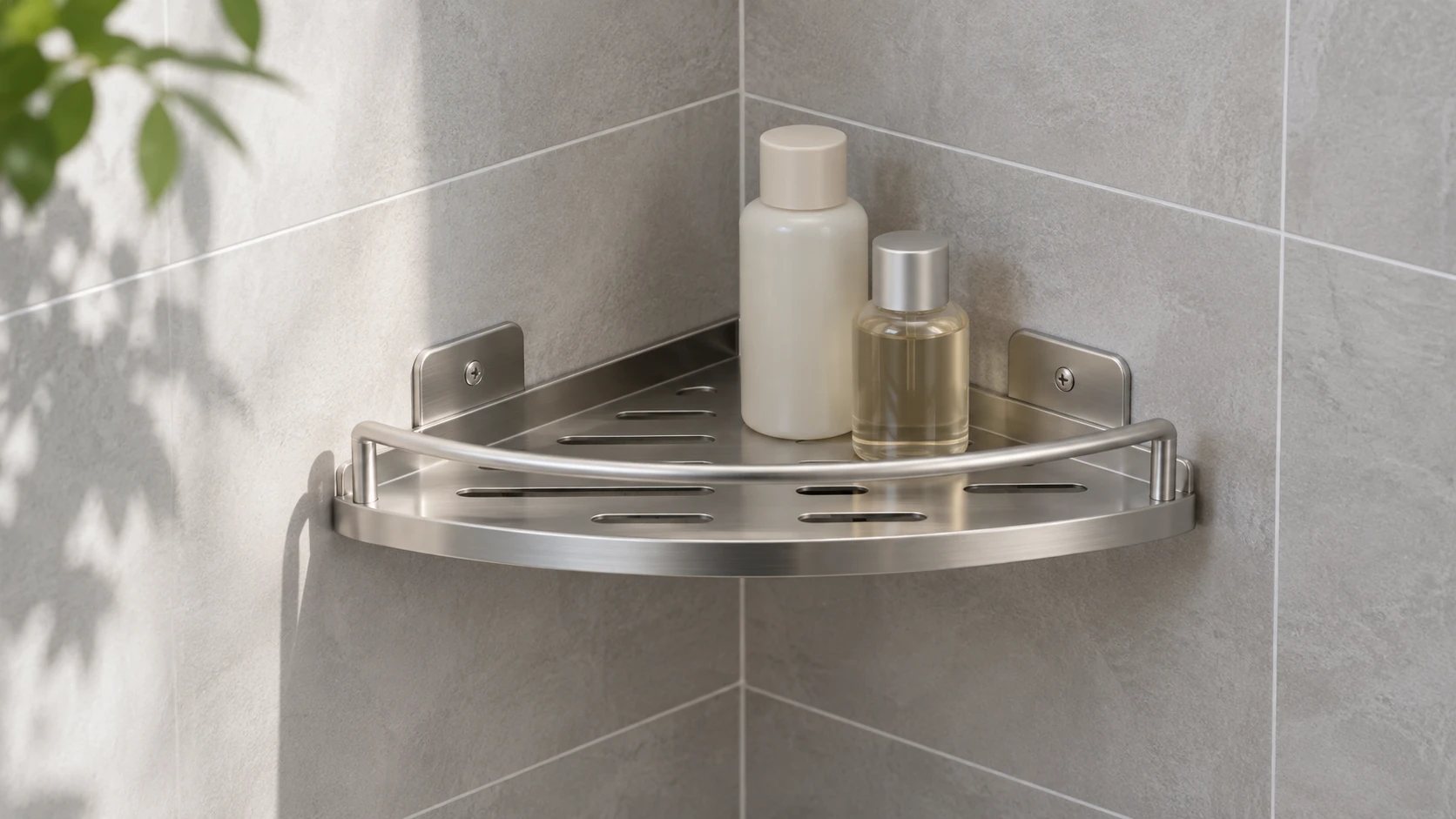
Before ordering a corner bathroom shelf, check the actual corner geometry, wall finish, usable mounting area and selected shelf variant. A nominally right-angle shelf is not evidence that an existing tiled corner is square or suitable for its fixing kit. Resolve fit questions with a documented sample review rather than forcing the shelf against the walls.
This guide covers purchasing and fit documentation, not drilling, adhesive application or waterproofing instructions. A competent installer must assess the substrate and applicable installation requirements.
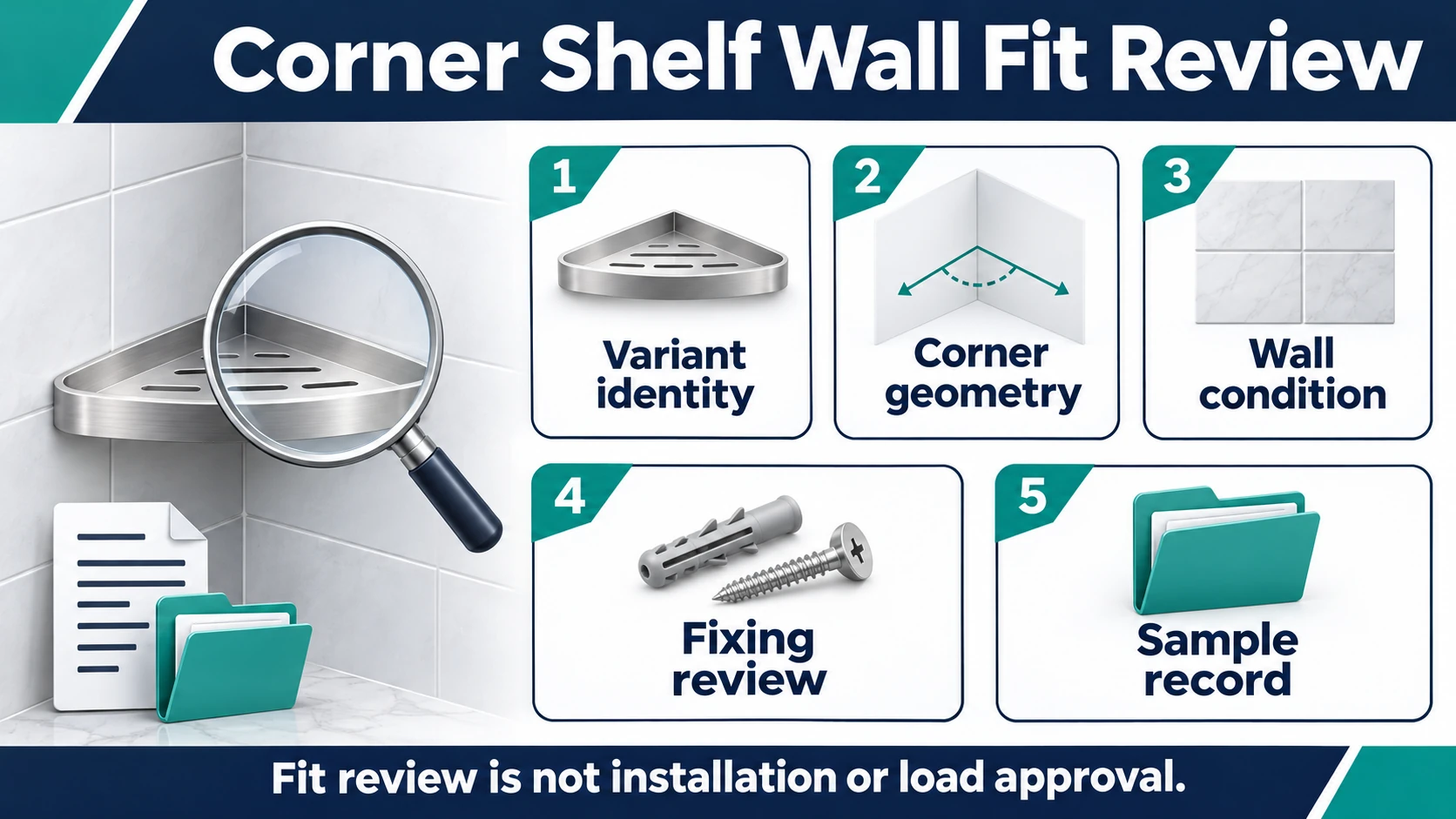
Identify the exact shelf before comparing wall fit
The CRF stainless steel corner and rectangular bathroom shelf family includes triangular corner and rectangular wall-mounted variants. The corner versions are intended for suitable right-angle corners; the rectangular versions use a flat-wall arrangement. Options within the family do not automatically share dimensions, materials or fixing hardware.
Create a variant reference that includes shape, selected finish, agreed dimensions and fixing kit. Use a current drawing or identified sample. Do not combine the mounting details from one photograph with the size of another version.
Avoid treating catalog dimensions as installed clearance
A shelf’s overall dimensions do not describe every contact point, fixing position or obstruction. Ask for the dimensions relevant to the selected mounting arrangement. If supplied references disagree, request a dimensioned drawing for the selected variant rather than inferring its dimensions from adjacent listings.
Record the corner and surrounding surfaces
Ask the installer to document the corner where the shelf will actually sit. Wall geometry can vary with position, and grout lines or trim may interfere with the intended contact area. A photograph is useful context, but it is not a substitute for measurements or a substrate assessment.
Include the planned height and nearby fittings in the review record. Shower controls, doors, hoses and other fixtures may affect access even when the shelf itself fits the corner. Avoid publishing a universal clearance value without a project-specific basis.
Compare fit questions by shelf arrangement
| Question | Corner shelf | Rectangular shelf |
|---|---|---|
| Geometry reference | Relationship between both wall faces | Selected flat-wall mounting area |
| Potential interference | Corner trim, grout and adjacent fittings | Controls, wall trim and adjacent fittings |
| Reference needed | Selected variant drawing and corner record | Selected variant drawing and wall record |
| Fixing review | Kit, substrate and wall contact arrangement | Kit, substrate and wall contact arrangement |
| Unresolved mismatch | Refer for supplier and installer review | Refer for supplier and installer review |
Neither shape automatically solves an unsuitable substrate or inadequate fixing method. Choose the arrangement that can be supported by the actual site information and approved instructions.
Keep geometry and mounting method as separate decisions
A shelf may appear to align with a corner while the proposed fixing kit remains unsuitable. Conversely, a suitable substrate does not guarantee that the shelf geometry matches the walls.
The CRF family page lists drilled and adhesive/no-drill options in supplier information. That does not establish that every kit suits every tile, painted surface or wet-area condition. Ask for the instructions applicable to the quoted variant. Adhesive specification, surface preparation, curing requirements and intended use need confirmation; drilled installations also require assessment of anchors, substrate and waterproofing.
Do not force, bend or improvise the fit
If the sample leaves an unexpected gap or conflicts with trim, document the discrepancy. Do not assume bending the frame, adding unapproved spacers or changing fasteners is acceptable. Such changes may affect the fixing arrangement or finish. Ask the supplier and installer to resolve the issue before volume purchasing.
Make sample review useful for a multi-room project
Select representative site conditions rather than assuming every room is identical. Link each sample review to a room or wall reference, the exact shelf variant and the proposed kit. Record any differences that require a separate configuration.
A useful review result states what was checked and what remains open. “Fits the reviewed corner geometry; mounting suitability awaiting installer assessment” is more informative than an unqualified “approved.” A fit check is not a load test, corrosion test or guarantee of long-term adhesion.
Procurement checklist before an RFQ
- Identify the triangular or rectangular variant and requested finish.
- Provide a dimensioned wall or corner record and relevant photographs.
- Mark trim, grout interruptions and nearby fixtures affecting placement.
- Ask for the selected variant’s drawing and applicable mounting instructions.
- Confirm the fixing kit and who assesses substrate suitability.
- Define sample review, unresolved questions and project acceptance responsibilities.
Do not specify a steel grade, load rating or adhesive performance based on appearance. Obtain evidence for the exact quoted configuration when those properties are relevant to the purchase.
For the separate choice of fixing approach, see the adhesive versus drilled mounting review. Wall geometry and substrate suitability must still be reviewed for the selected shelf.
FAQ
Will any triangular bathroom shelf fit an existing corner?
No. The actual wall geometry, shelf dimensions, mounting arrangement and surrounding obstructions need review. A triangular shape alone does not establish fit.
Can a rectangular shelf avoid an out-of-square corner problem?
It may offer a different placement option, but its wall area and fixing method still require assessment. It is not a universal solution for an unsuitable installation surface.
Does a successful dry fit establish a load rating?
No. Fit documentation cannot substitute for configuration-specific load evidence or applicable installation instructions. Do not place a load on an unsecured sample.
Should buyers order before the wall finish is finalized?
Provide the proposed finished-wall information and identify assumptions explicitly. Confirm any fit-critical details once the actual installation conditions are known rather than silently treating unfinished-wall measurements as final.
Ask CRF to review the selected variant
Send the required shape, finish, wall record, fixing preference, quantity and destination to sales@szcrftech.com, call +86 18938846756, or request a B2B quotation. Include the exact product reference so CRF can review the available configuration and documentation. Final materials, dimensions, included hardware and commercial terms must be confirmed in the quotation.
Request a B2B RFQ for the selected configuration and documentation scope. Images are AI-generated generic concepts, not exact CRF models, customer installations, approved procedures or performance evidence.