
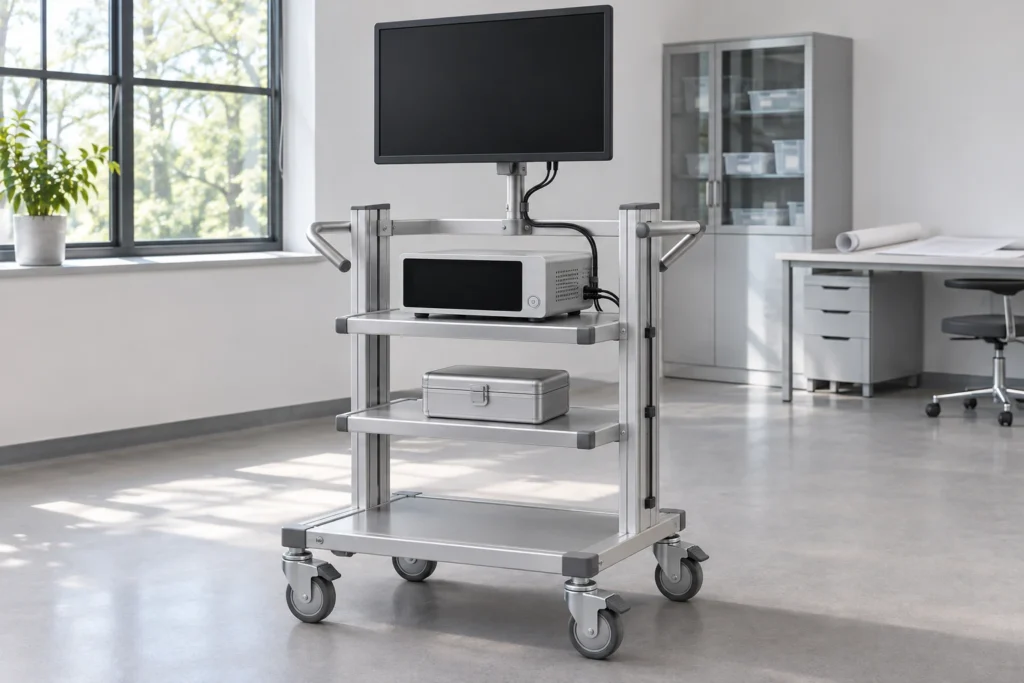
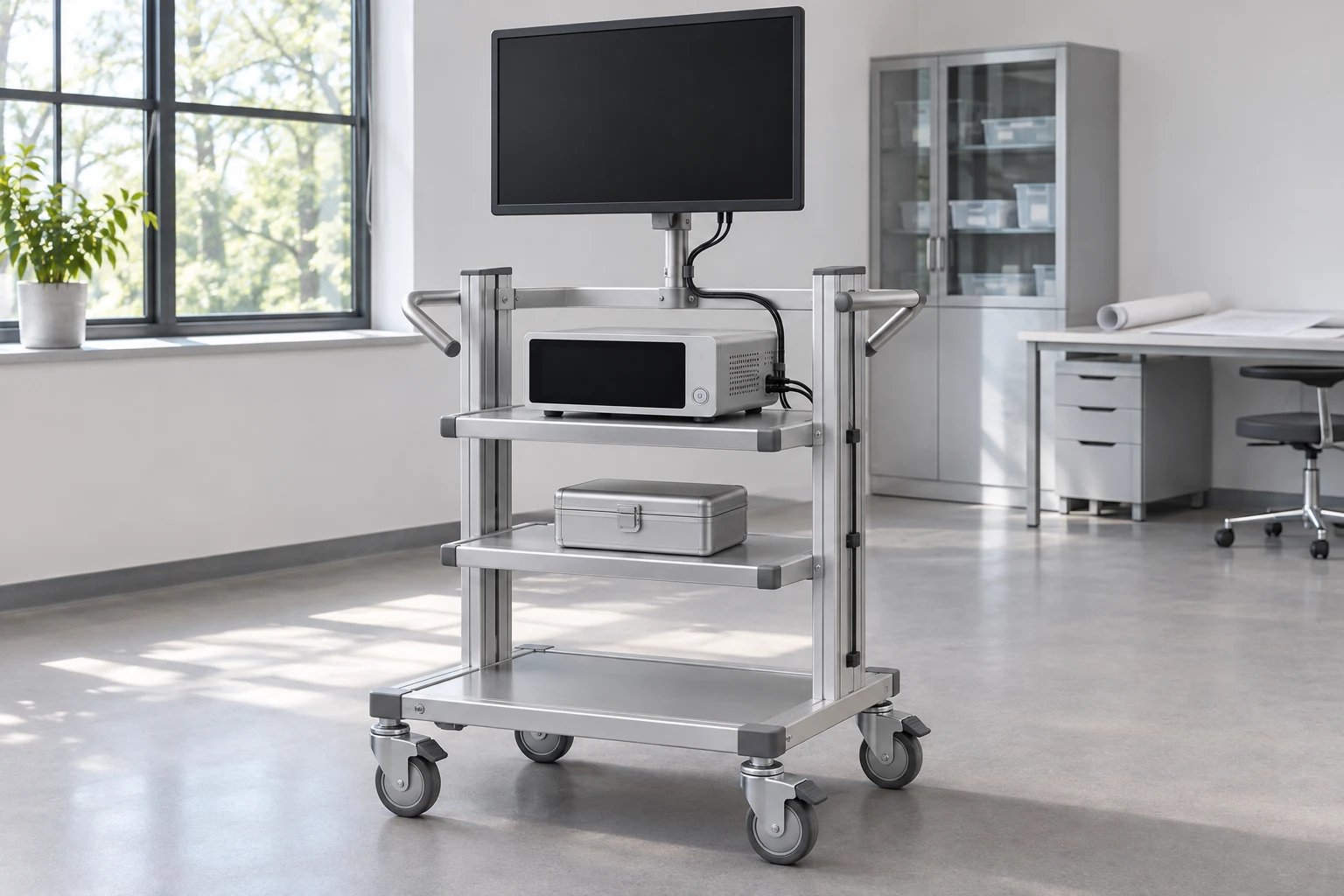
An endoscopy cart equipment layout should start with a named equipment list and an annotated arrangement, not a photograph of a similar tower. Record each device’s support footprint, operating clearances, connection access and intended position. Ask the cart supplier and equipment integrator to review the complete arrangement before treating any shelf or accessory as suitable.
This is a B2B mechanical planning guide, not a clinical setup instruction or electrical compliance assessment. A cart does not establish that the assembled medical system is safe or compatible.

Why the equipment map comes before the shelf count
Two systems with the same number of devices can need different arrangements. A cable outlet at the rear, a side ventilation opening or a frequently opened service panel can change the space required. Counting shelves alone misses these differences.
CRF lists a portable endoscope medical cart for mobile endoscope equipment organization. Its listing is a starting point for an inquiry, not a confirmed shelf drawing, material specification or promise that a particular endoscopy system will fit. Request current model-specific evidence before ordering.
Build a device-by-device equipment schedule
Use one row per actual device. Do not write only “processor” or “light source” where a model number is available.
| Information to record | Why the reviewer needs it |
|---|---|
| Manufacturer, model and revision | Prevents approving a visually similar device |
| Support footprint and overall envelope | Separates resting area from protruding housings |
| Device mass and accessory contents | Allows a configuration-specific support review |
| Vent locations and manufacturer clearances | Prevents assuming shelf spacing is sufficient |
| Plug direction and connected-cable envelope | Makes rear and side access visible |
| Controls, doors and removable parts | Identifies space needed during operation or service |
| Proposed shelf or mount position | Connects every item to a drawing location |
Use the device manufacturer’s instructions as the source for device requirements. Mark missing values as unresolved rather than estimating from sales photos.
Compare layout options by the work they must support
Fixed arrangement for a defined equipment set
A fixed proposal can make sense when the device list is stable. Review access to every control and service point in the proposed positions. The trade-off is that a later device replacement may require a new mechanical review; an empty-looking shelf is not automatically available capacity.
Configurable arrangement for a changing equipment set
A configurable proposal may be worth discussing when several approved device variants must be accommodated. Ask which adjustments are actually available on the quoted cart, who may make them and how the resulting configuration is documented. Do not assume adjustable shelves or mounts are included because another cart has them.
Separate storage from equipment support
A drawer for small items is not the same as a device shelf. A procedural cart is not automatically an endoscope drying cabinet or a validated clean/contaminated transport system. If scope storage or transport is required, involve the responsible clinical and infection-prevention reviewers and obtain the applicable equipment instructions.
Review a drawing in three views
A front view can help reviewers compare control visibility and position. A side view can expose projecting connectors, doors and possible operator access conflicts. A plan view can show the full footprint, side-mounted accessories and intended movement envelope.
These views should describe the same equipment revision and configuration. They are coordination aids, not proof of load capacity, stability, electrical safety or regulatory conformity. Ask for the separate evidence applicable to the exact proposal.
A reusable layout-review record
Give each device a neutral item identifier, such as D1, and repeat that identifier on the schedule and each drawing view. Use explicit document fields rather than treating an illustrative cart image as the arrangement.
| Record field | Entry to maintain |
|---|---|
| Device item and source | Model, revision and manufacturer document reference |
| Proposed support location | Shelf or interface identifier repeated in every view |
| Required access envelope | Source document and whether the proposal has been reviewed |
| Open discrepancy | Conflict between views, missing input or unresolved requirement |
| Owner and next evidence | Responsible reviewer and requested document or observation |
| Disposition | Open, revised proposal or documented decision with revision |
For example, if a rear connector envelope is absent from the side view, record that omission against the affected device item. Ask for the missing manufacturer information and an updated side view. Do not mark the item accepted merely because the front view looks clear. This is a document-coordination example, not a proposed equipment position or clearance value.
What should a layout review record?
- Freeze the device list and identify the proposed cart configuration.
- Mark each device and accessory on the arrangement drawing.
- Identify access requirements using manufacturer documents.
- Assign unresolved mechanical, electrical and workflow questions to the appropriate reviewer.
- Record sample observations and agreed changes against the drawing revision.
- Obtain the required approvals before procurement or use.
A sample review should use representative equipment or an agreed dimensional reference. It must not be described as clinical validation merely because devices can be placed on the cart. Do not improvise load or movement tests without an approved procedure.
For the broader project, see the endoscopy cart integration checklist. This layout review focuses on a device schedule and coordinated arrangement views, rather than repeating the full integration process.
FAQ
Can any processor be placed on an endoscopy cart shelf?
No. The support geometry, equipment mass, retention, clearances and complete system arrangement require review. A matching width is only one input.
Is a power strip included?
Do not assume so. Ask for explicit kit contents. Any powered arrangement requires the relevant equipment and electrical reviewers; this guide does not specify a compliant power architecture.
Does the cart also store reprocessed endoscopes?
Do not infer that from a cart name or accessory photograph. Storage and transport requirements must be reviewed separately against applicable instructions and facility procedures.
What should I send with an RFQ?
Send the equipment schedule, annotated layout, operating environment, intended quantity and destination market. Identify which requirements are mandatory and which remain open for feasibility review.
Request a configuration review from CRF
Use the RFQ option on the CRF portable endoscope cart product page to share your equipment map. Ask CRF to confirm the proposed model, drawings, materials, included accessories and commercial terms in writing. No price, capacity, certification, minimum order or delivery commitment is implied by this guide.
Request a B2B RFQ for the selected configuration and documentation scope. Images are AI-generated generic concepts, not exact CRF models, customer installations, approved procedures or performance evidence.