
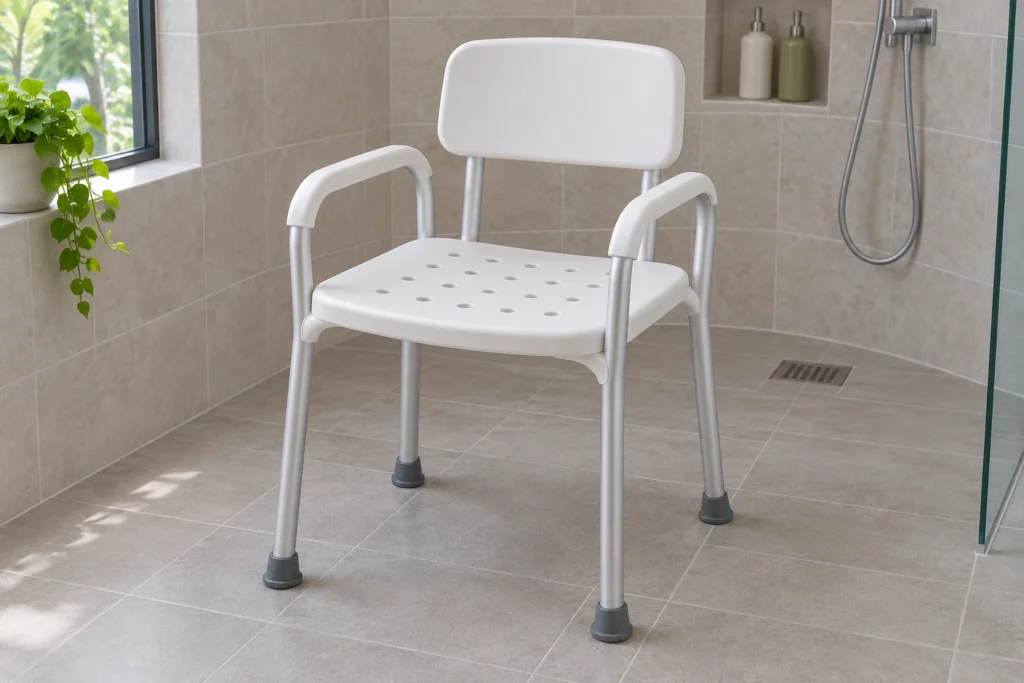

Shower chair seat drainage should be reviewed on the exact seat supplied, together with its underside and cleaning instructions. Visible holes show that openings exist; they do not establish a drainage rate, easy disinfection, reduced infection risk or suitability for a particular user. Ask for an approved sample and model-specific care information before making purchasing or marketing claims.
This guide is for procurement teams comparing a product’s observable design and documentation. It does not replace a qualified professional’s assessment of a person’s bathing needs or provide instructions for clinical use.
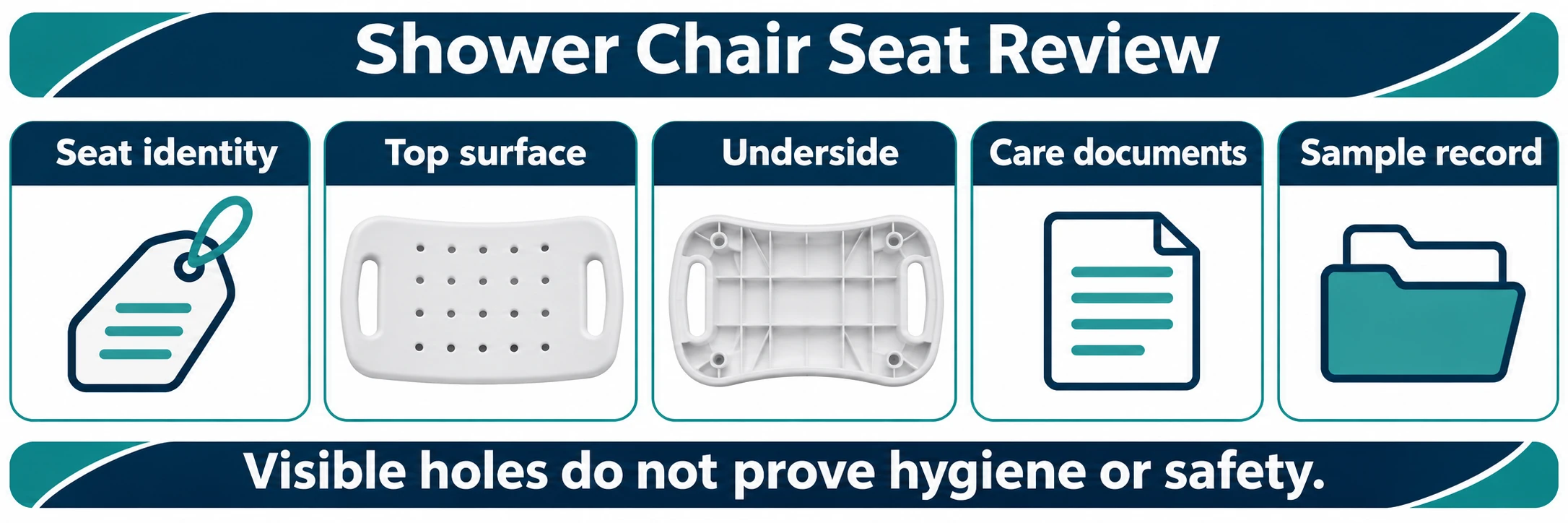
Start with the exact seat variant
The CRF CY0043-2 folding aluminum swivel shower chair listing shows multiple seat drainage holes and describes a white seat with backrest and arm supports. It also identifies several specifications as supplier-listed and requires final configuration confirmation.
That evidence supports discussing a perforated seat. It does not establish the seat-board material grade, water drainage performance, validated cleaning chemistry or a universal load rating. Request the proposed variant’s current drawing and instructions rather than borrowing details from another shower chair.
Compare drainage openings with the complete seat assembly
The top surface
Record the hole pattern and visible surface contours on the agreed sample. Ask whether the production version has the same tooling and finish. A photo can help identify the variant, but it cannot show how the entire seat behaves during use.
Do not equate a larger hole count with a better chair. Hole shape, surrounding surfaces and the rest of the assembly matter, and user suitability requires separate assessment.
The underside
Ask for clear underside images or inspect the physical sample. Supports, joints and fasteners may be relevant to access for cleaning and inspection. Record what is visible without assuming that an unfamiliar recess traps water or that a hidden area is sealed.
If a component must be removed for care, request the manufacturer’s authorized procedure and identify who is allowed to carry it out. Do not modify the seat or drill additional drainage holes.
Added pads or accessories
A pad or accessory can change which surfaces are exposed. Confirm whether it is part of the quoted configuration and request its own material and care documentation. Do not add an unapproved cushion or claim compatibility from dimensions alone.
A practical sample-review checklist
| Review point | Evidence to request | What not to conclude |
|---|---|---|
| Seat identity | Model, variant and dated sample photos | All catalog seats use the same construction |
| Hole pattern | Top and underside views of the same sample | A specified drainage speed |
| Surface condition | Sample observations and agreed acceptance criteria | Slip resistance or skin-contact suitability |
| Cleaning access | Care instructions and authorized access method | Validated disinfection or sterilization |
| Materials and finishes | Written component-specific specification | A particular polymer or alloy grade from appearance |
| Repeat-order consistency | Agreed revision and change notification | Future substitutions are equivalent |
Keep observations factual: for example, note that a particular underside area could not be inspected without disassembly. Do not convert that observation into a defect conclusion until the supplier has explained the design and the relevant reviewer has assessed it.
Drainage and cleaning claims need separate evidence
Drainage concerns the movement of water. Cleaning concerns removal of soil using an appropriate process. Disinfection, where required, involves additional product-specific instructions and validation. One property does not prove the others.
Ask CRF to provide the applicable care information for the quoted seat, frame, feet, arm supports and any accessory. If the intended facility requires a particular cleaning process, submit that requirement for written review rather than assuming compatibility.
Keep the purchasing decision distinct from user assessment
A procurement sample review can identify documentation gaps and clarify an order specification. It cannot determine whether a chair is suitable for every bathroom or person. Professional assessment, the product instructions and the actual environment remain important.
Similarly, this seat review does not settle the swivel lock, folding arrangement, height adjustment or stability of the complete chair. Those are separate configuration and safety questions. Any unresolved critical requirement should remain open rather than being covered by a general “sample approved” label.
FAQ
Do drainage holes mean the seat is hygienic?
Not by themselves. Hygiene claims need appropriate evidence and instructions for the exact product and intended setting. Visible openings do not validate cleaning or disinfection.
Can I specify a different hole pattern?
You can submit the requirement for feasibility review. Do not assume an existing seat can be modified without design assessment. Any accepted change needs updated documentation and review.
Can we use our usual facility disinfectant?
Ask for written compatibility and care instructions for the actual components. This guide does not recommend a chemical, concentration or contact time.
What should be included in a sample approval record?
Identify the model and variant, sample date, top and underside photographs, documents reviewed, factual observations and unresolved questions. State the scope of approval; visual review is not a safety certification.
Send a focused RFQ to CRF
Request the CY0043-2 shower chair configuration through its B2B quote option. Include intended market, quantity, exact seat requirements and required care documentation. Ask CRF to confirm feasibility, final specifications and commercial terms. No medical benefit, price, inventory, minimum order or lead time is promised here.
Request a B2B RFQ for the selected configuration and documentation scope. Images are AI-generated generic concepts, not exact CRF models, customer installations, approved procedures or performance evidence.