
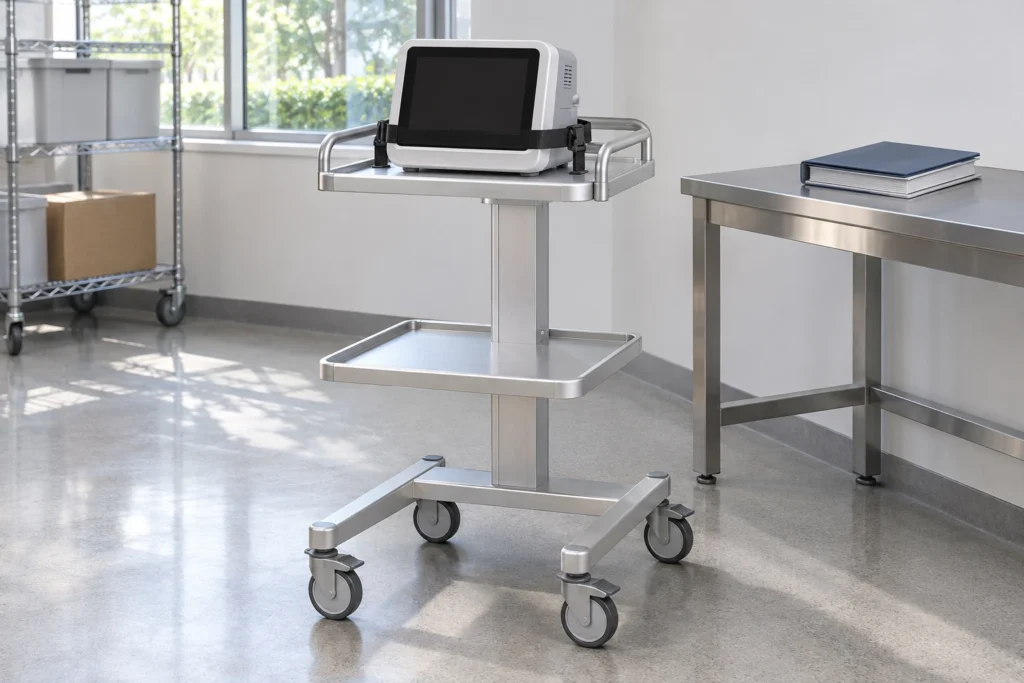

A medical cart assembly documentation package should identify the exact cart configuration, the matching drawing revision, supplied components, approved assembly instructions, inspection records and the person responsible for release. Do not assemble a cart from a photograph or a generic online tutorial. Obtain the model-specific instructions before work starts; this article is a procurement checklist, not an assembly manual.
For an OEM buyer, the key question is not simply whether a cart arrives assembled or flat packed. It is whether the receiving team can connect the delivered parts to a controlled configuration and recognize when information is missing.

Start with a real model and a defined delivery state
The CRF CA13Z004 four-wheel equipment cart is an aluminum alloy mechanical support cart. It is not an ultrasound scanner, ECG machine or walking aid. Diagnostic equipment is not included unless the quotation expressly states otherwise. Its product page requires review of device dimensions, mounting interfaces, equipment weight and cable routing.
Use this model as the starting point for a document request, not as evidence that a particular kit, fastener or procedure is supplied. Ask CRF to confirm whether your quoted configuration arrives assembled, partly assembled or as separate components. The packing state and the approved device integration need to refer to the same drawing.
What belongs in the document package?
Configuration identity
Request the model, order reference and drawing revision that apply to the delivered units. Identify which accessories are included and which equipment is supplied by the customer. A heading such as “universal cart assembly” is not enough if several bases, columns or trays exist.
Photographs can help identify parts, but they do not replace the approved bill of materials. A similar-looking column or bracket may belong to a different configuration.
Parts and fastener identification
Request a component list with identifiers that match the packing labels and assembly illustrations. The supplier should identify the fasteners, washers, spacers and other joining parts used for each connection where applicable. Buyers should not choose substitute fasteners by appearance.
If a part is missing or a label cannot be matched, record the discrepancy and obtain supplier instructions. Do not enlarge holes, add packing washers or force components together to make the kit fit.
Model-specific instructions
Ask for the approved sequence, tools, handling precautions and connection requirements. Any torque values, thread treatment, tightening sequence or re-use restrictions must come from the responsible supplier documentation. This article supplies none of those values because the approved joint design is not available here.
For equipment mounting, distinguish the cart assembly instructions from the device manufacturer’s installation requirements. Both documents may be needed, and neither automatically authorizes a change to the other product.
Inspection and release records
Request a checklist tied to the agreed configuration. It should distinguish an incoming parts check, an assembly check and a review of the completed equipment configuration. Ask who signs each record and how unresolved discrepancies are handled.
Visual completeness is not proof of load capacity, stability or resistance to tipping. The applicable evidence and sample evaluation must address the actual proposed equipment arrangement.
Compare delivery states before comparing quotes
| Delivery state to confirm | Document focus | Buyer question |
|---|---|---|
| Assembled cart | Configuration identity and pre-dispatch record | What remains for the receiving team to check? |
| Partly assembled cart | Remaining operations and connection identification | Which operations are explicitly assigned to the customer? |
| Component kit | Complete parts identification and approved sequence | Can the recipient identify every supplied component? |
| Cart plus customer device | Separate cart and device requirements | Who reviews the completed equipment arrangement? |
These are procurement scenarios, not confirmed CRF packing options. Ask which state is offered for your order and make the responsibilities explicit in the quotation.
A practical document-review workflow
- Identify the order. Record the model, configuration and proposed delivery state.
- Match the revision. Confirm that the drawing, component list and instructions describe the same build.
- Resolve omissions. Send a numbered list of missing or contradictory information to the supplier before assembly begins.
- Review the proposed device integration. Include the device drawing, mounting interface and accessory arrangement.
- Agree the release record. Define the evidence required before the assembled sample is accepted.
Keep the approved package with the order record. If the device or accessory arrangement changes, seek a revised review rather than assuming the previous package still applies.
RFQ checklist for a medical cart assembly package
Send the supplier the following information:
- Exact cart model and intended equipment.
- Device dimensions, interface drawing and proposed arrangement.
- Requested delivery state and destination receiving capabilities.
- Accessories expected in the shipment.
- Required drawing and instruction language.
- Requirements for component labels and discrepancy reporting.
- Proposed sample review and acceptance responsibilities.
- Quantity, destination market and commercial information needed for quotation.
Do not convert a procurement checklist into workshop instructions. An unconfirmed instruction can be more dangerous than a clearly marked missing document.
Limitations and escalation points
This guide does not specify fastener sizes, torque, approved assembly order, load ratings or electrical requirements. Those details depend on the reviewed configuration. Electrical installation and medical device integration require the responsible parties’ instructions and any applicable professional review.
Stop the document review if the model is unclear, drawing revisions conflict or the instructions depend on undocumented modifications. Request clarification in writing. A broad product description is not a substitute for a release-ready assembly package.
A document completeness matrix before assembly starts
Use a request register to distinguish a document that exists from a document that applies to the shipment. The output of this review is a list of matched records and unresolved questions, not authority to assemble or release the cart.
| Record | Identity to match | If the record is missing or contradictory |
|---|---|---|
| Configuration drawing | Order, model and revision | Ask for the drawing applying to the shipment |
| Component list | Part identifiers and supplied scope | Record unidentifiable items without substituting |
| Assembly instructions | Exact configuration and document revision | Request the correct instructions before work |
| Device instructions | Customer device and interface revision | Ask the responsible device party to resolve scope |
| Inspection record | Agreed checks and responsible reviewer | Confirm what evidence will accompany acceptance |
Keep document status separate from physical inspection results. A complete parts list does not mean all parts arrived, and a complete instruction set does not mean assembly has been performed correctly. For the later destination-work and acceptance stages, see the installation and handover guide. This page concerns the earlier document-package request only.
FAQ
Can a product photo be used as assembly instructions?
No. A photograph may assist identification, but it does not define hidden joints, component specifications, tightening requirements or the approved sequence.
Does every CRF cart include the same assembly manual?
That has not been established. Request the documents and delivery state for the exact quoted model and configuration.
Is this the same as installation and handover?
No. This checklist concerns the completeness and traceability of the documents required before assembly. Installation and handover address the site and completed system. Keep the records connected without treating the tasks as interchangeable.
Can a buyer use a generic torque table?
Do not infer a joint requirement from this article or an unrelated table. Obtain the approved requirement for the actual connection from the responsible supplier.
Request a configuration-specific review
Review the CA13Z004 product reference and send CRF your device drawing, proposed accessories, quantity and destination. Ask for a configuration-specific quotation and confirmation of the available assembly documentation. Contact sales@szcrftech.com or +86 18938846756. Dimensions, materials, performance evidence, packing state and commercial terms remain subject to confirmation.
Request a B2B RFQ for the exact configuration and documentation scope. Images are AI-generated generic concepts, not exact CRF models, customer installations, approved procedures, confirmed vehicle fit or performance evidence.