
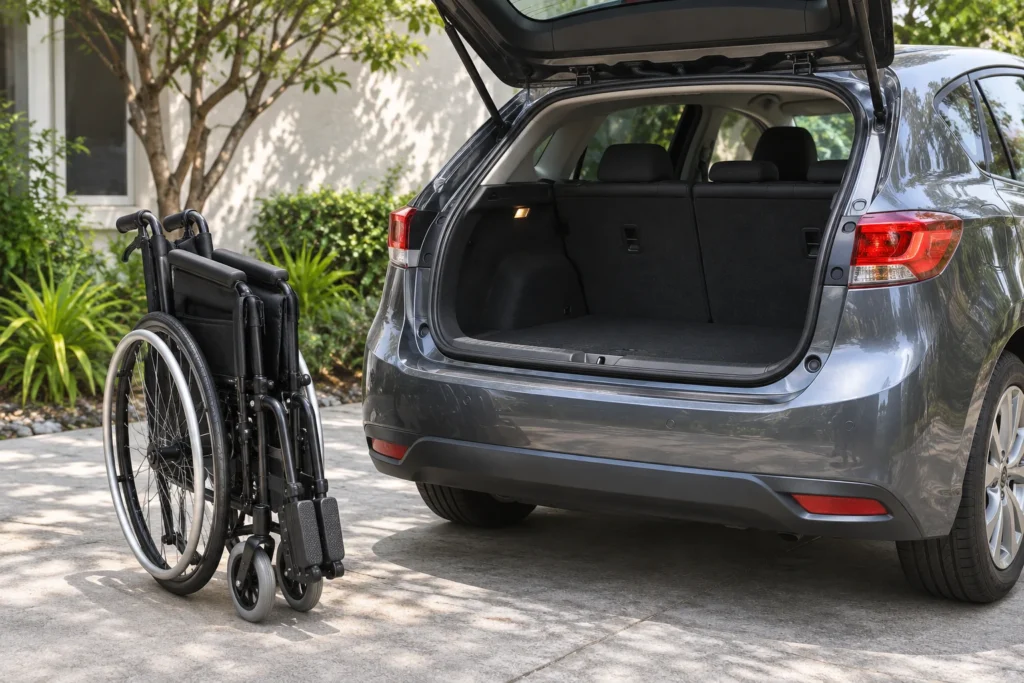
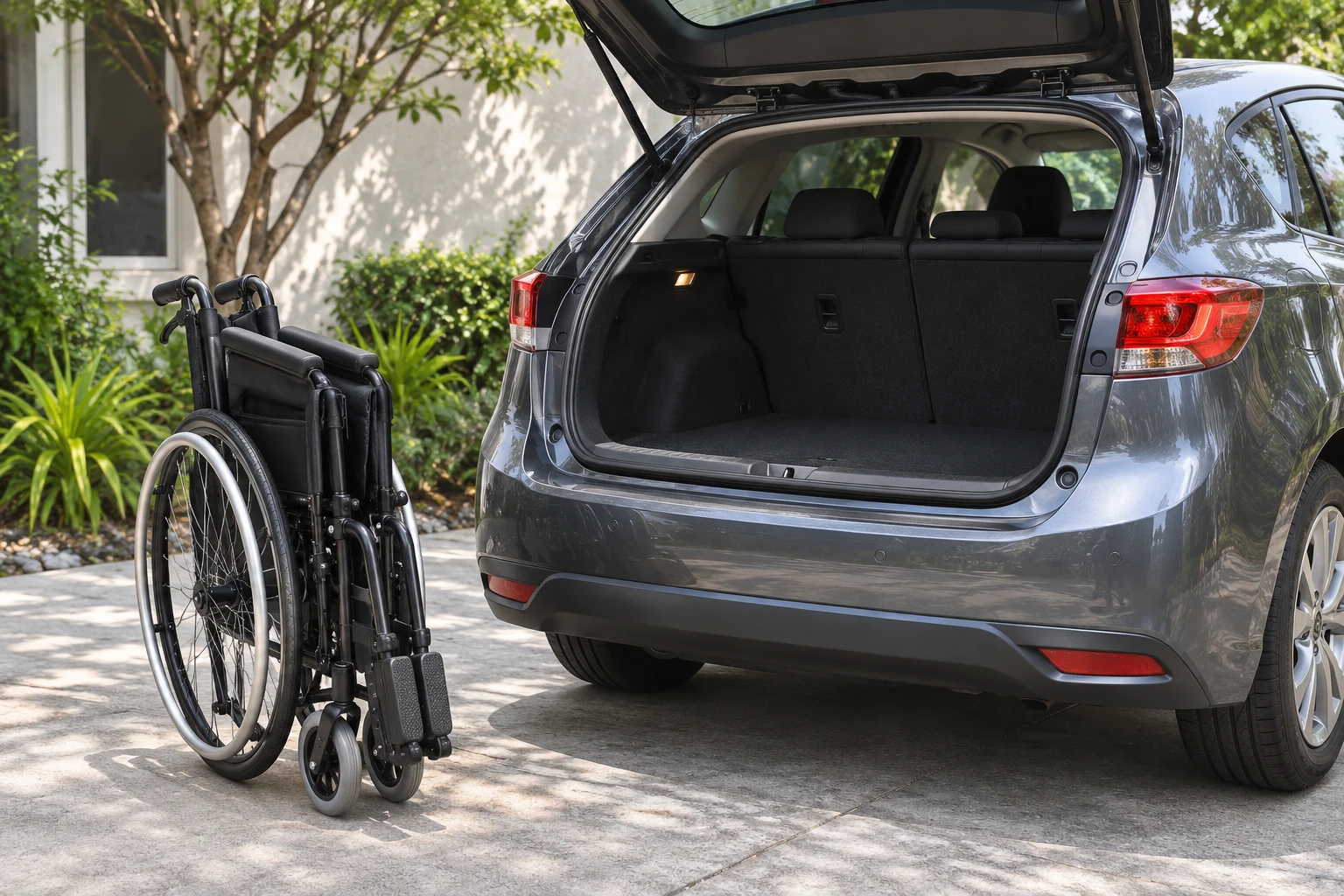
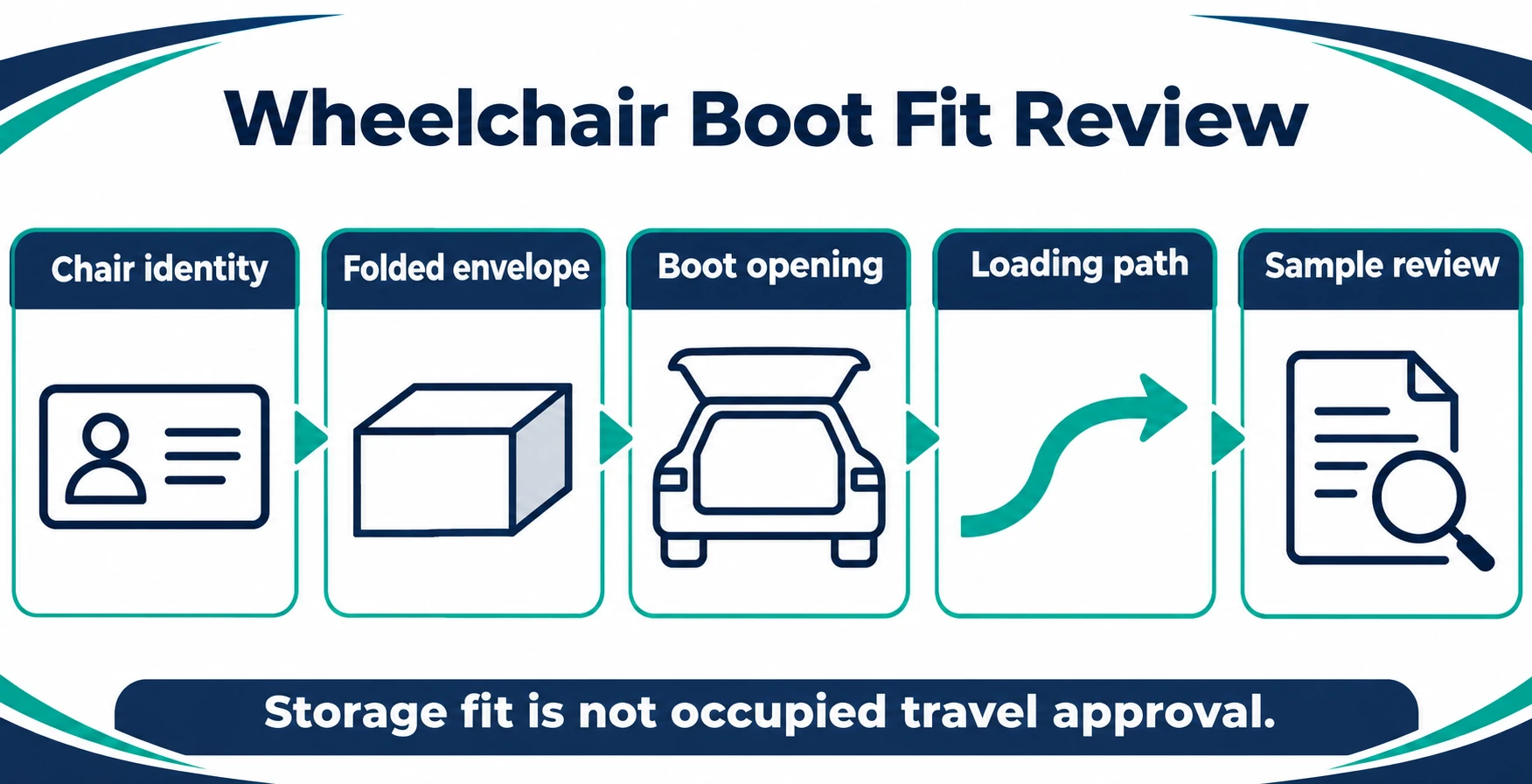
To review whether a folding wheelchair fits in a car boot, compare the actual chair’s complete folded envelope with both the boot opening and the usable storage space. Include the loading path, required handling space and separately carried components. A folded width or a boot capacity in litres alone cannot establish fit.
For distributors and procurement teams, this is a configuration-specific review. A chair that fits one vehicle may not fit another vehicle in the same market segment. Use a physical sample and the exact vehicle before making a customer-facing compatibility claim.
Begin with a verified product, not a generic size
CRF lists a lightweight folding wheelchair for portable assisted mobility. The listing provides a real product starting point, but it does not establish a complete verified folded envelope, removable-part specification or vehicle fit matrix for this review.
Ask CRF to confirm the exact variant and provide the appropriate instructions and measured dimensions. Do not assume that the backrest folds, the rear wheels detach or the footrests can be removed simply because another wheelchair has those features. The product listing’s general travel language is not a guarantee that the chair fits any particular car.
This article addresses storage of an unoccupied wheelchair. It does not address wheelchair seating during vehicle travel, occupant restraints, clinical selection or transfer technique.
Record the wheelchair in its actual transport state
Identify the configuration
Record the model or variant, accessory list and the document describing its approved folding procedure. State which parts remain attached during transport. Any removal must be permitted by the model-specific instructions; do not loosen structural or seating adjustments to reduce the envelope.
Make separate records if your sales proposal includes more than one transport configuration. A measurement taken with permitted parts removed cannot be presented as the fully equipped chair’s folded size.
Measure all three dimensions
Record the maximum folded length, width and height in the intended orientation. Include projections such as handles, wheels and footrests if they remain attached. Label the measurement directions in photographs or a sketch so that the supplier and buyer use the same definitions.
Measure the sample rather than estimating from an image. Record the method and sample identity alongside the measurements. Do not publish numerical specifications until the supplier has confirmed they apply to the offered variant.
Keep separate parts in the review
If the instructions permit component removal, identify the detached parts and their storage requirements. A compact main frame does not represent the complete transport load when wheels, cushions or other components need separate space.
Request the mass of the actual transport configuration and any separately carried items. Whether a person can handle the chair is a separate question from geometric fit and needs an appropriate assessment; this article gives no lifting-weight threshold or lifting instructions.
Measure the vehicle opening and interior separately
| Review area | What to record | Why it matters |
|---|---|---|
| Boot opening | Narrowest usable width and height | The chair must enter before it can be stored |
| Interior | Available length, width and height in the planned position | Internal storage can be restricted by trim or wheel arches |
| Loading path | Sill, angled entry and obstructions | A static internal measurement does not prove entry is possible |
| Other items | Space for detached parts and planned luggage | Empty-boot fit may not match everyday use |
| Closure and securement | Tailgate clearance and vehicle/manual requirements | Closing the boot does not by itself secure the load |
Measure the vehicle as it will actually be used. Identify the seat position and any normally fitted parcel shelf or storage accessories. Do not recommend removing vehicle safety equipment or changing seating arrangements solely to obtain a fit claim.
There is no universal clearance allowance established for this CRF product. Allow the handling space required by the actual loading method and relevant instructions, then validate the arrangement with a sample. Avoid copying a competitor’s numerical allowance as if it were a CRF specification.
Compare a paper review with a sample trial
A dimensional review can identify obvious conflicts before a sample is shipped. It cannot fully resolve how an irregular shape passes through a sloping opening or how the chair and separate parts will be secured.
Use two clear outcome categories:
- Document review pending: one or more dimensions, part-removal permissions or instructions remain unconfirmed.
- Specific sample arrangement reviewed: the identified sample and vehicle have been checked in the recorded configuration, with limitations documented.
Neither category supports a claim that the chair fits all hatchbacks, sedans or SUVs. Record the exact vehicle version and configuration instead of substituting a broad body-style label.
A distributor’s fit-review record
Before preparing website copy or a quotation, collect:
- Chair variant and sample identification.
- Approved instructions for folding and any permitted component removal.
- Folded length, width and height with measurement photographs.
- Separate component list and required storage space.
- Actual transport mass and source of the measurement.
- Vehicle identity, seat arrangement and measured opening.
- Usable storage space and the intended entry orientation.
- Relevant vehicle and wheelchair instructions for transporting the empty chair.
- Sample-trial observations, unresolved restrictions and reviewer approval.
Keep a failed or incomplete review in the record. A rejected arrangement can prevent an unsupported claim from reappearing in later sales material.
Limits: storage fit is not travel suitability
A folded chair fitting inside a boot does not prove that it is suitable for a particular user, safe for occupied transport, approved for aircraft cabins or compatible with a vehicle hoist. Each is a separate question requiring the applicable product information and specialist review.
If a hoist is involved, ask its supplier to assess the exact wheelchair, vehicle, attachment and loading path. Do not assume that spare boot height alone proves hoist compatibility. For clinical selection and transfers, consult an appropriately qualified professional and follow the relevant instructions.
FAQ
Is folded width enough to confirm car boot fit?
No. You need the full folded envelope, the boot aperture, interior space and a feasible loading path. Detached parts and planned luggage also need space.
Can all folding wheelchairs have their wheels removed?
No. Confirm the features and permitted operations for the exact model. A feature on another chair cannot be assumed for the CRF variant.
Does a successful fit check cover every vehicle of the same type?
No. Record the actual vehicle and configuration. Different openings, trim and seat arrangements can change the result.
Can CRF confirm folded dimensions before a sample order?
Request variant-specific dimensions and instructions with your RFQ. Their availability and applicability must be confirmed; this guide does not supply unverified CRF measurements.
Request a variant-specific quotation
Start with the CRF folding wheelchair product reference. Send CRF your intended variant, vehicle-fit information, quantity and destination market, and request confirmed transport dimensions, instructions and sample-review options. Contact sales@szcrftech.com or +86 18938846756. Product suitability, specifications and commercial terms require confirmation; no universal vehicle compatibility is promised.
Request a B2B RFQ for the exact configuration and documentation scope. Images are AI-generated generic concepts, not exact CRF models, customer installations, approved procedures, confirmed vehicle fit or performance evidence.