
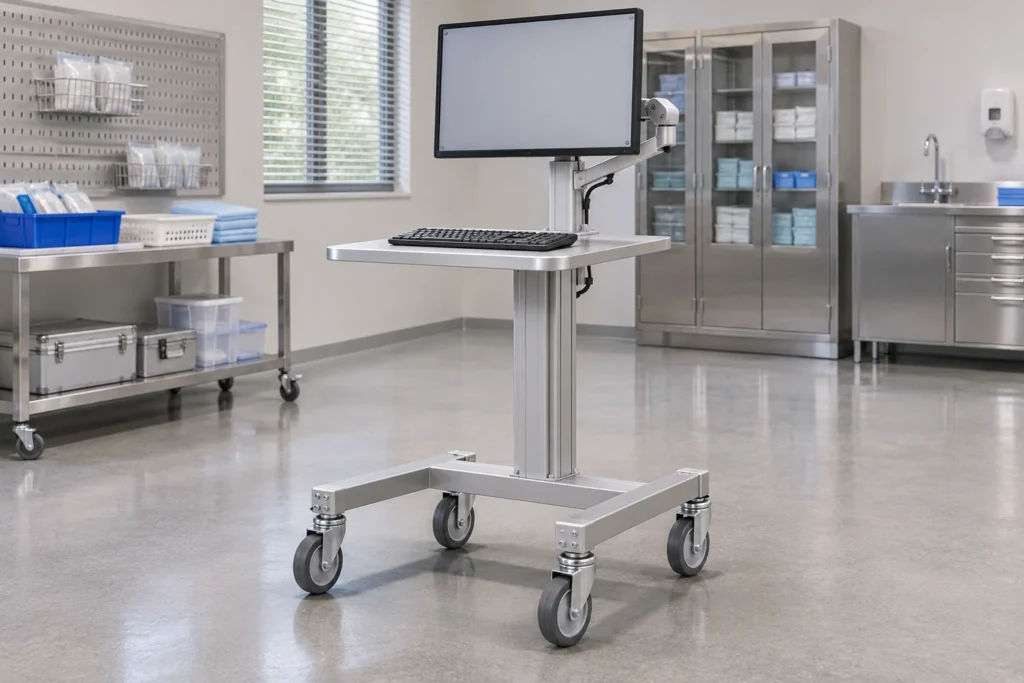
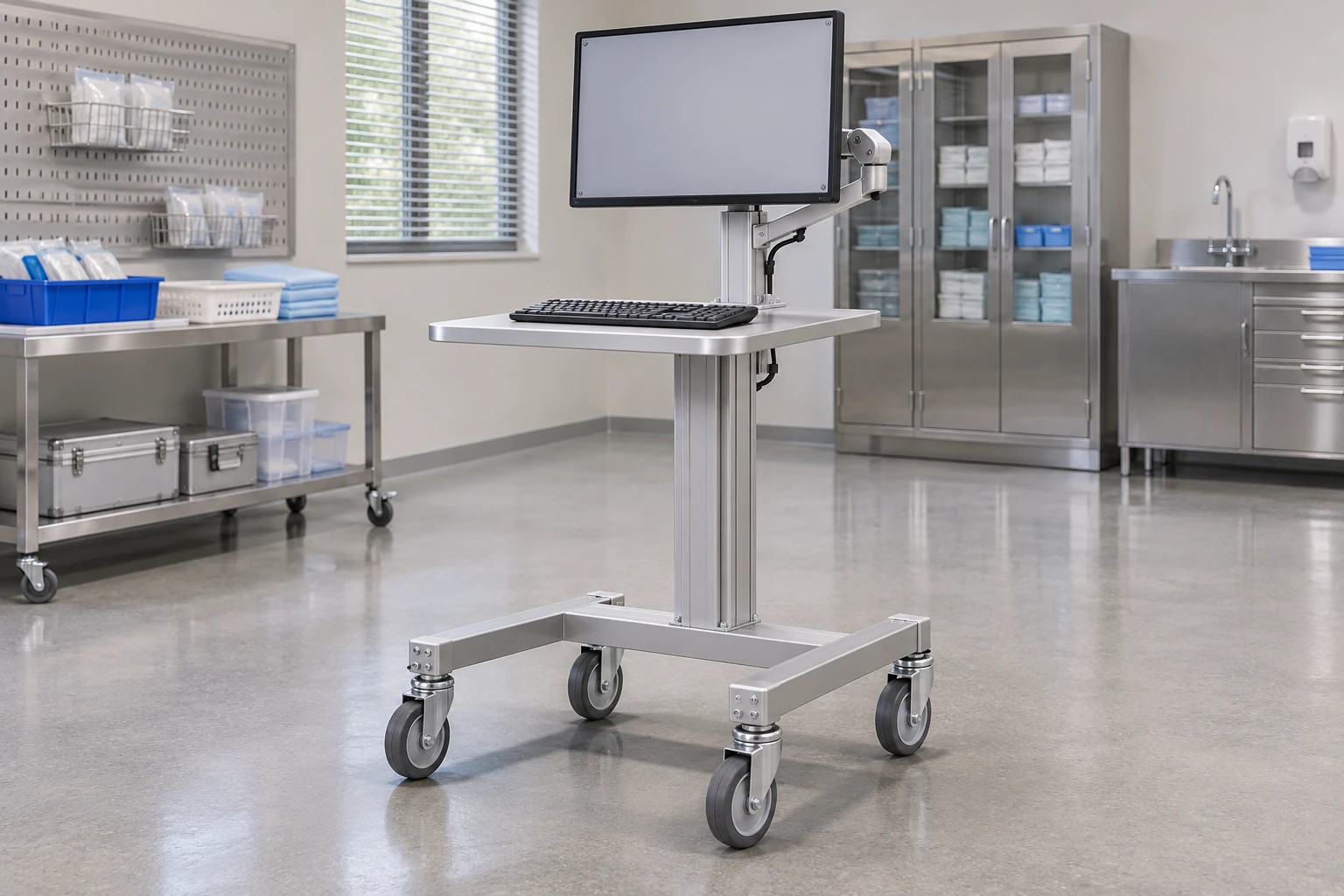
To specify medical cart wheels for an OEM project, first define whether the order concerns a wheel alone or a complete caster assembly. Then freeze the connection to the cart base, the installed-height reference, the swivel and pedal envelope, and the exact component revision. Matching wheel diameter is not enough to approve a caster for a new or existing cart.
The procurement deliverable should be a controlled interface record that a cart manufacturer and component supplier can both review. This guide explains that record. It does not provide repair steps, a load calculation, fastener settings or permission to return equipment to service.
Start with the boundary of the purchased assembly
A wheel is not the same item as the complete caster. A caster may include the wheel, axle, fork or housing, swivel mechanism, mounting connection and a brake or directional control. A quote for “medical cart wheels” can therefore describe very different supplied scopes.
State whether the supplier is quoting the wheel, complete caster, mounting socket or adapter, fasteners, brake-control linkage or a complete base. Ask for the exact part identity and document revision for each included item. Do not compare a wheel-only price with a complete caster price and treat the difference as an equivalent cost saving.
For an existing-cart replacement request, start with the separate spare-parts identification guide. The process below is for specifying and comparing the proposed interface, not diagnosing a damaged assembly or selecting an unapproved replacement.
Freeze the base connection before comparing wheel options
Component catalogues contain more than one mounting arrangement. TENTE’s medical-cart range, for example, includes a caster described as having a solid stem and round fitting.[2] That is an example of an interface type, not evidence that the component fits CRF equipment. A category label such as “medical” does not establish interchangeability.
Ask the cart supplier to identify the offered connection on a controlled drawing. The following records serve different interfaces; do not copy every field onto a drawing without first identifying the actual design.
| Connection proposed | Record to request | A misleading shortcut to avoid |
|---|---|---|
| Plate mounting | Plate outline, hole pattern, hole details and mounting face | Matching only the visible plate width |
| Threaded stem | Thread designation, relevant lengths, shoulder and seating details | Calling a thread “about the same diameter” |
| Round stem and socket | Mating stem/socket specification and retention arrangement | Assuming a smooth-looking stem is universal |
| Adapter or special fitting | Both mating interfaces and the approved assembly scope | Treating an adapter as a neutral size converter |
The responsible engineers must define tolerances, retention and installation requirements. Do not estimate a thread pitch or hidden engagement from a product photograph. If the drawing is missing, list that as an unresolved input before order release rather than asking purchasing to choose the nearest catalogue entry.
Use an installed-height datum that both suppliers understand
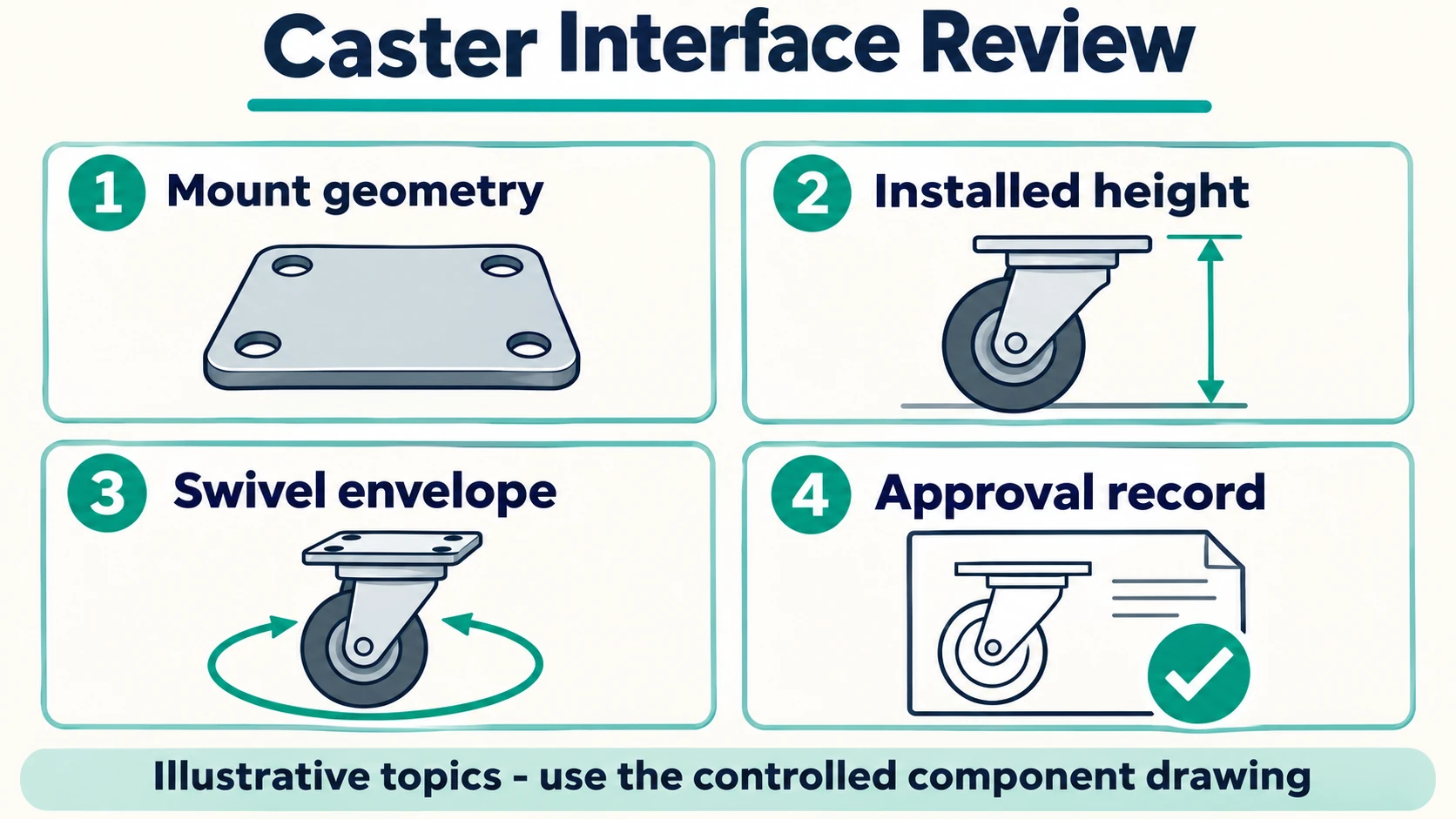
Wheel diameter and installed height are different fields. The base sits on the complete caster assembly, not simply on the diameter of its wheel. Ask the drawing to show the floor reference, the actual seating or mounting reference, and the dimension between them for the specified configuration.
If the fitting has a stem, distinguish the part of the stem that enters the base from the reference that determines the assembled height. If an adapter or socket is included, show its effect on the assembled interface. This avoids comparing two dimensions that happen to share the label “overall height” but use different endpoints.
Do not accept “same size” as the answer to a substitution proposal. Ask which drawing dimensions are unchanged and which are different. Any resulting change to base clearance, cart level or equipment position belongs in the assembled-cart review. A drawing comparison is an input to that review, not proof of stability or suitability.
Draw the swivel envelope, not only the parked wheel
A caster can occupy different space as it turns. Request the relevant swept envelope around the mounting axis, including the wheel, fork and pedal in the states specified by the component documentation. Review it against base arms, covers, cables and neighbouring hardware.
A parked photograph may show generous clearance while hiding a conflict at another orientation. Likewise, an accessible brake pedal in an empty-base image may be obstructed after the full workstation is assembled. Use the separate caster-brake selection guide to define what the control must do; use the interface drawing to locate the actual control and its required clearance.
For a computer-cart configuration such as CA13Z029, carry the workstation’s equipment and accessories into the review.[3] Its published four-arm base is a product reference, not a published caster part number, wheel size or retrofit specification. Ask CRF to confirm the exact base and caster arrangement for the offered configuration.
Compare proposals in a single interface matrix
Keep the review practical by asking both suppliers to respond to the same matrix. Include a column for evidence, not only an answer of “yes.”
| Review field | Proposed component | Evidence to attach | Decision needed |
|---|---|---|---|
| Purchase boundary | Wheel, caster or base assembly | Quotation and parts list | Are the quotes comparable? |
| Cart connection | Exact fitting and mating base | Controlled interface drawing | Is the connection agreed? |
| Installed height | Defined floor-to-seat reference | Dimensioned assembly view | Are the references consistent? |
| Swept envelope | Wheel, fork and control movement | Component envelope drawing | Is interference resolved? |
| Identification | Part and revision | Approved component record | Can repeat orders be traced? |
| Change proposal | Difference from approved item | Marked comparison and review record | Who must approve it? |
Do not multiply an isolated caster rating by the wheel count to declare a cart capacity. The complete cart, load distribution, route, operating conditions and applicable criteria require their own assessment by the responsible team. Nor does an unchanged mounting connection prove unchanged rolling behavior, braking, cleanability or component life.
Make the sample review answer specific questions
The approved sample should correspond to the drawing and quoted component identity. Ask qualified reviewers to confirm the actual fitted assembly, the relevant clearances and the agreed operating states. Keep document conformity separate from functional acceptance: a correctly identified component can still need a finished-system evaluation.
Record the component markings, cart and base revision, supplied hardware, document references, review conditions and unresolved differences. If the proposed component differs from the drawing, resolve the difference rather than retrospectively renaming the drawing to match the sample.
Control repeat orders through the agreed part identity and change process. A substitution described as “equivalent” should identify its differences and the evidence needed for review. For wider purchasing controls, see the cart configuration change-control guide.
FAQ
Are wheel diameter and caster installed height interchangeable?
No. Record wheel diameter separately from the dimension between the floor and the agreed mounting or seating reference. The assembly drawing should make the endpoints explicit.
Can a catalogue caster be approved because it is labelled for medical carts?
No. The label does not confirm the cart connection, envelope, operating conditions or finished-system suitability. Review the exact component and complete assembly.
Can the caster drawing replace a loaded-cart evaluation?
No. It establishes component geometry and documented requirements, not the performance of the completed cart. The responsible project team must define the appropriate assembly-level checks.
Does this guide explain how to remove or install a caster?
No. Use applicable manufacturer instructions and qualified personnel. Do not disassemble loaded or damaged equipment to obtain procurement measurements.
Send an interface-led RFQ
Request a B2B RFQ with your cart/base drawing, proposed wheel or caster scope, equipment configuration, route, quantity and destination requirements. Please contact us to confirm which mounting and component options are feasible for the exact order. Request a controlled drawing and sample-review scope before approving substitutions; price, stock, lead time and documentation availability must be quoted.
Images are AI-generated generic concept visualizations and editorial review diagrams. They are not actual CRF caster drawings, supplied component records, customer installations, measured dimensions or performance evidence.
Sources
[2] https://www.tente.com/en-us/industry/healthcare/medical-carts
[3] https://szcrftech.com/product/crf-ca13z029-medical-computer-cart-with-keyboard-tray-and-storage-bin