
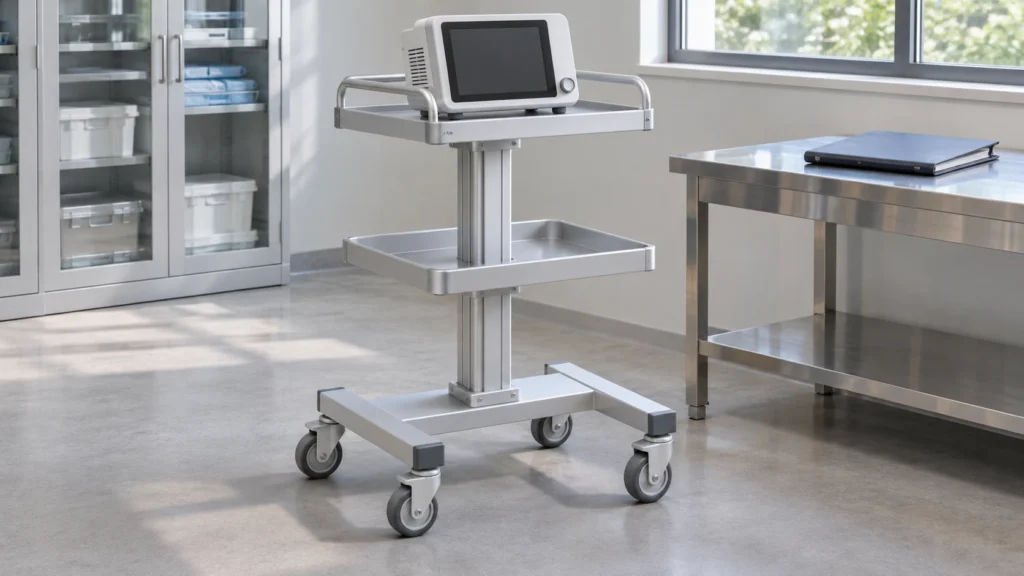

To identify a replacement part for a medical equipment cart, provide the exact cart configuration, the affected component, its mounting interface and the approved drawing revision. A photograph or wheel diameter alone does not establish interchangeability. Ask the cart supplier to confirm the replacement against the installed configuration before ordering or fitting it.
This guide is a procurement and documentation checklist, not repair instructions. Remove damaged equipment from service according to your facility’s procedures and assign installation and release decisions to qualified personnel.

Start with the cart, not a visually similar component
The CRF CA13Z004 four-wheel aluminum alloy equipment cart is a mechanical support product. Its public page requires confirmation of caster size, brakes, accessories and final configuration against the approved drawing and quotation. It does not establish a universal replacement caster or a published spare-parts stock commitment.
CRF’s range includes different base arrangements. A part used on one four-wheel configuration must not be assumed suitable for another four-wheel model, or for a three- or five-wheel base. These are equipment carts, not walking aids.
Record the cart model, project or purchase-order reference, configuration revision and any available identification label. Where a serial number is not present, say so. Do not invent an identifier from a catalogue photograph.
Separate identification evidence from approval evidence
| Evidence | What it helps establish | What it does not establish |
|---|---|---|
| Overall cart photograph | Current visible configuration | Original approved bill of materials |
| Component close-up | Shape, markings and visible damage | Material grade or load rating |
| Interface drawing | Connection geometry and revision | Suitability of an unreviewed substitute |
| Original order record | Supplied scope and transaction reference | Present stock or delivery commitment |
| Written supplier confirmation | Proposed replacement and applicable limits | Correct installation or release to service |
Photograph labels and interfaces without exposing patient information, customer records or restricted site details. Include a scale only where it can be used safely; never disassemble a loaded cart merely to obtain a measurement.
Build a component-specific request
Casters and base connections
Identify whether the request concerns a complete caster, wheel, brake component or base assembly. Provide the available manufacturer markings and approved mounting details. Similar wheel diameters can conceal different stems, threads, plates, offsets or overall heights.
Ask whether the proposed replacement changes the cart’s level, brake arrangement, turning envelope or approved configuration. Do not calculate the cart’s capacity by multiplying an unrelated caster rating by the wheel count. The assembled configuration needs its own review.
Trays, baskets and mounting hardware
State whether the issue affects a tray, basket, column attachment, equipment mount or fastener. Include the mating component and orientation, not just the loose item. Confirm whether the requested scope is an individual part or a complete assembly with associated hardware.
A screw that appears to fit is not necessarily the approved fastener. Thread engagement, retention and tightening requirements must come from controlled documentation or the responsible engineering review—not this article.
Installed equipment and cables
Identify the supported device and any accessories that constrain removal or replacement. A replacement shelf or mount can affect connector access, cable travel, device retention and service access. Do not assume a mechanically attachable part preserves the accepted equipment integration.
Compare like-for-like replacement with substitution
A like-for-like request should point to the approved part identity and revision. A substitution request must identify the difference and the party responsible for reviewing its effect. Neither route should rely on “looks the same” as its acceptance criterion.
Keep the original reference, proposed replacement, supplier response, installation instructions and release record together. If the supplier cannot confirm the original configuration, treat compatibility as unresolved rather than ordering a generic alternative to meet a deadline.
This article focuses on identifying the requested part. Broader lifecycle planning, maintenance schedules and repair procedures remain separate workstreams; it does not replace them.
Replacement-part RFQ checklist
Send CRF:
- cart model and original order or project reference;
- drawing revision and available component identifier;
- overall and close-up photographs with private information removed;
- affected interface and any approved dimensional drawing;
- supported equipment and accessories;
- description of the issue, without unsupported failure diagnosis;
- requested component versus complete assembly scope;
- destination, quantity and required documentation; and
- whether the request is like-for-like or requires a substitution review.
Ask for written confirmation of compatibility, supplied hardware, installation-document scope and commercial terms. Availability, minimum quantities, price and lead time must be quoted; no standing commitment is implied here.
A first-response request record
Keep the initial identification request separate from an order release. Give each uncertain item a reference that the supplier can answer without treating a photograph as an approved part number.
| Request field | Buyer entry | Response to request |
|---|---|---|
| Installed cart identity | Model, order reference and known revision | Whether the configuration can be traced |
| Component identity | Existing marking, or explicitly unmarked | Proposed part identity and remaining uncertainty |
| Mating interface | Available controlled drawing or unobstructed photograph | Which additional record is needed |
| Supply boundary | Individual component or complete assembly | Included hardware and document scope |
| Unresolved difference | Known change or missing record | Review owner and next evidence |
Do not fill an empty identifier with a visually similar catalogue number. If the supplier proposes a different part, carry that proposal into the separate configuration change-control review. This request record identifies what is being discussed; it does not authorize fitting, substitution or release to service.
FAQ
Can CRF identify a part from one photograph?
A photograph can start the discussion, but the model, interface and configuration records may still be required. Ask what additional evidence is needed before ordering.
Can any caster with the same diameter be used?
No. Diameter does not confirm mounting geometry, installed height, braking arrangement or suitability for the assembled cart.
Does this guide provide a repair method?
No. It supports procurement identification. Qualified parties must use the applicable instructions and determine inspection and release requirements.
Request a configuration-specific review
Use the CA13Z004 product inquiry to share the records above, or email sales@szcrftech.com. Request a replacement-scope review before treating any part as interchangeable. Do not send patient information with your RFQ.
Request a B2B RFQ for the exact configuration and documentation scope. Images are AI-generated generic concepts, not exact CRF models, customer installations, approved procedures or performance evidence.