
When comparing med carts for sale, first establish whether you need an existing catalog configuration or a custom manufacturing project. For custom carts, compare the same approved scope—not just the quoted unit price. Drawings, material definitions, storage layout, accessories, acceptance criteria and commercial terms should be visible before an order is approved.
CRF can customize carts, with aluminum alloy and stainless steel as key material options. A particular configuration, specification or delivery commitment must be confirmed for your project. This guide is purchasing education, not medical advice or a claim that a specific cart is currently in stock.
Choose the right purchasing route
A catalog cart may suit a well-defined requirement that matches the supplier’s documented configuration. A custom project is worth discussing when footprint, mounting interfaces, storage arrangement or material requirements do not fit an existing offering.
| Route | Start with | Verify before ordering |
|---|---|---|
| Catalog purchase | Exact model and configuration | Current specification, included accessories and availability |
| Modified configuration | Base design and requested changes | Revised drawing, responsibility for compatibility and change costs |
| Custom manufacturing | Application brief and interface requirements | Feasibility, drawings, sample plan and agreed acceptance criteria |
Custom does not automatically mean better or cheaper. The value depends on whether the changes solve a real application requirement and can be verified.
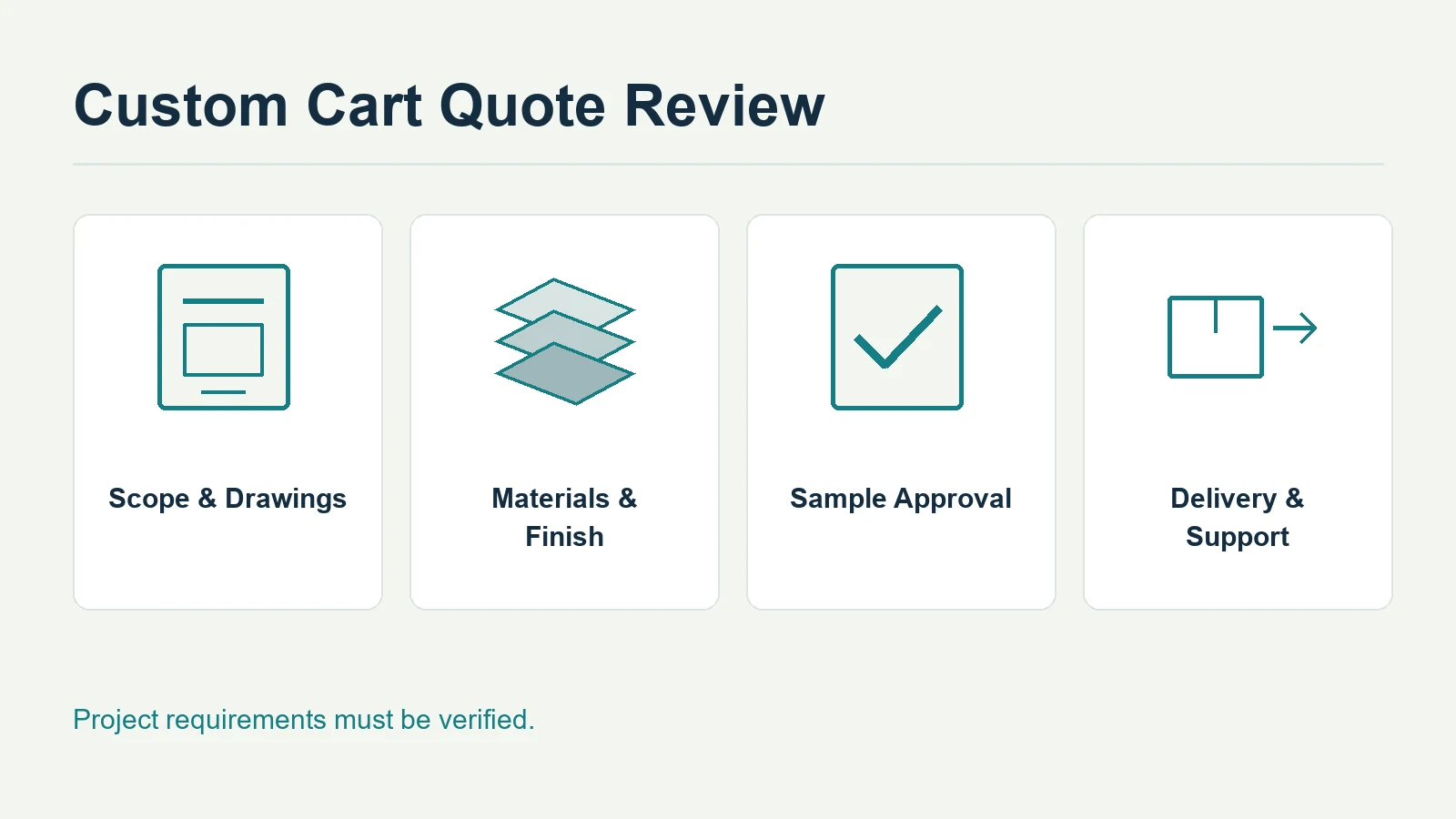
Build a like-for-like quote comparison
Define the complete scope
Send every supplier the same brief and revision number. Include the intended application, quantity estimate, overall size constraints, item dimensions, loading locations, parking conditions and cleaning requirements. Separate mandatory requirements from preferences.
A cart body price can exclude components another quote includes. Identify drawers, inserts, shelves, handles, casters, brakes, mounting hardware and packaging individually. Mark each line included, optional, excluded or awaiting confirmation.
Specify materials without assuming performance
“Aluminum” or “stainless steel” alone does not define the finished cart. Ask which components use which material, how joints and exposed edges are finished, and what surface treatment is proposed. Obtain project-specific material information rather than assuming a grade, corrosion resistance or cleaning compatibility.
Our healthcare cart material selection guide explains why workflow and evidence matter alongside material names. For quote comparison, record the agreed construction rather than ranking suppliers by a broad material label.
Compare commercial boundaries
| Quote field | Buyer question |
|---|---|
| Drawings and revisions | Which revision defines the deliverable? |
| Development and tooling | Are these separate charges, and who controls the resulting assets? |
| Sample stage | What is included, and what happens after a failed review? |
| Assembly and packaging | What arrives assembled, and how are parts protected? |
| Delivery basis | Which shipping terms, location and responsibilities are included? |
| Support | What are the agreed warranty, repair and replacement-part terms? |
Do not infer MOQ, lead time, warranty or price from another supplier’s catalog. Ask for written terms for the actual project.
Request evidence, not broad assurances
Ask the supplier to explain how proposed requirements will be demonstrated. Useful evidence may include a controlled drawing, component documentation, material declaration, sample inspection record and an agreed test procedure. Whether a particular document or certification is required depends on your intended use and market.
Avoid treating “medical grade,” “silent,” “easy to clean” or “heavy duty” as measurable acceptance criteria. Convert relevant claims into questions about test conditions, limits and evidence. A cart assembled from documented components still requires review as a complete system.
For equipment-specific projects, see the OEM equipment cart integration guide.
Agree the sample approval process
- Freeze the sample drawing revision and open questions.
- Identify who reviews fit, movement, storage access and cleaning access.
- Define representative loading and conditions without inventing thresholds.
- Record observations and nonconformities against the agreed brief.
- Document revisions and any repeat checks.
- Approve the production baseline in writing before proceeding.
Include relevant operational users and qualified safety or compliance reviewers. Photographs alone cannot establish stability, load capacity or compatibility. A sample approval also does not automatically prove regulatory compliance.
Prepare a practical RFQ package
Your request should contain:
- Application and destination market, with intended-use boundaries.
- Dimensioned sketches and equipment or supply interfaces.
- Preferred materials and required component information.
- Storage and accessory list with mandatory versus optional items.
- Movement route, parking conditions and available space.
- Facility cleaning products and compatibility questions for review.
- Quantity estimate, sample expectations and desired delivery requirements.
- Agreed evidence, inspection and acceptance responsibilities.
CDC’s environmental services guidance provides general cleaning context; it does not certify any cart material or configuration. Cleaning procedures and chemical compatibility must be confirmed by the responsible facility team and relevant manufacturers.
Limits of this buying guide
This page does not provide live stock, prices, medical performance claims, verified load ratings or a promised delivery schedule. It does not list required treatment supplies or establish which regulatory rules apply to your project. Obtain qualified review where intended use or market requirements demand it.
FAQ
Are custom med carts ready to buy from a standard price list?
Not necessarily. A custom quotation depends on the agreed design and scope. Confirm sample, production and shipping terms directly.
Is the lowest unit price the best offer?
Only if the scope and evidence are comparable. Missing accessories, development charges or unclear service terms can change the purchase decision.
Can CRF discuss aluminum alloy and stainless steel carts?
Yes. CRF’s confirmed capability includes custom carts with these key materials. The exact construction and suitability must be reviewed for the application.
Should a buyer ask for a sample?
Discuss a sample or other verification plan when fit, access or movement cannot be established from documentation alone. Agree its scope and approval criteria before commissioning it.
Request a scoped custom cart quote
Send CRF your custom cart RFQ with the application, sketches, estimated quantity and required verification plan. Ask the team to confirm feasibility, included scope and open questions before comparing offers.