
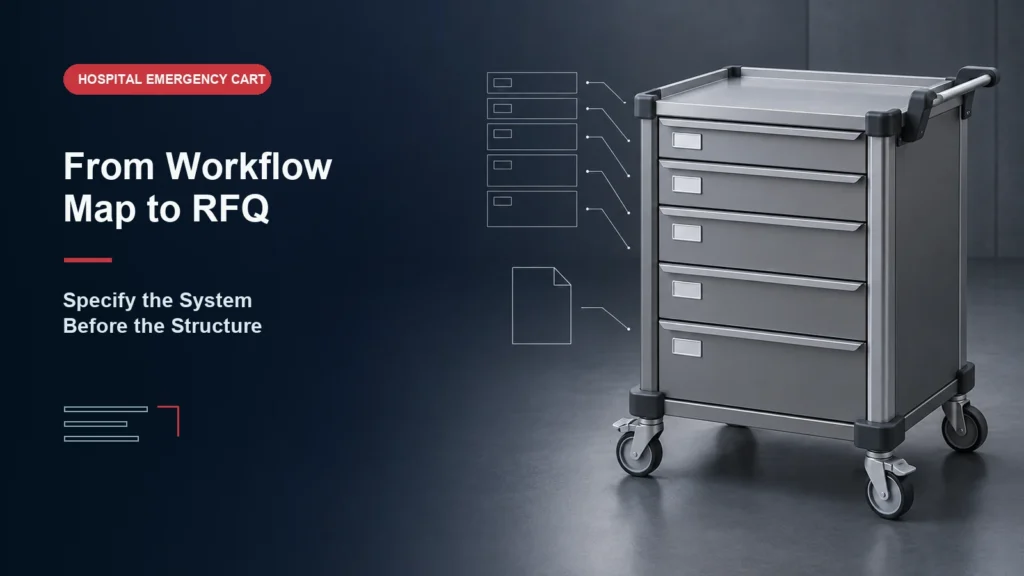
A hospital emergency cart should be specified from the facility’s response workflow outward: who uses it, where it travels, how contents are arranged, how access is controlled, how it is checked and cleaned, and how it is restored after use. The cart manufacturer should not invent the medication or clinical-content list. Those decisions belong to the facility’s qualified clinical, pharmacy, safety and compliance teams.
For OEM buyers and distributors, this distinction is essential. The manufacturer can engineer the mobile structure, drawer system, accessory interfaces and production documentation around an approved requirements set. This guide explains how to turn that set into a clearer custom-cart RFQ. It is procurement education, not clinical or medical advice.
Define the emergency-cart mission
Before discussing drawer count or color, write one sentence that defines the cart’s role. State the department, response scenario, users, travel path and intended contents at a category level.
Then answer:
- Is the cart dedicated to one department or standardized across several locations?
- Who owns the approved contents list and drawer map?
- Does the cart remain sealed between checks, use a lock or follow another facility-defined access process?
- Which equipment mounts, work surfaces and accessory positions are required?
- Where is it stored, and what doors, corners, thresholds or lifts must it pass?
- Who inspects, cleans, restocks and returns it to service?
A generic label such as “crash cart” does not answer these questions. A project brief should.
Separate clinical contents from physical-cart design
The content list and the cart are connected but governed differently.
Facility-controlled inputs
Qualified facility stakeholders should approve:
- medication and supply lists;
- required quantities and expiry-control procedure;
- drawer sequence and labels;
- access and tamper-evidence policy;
- inspection frequency and sign-off process;
- cleaning and disinfection procedure;
- staff training and response protocols;
- jurisdiction-specific regulatory requirements.
Manufacturer-controlled deliverables
A custom-cart manufacturer can translate approved inputs into:
- cabinet, frame and base geometry;
- drawer heights, travel and divider provisions;
- mounting interfaces for specified equipment;
- handles, bumpers, casters and brakes;
- aluminum or stainless steel construction options;
- finish and label application;
- assembly, inspection and packaging documentation;
- prototype and change-control process.
As with medical equipment cart OEM integration, keeping these responsibilities clear reduces the risk of an attractive physical cart being mistaken for a clinically approved system.
Build a drawer map before setting dimensions
Drawer count alone is a weak specification. Start with the approved contents and map each item category to a location based on the facility’s workflow.
A practical mapping sequence
- List approved content categories. Do not ask the fabricator to decide what belongs in an emergency response protocol.
- Record package envelopes. Capture maximum width, depth and height, including bins or organizers.
- Define access order. Facility specialists should identify what requires immediate visibility or access.
- Set drawer depths. Match usable internal dimensions to the approved contents rather than selecting equal drawers by default.
- Plan dividers and labels. Define whether dividers are fixed, adjustable or removable, and who controls label content.
- Check full extension and interference. Verify that handles, accessories and adjacent drawers do not block access.
- Create a controlled reference. Freeze the drawer map with a revision number, image or diagram approved by the buyer.
The result is a dimensional input for engineering—not a substitute for the facility’s clinical policy.
Design for access and controlled readiness
Emergency use creates a tension between fast access and controlled readiness. The facility should define the access model; the cart design should then support it.
Questions for the RFQ include:
- What event authorizes opening the cart?
- Is visible tamper evidence required?
- Must all drawers release together or remain independently controlled?
- How is the cart checked after opening?
- What happens if a key, code, seal or electronic component is unavailable?
- Is a purely mechanical solution preferred, or are powered components acceptable?
- Who supplies, validates and services any electronic access hardware?
Do not claim that a lock type is “compliant” without identifying the applicable rule, configuration and evidence. Request explicit documentation for every buyer-mandated standard.
Mobility, stability and workspace
A hospital emergency cart is a moving system. Its behavior depends on total mass, mass distribution, drawer extension, accessories, caster layout and floor conditions.
Mobility inputs
Document the full route:
- narrowest clear doorway;
- corridor and bedside turning space;
- elevator threshold and interior;
- floor types and transitions;
- ramps or slopes, if any;
- parked location and brake-use procedure.
The buyer should request evaluation with the representative payload installed. An empty-cart demonstration does not reproduce the loaded configuration.
Stability inputs
Provide the mass and position of mounted equipment, extended accessories and drawer contents. Define foreseeable configurations for review, such as an open drawer or attached equipment. The engineering and test plan should state the evaluated conditions rather than offer a bare “stable” claim.
Workspace inputs
Confirm usable worktop area after equipment is mounted. Place handles and accessories so they do not obstruct the work surface, drawer access or movement path. If height, reach or force targets are required, state how they will be evaluated with representative users.
Aluminum or stainless steel?
CRF can custom-manufacture carts in aluminum and stainless steel, but selection should follow the project requirements.
Aluminum direction
Aluminum can help manage frame mass and can support modular columns, brackets and equipment interfaces. The project must still specify finish, joint details, load conditions and cleaning compatibility.
Stainless steel direction
Stainless steel can provide a robust corrosion-resistant metal structure or surface. The project must identify grade and finish requirements where relevant, along with weld treatment, seam design and cleaning compatibility.
Neither material is automatically approved for an emergency-cart application. Assess the complete cart and require evidence relevant to the intended market.
Cleanability and maintenance planning
CDC guidance treats mobile and shared equipment, including code carts, as items requiring clearly assigned cleaning responsibility. It also emphasizes compatibility with manufacturers’ instructions and attention to high-touch surfaces.
Translate that into design requirements:
- smooth, reachable high-touch areas;
- minimized dirt traps and inaccessible gaps;
- compatible labels, bumpers, seals and plastics—not just a compatible metal frame;
- access for cleaning around mounts and handles;
- a process for reporting damaged surfaces;
- replaceable wear components where practical;
- documented responsibility for cleaning, inspection and return to service.
The finished cart should be reviewed against the facility’s approved products and procedures. Do not describe a cart as antimicrobial, sterile or infection-proof unless specific, supportable evidence exists for the exact claim.
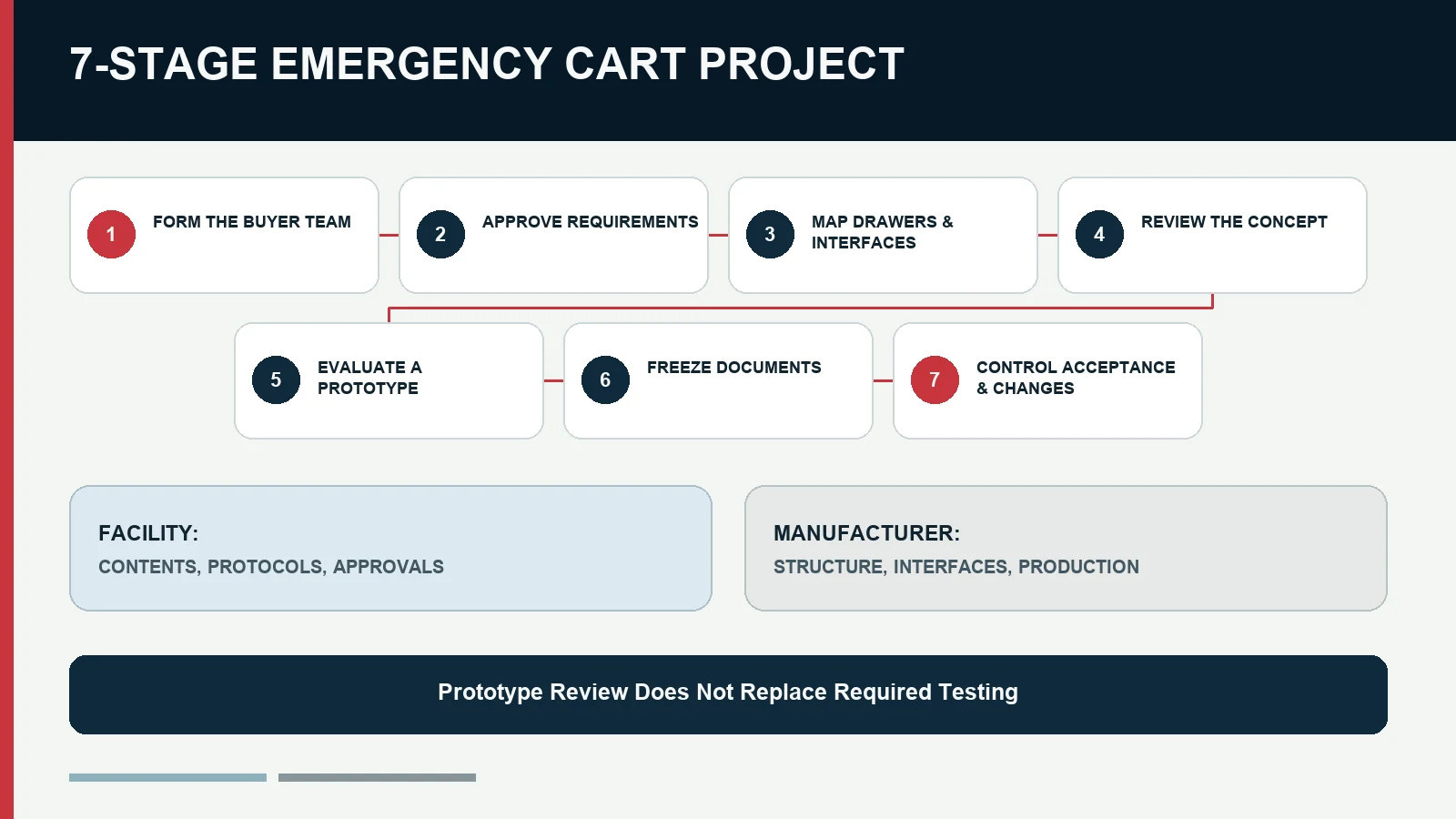
Seven-stage hospital emergency cart project
1. Form the buyer team
Include the facility functions responsible for clinical workflow, pharmacy, infection prevention, biomedical or technical integration, facilities, procurement and maintenance as applicable.
2. Approve the operational requirements
Freeze the mission, contents ownership, access process, route, storage location and cleaning procedure.
3. Create the configuration package
Prepare the drawer map, equipment-interface drawing, accessory list, labels, dimensional envelope and material preferences.
4. Review engineering concepts
Compare concepts against a compliance matrix. Track open questions, assumptions and exceptions instead of resolving them through undocumented conversations.
5. Prototype and evaluate
Use representative payloads and intended routes. Review access, visibility, mobility, brakes, drawer operation, cleaning access and serviceability. A prototype review does not replace any required formal testing.
6. Freeze production documents
Approve drawings, bill-of-material requirements, finishes, label artwork, inspection points, packaging and configuration revision.
7. Plan acceptance and change control
Define incoming inspection, discrepancy handling, spare components and how future changes to drawers, accessories or materials will be approved.
RFQ checklist for a custom hospital emergency cart
Send suppliers a structured package containing:
Application
- department and use context;
- quantity and deployment locations;
- responsible buyer stakeholders;
- target market and buyer-specified standards.
Configuration
- overall maximum dimensions;
- approved drawer map and usable internal dimensions;
- divider and label requirements;
- equipment and accessory interface drawings;
- handle, worktop and bumper requirements;
- access-control or tamper-evidence concept.
Movement and structure
- payload map with masses and positions;
- movement route and floor conditions;
- caster, swivel and brake preferences;
- stability and structural evaluation conditions;
- aluminum or stainless preference and finish.
Cleaning and service
- cleaning products or compatibility-review process;
- high-touch and hard-to-reach design concerns;
- replaceable parts expectations;
- maintenance access and service documentation.
Commercial and quality
- prototype or sample requirement;
- drawings and material declarations;
- inspection records and acceptance criteria;
- packaging, destination and shipping constraints;
- milestones, quantity and requested quotation validity;
- explicit inclusions, exclusions and assumptions.
Limitations buyers should state explicitly
A custom metal cart is not automatically a medical device, and a cart’s classification can depend on intended use, claims, integrated equipment and jurisdiction. Integrating powered components or medical equipment may introduce requirements beyond the mechanical cart. CRF should only claim certifications, test results, load ratings or chemical compatibility that are documented for the final agreed configuration.
The buyer remains responsible for clinical contents, protocols, local approvals and professional review. The manufacturer and buyer should agree in writing who is responsible for each interface and document.
Frequently asked questions
What is the first step in specifying a hospital emergency cart?
Define the facility-approved workflow and content ownership. Then map contents and equipment to physical spaces and interfaces.
How many drawers should an emergency cart have?
There is no universal number. Drawer count and depth should follow the approved contents, package sizes and access sequence.
Can CRF customize the drawer layout and accessories?
CRF can evaluate custom cart structures, drawer arrangements and accessory interfaces from an approved brief, drawing or sample. Feasibility and final details require project review.
Should the cart be aluminum or stainless steel?
Choose according to total mass, structure, finish, cleaning process, environment and manufacturing requirements. Compare complete designs rather than material labels alone.
Who decides which medications and supplies are included?
The healthcare facility’s qualified clinical, pharmacy, safety and compliance teams should approve contents and protocols. This guide does not recommend medications or clinical supplies.
Does a prototype prove compliance?
No. A prototype supports fit and workflow evaluation. Required standards, formal tests and documentation must be defined and completed separately for the final configuration.
Prepare a quote-ready project brief
If your team has an approved workflow, drawer map and equipment list, send them to CRF with the dimensional envelope, material direction, quantity and destination. CRF can review the metal structure and OEM/ODM manufacturing path. Request a custom hospital emergency cart quote