

An aluminum medical equipment cart should be reviewed around the people, tasks and spaces in which the complete system will be used. Handle position, work-surface access, display orientation, device controls, cables, accessories, caster behavior and the loaded assembly all affect the workflow. A lightweight frame description alone does not establish low push force or good ergonomics.
CRF focuses on aluminum alloy medical equipment carts with three-, four- and five-caster bases. This guide concerns mobile equipment platforms—not three-wheel walkers or other patient mobility aids. It provides procurement education, not medical or occupational-health advice. Qualified users, engineers and safety reviewers must define and validate project-specific requirements.
Start with users, tasks and environments
The FDA describes human-factors work through three connected elements: intended users, use environments and user interfaces. For a cart project, translate those elements into observable tasks rather than asking for an abstract “ergonomic design.”
Build a task map that covers:
- unpacking, setup and device installation;
- moving the cart from storage to its use location;
- approaching doors, turns, thresholds and elevators;
- positioning and parking the cart;
- viewing a display and operating controls;
- reaching accessories, connectors and consumables;
- cleaning, inspection and authorized maintenance; and
- returning the system to storage.
Identify the intended user groups and the environment for each task. A mounting position that works in a clear showroom may become awkward when the cart is beside other equipment. A handle that suits one user cannot automatically represent the full intended population.
Review the cart as a user interface
Handles and movement
The user should have a defined contact point for maneuvering the cart. OSHA’s hospital housekeeping guidance recommends using handles rather than pushing the sides of a cart, keeping handles for pushed devices around waist-to-chest height and pushing rather than pulling where possible. Those recommendations are useful prompts, but they do not provide a universal handle dimension for every medical equipment cart.
For the actual project, record:
- intended hand positions and grip clearance;
- whether cables or accessories obstruct the handle;
- whether hands remain clear of walls and adjacent equipment;
- the user’s sightline in the intended travel direction; and
- whether the same handle is suitable for positioning and longer travel.
Do not declare the cart ergonomic from a CAD view. Observe representative users moving a representative loaded configuration through the expected route.
Display, tray and control access
Map the position of each task-critical display, control and connector. The FDA includes components that users connect, position, configure or manipulate within the device user interface. The cart and installed equipment therefore need to be reviewed together.
Check whether:
- the display is visible in the intended operating position;
- adjustments can be made without an awkward reach;
- the tray or work surface remains usable after the device is mounted;
- connectors can be reached without moving unrelated accessories;
- labels and indicators remain visible; and
- adjustment mechanisms cannot be mistaken for handles.
If a height, tilt or rotation adjustment is proposed, define who may operate it, its permitted range and the configurations that require reassessment. An adjustable part does not guarantee suitability for every user.
Separate frame material from movement performance
Aluminum alloy can support a comparatively light structural approach, but total system behavior depends on more than frame material. Installed equipment, batteries, counterweights, shelves, brackets and accessories all contribute to the moving mass and load distribution.
Do not estimate push or steering performance from an empty cart. Evaluate the approved loaded configuration, including the actual caster specification and floor conditions. OSHA identifies pushing and pulling heavy loads and awkward postures as ergonomic risk factors, while its hospital guidance highlights large, low-resistance wheels, maintenance and mixed-floor transitions. A buyer should turn those general prompts into project-specific evaluation criteria rather than repeat unverified “effortless mobility” language.
Include the base and casters in the workflow review
Three-, four- and five-caster bases provide different geometries, but wheel count alone does not determine ergonomics, maneuverability or stability. Consider equipment weight, center of gravity, base dimensions, caster positions, wheel and bearing design, braking, attachments and the travel route.
Review at least these conditions:
- starting and stopping on representative floors;
- straight travel and controlled turns;
- approach to thresholds, elevator gaps and doorways;
- final positioning beside other equipment;
- access to the intended brake controls;
- visibility of protruding base arms; and
- movement with cables and accessories in their approved transport positions.
A five-caster cart is not automatically easier to steer or more stable than a three- or four-caster design. The complete assembly needs its own engineering and user evaluation.
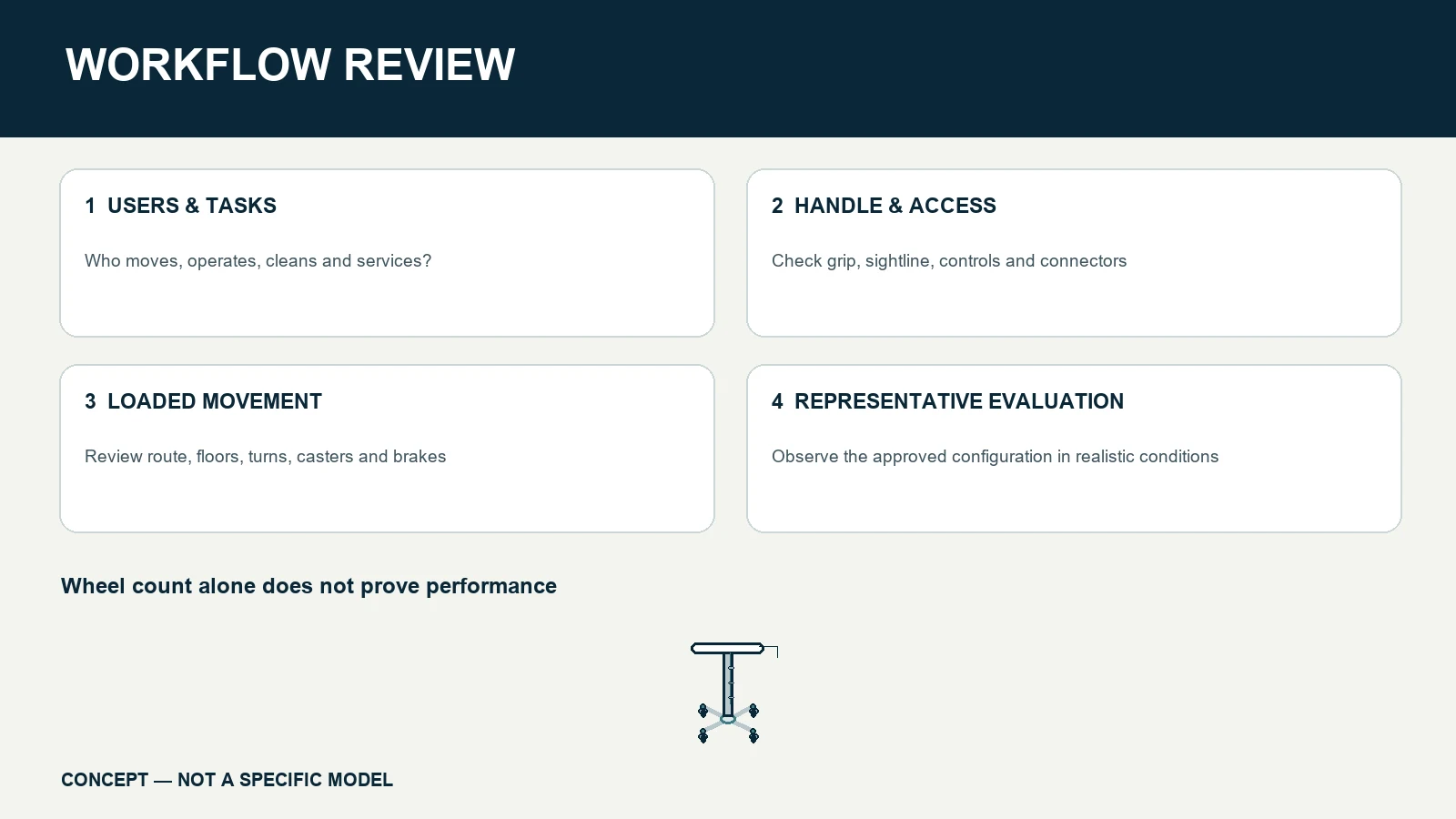
Use representative workflow evaluation
A practical review can be organized in five stages.
1. Define the representative configuration
Freeze the device, bracket, tray, accessories, cable routing and base concept. Record the drawing revision and the mass and position inputs supplied by responsible parties.
2. Define users and tasks
List who installs, moves, operates, cleans and services the system. Identify the tasks that matter to each group and the expected use environments.
3. Set observable criteria
Specify what reviewers should observe: hand clearance, visibility, access, movement route, brake operation, cable interference and adjustment sequence. Qualified teams should define any measurement methods and acceptance limits; this article supplies none.
4. Evaluate a representative sample
Use representative users, a representative loaded cart and sufficiently realistic conditions. Record difficulties, workarounds, contact points and unexpected behavior rather than relying only on a satisfaction question.
5. Control changes
Revisit the evaluation if the device, mounting height, accessory position, caster, base, handle or cable route changes. A cosmetic-looking revision can alter reach, sightlines or load distribution.
Buyer checklist for an OEM RFQ
Send the manufacturer:
- device and accessory drawings;
- equipment mass and center-of-gravity inputs from the responsible source;
- intended user groups and key tasks;
- transport and operating configurations;
- required display, control and connector access;
- representative route, floor transitions and space constraints;
- preferred base concept, without assuming that wheel count proves performance;
- cleaning and service access requirements; and
- the expected sample-review and change-control process.
Ask the supplier to identify unresolved assumptions. “Ergonomic,” “easy to move” and “universal” should not replace a drawing, configuration record and evaluation plan.
CRF references for project discussion
The CRF 4-Wheel Universal Ultrasound/ECG Medical Cart is a four-wheel catalog reference for discussing equipment integration. The CRF Five-Wheel Medical Monitor Cart is a separate five-wheel reference. Their listings do not establish compatibility, ergonomic acceptance, availability or an advantage for either base layout in your project.
Use the current CRF medical cart collection to identify a discussion starting point, then provide the intended equipment and workflow for configuration-specific review.
Limits of this guide
This article does not provide a push-force limit, handle-height specification, load rating, alloy grade, validated human-factors result, certification, price, stock status or delivery date. OSHA guidance cited here is not a product approval, and FDA human-factors information must not be represented as a certification of a CRF cart. Regulatory and validation responsibilities depend on the finished system, intended use and destination market.
FAQ
Does an aluminum frame automatically make a medical cart ergonomic?
No. Frame material is only one input. The loaded assembly, handle, work height, controls, accessories, caster behavior, route and intended users all require review.
What is the best handle height for a medical equipment cart?
There is no universal value in this guide. OSHA offers general workplace guidance, while the project team must assess representative users, tasks and configurations and define suitable acceptance criteria.
Is a five-caster base easier to maneuver than a three- or four-caster base?
Not necessarily. Caster layout, footprint, wheel design, load position, steering behavior, brakes and route conditions matter. Evaluate the actual loaded assembly.
Should buyers test an empty prototype?
An empty sample may help identify basic assembly issues, but it cannot represent the movement and access behavior of the approved loaded configuration. Plan a representative review before final acceptance.
Discuss your equipment-cart workflow with CRF
Explore CRF’s aluminum medical equipment cart catalog and send an RFQ through the contact page or relevant product page, or email sales@szcrftech.com. Include the equipment drawing, accessory list, intended users, task map, route constraints and preferred three-, four- or five-caster concept. Ask CRF to identify open inputs and propose a drawing and sample-review scope before approval.