

Choose a fixed-height medical equipment cart when one verified working level meets the intended device and workflow requirements. Consider an adjustable configuration when the working level must change between tasks or users—but approve the adjustment mechanism, locking method and cable travel with the actual equipment before ordering. Neither design is automatically suitable because it has more features.
This guide compares the purchasing decision, not clinical outcomes. It does not establish a load rating, adjustment range or device compatibility for any CRF trolley.
Start with the level that actually needs to change
An adjustable column, adjustable display mount and adjustable keyboard tray do different jobs. Before comparing quotations, identify which surface or interface needs to move. A screen may need repositioning while a device platform remains fixed. Conversely, raising a worktop may not put a separate display or input device in the required position.
Create a task list covering equipment loading, routine operation, accessory retrieval and parking. Record the required position for each task using a mock-up and the intended users. Avoid a single request such as “ergonomic height” without a defined reference surface and acceptance method.
Separate worktop height from overall height
Ask suppliers to identify the floor-to-worktop reference, the highest accessory position and the complete equipment envelope separately. A dimension for an empty tray is not the same as the operating position of controls on a device placed on it. Specify whether each dimension is nominal, measured on a sample or confirmed in a drawing.
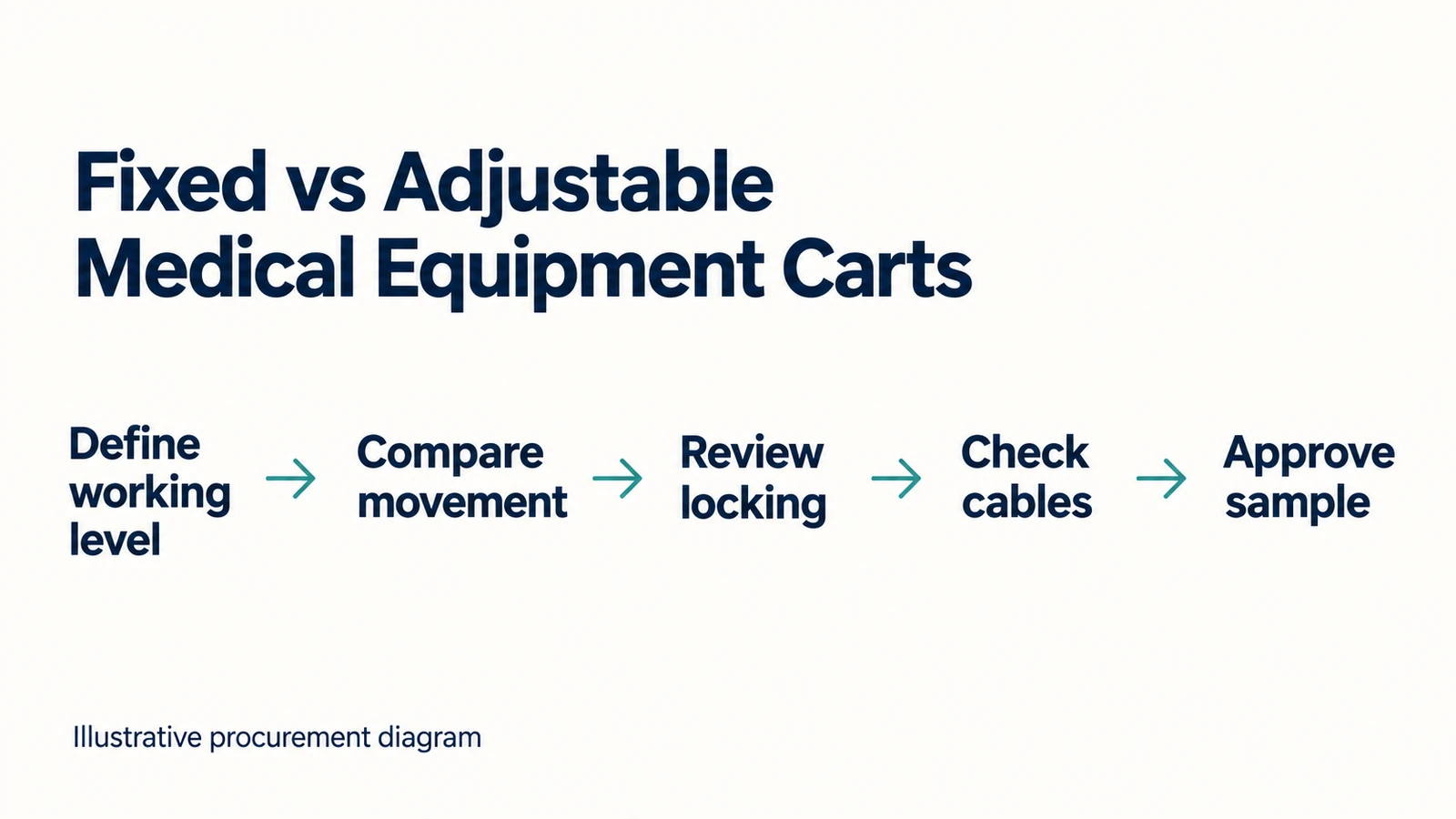
Compare fixed and adjustable configurations
| Purchasing question | Fixed-height configuration | Adjustable configuration |
|---|---|---|
| What must be approved? | Selected working level and the complete equipment layout | Required positions plus mechanism operation and retention |
| What changes during use? | Equipment and accessories may still move independently | Column or another specified interface changes position |
| What should cable review cover? | Routing, access and travel during cart movement | Those checks plus the full approved adjustment movement |
| What documentation matters? | Configuration drawing and assembly instructions | Those documents plus adjustment and locking instructions |
| What cannot be assumed? | That one level suits every user or task | That adjustment is powered, continuous or permitted under load |
These are review categories, not claims that one design is cheaper, stronger or easier to clean. Compare quoted configurations and supporting documentation rather than feature labels alone.
Use real CRF examples without treating them as interchangeable
The CA16Z106 equipment cart with printer shelf is currently described with a fixed-height column, five-caster base, upper tray, storage basket and lower printer shelf. It is a relevant starting point for a fixed-level equipment-layout discussion. Confirm the final drawing and included components for the ordered version.
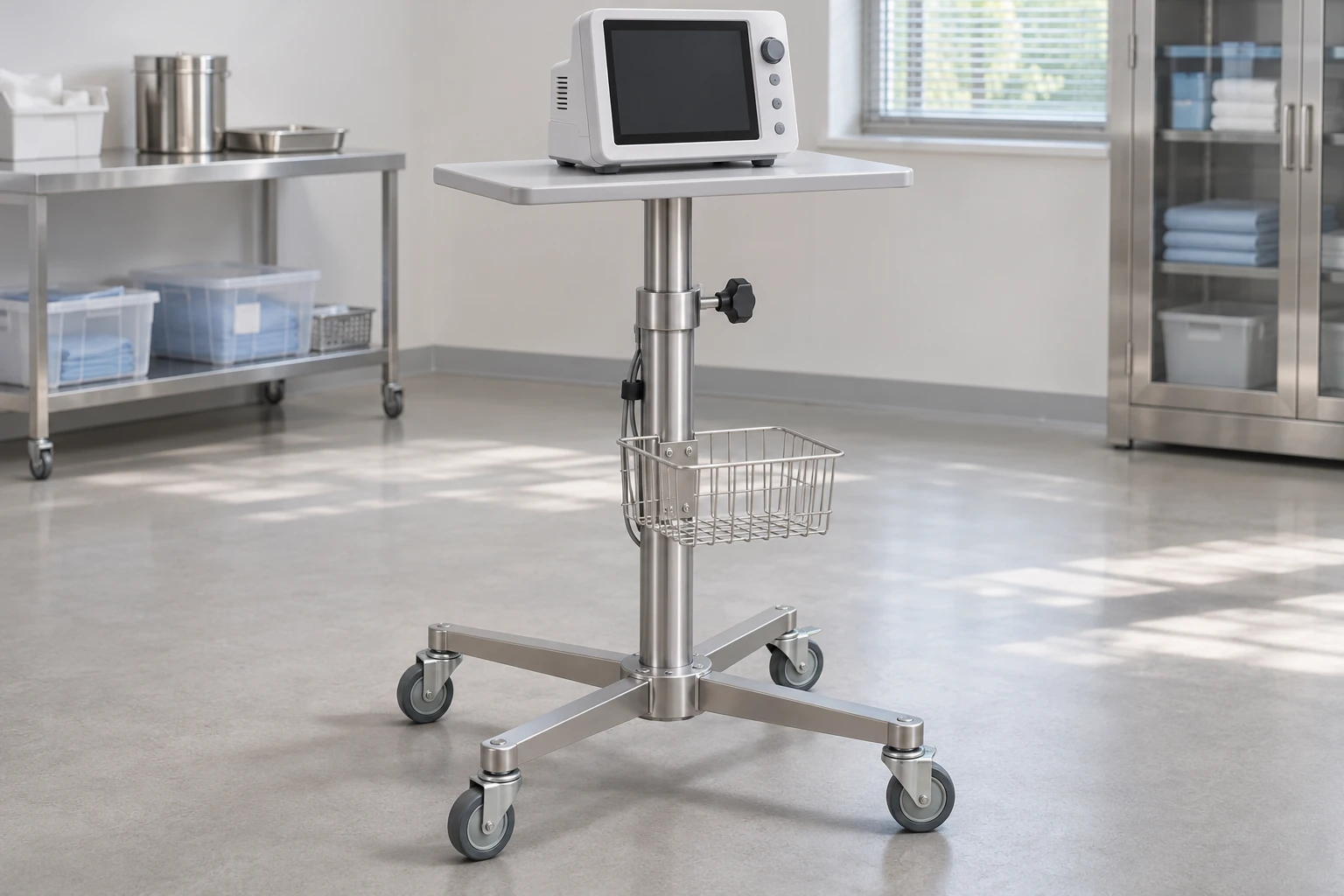
The CA16Z003 adjustable ultrasound cart is described with a telescopic round column and side adjustment knob, a wire basket and a compact four-arm caster base. Its current page does not establish an adjustment range or tested load rating. The page also identifies its image as an AI reference-guided visualization, not documentary photography or compatibility evidence.
These products differ in more than height adjustment. Do not compare them as identical trolleys with an optional lift added. If both are candidates, ask CRF to review the same device inputs and required accessory list for each.
Questions to resolve before accepting an adjustable sample
How is adjustment performed and secured?
Request the configuration-specific instructions. Establish what must be supported or removed before adjustment, how the position is retained, and how the operator confirms engagement. A visible knob does not establish the internal mechanism, operating force or suitability for adjustment with equipment installed. Do not invent an operating sequence from a photograph.
What moves with the work surface?
Identify every attached holder, basket, shelf and cable restraint. Review access and potential interference at each approved position. A cable that reaches at one level may restrict movement at another. This is a reason for configuration review, not an instruction to add an arbitrary cable loop.
What evidence closes the decision?
Agree the sample revision, device identity, acceptance positions and reviewers before the review. Record unresolved points rather than accepting the sample on appearance. Stability and equipment retention must be assessed for the assembled configuration using appropriate professional guidance; an empty-cart demonstration is not sufficient evidence.
For broader workstation layout questions, see the medical equipment cart ergonomics guide. This comparison focuses on specifying whether and where height must change, not on prescribing an ergonomic height.
Procurement checklist for a comparable RFQ
Provide the device model, dimensions, mass and mounting information; required work surface positions; accessory inventory; intended adjustment frequency; cable and power requirements; destination; quantity; and requested documentation. Mark unknowns explicitly.
Ask the quotation to identify the proposed configuration and exclusions. Request confirmation of the adjustment type, approved operating instructions, final dimensional references and sample review scope. Commercial terms and performance evidence should come from the quotation and supporting documents, not assumptions based on a product family name.
FAQ
Is an adjustable cart always the better choice?
No. Its value depends on a real need for different positions and whether the proposed configuration can meet that need. A fixed level can remain a valid candidate when verified against the intended tasks.
Does height-adjustable mean powered?
No. The term alone does not identify the mechanism. Request configuration-specific information before comparing powered, assisted or manual options.
Can the CA16Z003 replace the CA16Z106 directly?
That is not established. Their listed structures and accessories differ. Submit the complete equipment layout for a suitability review rather than treating one as a direct substitute.
Does a product image prove adjustment safety?
No. A photograph or visualization cannot establish operating limits, locking performance or assembled-system suitability. Request instructions and the appropriate sample evidence.
Request a configuration-specific review
Send CRF an RFQ for fixed-height and adjustable cart options with the equipment details and required working positions. Ask for a documented configuration comparison before approving a sample. This article is procurement education, not medical advice or a substitute for qualified equipment and workplace-safety review.