
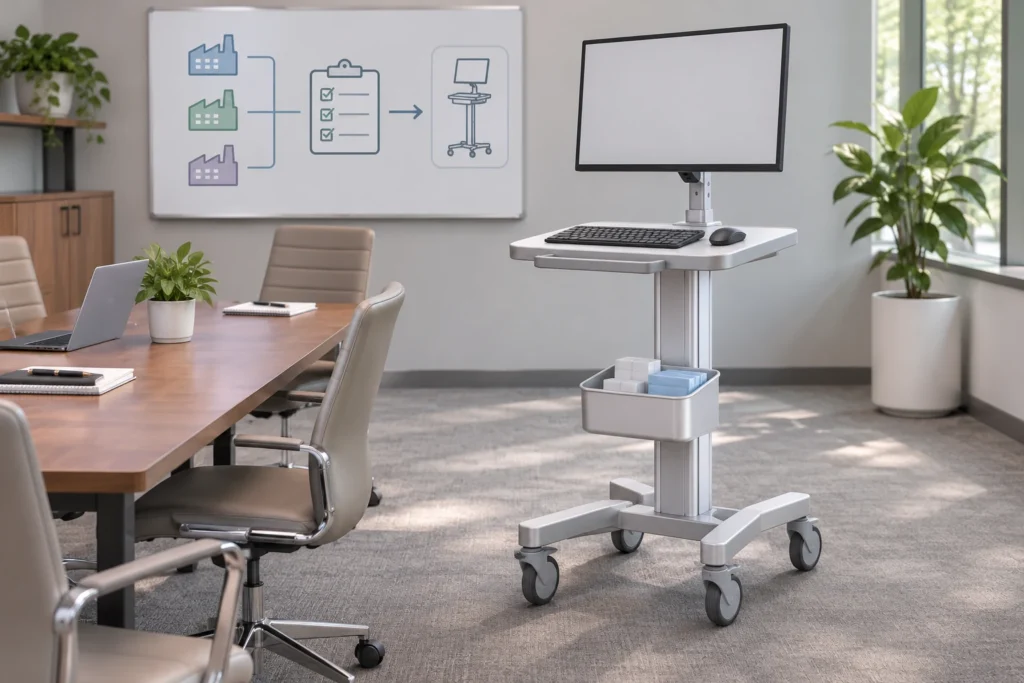

The best way to source custom medical carts is to send the same configuration brief to suppliers with the right scope, compare their exclusions as carefully as their prices, and approve a representative sample before committing to a repeat order. Start by deciding whether you need a cart structure, an equipment integration service, or a complete supported workstation. Those are different purchases.
A low cart-only quotation cannot fairly be compared with a price that includes device installation, electrical integration, packaging validation or local service. This guide explains how to choose a sourcing route and make the commercial comparison meaningful. It is a procurement framework, not a claim that one supplier model is always best.
Choose the sourcing route before requesting prices
Direct cart manufacturer
A direct manufacturer is a useful route when the project centers on the mechanical platform: base geometry, column, worktop, equipment interfaces and storage. It can also suit an OEM that already owns the electronics and system verification process. Ask who controls drawings, component changes and repeat-order identification. Do not assume that manufacturing a cart also means supplying a certified powered system.
CRF’s medical cart range includes equipment cart and workstation configurations, with project customization described for dimensions, mounting interfaces, storage, casters and accessories. Use these as starting points for a scoped inquiry; availability and suitability still need confirmation for the exact proposed configuration.
Distributor or local reseller
A distributor may be appropriate when the main requirement is local procurement, access to several established brands, or a familiar service channel. Establish which changes are available from the original manufacturer and which are installed locally. The person issuing the invoice may not control the design revision or hold every replacement component.
Integration partner
An integrator can be relevant when the cart must arrive with computing, displays, power components or equipment installed. Ask which organization is responsible for each subsystem and for the completed assembly. A single commercial contact is helpful only if the technical responsibilities are equally clear. Obtain an explicit list of customer-supplied and supplier-supplied equipment.
| Route | Potential reason to shortlist | Evidence to request | Boundary to clarify |
|---|---|---|---|
| Direct manufacturer | Mechanical customization and repeat configurations | Drawing revision, sample scope, component list | Electronics and complete-system responsibilities |
| Distributor | Local purchasing and brand access | Authorized supply route, configuration code, service terms | Who approves changes and supplies spare parts |
| Integrator | A configured equipment workstation | Assembly scope, interface plan, verification responsibilities | Which equipment and system work are included |
Issue one brief that every supplier can answer
Provide a device list, proposed quantities, destination market, expected deployment environment and a description of the work. Include equipment dimensions, mass and mounting information where available, but identify preliminary values. A drawing marked provisional should not quietly become a production requirement.
Separate mandatory requirements from preferences. A mandatory interface may determine whether a supplier is viable; a preferred color usually should not eliminate an otherwise suitable platform. Tell suppliers whether alternative proposals are welcome and require each alternative to be listed separately.
For mechanical requirements, refer to the whole-cart selection guide. In the sourcing comparison, concentrate on whether each bidder has answered the same brief rather than repeatedly redesigning the cart through email.
Normalize the quotation before judging the price
Build a comparison sheet with the same rows for every offer: cart configuration, accessories, development work, sample, packaging, assembly condition, shipping terms, inspection, warranty scope and replacement parts. Record exclusions in a separate column. Leave unknown costs blank instead of treating them as zero.
Consider a hypothetical example with no price assumptions: one offer includes the monitor bracket but excludes the monitor; another includes a complete display assembly; a third allows only the buyer’s own mounting kit. These are three scopes, not three directly comparable prices. Ask for the same defined build or explain why an alternative remains under consideration.
Also distinguish recurring unit costs from non-recurring work. Identify whether a tooling or development payment affects drawing access, later modifications or repeat purchases. Confirm commercial terms in the quotation and purchase agreement; this article does not establish CRF’s payment, warranty or delivery commitments.
Check supplier evidence proportionately
Ask for evidence that relates to your configuration rather than collecting unrelated badges. Useful records can include an identified sample, a dimensioned drawing, a component list, agreed inspection criteria and a process for handling substitutions. Certification documents must match the product, configuration and destination requirements where applicable. A company-level document is not automatically approval of the complete device-and-cart assembly.
The HUI article on choosing a medical cart supplier illustrates the breadth of supplier-capability questions buyers encounter. Its supplier-specific capabilities should not be transferred to CRF or to another bidder. Your own comparison should state what each party has actually offered and substantiated.
Turn sample approval into an order reference
Approve the sample against an agreed scope, not a photograph alone. Record its configuration identifier, drawing revision, supplied contents and any open issues. If the sample is accepted with a change, make the change explicit before the production order. A verbal promise to adjust something later is not a controlled order definition.
For repeat orders, request notification before substitutions affecting interfaces, mobility, finish, accessories or service parts. Keep receiving checks linked to the approved configuration. This reduces ambiguity without pretending that a sample review proves every aspect of long-term performance.

FAQ
Is buying directly from a factory always cheaper?
Not necessarily. Compare the same delivered scope and your own integration, inspection, freight and support responsibilities. A lower unit quotation may exclude work another supplier includes.
Should every supplier receive the same drawings?
Use a consistent brief, but share only information you are authorized to disclose. Define access to confidential drawings and identify preliminary revisions clearly.
Does a custom cart require a completely new design?
No. A standard or adapted platform may meet the need. Ask bidders to explain the changes and verification implications of each proposed route.
What should I send CRF first?
Send the equipment outline, application, estimated quantity, destination and requested customization. Please contact us to confirm the proposed supply scope and the information needed for a quotation.
Request a scope-based quotation
Use the B2B RFQ form to describe whether you need a cart structure, accessory adaptation or equipment-integration review. Attach available interface information and ask for inclusions, exclusions and open assumptions to be identified. The next useful step is a comparable proposal, not an unsupported promise of the lowest price.