
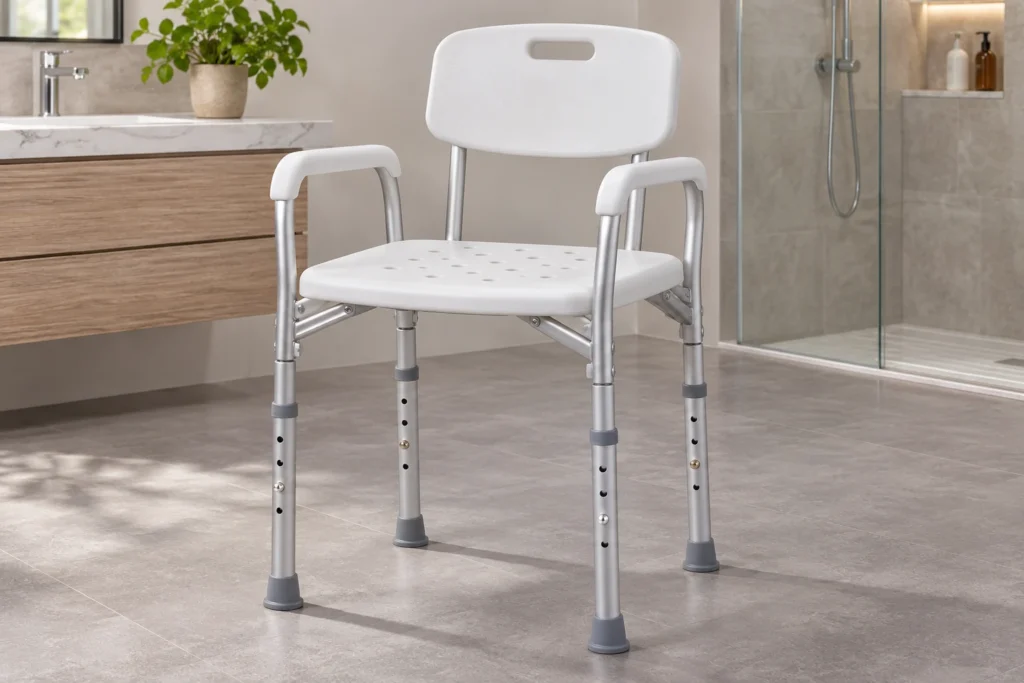
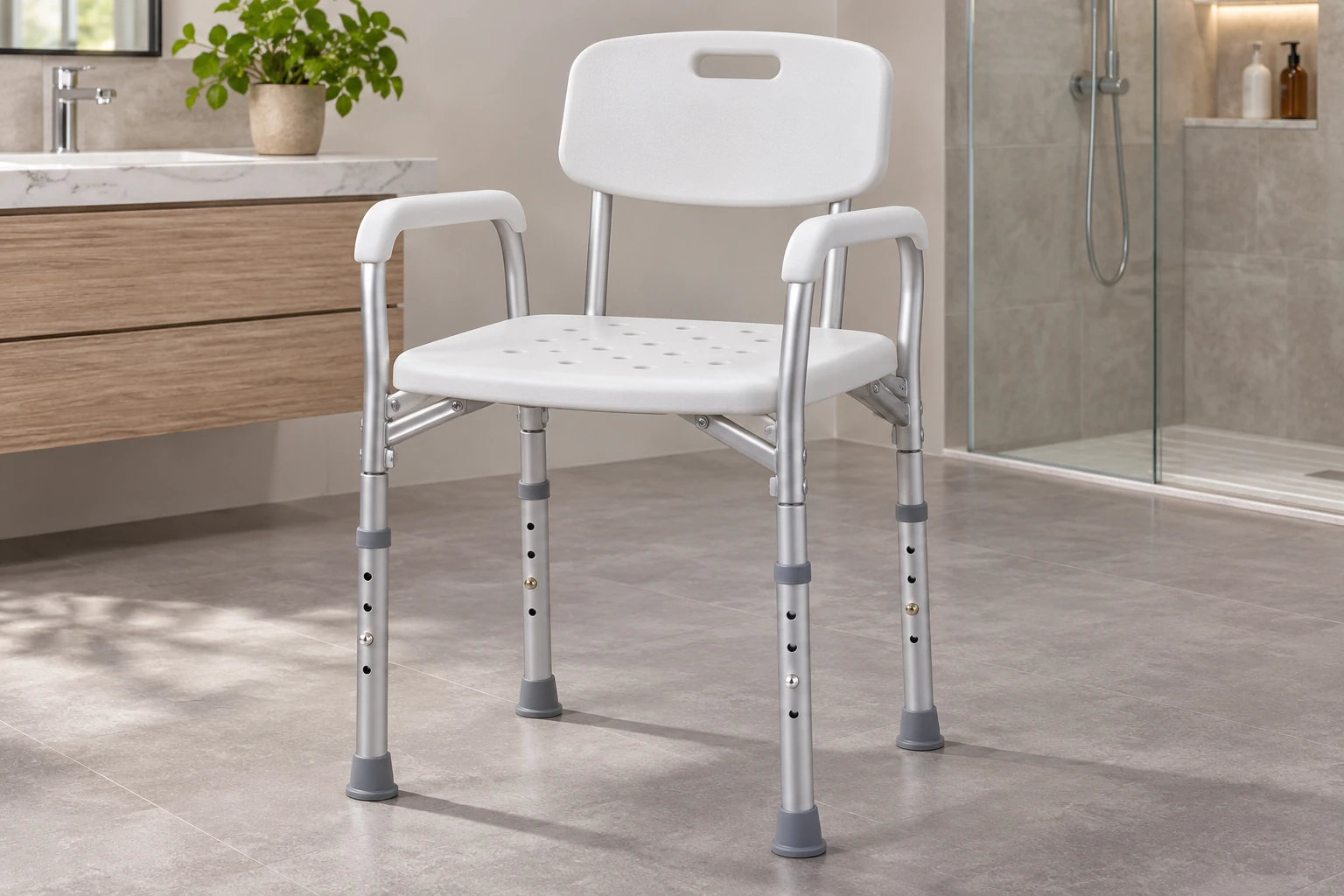
Specify adjustable shower chair seat height as a defined measurement from an agreed reference surface to the agreed seat surface, with the chair in its documented deployed configuration. Request the permitted adjustment positions, measurement conditions and exact model revision. Do not confuse overall chair height with seat height, or treat an advertised range as proof of suitability for an individual user.
For a real product reference, the CRF CY0043-2 folding aluminum swivel shower chair has a supplier-listed adjustable configuration. Confirm the final dimensions, available settings, mechanism and included parts in the quotation and controlled drawing. This guide intentionally does not convert supplier-diagram values into a verified acceptance range.

Decide which height the quotation describes
Buyers can receive different answers to the same request for “chair height.” One supplier may measure to the backrest, another to the seat, and another may quote a packaged dimension. Label each dimension explicitly.
Define the measurement endpoints
Ask the supplier to mark the seat-height reference on a drawing, including where on the seating surface the measurement ends. Identify the reference floor or inspection surface and the chair configuration. If a cushion, shaped seat or optional insert is involved, clarify whether it is included and how the measurement is defined.
Agree whether measurements are taken unloaded and how any other required conditions are handled. Do not improvise a loaded measurement or ask an individual to sit on an unapproved sample. Required methods and conditions belong in a responsible, documented review.
A range is not a list of permitted positions
Minimum and maximum values do not show whether adjustment is continuous or discrete. Request the actual permitted positions and the mechanism instructions for the quoted version. Do not assume that any intermediate height is allowed or that every illustrated variant uses the same leg assembly.
For procurement, a position schedule can include setting identifier, measured seat height, measurement method and relevant configuration notes. The supplier should provide the values; the buyer should not reconstruct them by dividing an advertised range into guessed increments.
| Information | Question for the supplier | Why it matters |
|---|---|---|
| Seat-height definition | Where does the measurement start and end? | Makes quotations comparable |
| Available settings | Which positions are permitted? | Avoids assuming a continuous range |
| Adjustment assembly | Which exact parts and revision are supplied? | Prevents mixing variant details |
| Configuration | Are seat, feet and accessories included? | Keeps measurements tied to the order |
| Inspection method | What conditions and tolerances are agreed? | Creates a repeatable receiving check |
| User assessment | Who decides the required height? | Separates dimensional supply from suitability |
Keep clinical selection separate from dimensional supply
A supplier can document geometry. That is not the same as selecting a height for a person. The intended user, assistance needs, transfer plan and bathroom environment must be assessed by qualified responsible professionals.
Avoid a universal “best seat height” in a purchasing specification. Instead, obtain the assessor-defined requirement and compare it with the manufacturer’s permitted configurations. If the requirement falls outside those configurations, pause and request an appropriate product review rather than modifying the chair.
Review the adjustment instructions and floor contact
Ask for the final assembly, adjustment and inspection instructions. Request clear identification of the permitted engagement states and the parts that must be checked before use. Do not prescribe a generic pin sequence or adjustment technique when the exact mechanism has not been confirmed.
Height adjustment is not permission to compensate for an unsuitable floor by independently extending legs. Floor slope, joints, drainage features and surface condition need a model-specific suitability review. Do not add improvised shims, substitute feet or modify tubes to obtain a target dimension.
Define what receiving staff can check
A receiving inspection can confirm model identity, parts, visible condition, documented settings and measurements against the approved drawing. It cannot by itself establish user suitability, wet-floor performance or clinical safety. Define escalation steps if parts, instructions or measurements do not match.
Compare two quotations on the same basis
Before comparing prices, normalize the requested configuration in writing. Ask both suppliers to identify the seat, backrest, armrests, leg assemblies, feet and any optional components. A height range from one version and a photograph of another should not be accepted as one specification.
For CY0043-2, the published page also discusses folding-armrest and swivel features. Those features require their own review. This article concentrates on measurement and adjustment documentation; neither folding nor rotation proves that a selected seat height suits a user.
Create a seat-height approval record
Record the product model, drawing revision, seat-height convention, permitted settings, accepted measurement conditions and reviewer. Keep the approved sample and instructions aligned with that record. If a seat or foot component changes, ask whether the dimensions and acceptance documentation need revision.
Useful RFQ inputs include:
- Required seat-height information from the responsible assessor.
- Exact model and configuration to be quoted.
- Drawing references for seat height and overall height.
- Requested setting schedule and adjustment instructions.
- Component list, including seat and feet.
- Agreed inspection conditions, tolerances and evidence requirements.
- Destination market, quantity and packaging requirements.
This record is a procurement aid, not a substitute for applicable evaluation or the final manufacturer’s instructions.
FAQ
Is overall height the same as seat height?
No. Overall height may extend to the backrest or another highest point. Ask the drawing to label both measurements separately.
Can any height between the stated minimum and maximum be selected?
Not necessarily. A chair may have discrete permitted positions. Request the actual setting schedule and instructions for the exact variant.
Can different leg settings correct a sloping shower floor?
Do not assume so. Follow the exact product instructions and obtain a qualified assessment of the intended surface and configuration. This guide does not authorize that adjustment.
Does CRF’s product listing replace sample approval?
No. Use the listing to identify the model, then confirm the quotation, controlled drawing, instructions and required evidence before approval.
Request the exact configuration from CRF
Review the CY0043-2 product reference and submit an RFQ with your measurement convention, configuration, documentation requirements, quantity and destination. Ask CRF to confirm what is supplied and which values remain subject to final review.
This content is B2B procurement education, not a prescribed seat height, transfer instruction or medical recommendation. Qualified professionals must review user and environmental suitability. No load rating, slip resistance, certification, medical outcome, price, inventory, MOQ or lead time is asserted here.
Request a configuration-specific RFQ from CRF.
For the separate rotation question, see the swivel shower chair mechanism review. Seat-height endpoints and the permitted setting schedule require their own specification.