
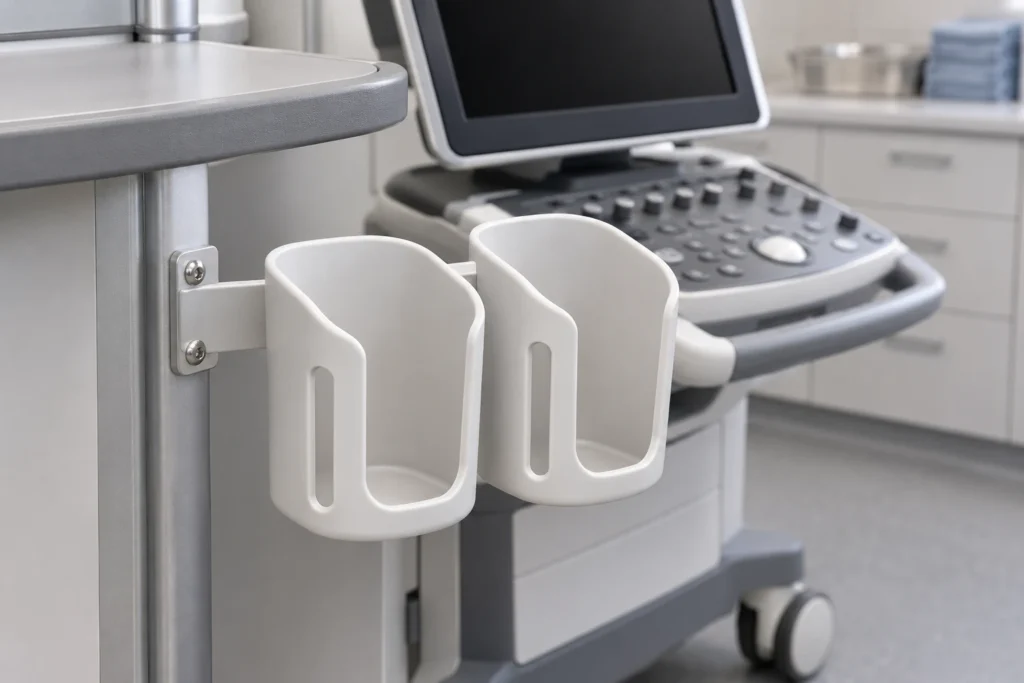
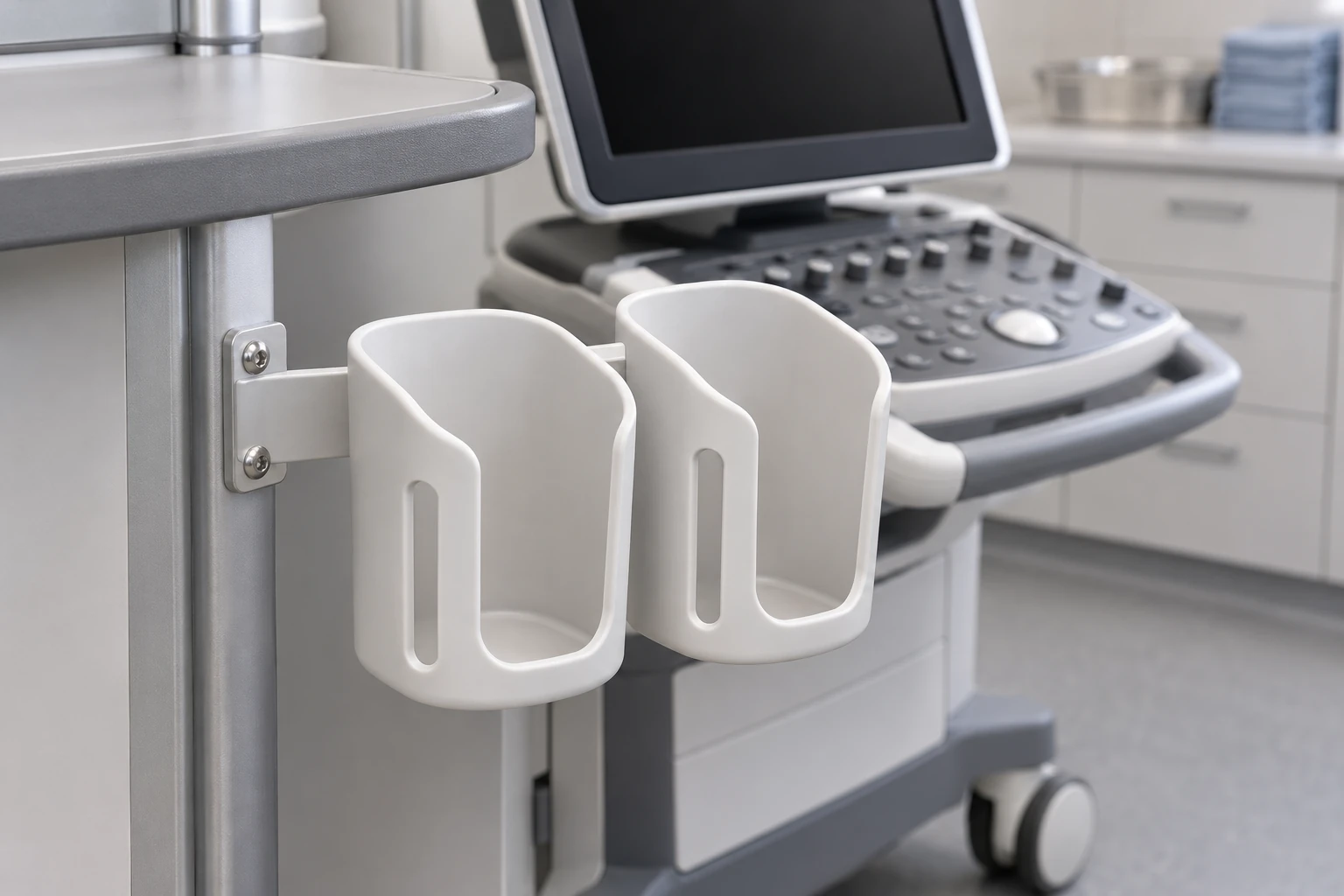
To check ultrasound probe cup holder fit, compare the exact probe body, the holder’s internal profile and depth, the cable exit, and the complete attachment interface. An opening that accepts a probe is not proof that it supports the probe correctly. Review a dimensioned drawing and a representative sample with the device manufacturer’s handling instructions before approving an accessory.
The CRF CB27Z006 dual probe cup holder provides a real accessory reference: two adjacent open-sided cups joined by a support. Its public description does not establish a universal probe fit, mounting pattern or load rating. Those details must be confirmed for the quoted configuration.
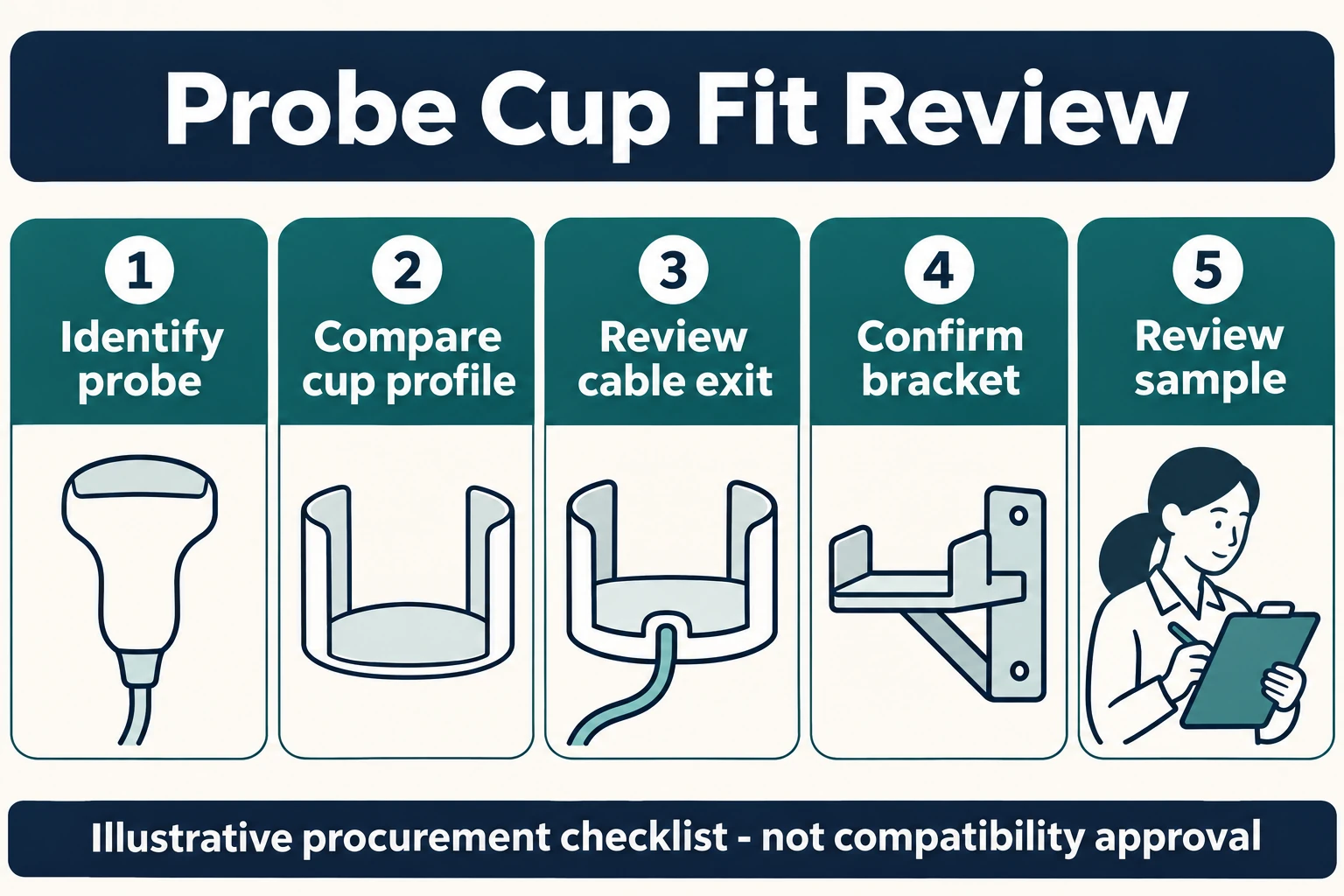
Separate storage support from procedural positioning
A storage cup and a probe-positioning fixture solve different problems. This guide concerns parking a probe on compatible equipment between uses. It does not describe holding a transducer against a patient, sterile storage or an intervention fixture.
Start the RFQ by identifying the intended use. Include the exact device and probe models, the intended equipment cart, and the responsible person who will review compatibility. If several probes will share the accessory, list each separately rather than using “standard ultrasound probe” as a specification.
Record the probe shape, not just its widest dimension
Provide a dimensioned outline or manufacturer-approved drawing showing the body profile and the portions permitted to contact a holder. Identify the intended support location, the cable strain-relief area and any controls that must remain clear. Do not press a sensitive face or connector into a cup merely because the outline appears to fit.
Avoid estimating dimensions from a perspective photograph. Photographs help identify shape and orientation; they do not replace measurements. If a drawing cannot be shared, agree on a documented measurement method and sample review with the appropriate owner.
Build a cup-and-probe fit sheet
A useful fit sheet pairs each probe with each proposed cup. For a dual holder, label the positions so that the approved arrangement remains unambiguous.
| Fit input | What the supplier should show | What the reviewer should confirm |
|---|---|---|
| Entry profile | Opening shape and internal dimensions | Probe can enter in the intended orientation |
| Support region | Contact surfaces and effective depth | Contact is permitted by the probe instructions |
| Cable opening | Slot geometry and orientation | Cable and strain relief are not trapped |
| Adjacent cup | Position and spacing | Both intended probes can be parked without interference |
| Attachment | Complete bracket and fixing details | Interface matches the chosen cart configuration |
| Removal envelope | Space above and around the cup | Probe can be retrieved without striking adjacent equipment |
Leave unsupported values open for supplier confirmation. A supplier’s dimensions for another cup, even one that looks similar, do not define CB27Z006.
Review depth and cable exit together
A deeper cup is not automatically a better match. Its contact location may differ from the intended support region, and a cable opening may not align with the actual cable path. Ask the reviewer to consider the parked position and the full insertion and removal movement.
For the open-sided configuration shown on CB27Z006, request a drawing that identifies the slot, cup profile and support connection. Do not infer the internal shape from the exterior view alone. Ask whether any liner or insert is included; if proposed, record its material and geometry rather than treating it as standard equipment.
Keep cable access separate from connector access
Cable clearance at the cup is one question. Access to a connector on the ultrasound system is another. Record both, but do not make cable routing or connector arrangement the main subject of the cup fit approval. Follow the device manufacturer’s cable-handling instructions; this article supplies no bend-radius or retention-force value.
Check the complete mounting assembly
A cup that matches the probe can still be unsuitable for the cart. Request the support, bracket, fixing parts and mounting location as one identified assembly. Confirm which pieces are included in the quotation and which belong to the existing equipment.
Review the holder’s position relative to the worktop, device, tray, basket and cart controls. Do not drill, reshape or substitute hardware on the basis of a photograph. Changes need an approved engineering review for the actual assembly.
Use a documented sample decision
Before a production order, agree who will assess the sample and what evidence is required. A dimensional inspection, a handling review and any required performance evaluation are separate activities. One successful visual check cannot establish all three.
Record the probe models, holder revision, attachment parts, approved positions, review method and unresolved issues. If one of two probes is acceptable and the other is not, do not describe the entire dual holder as approved. Update the configuration record after changes rather than relying on an old sample photograph.
Procurement checklist
- Exact probe models and intended storage purpose.
- Approved probe outlines and permitted contact areas.
- Cup opening, internal profile, depth and cable-slot drawing.
- Left/right position assignment for a dual holder.
- Complete mounting assembly and included-parts list.
- Removal clearance and adjacent-equipment review.
- Cleaning instructions and material information for the quoted revision.
- Sample, evidence requirements and named approval owner.
FAQ
Is a dual probe cup holder compatible with every ultrasound probe?
No. Fit depends on the probe profile, permitted contact surfaces, cable exit and complete mounting configuration. “Dual” describes the number of cup positions, not universal compatibility.
Can cup diameter alone confirm fit?
No. Internal shape, depth, slot geometry, support contact and removal clearance also matter. A single outside dimension is insufficient.
Does a storage cup establish cleaning or sterile-storage compliance?
No. Request the relevant instructions and evidence for the actual device, accessory and process. Follow the responsible organization’s approved requirements.
Request a configuration-specific RFQ
Send CRF your probe models, drawings or agreed measurements, cart interface, position requirements, quantity and destination. Request a B2B accessory review and identify CB27Z006 so the quotation can address the exact assembly and exclusions.
This is procurement education, not clinical advice or authorization to modify a medical device. Qualified device and engineering reviewers must approve the final application. No universal load, certification, medical-effect, price, stock, MOQ or delivery claim is made.
Request a configuration-specific RFQ from CRF.
For whole-cart placement and cable planning, see the ultrasound cart probe-holder storage review. This component guide focuses instead on the internal cup profile, depth and attachment fit sheet for CB27Z006.