
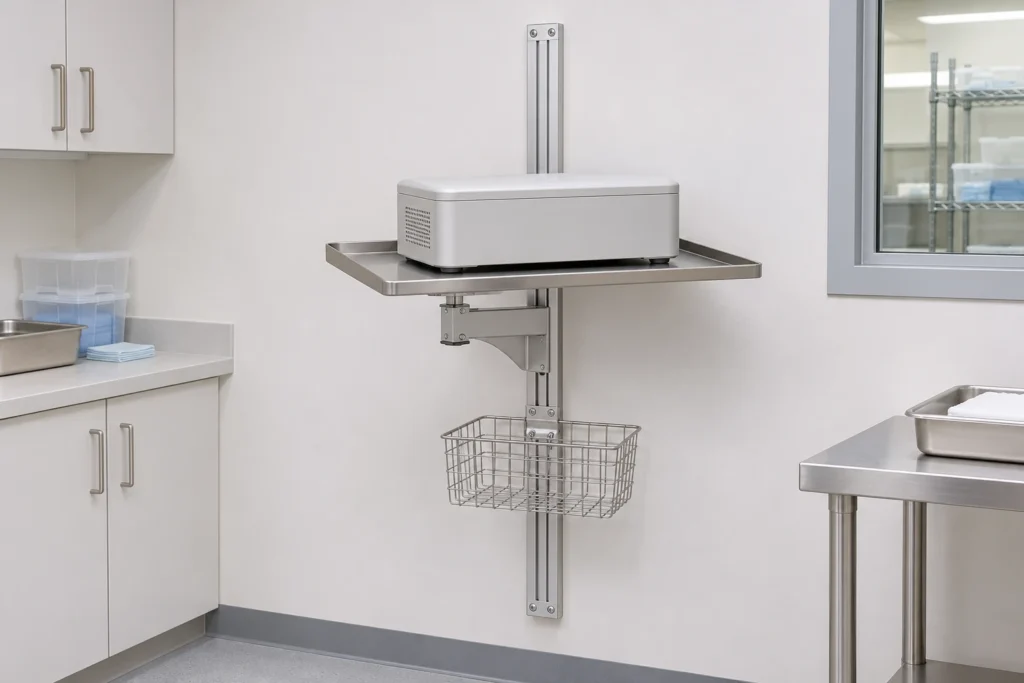
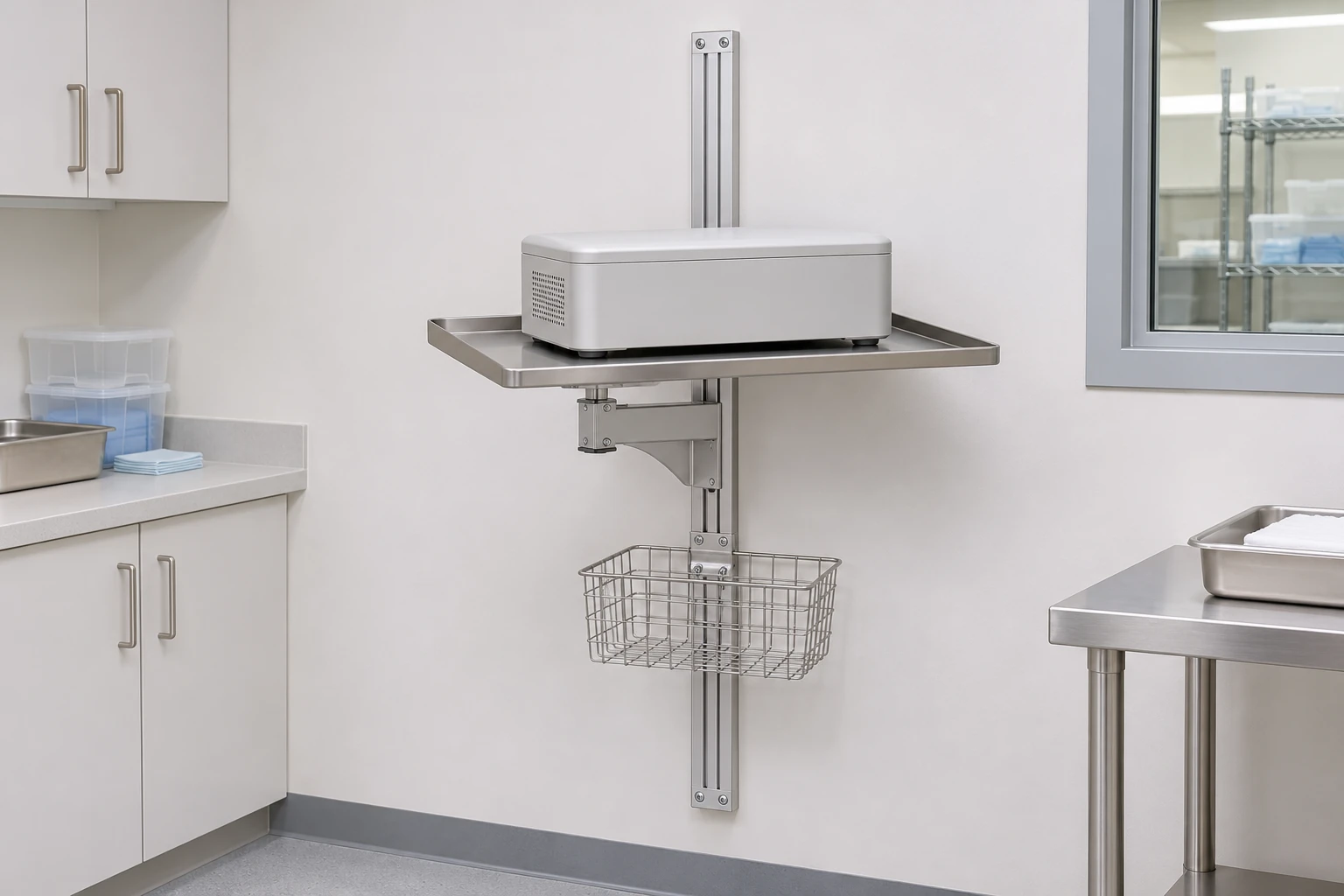
Choose a wall-mounted equipment tray when the device belongs at a defined station and the building can support a verified installation. Consider a mobile equipment cart when the workflow genuinely requires repositioning between locations. Neither approach is automatically safer or more space-efficient: compare the complete device envelope, movement path, mounting interface, cables and service access before requesting a quotation.
This guide is for equipment distributors, OEM teams and facility buyers comparing a fixed station with a mobile arrangement. It is procurement education, not structural, electrical or clinical installation advice. Qualified personnel must approve the actual equipment and site.
Start with where the equipment needs to work
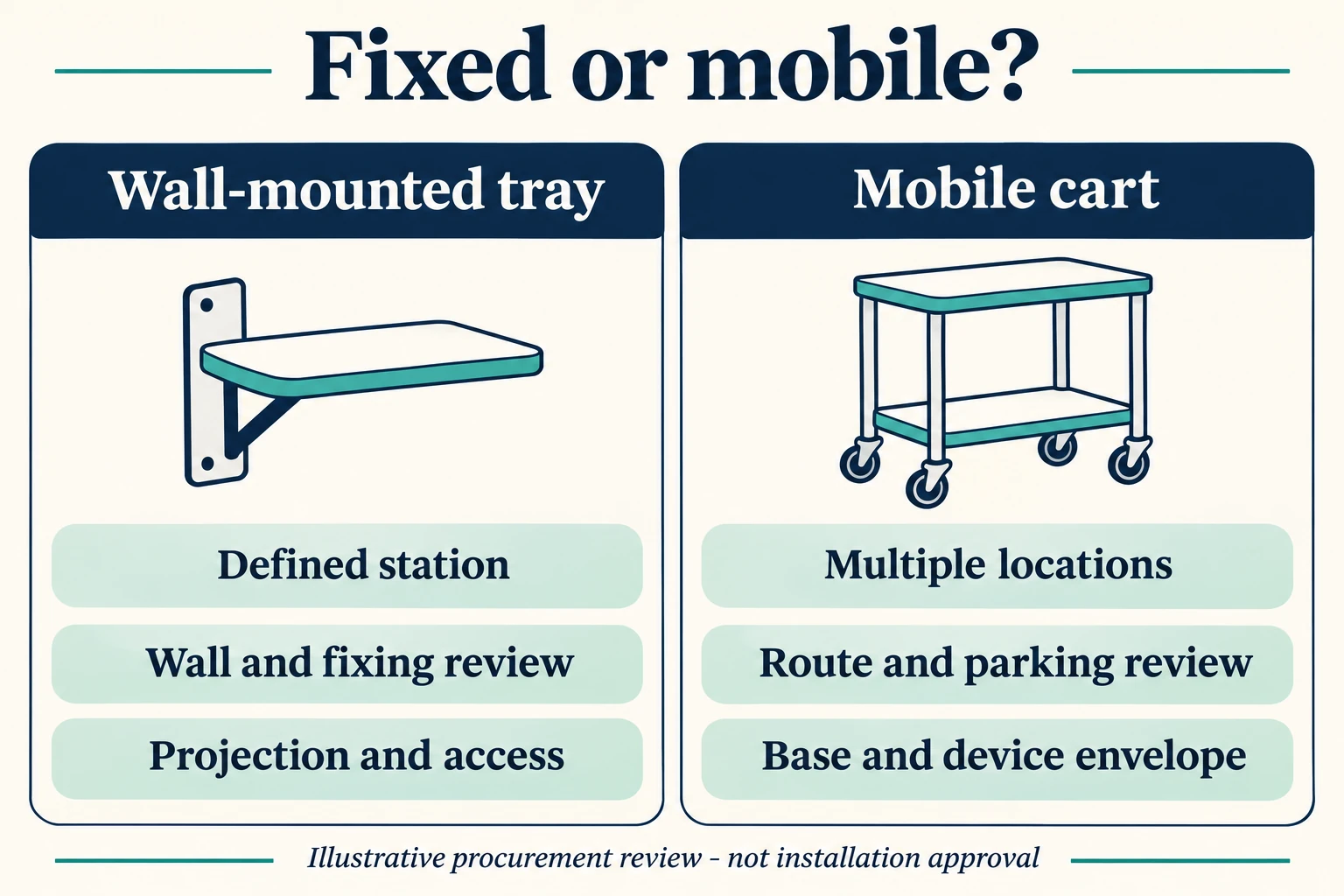
A purchasing brief that only says “save space” leaves several decisions unresolved. A wall-mounted tray may remove a floor base but still project into a circulation area. A cart can be moved, but needs an agreed operating and parking position. Record the places where the equipment is used, stored, connected, maintained and cleaned before choosing either configuration.
One defined station
If equipment normally stays beside a particular work area, investigate a wall-mounted option. Ask facilities staff to identify the wall construction and permissible installation locations. Do not treat a wall photograph, decorative panel or existing hole as evidence that a fixing can support the proposed assembly.
Several work locations
If equipment travels between work areas, document the route, door operation, thresholds and parking arrangements. Include accessories in the movement envelope. A cart drawing without the actual device, handles, connectors and basket contents does not describe the complete arrangement.
Compare the complete configuration, not just the tray
| Procurement question | Wall-mounted equipment tray | Mobile equipment cart |
|---|---|---|
| Where is the device needed? | Confirm the fixed station and permitted reach | Confirm operating locations and travel route |
| What supports the assembly? | Review substrate, rail, arm and specified fixings | Review base, casters and the complete supported configuration |
| What occupies room space? | Include projection and any permitted arm movement | Include base, accessories and parking envelope |
| How are cables handled? | Check connector access and any permitted movement | Check parked and moving states; follow equipment instructions |
| What maintenance is needed? | Preserve access to fasteners and adjacent services | Preserve access to wheels, supports and removable parts |
| What proves compatibility? | Configuration drawing and qualified installation review | Configuration drawing and equipment-specific review |
These are review categories, not performance ratings. Do not infer load capacity, electrical suitability or permitted adjustments from the product category alone.
Two real CRF configurations to review
The CA14Z020 wall-mounted equipment tray with wire basket is presented with a vertical rail, curved supporting arm, rectangular tray, adjustment knobs and a lower wire basket. Its published description explicitly asks buyers to verify the wall substrate, fasteners and equipment interface. That is a starting configuration for an RFQ, not approval to mount any medical device on any wall.
For a mobile alternative, review the CA15Z004 equipment trolley with handled tray and wire basket. Its published configuration includes a handled tray, upper shaft with adjustment knob, wire basket and caster base. Confirm the exact drawing and included components rather than assuming that its tray or accessories match the wall-mounted assembly.
These are separate products. A similar-looking basket does not establish interchangeable parts. Neither page establishes universal device compatibility or a tested load rating for your application. Displayed equipment is not included unless expressly agreed in the quotation.
Build a room-and-device review pack
Identify the complete supported equipment
Send the device manufacturer and model, dimensions, mass, mounting points and intended accessories. Include connector projections and required access to controls, consumables and removable covers. Ask who is responsible for any adapter and how the device is retained. A tray outline alone cannot establish retention or compatibility.
Describe installation and movement constraints
For a wall-mounted request, supply the proposed station, site photographs and available substrate information for qualified review. Request confirmation of the rail, arm, fixing specification and installation responsibility. Do not substitute generic fasteners without an approved review.
For a mobile request, provide the route and parked position. State whether the unit must be moved with equipment attached and request written guidance for that condition. Do not assume that casters, a handle or a compact footprint establish safe movement with the intended load.
Review cables and service access
List power, data and equipment connections. Identify where the cables enter the station and where disconnection or maintenance takes place. Any moving arm or mobile cart needs a review of the permitted movement and connection state. Do not invent an integrated electrical system, battery capability or cable-management feature that is not documented for the selected configuration.
Turn the comparison into an approval checklist
Before a sample is accepted, agree on the configuration identifier, drawing revision, included parts and review responsibilities. Check the actual device fit, connector access and operating envelope against that record. Record unresolved site or device questions instead of allowing a satisfactory photograph to stand in for technical approval.
A useful decision record states why the equipment needs a fixed or mobile position, which configuration was reviewed, which documents support the decision and which limitations remain. If a different device or installation location is introduced later, reopen the relevant compatibility review.
FAQ
Does a wall-mounted tray always save more space?
No. It removes the need for a cart base at that station, but tray projection, any arm movement and access requirements still occupy space. Compare the complete configuration in the actual room.
Can the same device be moved between a tray and a cart?
Only after the two configurations and any required adapters have been reviewed. Similar tray dimensions do not establish identical mounting points, retention or permitted use.
Can CRF confirm the wall anchors from a product photograph?
A photograph alone is insufficient. Provide the site information and obtain a qualified assessment of the substrate, assembly and selected fixings. Agree installation responsibilities before ordering.
Is wall-mounted equipment automatically preferable for infection control?
No general claim is made here. Cleaning procedures, material compatibility and access requirements need review by the responsible facility team for the exact configuration.
Request a configuration-specific RFQ
Send CRF your equipment model, drawing, accessories, proposed station or movement route, quantity and delivery destination. Ask for separate quotations for the wall-mounted and mobile configurations if the workflow decision is still open. Request confirmation of the parts list, interfaces, documentation, packaging and commercial terms through the CRF B2B contact form or sales@szcrftech.com. Final suitability depends on the reviewed device, configuration and installation environment.