

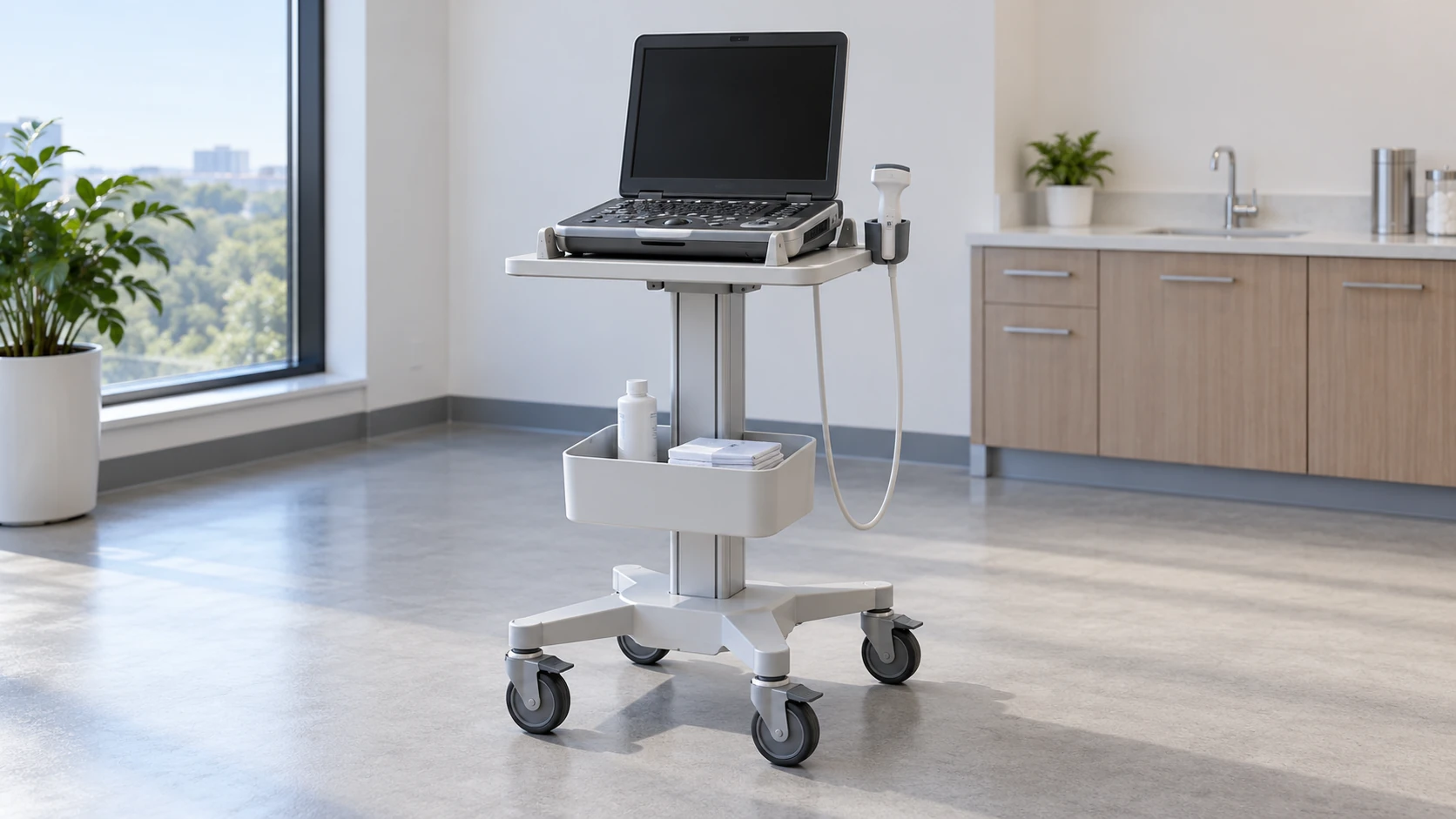
An ultrasound machine fitting on a cart does not establish that it is securely retained. Before approving an ultrasound cart, review the device footprint, the permitted attachment points, the proposed retention method and access to controls, connectors and ventilation. Confirm the complete arrangement with a configuration-specific sample; a wide tabletop alone is not a compatibility certificate.
This guide is for OEM procurement and engineering teams evaluating equipment support, not clinical practice or patient treatment. CRF’s CA13Z115 ultrasound cart with wide tabletop and basket provides a real product reference. Its listing describes a mounted platform with a clamp or bracket. That description does not establish compatibility with every ultrasound device or identify an approved attachment method for a particular manufacturer.

Start with the device underside, not just its outside dimensions
Request the exact device model and hardware revision. A top-view photograph misses feet, underside recesses and other contact details that can determine whether the machine sits as intended.
Identify the actual support points
Record the footprint of the feet, the location of vents and any manufacturer-designated docking or mounting features. Ask the device supplier which surfaces may be supported and which must remain unobstructed. Do not drill the enclosure, remove feet or use existing enclosure screws as mounting points without the device manufacturer’s approval.
Record operating and transport configurations separately
An open display, connected probe or attached power adapter may change the occupied space. Define whether the equipment is expected to remain on the cart during movement and whether the proposed installation is approved for that condition. A photograph taken with the device parked is not evidence for movement suitability.
Compare retention approaches without assuming they are interchangeable
| Approach to discuss | What procurement should confirm | Important limitation |
|---|---|---|
| Device-specific docking interface | Approved device revision, engagement and release procedure | A similar-looking underside is not proof of compatibility |
| Reviewed clamp or bracket | Contact surfaces, fastening details and access clearance | Contact must not obstruct vents or damage the enclosure |
| Supplemental strap, if permitted | Approved route, attachment points and cleaning instructions | A strap is not automatically an acceptable substitute for a dock |
| Tabletop placement alone | Whether the device manufacturer permits this arrangement | Surface area and a raised edge do not establish retention performance |
These are review categories, not a statement that every option is supplied with CA13Z115. Ask CRF to identify the proposed components on the configuration drawing and quotation.
Check access after the retention hardware is installed
A bracket may look acceptable in isolation yet block a connector when the cable is attached. Review power connection, probe connection, service access and the full display movement envelope using the actual intended device and accessories.
Do not route a strap across a control panel or ventilation opening. Avoid relying on a connected cable to restrain the device. Ask the responsible engineering team to define cable support and any required strain relief independently from equipment retention.
The basket is accessory storage, not an assumed structural anchor. Confirm its intended function and attachment before proposing it as part of a retention system.
Build a sample-review record that can be repeated
Use a blank acceptance record rather than inventing a universal test threshold:
- Exact device and cart identification, including revisions.
- Drawing reference and component list for the retention arrangement.
- Device-manufacturer instructions permitting the proposed interface.
- Photographs of support points and installed hardware.
- Connector, ventilation and service-access observations.
- Intended operating and movement conditions.
- Project-specific verification method and acceptance criteria agreed by the responsible parties.
- Deviations, corrective actions and named approval responsibility.
A sample approval applies to the reviewed configuration. Changing the device housing, clamp, platform or attachment hardware should trigger a review of affected interfaces. Do not transfer approval solely because the new machine has similar length and width.
What this review cannot establish
This checklist does not establish working load, dynamic stability, transport qualification, electrical safety or regulatory compliance. Those require applicable documentation and configuration-specific assessment. Existing product photographs are identification references, not test reports. Procurement should obtain the evidence required for the destination market and intended use before making performance claims.
FAQ
Is a tabletop larger than the machine enough?
No. It can be a starting point for placement review, but does not confirm attachment, permitted contact points or suitability during movement.
Can a universal clamp hold any portable ultrasound machine?
Do not assume so. Confirm enclosure geometry, approved contact surfaces, ventilation and the exact clamp configuration with the responsible suppliers.
Does the CRF listing prove that my device is compatible?
No. The listing identifies a candidate cart. Compatibility still requires the device inputs, a proposed arrangement and review of the actual configuration.
Should procurement specify a generic retention test?
Have qualified project stakeholders define the applicable method, conditions and acceptance criteria. Do not substitute an informal movement demonstration for required verification.
Request a configuration-specific RFQ
Send CRF your device model, underside photographs or approved drawings, permitted attachment details, accessory list and intended movement conditions. Reference CA13Z115 and identify what evidence you need for sample approval. Contact CRF for a B2B equipment-cart review; final components, commercial terms and verification scope must be confirmed in the quotation.
Request a B2B RFQ for the exact configuration and documentation scope. Images are AI-generated generic concepts, not exact CRF models, customer installations, approved procedures or performance evidence.