

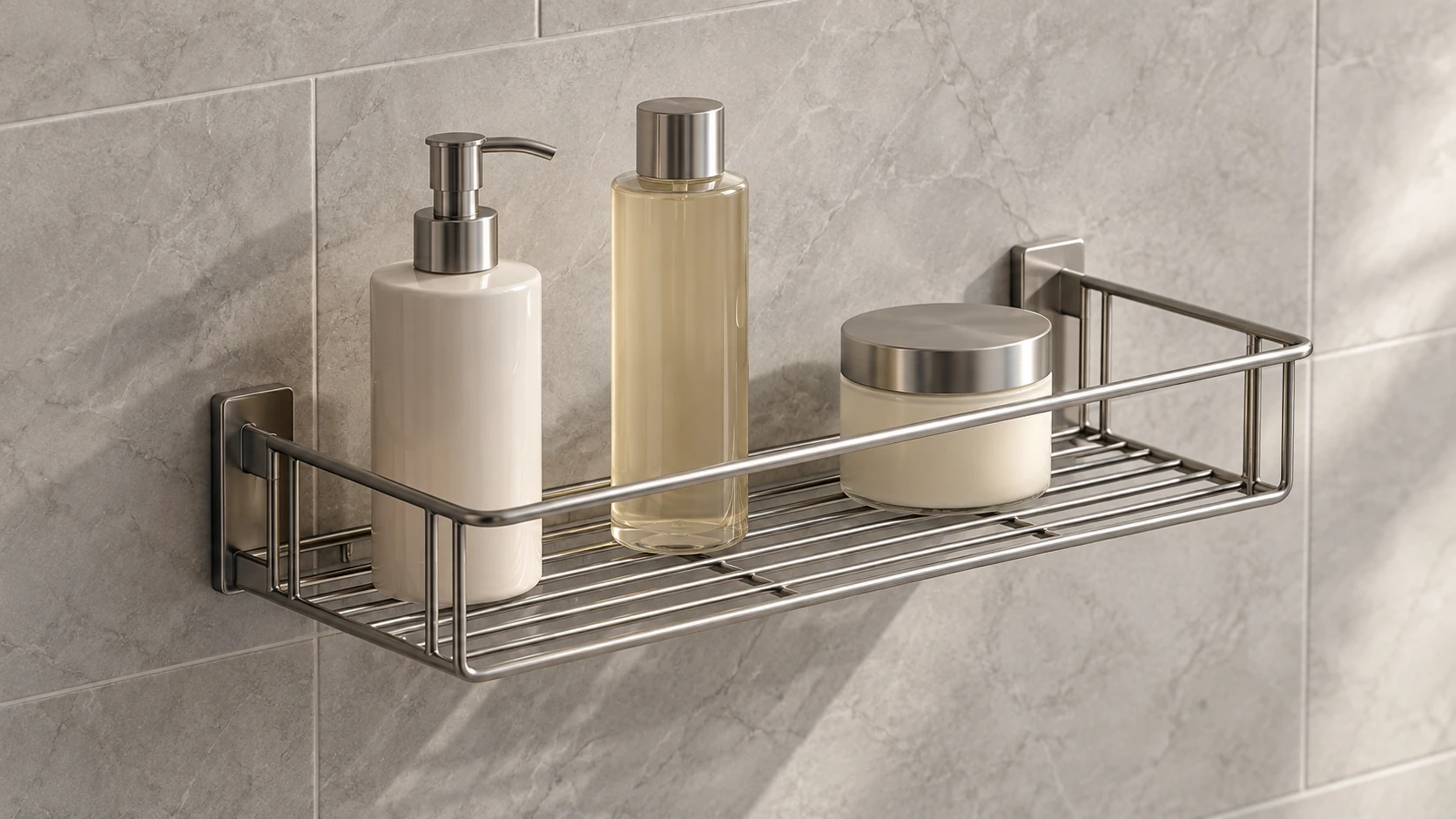
To select a bathroom shelf for toiletries, review usable internal space, the actual bottle bases, access for dispensing and the shelf’s drainage and cleaning arrangement. External shelf dimensions alone do not show whether a planned assortment fits. Open or slotted shelf construction can provide pathways for water, but it does not establish a drainage rate, corrosion guarantee or universal compatibility with bottles and accessories.
For B2B buyers, the useful next step is a sample review using the intended toiletries and the selected shelf variant—not an unsupported capacity claim. This guide covers item fit and storage usability. It does not compare mounting methods or prescribe structural installation.
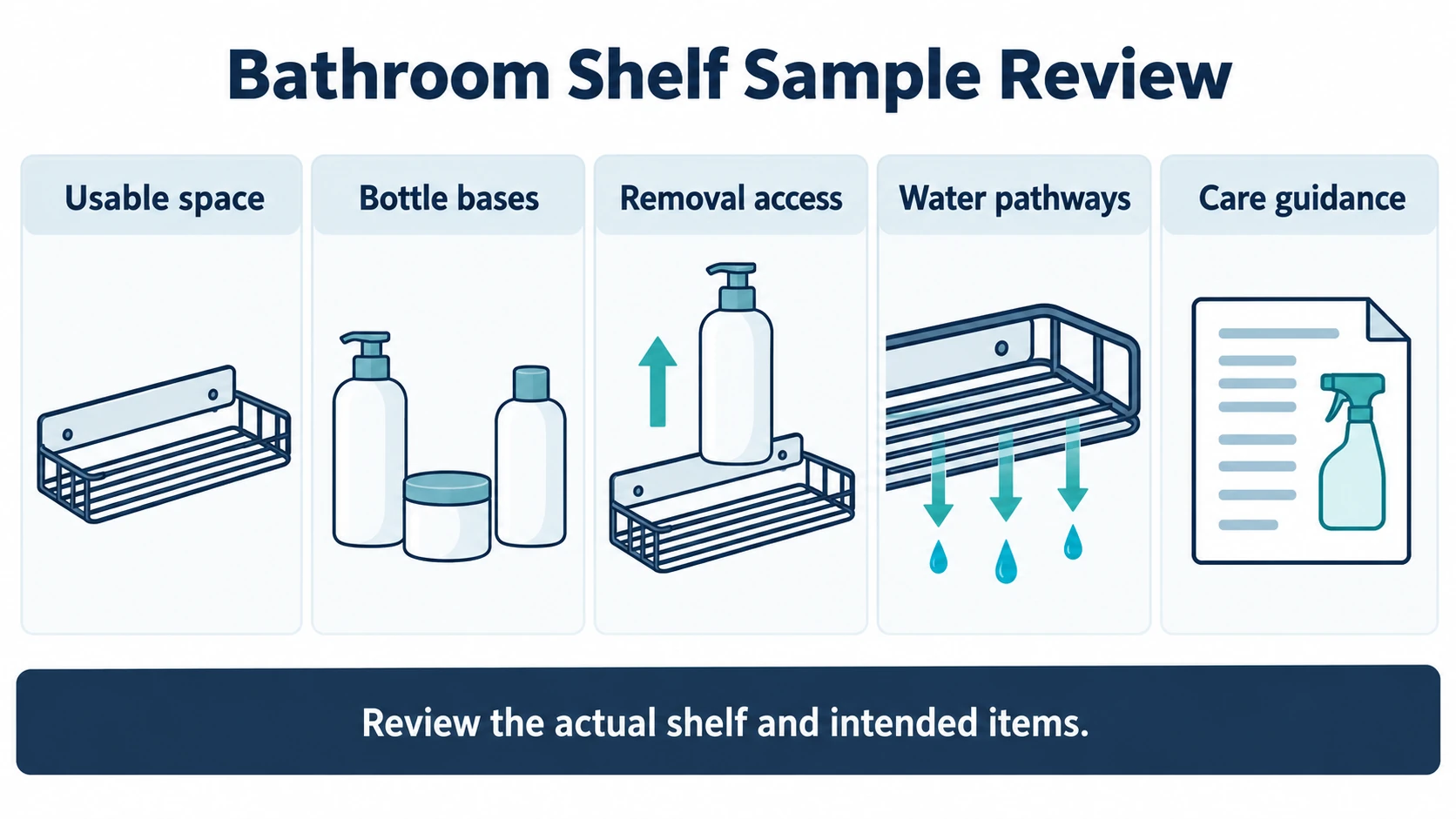
Start with the items, not the catalogue outline
List the toiletries that the shelf must hold. Include each bottle’s base footprint, overall height and intended orientation. Record whether users remove a bottle for dispensing or operate a pump while it is on the shelf. A pump’s working height can exceed the bottle’s resting height.
Also identify small items, such as a soap container or grooming accessory. Some small bases may bridge openings poorly or sit unevenly. Treat this as a sample-check question, not a reason to assume every open or slotted shelf is unsuitable.
The CRF stainless steel corner and rectangular bathroom shelves are a verified current product family. The listing describes slotted shelf surfaces and variant-dependent configurations. Select an exact variant before reviewing space. Dimensions or material wording from one option should not be transferred to another.
External dimensions versus usable storage space
Measure the internal placement area
An outside width can include wire, edging and mounting-related structure. Ask for a current drawing that distinguishes external size from usable placement space. For a corner shelf, identify the internal geometry rather than assuming the entire triangular outline is available for bottles.
Check the front edge and access path
Review how bottles are lifted out, replaced and reached. A retaining edge may affect removal of a large bottle. A shelf above it can restrict access even when a bottle fits underneath at rest. Where products are arranged in multiple rows, check whether front items block access to those behind them.
Review the actual assortment
An arrangement photographed with a few small containers does not establish suitability for larger refill bottles. Test the planned assortment, including realistic spacing and access. Do not convert a promotional photo into a stated bottle count or load rating.
Compare bottle types during sample review
| Item type | Fit question | Evidence to request or record |
|---|---|---|
| Tall pump bottle | Can it be used or removed without obstruction? | Bottle height, pump movement and overhead clearance |
| Wide refill bottle | Does the base sit within the intended storage area? | Actual base footprint and sample placement |
| Small container | Does its base sit consistently on the selected base layout? | Placement observations using the actual container |
| Soap container | Can it be removed and cleaned as intended? | Contact area, accessibility and cleaning instructions |
This table is a review framework. It does not state an approved capacity for CRF shelves. Any permitted loading and operating conditions require supplier confirmation for the selected shelf and fixing arrangement.
Understand what shelf openings do—and does not—mean
The CRF product listing describes slotted surfaces with openings for drainage. That is a design description, not a quantified test result. Bottles, containers and liners can change where water collects or how easy the shelf is to clean.
Review the actual shelf with the intended assortment in a controlled sample evaluation agreed with the supplier. Observe accessible areas where water may remain and how the relevant surfaces can be reached for cleaning. Record the conditions and findings without turning an informal observation into a certified performance claim.
Do not add a solid liner and assume it leaves drainage unchanged. A liner may alter item support, cleaning and water pathways. Obtain supplier review before treating it as part of the approved configuration.
Cleaning access and finish are separate questions
Ask for the selected variant’s material and finish information and appropriate care instructions. Stainless steel wording alone does not establish resistance to every cleaner or bathroom environment. Do not select cleaning chemicals from this article; use the supplier’s documented guidance and the facility’s applicable procedures.
During sample review, check whether the underside, intersections and openings and retaining edges are accessible. Distinguish cosmetic expectations from functional requirements. A smooth-looking image is not evidence of a verified finish inspection or long-term corrosion performance.
Keep storage shelves separate from support devices
A bathroom storage shelf is not a grab bar, handrail or transfer aid. Do not ask users to lean on it or describe it as fall-prevention equipment. A bottle-placement review is not a load test or installation approval.
Wall suitability, fasteners, adhesives where offered, water management at penetrations and permitted loading remain separate installation questions. Follow the approved instructions and competent installation review. This article deliberately does not repeat the site’s mounting-method comparison.
A practical B2B acceptance record
For a selected sample, document:
- The exact shelf variant and drawing revision.
- External dimensions and confirmed usable placement area.
- The bottle and container assortment, with base sizes and heights.
- Placement, removal and dispensing observations.
- Access above and around the shelf in the intended layout.
- Agreed drainage and cleaning review conditions and observed limitations.
- Material, finish, care guidance and unresolved supplier questions.
- Any proposed accessory or liner, recorded separately for review.
Keep the photo record specific to the reviewed sample. Do not reuse an accepted arrangement to approve a different shelf variant automatically. Final dimensions, hardware, rated loading, packaging, price, MOQ and lead time must be confirmed in the quotation or supporting documentation.
FAQ
Can I estimate bottle capacity from outside shelf dimensions?
Only as an initial screening exercise. Final fit depends on internal geometry, bottle bases, retaining edges and access. Use a drawing and sample review; do not publish an unverified bottle-count claim.
Does an open or slotted shelf guarantee that no water remains?
No. Item placement and the installation environment can affect water collection. A construction description does not establish a tested drainage rate or a no-standing-water guarantee.
Is a shelf suitable for operating a pump bottle in place?
That requires review of clearance and the approved loading and fixing conditions. Do not assume in-place dispensing is permitted merely because the bottle fits.
Can a storage shelf be used as a support handle?
No. This product family is described as bathroom storage, not personal support equipment. Specify a separate, suitable support product and obtain the required professional review when that is the need.
Request a variant-specific quote
Send CRF a bathroom shelf RFQ with the selected variant, bottle assortment, intended layout and sample-review requirements. Ask for drawings, care information and configuration-specific documentation before approval. Public enquiries: sales@szcrftech.com.
Request a B2B RFQ for the exact configuration and documentation scope. Images are AI-generated generic concepts, not exact CRF models, customer installations, approved procedures or performance evidence.