
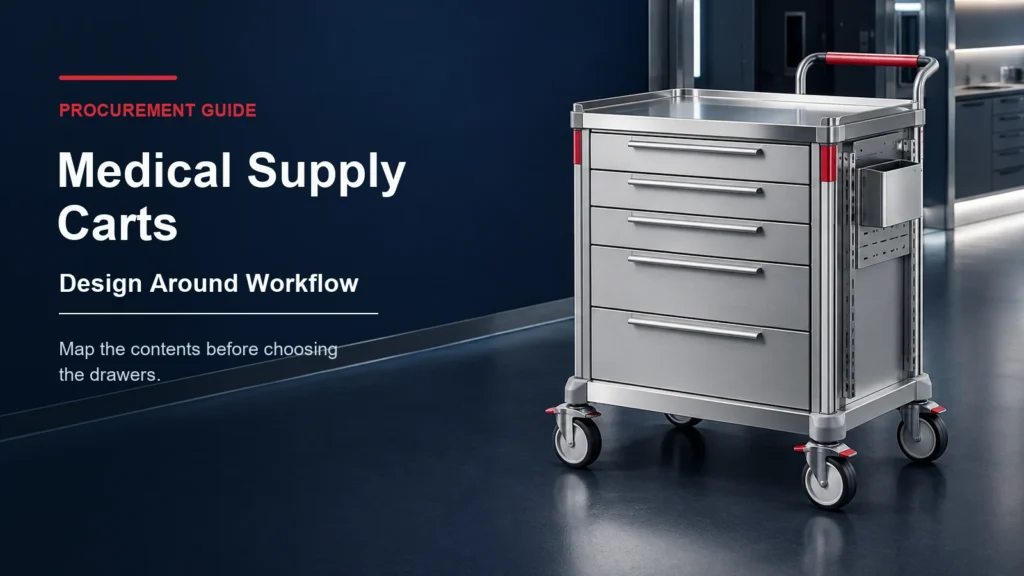
Medical supply carts should be designed from a verified item list and workflow—not from drawer count alone. For a custom OEM/ODM project, buyers should first define what the cart carries, who accesses it, where it moves, how it is cleaned and how supplies are replenished. Those inputs determine the useful internal dimensions, divider layout, access control, caster system, material and finish far better than a catalog photograph.
CRF can manufacture customized carts in aluminum alloy or stainless steel, with structural development, metal processing and assembly based on approved requirements. This article is a procurement framework, not a claim that one cart configuration is suitable for every clinical department or regulatory market.
Buyer takeaway: Attach a drawer-by-drawer content map to the RFQ. Include item dimensions, access sequence, cleaning agents, floor conditions and replenishment method so suppliers can quote the same scope.
What Are Medical Supply Carts?
Medical supply carts are mobile storage and work platforms used to organize and transport supplies, accessories or equipment within a healthcare-related workflow. A project may use open shelves, enclosed drawers, bins, trays, accessory rails or a mixed layout.
The label covers different use patterns:
- General supply carts for consumables and routine support items
- Procedure-support carts arranged around a defined task sequence
- Equipment-and-supply carts combining a mounted device with storage
- Mobile workstation carts integrating technology, peripherals and supplies
- Department-specific carts configured to a buyer-approved item and access map
These categories should not be treated as interchangeable. Contents, access rules, contamination exposure, travel route and restocking process can require different structures.
The Short Answer: Specify Workflow Before Hardware
A quote-ready specification follows this order:
- Identify the users, department and task cycle.
- Build a list of every stored item and its package dimensions.
- Rank items by frequency and sequence of access.
- Map drawers, shelves, bins and work surfaces around that sequence.
- Define security, cleaning, mobility and delivery requirements.
- Review a prototype or approved sample against the real workflow.
Starting with “six drawers” reverses the process. Drawer quantity is an output of the storage plan, not the starting requirement.
Medical Supply Cart vs Medical Equipment Cart
| Decision area | Medical supply cart emphasis | Medical equipment cart emphasis |
|---|---|---|
| Primary purpose | Organized storage and transport | Support and integration of a device or system |
| Key input | Item list, package size and retrieval sequence | Equipment envelope, weight, interface and center of gravity |
| Layout focus | Drawers, dividers, bins, labels and work surface | Mounts, shelves, cable routing, power and service access |
| Security | Based on contents and buyer policy | Based on device, peripherals and buyer policy |
| Stability review | Full drawer and accessory configuration | Installed equipment and accessory load positions |
| Cleaning review | Surfaces, drawer interiors, handles and removable organizers | Surfaces plus cables, mounts, electronics and service zones |
Many projects combine both functions. If a cart supports a monitor or computer and stores supplies, provide both the equipment interface data and the drawer content map.
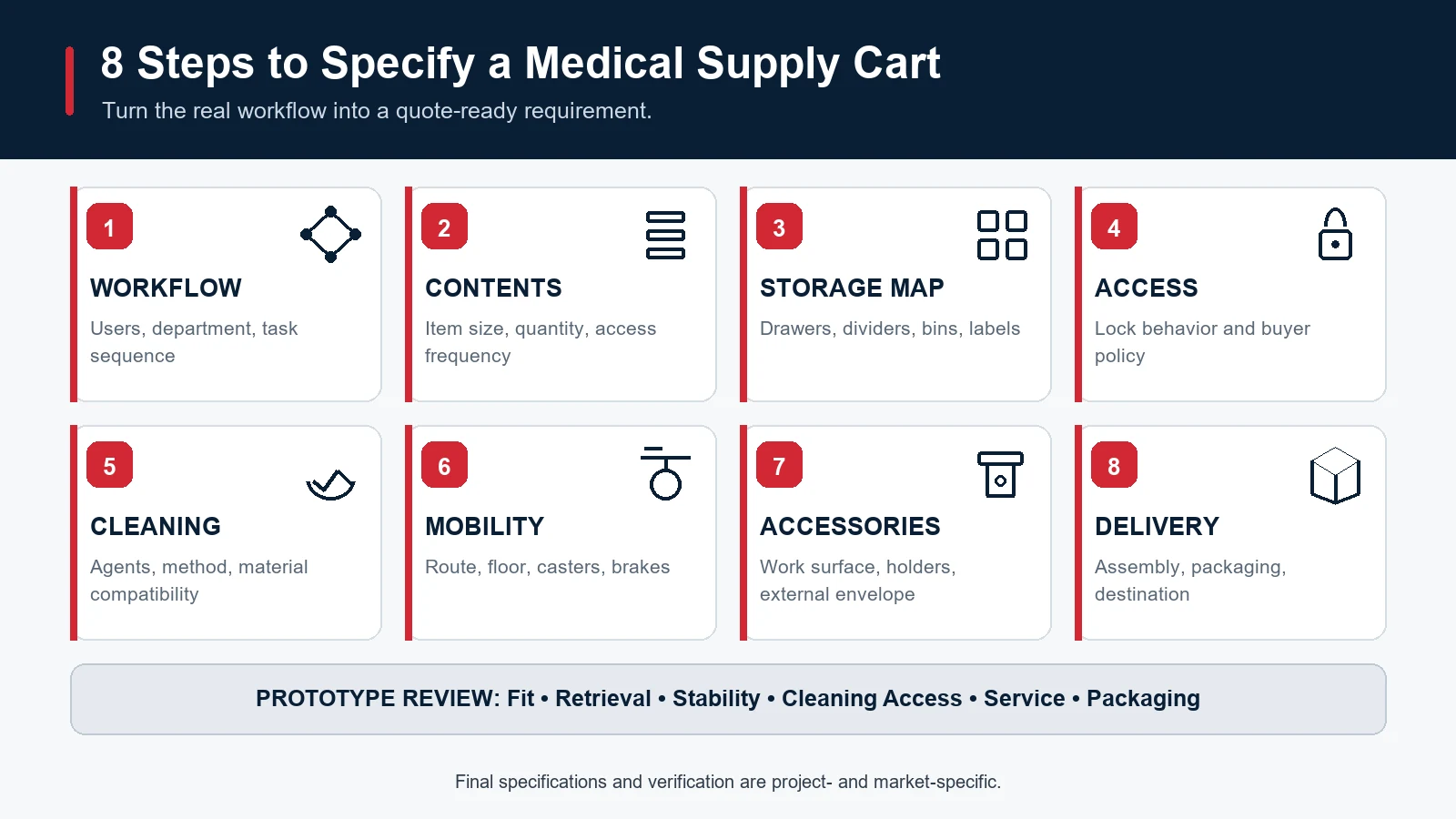
Eight Decisions That Shape a Custom Medical Supply Cart
1. Department and task sequence
Describe the cart’s job from preparation through use, return, cleaning and replenishment. Identify who pushes it, who opens it and which tasks happen at the work surface. If several departments need different contents, decide whether to create separate configurations or a common platform with controlled modules.
2. Stored-item dimensions and quantities
List the external package dimensions and normal quantity of each item. Do not rely on a generic name such as “dressings” or “consumables.” Packaging can change the required drawer height, divider spacing and usable depth.
Group the list into:
- frequent-access items;
- task-sequence items;
- bulky or heavy items;
- restricted items;
- replenishment reserve; and
- accessories mounted outside the cabinet.
Keep heavier items lower when practical, but verify the complete load distribution rather than relying on a rule of thumb.
3. Drawer, divider and bin layout
Specify usable internal dimensions, not only drawer-face dimensions. Confirm drawer extension, slide behavior, stops, removable bins, adjustable dividers and label locations. More drawers do not automatically improve organization: a smaller number of correctly sized, divided drawers may fit the workflow better.
Create a numbered map showing what belongs in each storage zone. That map can become part of prototype review, assembly instructions and acceptance inspection.
4. Access and security
Security depends on the contents and the buyer’s internal procedures. Define:
- who may access the cart;
- when it must be locked;
- whether one lock controls all drawers or selected compartments;
- how keys, codes or credentials are managed;
- the required behavior if power is unavailable; and
- whether an access record is required.
A metal cabinet and lock do not by themselves establish compliance with medication, privacy or controlled-substance rules. The buyer’s compliance team must define the applicable policy and market requirements.
5. Material, surface and cleanability
CRF’s relevant custom manufacturing directions include aluminum alloy and stainless steel. Select between them only after defining mobility, exposure, structure and finish.
For cleanability, review more than the base metal:
- surface texture and finish;
- exposed seams, fasteners and crevices;
- drawer interiors and removable organizers;
- handles, rails and accessory brackets;
- label materials and adhesives;
- caster housings and bumpers; and
- compatibility with the facility’s actual cleaning products.
CDC guidance for noncritical patient-care equipment says compatible cleaning and disinfectant products should be identified in manufacturer instructions or provided on request. It also notes that material compatibility varies by disinfectant; for example, chlorine/hypochlorite products can be corrosive to metals.[3] The practical procurement step is to disclose the intended agents, dilution practice and contact process, then agree what compatibility evidence or review is required.
Do not use “antimicrobial,” “sterile” or similar claims unless the exact material, treatment, evidence and permitted claim have been independently confirmed for the finished configuration and target market.
6. Mobility, brakes and route
Record the route the loaded cart must travel: floor materials, thresholds, gaps, ramps, doorways, elevators, turning areas and storage bays. Define the desired caster diameter, swivel behavior, brake arrangement, noise expectation and bumper needs.
Evaluate mobility with the configured payload. Empty-cart movement does not reveal how a tall load, extended drawer or side accessory affects handling and stability.
7. Work surface and external accessories
List each external item and its operating position. Examples may include a push handle, side shelf, basket, holder, rail, equipment platform or cable organizer. Confirm whether accessories remain attached during cleaning, transport and packaging.
A fold-out surface may improve usable area but can also change the envelope and load position. External accessories can create snag points or difficult-to-clean interfaces if added late. Include them in the original design and prototype review.
8. Replenishment, maintenance and delivery
Define how users identify low stock, remove bins, replace labels and return the cart to its approved layout. Ask how casters, drawer slides, locks and organizers can be serviced or replaced.
For delivery, state whether the cart should arrive assembled, partly assembled or knocked down. Specify carton and pallet constraints, accessory packing, labels, instructions, destination and acceptance checks. A low unit price can be misleading if the packaging method adds assembly work or damage risk.
Aluminum or Stainless Steel for Medical Supply Carts?
Neither material is the universal answer.
Consider an aluminum-alloy direction when:
- frequent movement makes lower frame mass valuable;
- the design combines a column, equipment platform or modular fabricated structure;
- a specified exterior finish and branded appearance are important; or
- the buyer wants a configurable platform architecture.
Consider a stainless-steel direction when:
- the cleaning or moisture exposure justifies review of a stainless structure;
- robust shelves, cabinets or welded assemblies fit the project;
- the workflow can accept a heavier cart direction; or
- the specification can clearly define grade, surface finish, weld treatment and exposed details.
Material selection does not replace engineering or compatibility review. Final mass, rigidity, corrosion behavior and cleanability depend on the complete design, material grade, joints, finish, fasteners and cleaning process. For a deeper comparison, see CRF’s aluminum vs stainless steel medical rolling cart guide.
Build a Drawer-by-Drawer Content Map
Use a simple table as an RFQ attachment:
| Zone | Item or task group | Package size | Normal quantity | Access frequency | Security | Notes |
|---|---|---|---|---|---|---|
| Top surface | Define active work items | Buyer input | Buyer input | Buyer input | Buyer policy | Keep the approved work area clear |
| Upper storage | Frequent-access items | Buyer input | Buyer input | High | Buyer policy | Confirm usable internal height |
| Middle storage | Task-sequence items | Buyer input | Buyer input | Medium | Buyer policy | Define dividers and labels |
| Lower storage | Bulky, heavy or reserve items | Buyer input | Buyer input | Lower | Buyer policy | Review load distribution |
| External accessories | Holders, bins or platforms | Buyer input | Buyer input | Buyer input | Buyer policy | Include in overall envelope |
Do not send confidential patient data or unnecessary sensitive information. The manufacturer needs product and workflow requirements, not protected records.
Prototype Review: What to Test Before Production
A prototype review should be tied to written acceptance criteria. At minimum, check:
- Fit: Do actual packages and accessories fit the usable spaces?
- Retrieval: Can users reach items in the intended order without obstruction?
- Drawer behavior: Do drawers open, stop and close as specified at the intended load?
- Access control: Does the selected lock behave according to the buyer-approved procedure?
- Mobility: Can the loaded cart travel the real route and pass the narrowest point?
- Stability: Review defined drawer, shelf and accessory positions under the agreed test plan.
- Cleaning access: Can users reach surfaces, corners and removable organizers using the intended method?
- Compatibility: Has the material/finish strategy been reviewed against disclosed cleaning products?
- Service: Can agreed replaceable parts be accessed without unintended disassembly?
- Packaging: Does the delivered configuration meet assembly and protection requirements?
The exact test method, loads and pass/fail criteria must be agreed for the project. A visual review alone is not a regulatory or performance certification.
Custom Medical Supply Cart RFQ Checklist
Include these fields when requesting a quote:
- Intended department, users and task sequence
- Cart type: supply, procedure support, equipment-plus-storage or another defined use
- Item list with package dimensions and normal quantities
- Drawer-by-drawer or zone-by-zone content map
- Required usable drawer, shelf and bin dimensions
- Divider, label and removable-organizer requirements
- Access-control and lock behavior defined by buyer policy
- Normal and maximum intended payload with load locations
- Overall width, depth and height limits
- Real travel route, floor conditions, thresholds and turning space
- Caster, swivel, brake, handle and bumper requirements
- Aluminum-alloy or stainless-steel direction, or request for comparison
- Finish, color, texture, edge, seam and visible-weld expectations
- Cleaning products, method, frequency and compatibility requirements
- Work surface and external accessories
- Branding, labels and instructions
- Prototype, pilot and forecast order quantities
- Target market and buyer-specified documents or standards
- Assembly, packaging, pallet and destination requirements
- Spare-part, service and configuration-control expectations
- Target prototype and delivery schedule
CRF’s public manufacturing process invites buyers to start with an idea, 2D/3D drawing, physical sample or installation dimensions, then provide quantity, branding and packaging requirements.[1]
Common Procurement Mistakes
Choosing by drawer count
Two carts with the same drawer count may have very different usable dimensions, divider systems and access behavior. Map the contents first.
Leaving security undefined
“Lockable” does not specify who gets access, what is locked, what happens during power loss or whether records are needed. Convert policy into functional requirements.
Treating “easy to clean” as a specification
Provide the cleaning products and process. Review surfaces, seams, removable parts, labels, handles, casters and material compatibility.
Adding accessories after structural approval
Side-mounted items and fold-out surfaces can change the envelope, balance, packaging and cleaning access. Include them before prototype review.
Comparing incomplete quotations
Separate included components from options. Confirm finish, organizers, casters, locks, packaging, assembly and documentation so quoted scopes are comparable.
Assuming a custom cart is automatically a compliant medical device
Classification and regulatory responsibility depend on intended use, finished configuration, target market and commercial arrangement. Obtain appropriate regulatory and clinical review before production and use.
Why a Custom Metal Manufacturing Partner Matters
A custom partner is appropriate when a standard cart cannot match the approved contents, device interface, workflow, brand system or shipping program. CRF supports structural design, metal processing, assembly and project delivery for custom metal products. Its current medical cart catalog includes ultrasound, ECG, patient-monitor, endoscopy, computer-workstation and other cart directions, demonstrating relevant product-category experience.[1][2]
The value is controlled translation of requirements into drawings, fabricated parts, assembly and agreed inspection—not a promise that one design meets every institution’s rules.
FAQ
How do I choose the right medical supply cart?
Start with the department workflow and a complete item list. Record package sizes, quantities, retrieval sequence, access rules, cleaning products, travel route and replenishment process. Use those inputs to define storage, material, mobility and accessories.
How many drawers should a medical supply cart have?
There is no universal number. Determine drawer count from the usable internal dimensions and drawer-by-drawer content map. A smaller number of correctly sized drawers with suitable dividers may be more useful than more poorly sized drawers.
Is aluminum or stainless steel better for a medical supply cart?
It depends on the complete cart. Aluminum alloy may suit frequently moved or equipment-integrated structures; stainless steel may suit projects where exposure, cleaning or robust cabinet construction drives the design. Review mass, structure, finish and cleaning compatibility together.
What cleaning information should be sent to the manufacturer?
Provide product names or chemistry classes where appropriate, dilution practice, contact time, frequency, application method and any rinse or drying step. Ask what material and finish compatibility information can be supplied. Facility staff must still follow applicable product labels and internal protocols.
Can CRF customize drawer layouts and accessories?
CRF’s confirmed business capability is custom cart manufacturing, including requirement review, structural development, metal processing and assembly in aluminum alloy and stainless steel. Exact drawer systems, locks, accessories, quantities and verification requirements must be reviewed for each project before being promised.
Does a custom medical supply cart automatically meet hospital regulations?
No. Intended use, target market, configuration and buyer policies determine the applicable requirements. The buyer should define required standards, documents and verification with qualified compliance and clinical personnel.
Prepare a Quote-Ready Cart Requirement
Send CRF your item list, drawer map, application, cart envelope, payload, route, cleaning products, access-control requirements, material direction, accessories, quantities, branding, packaging and destination. CRF can review the requirement and discuss a practical custom manufacturing approach.