
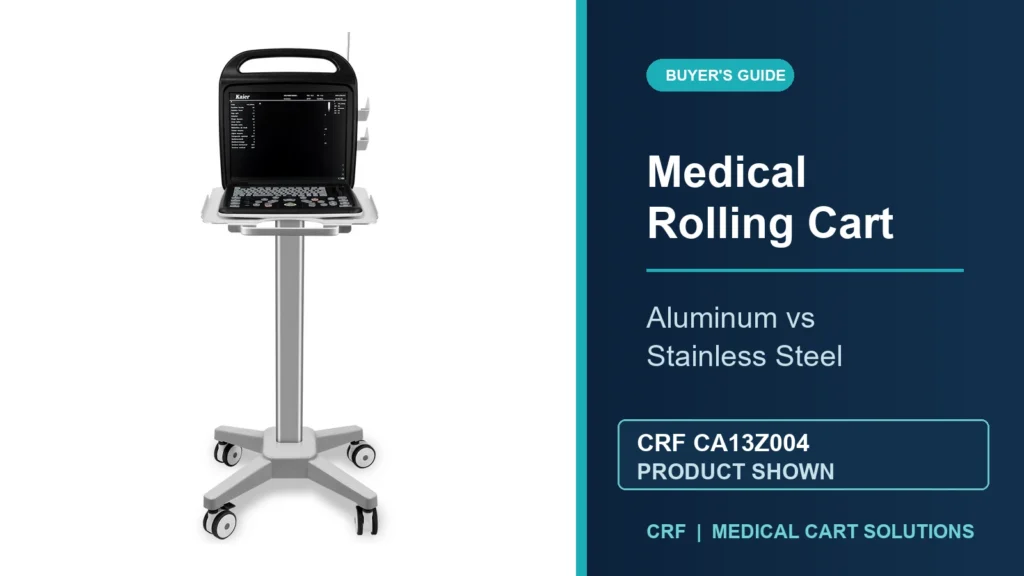
A medical rolling cart should be specified around its real job—not selected from a generic feature list. For an OEM or project buyer, the first material decision usually comes down to aluminum alloy or stainless steel. Aluminum is often the practical starting point when frequent movement, lower frame mass and integrated equipment matter. Stainless steel is often considered when the cleaning regime, exposure conditions or required rigidity justify a heavier structure. The final choice still depends on the payload, footprint, workflow, cleaning agents, accessories and target-market requirements.
CRF manufactures custom metal products and supports overseas brands, distributors and project buyers with requirement review, structural development, metal processing, assembly and project-oriented manufacturing. Its medical cart catalog includes carts for ultrasound, ECG, patient monitoring, endoscopy, computer workstations, IV equipment and other custom clinical applications.[1][2]
Buyer takeaway: Send the application, equipment envelope, payload, target quantity and cleaning requirements before locking the material. A well-defined requirement is more useful than asking for a “standard medical cart” without context.
What Is a Medical Rolling Cart?
A medical rolling cart is a mobile platform or storage structure designed to organize, support or move equipment and supplies within a healthcare-related workflow. Depending on the application, the cart may need open shelves, drawers, equipment mounts, a work surface, cable routing, handles, braking casters, accessory rails or a combination of these features.
The term covers several distinct project types:
- Equipment carts for monitors, ultrasound systems, ECG devices or endoscopy equipment
- Mobile workstations that integrate a display, computer, keyboard tray or peripherals
- Supply and storage carts with shelves, drawers, bins or organizers
- Procedure-support carts configured for a defined department or workflow
- IV and accessory carts that combine a mobile base with dedicated mounting points
These are not interchangeable simply because all have wheels. The supported equipment, center of gravity, cleaning process and daily route can change the appropriate structure.
Aluminum vs Stainless Steel: The Short Answer
Choose the material by evaluating the complete cart system rather than material reputation alone.
This table is a sourcing framework, not a performance certification. Neither material automatically makes a finished cart suitable for a particular hospital, department or regulatory market.
When an Aluminum Medical Rolling Cart Makes Sense
1. The cart moves frequently
For bedside examination, diagnostic equipment movement or mobile workstation use, operators may reposition the cart many times per shift. An aluminum structure can help reduce frame mass, but the buyer should compare the complete configured cart—including devices, drawers, batteries, counterweights and accessories—not the empty frame alone.
2. The product integrates equipment
Aluminum profiles, fabricated panels, columns and trays can support a clean, modular equipment-cart architecture. CRF’s current medical cart catalog includes aluminum-alloy medical cart products and carts for ECG, ultrasound and patient-monitor applications, which confirms this material direction is relevant to its manufacturing scope.[2][3]
3. The exterior finish is part of the product design
A custom project may require a defined color, texture, branding area or enclosure appearance. The finish specification should identify the process, color reference, gloss or texture target, acceptable variation and cleaning-agent compatibility. Do not treat “powder coated” or “anodized” as a complete specification.
4. The buyer wants a platform that can be configured
A cart platform may share a base architecture while changing the shelf, column, monitor interface, handle, drawer or cable-management system. Modular thinking can reduce unnecessary redesign, but every configuration still needs its own load and stability review.
When a Stainless Steel Medical Rolling Cart Makes Sense
1. The cleaning regime drives the design
Stainless steel is commonly evaluated where repeated cleaning, moisture exposure or a durable metal surface is important. The request should name the cleaning agents and process rather than state only “easy to clean.” Material grade, surface finish, weld finishing, joints, fasteners and crevice control all affect the finished product.
2. The cart needs a robust shelf or cabinet structure
A stainless-steel direction may be suitable for utility carts, storage carts or procedure-support structures where buyers prioritize rigidity and a substantial construction. That does not remove the need for engineering: shelf span, distributed and point loads, drawer extension and impact conditions still need definition.
3. The buyer can accept greater cart mass
More mass can be a reasonable trade-off for some stationary or short-route workflows. For frequent travel, evaluate push/pull effort, caster diameter, floor transitions, thresholds and turning space with the real payload.
4. The specification controls exposed details
For a stainless cart, a useful RFQ identifies the target grade, surface finish, visible weld expectations, edge treatment and permitted material substitutions. “Stainless steel cart” alone leaves too much open to interpretation.
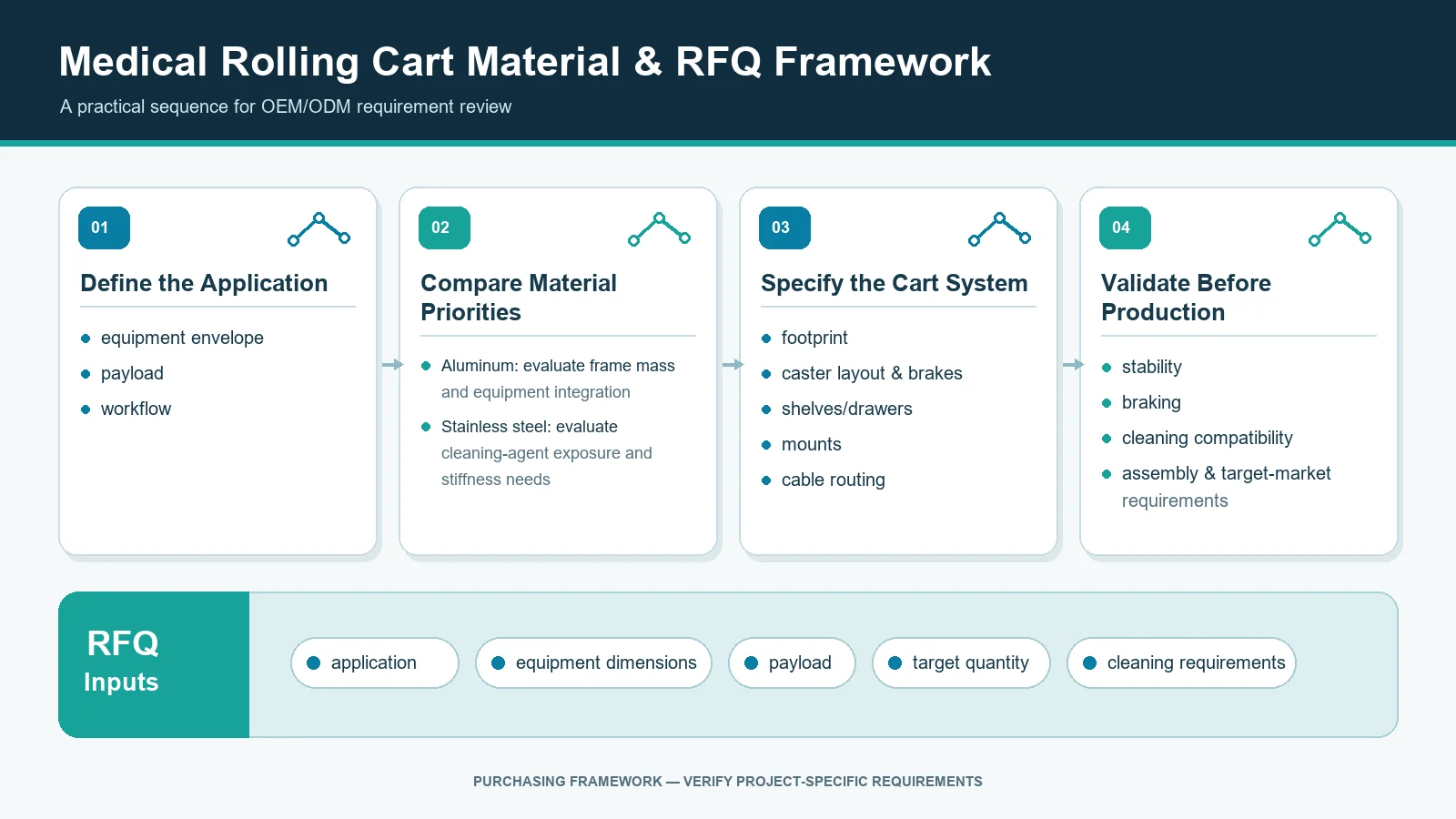
The Cart Is a System: Seven Decisions Beyond Material
1. Payload and load position
State the normal payload, maximum intended payload and where the load sits. A tall display or side-mounted device affects stability differently from evenly distributed supplies. Include the equipment’s dimensions, mounting pattern and center-of-gravity information when available.
2. Footprint, travel path and turning space
Provide the maximum cart width, depth and height. Note doorways, elevators, bedside clearances, ramps, thresholds and uneven transitions. A compact footprint is not automatically better if it reduces stability or usable storage.
3. Caster and braking behavior
Define wheel diameter, floor type, noise expectations, swivel behavior and braking logic. Confirm whether two-wheel braking, total-lock casters or another arrangement is required. Casters should be chosen as part of the loaded system, not as an accessory after the frame is complete.
4. Work surface and storage layout
Map what users need to reach first. Specify shelf spacing, drawer quantity, drawer extension, bins, dividers, handles and accessory locations. A simple workflow sketch can prevent expensive layout changes later.
5. Equipment mounting and cable management
Provide the interface drawing or physical sample for mounted devices. Identify cable entry and exit points, bend limits, power-adapter locations and service access. Cable routing should avoid pinch points and should remain accessible for maintenance.
6. Cleaning and surface requirements
List cleaning agents, concentration or dilution practice when known, contact time, frequency and whether the cart is wiped, sprayed or otherwise processed. Ask the supplier to review material and finish compatibility. Avoid unverified “antimicrobial” claims unless a specific material or coating has documented evidence and approval for the target market.
7. Packaging and delivery constraints
State whether the cart should ship assembled, partly assembled or knocked down. Include carton limits, pallet requirements, destination, labeling, spare-parts expectations and any installation instructions needed by the buyer.
A Practical RFQ Checklist for a Custom Medical Rolling Cart
Send the following information with your inquiry:
- Application: department, workflow and what the cart carries
- Equipment data: dimensions, weight, mounting pattern and drawings or sample availability
- Payload: normal and maximum intended loads with load locations
- Envelope: maximum width, depth and height
- Material direction: aluminum alloy, stainless steel or request for comparison
- Surface requirement: finish, color, texture and appearance standard
- Mobility: caster diameter, floor conditions, brakes and noise expectations
- Storage: shelves, drawers, bins, dividers and security needs
- Accessories: monitor mount, IV pole, handle, keyboard tray, scanner holder, cable management or other interfaces
- Cleaning: agents, method and frequency
- Quantity: prototype quantity, pilot quantity and forecast order quantity
- Branding and packaging: logo method, labels, manuals, carton and pallet requirements
- Target market: destination countries and buyer-specified standards or documentation
- Schedule: target prototype and delivery timing
CRF asks buyers to start with an idea, 2D/3D drawing, physical sample or installation dimensions, together with target quantity, branding and packaging requirements.[1]
From Requirement to Finished Product
A custom cart project should move through controlled decisions:
- Requirement review — align the application, loads, dimensions, interfaces and commercial scope.
- Structural design — develop the frame, mounting, storage and movement concept.
- Metal processing — fabricate parts to the approved design and material/finish callouts.
- Assembly and integration — assemble the cart and fit approved components.
- Inspection — check the agreed dimensions, appearance and project requirements.
- Packaging and delivery — protect the configured product for the selected shipping method.
CRF presents this requirement-to-delivery sequence as its standard project path.[1]
Prototype questions to close before production
- Does the configured cart fit the largest intended device?
- Is the cart stable across expected drawer, shelf and accessory positions?
- Can users reach brakes, handles, controls and supplies naturally?
- Do cables remain protected through height adjustment and movement?
- Are surfaces, joints and edges compatible with the agreed cleaning process?
- Does the cart pass through the narrowest real route?
- Is the packaging method practical for destination handling and assembly?
The exact verification plan should be agreed for the project and target market. Do not assume that a generic inspection proves regulatory compliance.
Common Sourcing Mistakes
Selecting material before defining use
“Aluminum is lighter” or “stainless steel is durable” may be directionally useful, but neither statement defines the finished cart. Start with use conditions and total configuration.
Copying a catalog cart without checking the equipment interface
A similar-looking product can have a different mounting pattern, load distribution or cable path. Supply interface drawings or a sample whenever possible.
Treating casters as a commodity
Wheel material, diameter, bearing, swivel and brake design affect handling. Evaluate the caster set on the floor and under the expected load.
Requesting unsupported compliance language
Ask for the exact documents and test scope required by your organization or target market. Do not convert a company-level certificate, material declaration or component report into a blanket claim about a finished custom cart.
Asking for a firm quote with missing requirements
A quote based on an undefined payload, finish, accessory set or packaging method is likely to change. A concise RFQ brief improves both pricing accuracy and development speed.
Why Work With a Custom Metal Manufacturing Partner?
A custom partner is useful when the cart must fit an existing device, brand system, department workflow or distribution program. CRF supports structural design, metal processing, assembly and OEM/ODM product development from its Shenzhen manufacturing operation. The company states that it was founded in 2003 and operates approximately 10,000 square meters of manufacturing space.[1]
The value of that capability is not a claim that one cart suits every market. It is the ability to evaluate a defined requirement and develop a manufacturing approach around approved drawings, samples and configuration data.
FAQ
Is aluminum or stainless steel better for a medical rolling cart?
Neither is universally better. Aluminum is often evaluated for frequently moved equipment carts and workstation structures; stainless steel is often evaluated where the cleaning regime or robust shelf/cabinet construction drives the project. Compare the complete configured cart and its real workflow.
What information is needed to quote a custom medical cart?
Provide the application, equipment dimensions and weight, payload positions, maximum cart envelope, material and finish direction, caster requirements, storage/accessory layout, cleaning agents, target quantity, destination and schedule.
Can a medical rolling cart be customized around existing equipment?
Yes, when the manufacturer receives reliable interface data such as a 2D/3D drawing, mounting pattern, installation dimensions or physical sample. The resulting design should be prototyped and reviewed before production.
Should I request an antimicrobial medical cart?
Only request antimicrobial language when you can define the required material or coating and obtain suitable evidence for the intended claim and market. A hygienic design also depends on surfaces, joints, fasteners, crevices and the validated cleaning process; a marketing label is not a substitute.
What caster details should be included in the RFQ?
Include floor types, thresholds, desired wheel diameter, noise expectations, swivel behavior, brake arrangement and the complete loaded cart mass. If a specific caster or supplier is required, provide that information explicitly.
Does a custom medical cart automatically meet medical-device regulations?
No. Regulatory responsibility and classification depend on the finished product, intended use, target market and supply arrangement. Define required standards, documentation and verification with the appropriate compliance professionals before production.
Build a Better Medical Rolling Cart Brief
If you are sourcing an aluminum or stainless steel medical rolling cart, send CRF your application, drawings or sample, equipment dimensions, payload, cart envelope, accessory list, cleaning requirements, quantity and destination. CRF can review the requirement and discuss a practical custom manufacturing approach.