
A medical cart push handle should be reviewed with the intended equipment, accessories and operator hand space in place—not as an isolated frame feature. Before ordering, confirm which component is the designated handhold, whether fingers can clear adjacent parts, and whether the approved configuration can be moved without holding a device, basket or cable. A low or prominent handle in a catalog image is not proof of ergonomic suitability.
This guide focuses on push-handle access and clearance during equipment integration. It does not specify a universal handle height, certify a CRF configuration or replace a workplace handling assessment.
Start with a real configuration, not a generic cart silhouette
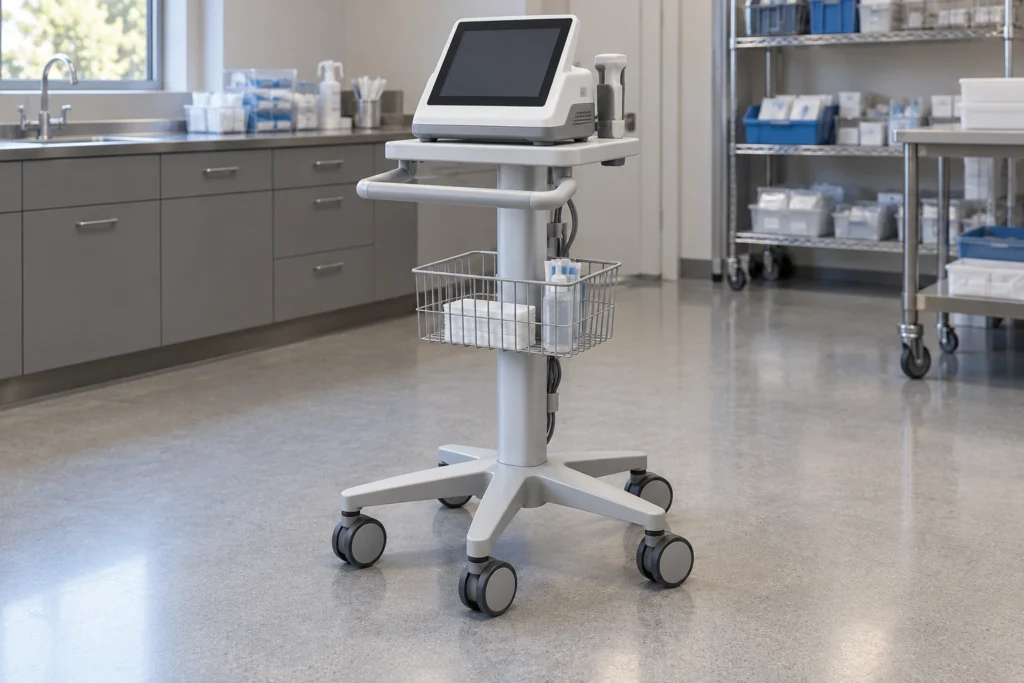
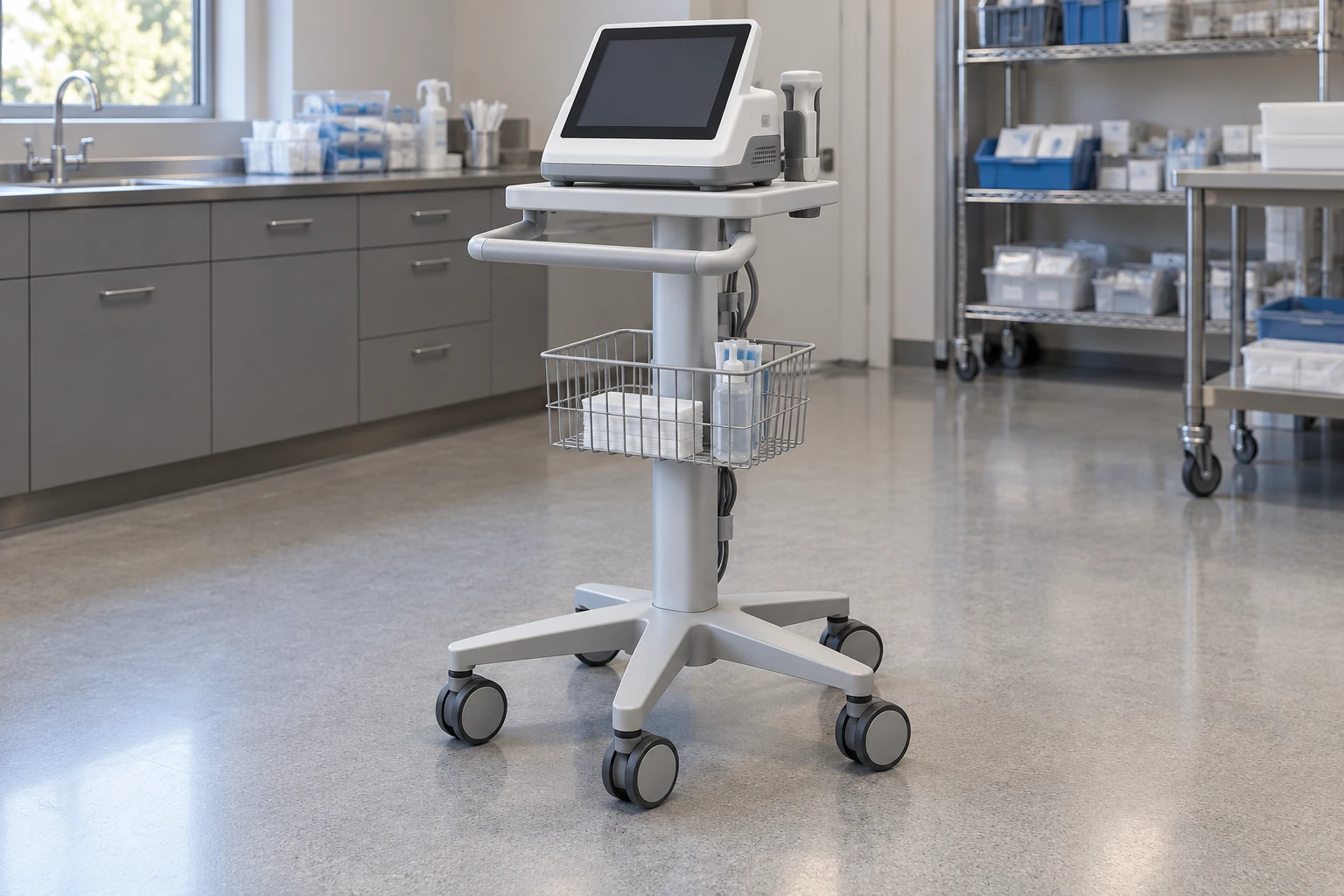
CRF lists the CA15Z045 medical equipment cart with low front handle. Its published description identifies an upper platform, upright, basket, low forward-projecting handle and five-arm caster base. The page explicitly labels the product image as an AI reference-guided visualization, not documentary photography or engineering evidence.
Use that listing to identify the configuration to discuss with CRF. Do not measure the image or interpret the handle position as approved for every operator. Request a current drawing, genuine configuration photographs and a representative sample before accepting mechanical fit. The article does not claim that an adjustable handle or a particular handle material is supplied.
Three clearance questions for the integration drawing
1. Can the hand reach the intended grip?
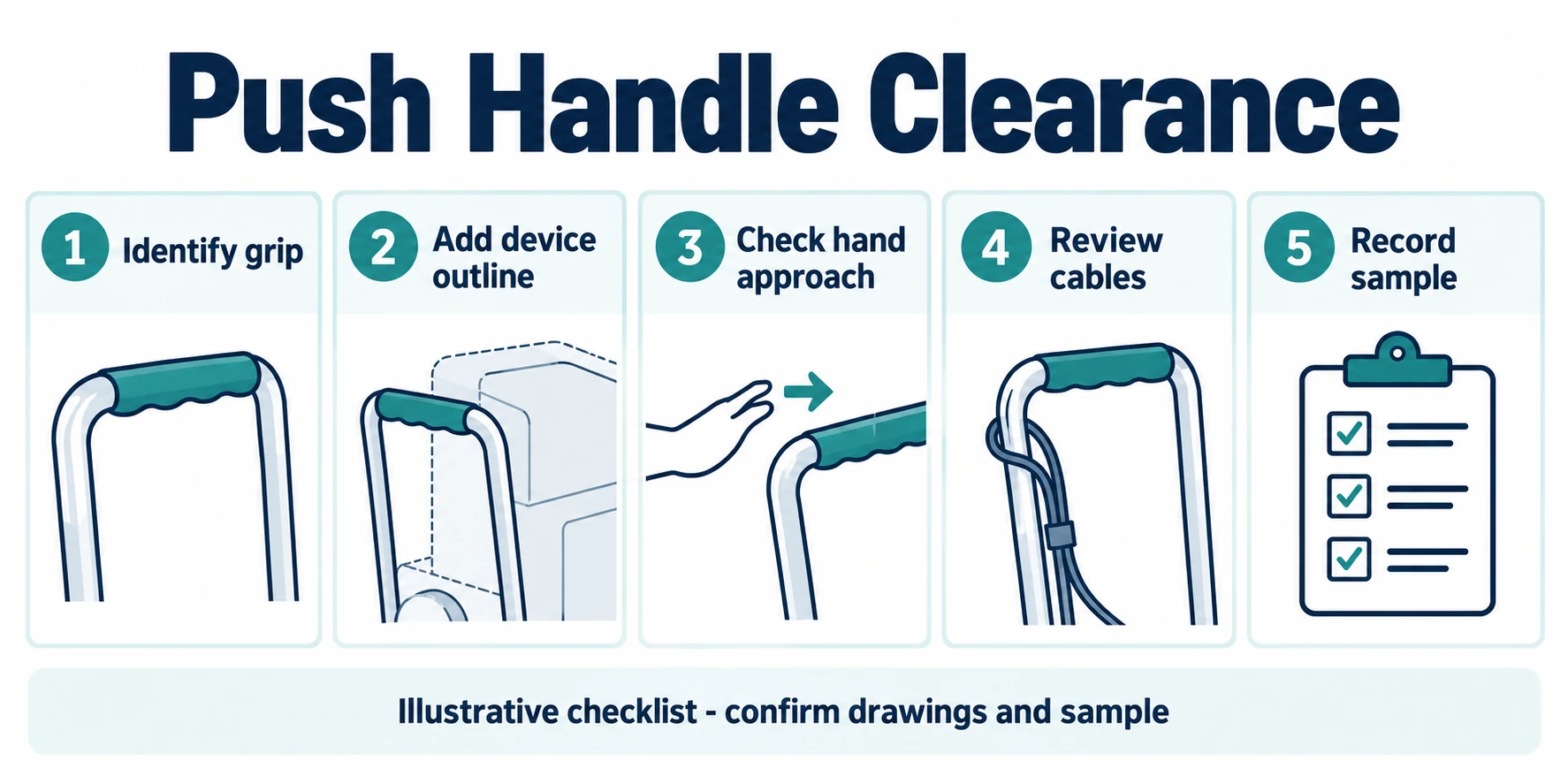
Mark the designated handhold on the drawing. Show nearby platform edges, basket rims, device overhang and accessory brackets. Review the approach to the grip as well as the space around a hand already holding it. An opening that appears adequate from the front may be obstructed from above or from the side.
If users wear gloves, include the intended glove condition in sample review. Record observations rather than inventing a universal clearance allowance. Ask the responsible ergonomics or safety reviewer to define the acceptance conditions for the actual workforce.
2. Does access remain available after equipment installation?
Repeat the check with the specified device, adapter, cable connectors and storage arrangement. A bare-frame check cannot establish access after a device projects beyond the platform or a basket is loaded.
Identify the permitted cable route without treating the handle as a cable reel. Confirm whether connectors, hooks or loose leads enter the grip approach. If an accessory location changes, reopen the handle-access review rather than assuming the previous sample approval still applies.
3. What moves close to the operator’s hands?
Include swivel-caster positions, adjustable accessories and opening storage components where applicable. Ask whether the approved hand position remains clear during the intended maneuver. This is a request for application-specific review, not a claim that a particular design prevents pinching or collision.
Compare the proposal and the assembled sample
| Review item | Drawing or quotation evidence | Sample question |
|---|---|---|
| Designated handhold | Annotated component and mounting location | Is the intended grip identifiable without using the device? |
| Hand approach | Adjacent parts and equipment envelope | Can the intended user reach it in the reviewed glove condition? |
| Device overhang | Device outline and connector projection | Does the installed device obstruct the grip? |
| Cable route | Agreed routing and retention positions | Do leads enter the hand-access area? |
| Configuration revision | Drawing and accessory-list revision | Does the sample match the configuration being purchased? |
A horizontal grip, vertical grip and integrated tray handhold are not automatically interchangeable. They change the available hand positions and the way accessories can obstruct access. Compare them within the actual configuration; do not select from appearance alone.
Separate clearance approval from handling performance
An accessible grip does not establish acceptable starting force, stopping behavior or maneuverability. Those depend on the assembled load, wheels, maintenance and route as well as handle design. Review those issues separately with qualified personnel.
The occupational-safety resource Using Carts in Healthcare discusses handles alongside cart dimensions, casters and environmental conditions. It is general guidance, not CRF product certification. No illustrations or diagrams from that publication are reproduced here.
For wider configuration planning, see CRF’s medical equipment cart OEM integration guide. Keep this handle-specific checklist as an input to that project rather than a substitute for complete sample approval.
RFQ checklist
Send CRF the equipment model and outline, installed weight, connector locations, desired handhold location, glove conditions, accessory layout and intended route description. Include annotated interference concerns and the required drawing revision. Ask CRF to confirm feasibility, supplied components and sample-review scope in the quotation. Do not assume accessories, tests or commercial terms are included.
FAQ
Is a lower medical cart handle always better?
No. A lower position may affect reach and posture differently for different users and tasks. Review the actual assembled configuration with qualified workplace personnel rather than using image position as a selection rule.
Can a basket rim or device handle be used instead?
Do not assume so. Ask the supplier to identify the designated cart handhold and follow the approved operating instructions. Storage components and equipment handles are not automatically approved cart push points.
Can handle clearance be approved from a rendered image?
No. A rendered image can identify a proposed layout, but it cannot establish dimensions, strength, operator clearance or actual assembled fit. Request appropriate drawings and sample evidence.
Does this checklist establish safe handling limits?
No. It is procurement education. Application-specific ergonomics, mechanical and medical-equipment integration requirements need qualified review.
Request a configuration-specific review
Send CRF an RFQ with your equipment outline and marked hand-access concerns. Request confirmation of the proposed handle configuration and the evidence needed for your own acceptance process.