

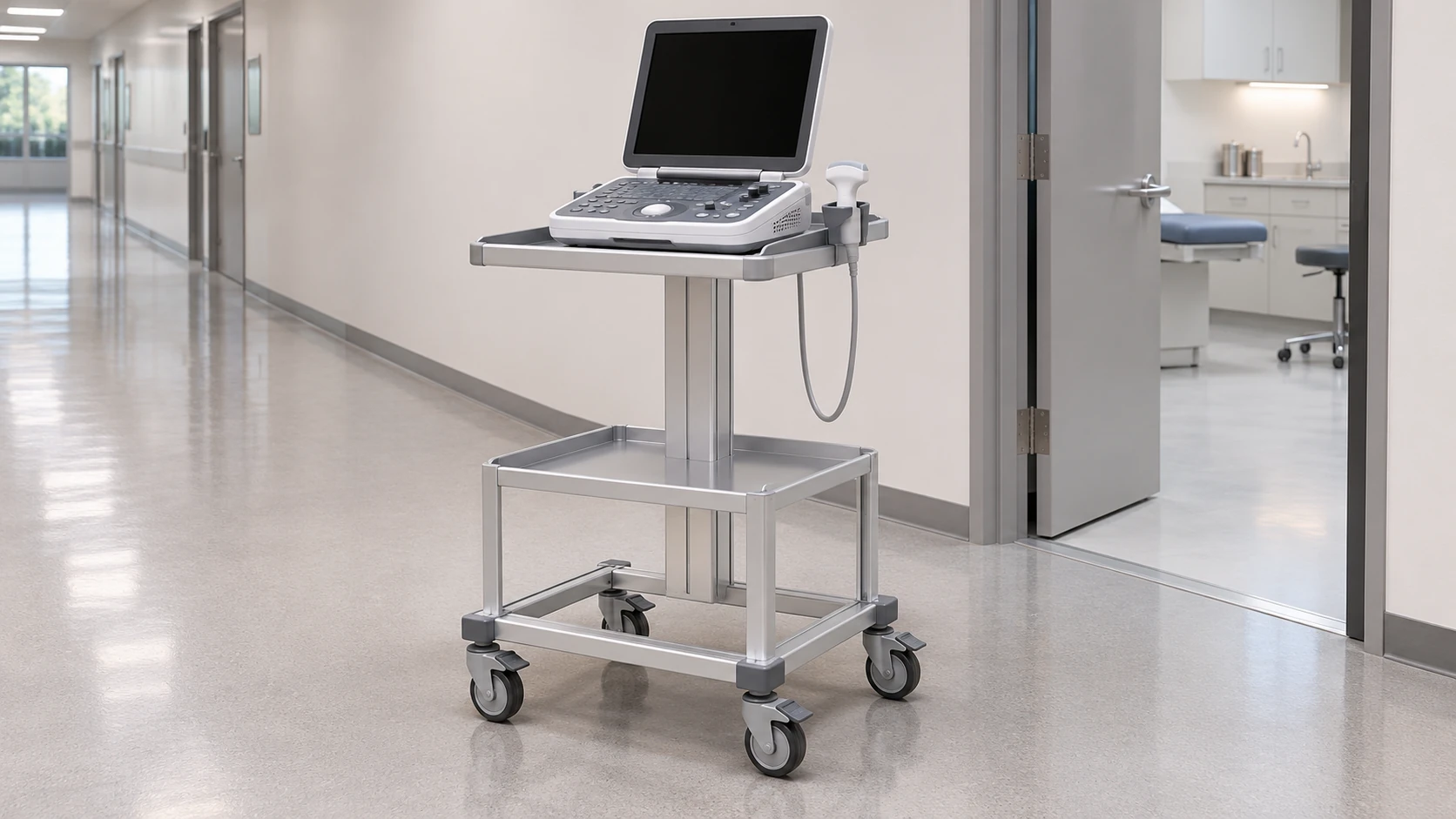
To assess medical cart doorway clearance, compare the narrowest usable opening and the complete travel route with the cart in its actual transport configuration—not just its tabletop width. Include the base, handles, equipment, holders and secured cables, then review the approach, turn and exit with a representative sample. A cart described as compact is not automatically suitable for every doorway.
This guide is for equipment OEMs and procurement teams reviewing a mobile equipment support cart. It is not a building-code assessment, an accessibility certification or a clinical operating instruction.
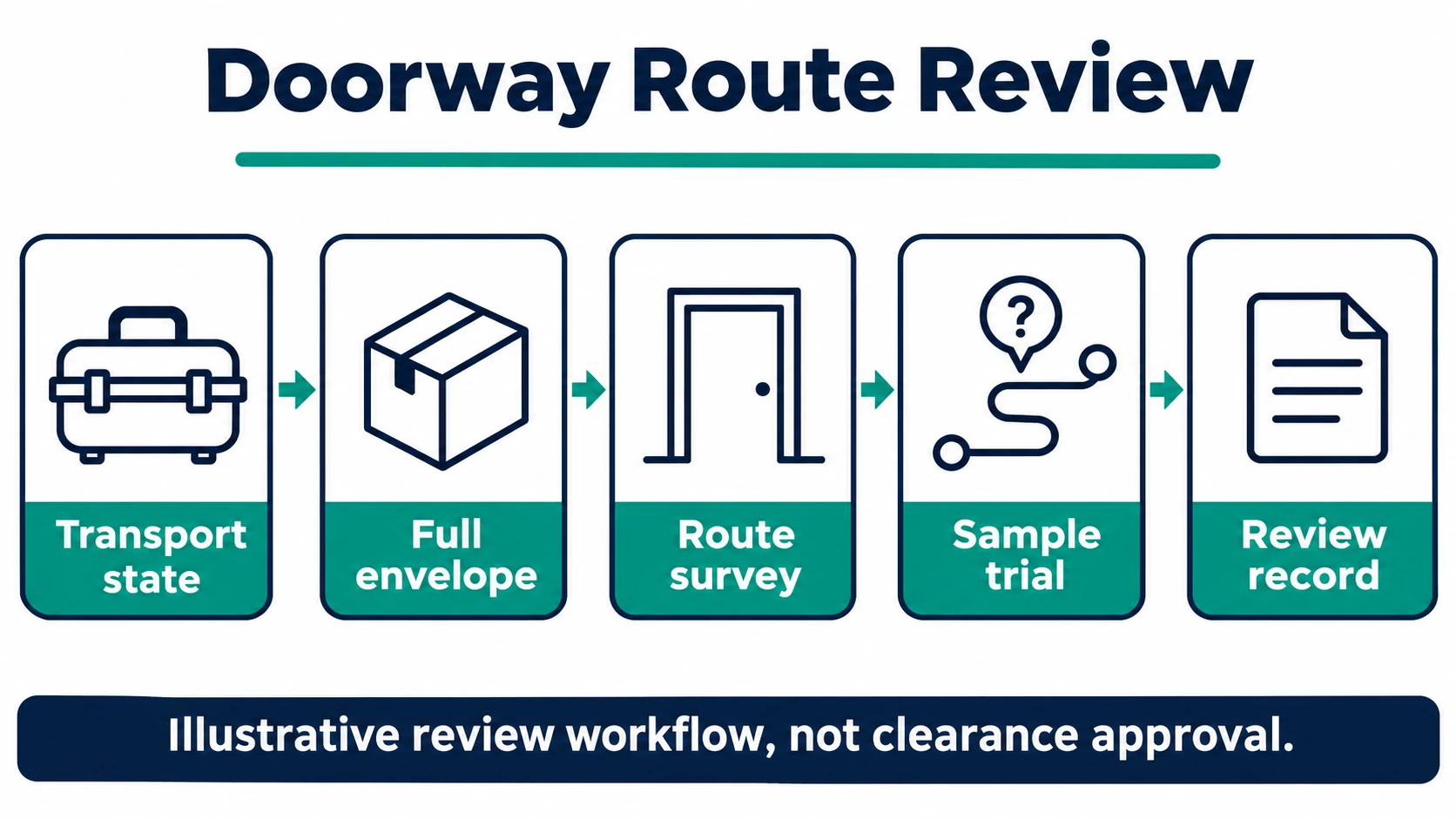
Start with a real cart, not an assumed footprint
The CRF CA13Z019 compact aluminum alloy ultrasound cart is a current product reference for mobile ultrasound equipment support. Its product page identifies a top platform, lower storage area and four casters. Those features make it a relevant starting point for an equipment-route review; they do not establish an approved doorway width or turning radius.
Ask for a current configuration drawing before selecting this or another model. Public photographs do not provide reliable dimensional measurements. Confirm whether optional holders, handles or equipment projections are included in the drawing.
Distinguish working position from transport position
An accessory may project farther when opened for use than when secured for movement. Document both states. If a tray or holder must be repositioned before transport, request the applicable instructions and verify that the intended operator can perform that step without improvisation.
Do not assume that removing accessories is an acceptable solution. Removal may change equipment support, introduce handling steps or leave items without a secure storage location.
Record the complete moving envelope
List the widest and longest projections at different heights. The base may be wider than the tabletop; the equipment or handle may extend beyond both. Include cable loops only in their intended secured state, and identify any loose item that needs a defined transport location.
The result should be a configuration-specific envelope, not a single dimension copied from a product name.
Survey the route before comparing cart sizes
Record each door, corridor change, lift entrance and parking location on the intended route. For a doorway, distinguish the nominal door size from the usable opening in its normal operating condition. Door hardware and nearby furniture can affect the practical approach.
Ask the facility team to identify restrictions, permitted routes and any requirements concerning emergency access. Do not stage a trial that obstructs an active route or compromises local safety procedures.
Check the approach and exit
A straight opening and a turn immediately after an opening are different review tasks. Record the available space on both sides, the direction of approach and fixed obstacles near the door. Include the operator’s position and visibility rather than considering an unattended cart alone.
Treat floor transitions separately
A drawing that fits through an opening says nothing about performance over a threshold or other transition. Record floor surfaces and transitions for supplier review. Ask what conditions the selected cart configuration is intended to encounter; do not infer a threshold capability from wheel appearance or diameter.
Compare the evidence, not the word “compact”
| Review input | What it helps establish | What it does not establish |
|---|---|---|
| Base and tabletop dimensions | Static plan dimensions | Complete equipment and accessory envelope |
| Configured transport drawing | Identified projections in one defined state | Actual maneuvering performance |
| Route measurements | Available openings and nearby restrictions | Cart compatibility without a configuration review |
| Representative route trial | Observations for the tested setup and route | Suitability for every building or future revision |
A smaller tabletop is not necessarily the better choice if the equipment cannot be retained appropriately. Likewise, selecting a different base without reviewing the complete configuration can create a new integration question. Resolve device support and route access together.
Build a configuration-specific route checklist
Before requesting a quotation or sample, prepare:
- The intended equipment identity and supplier-provided dimensions.
- The cart model and a drawing revision identifying the selected accessories.
- The transport state of trays, holders, handles and cables.
- Measured usable openings and annotated photographs of the route, without patient or private information.
- Approach and exit restrictions, including nearby fixed furniture.
- Floor surfaces, transitions and approved parking locations.
- The facility contact responsible for reviewing route and access requirements.
- The proposed sample-review procedure and how findings will be recorded.
Do not invent a universal clearance margin. Have the responsible project team define acceptance criteria for the actual route, applicable requirements and equipment setup.
Validate with a representative sample
Use a sample matching the proposed order configuration. Follow supplier instructions and the facility’s controlled evaluation process. Record whether the cart can approach, pass and leave each relevant opening as intended, with accessories secured and visibility maintained.
Capture the tested configuration, route conditions, observations and unresolved issues. If a handle, holder or device changes later, reassess the affected envelope instead of treating an earlier trial as permanent approval.
A trial is not a substitute for structural, equipment-retention, electrical or cleaning-compatibility review. Those remain separate workstreams. This article also does not use wheelchair turning-space rules as a specification for an equipment cart; facility accessibility and circulation requirements need their own competent review.
For the separate hand-access question, see the medical cart push handle clearance guide. A handhold-access review does not replace the full-route assessment here.
FAQ
Does tabletop width tell me whether a cart fits through a door?
Not by itself. The base, handles, installed equipment and accessories may project farther. The approach and exit also affect the route review.
Is a four-wheel cart always easier to move through a small room?
Wheel count alone does not establish maneuverability. Review geometry, the configured equipment, caster behavior, operator access and the actual route. No universal turning-radius claim is made here.
Can CRF confirm fit from a doorway photograph?
A photograph can help explain the site, but it is not a substitute for measurements, a configured drawing and an appropriate sample evaluation. Send both route information and equipment details for project review.
Is a successful route trial proof of accessibility compliance?
No. It documents the tested cart and route conditions. Building accessibility, emergency circulation and other facility obligations require separate assessment.
Request a route-focused RFQ
For the CA13Z019 or another CRF equipment cart, send the device details, configuration drawing requirements, usable opening measurements, route restrictions, quantity and destination. Ask CRF to identify what is confirmed, what needs a drawing and what requires sample evaluation.
Request a configuration-specific quotation from CRF or email sales@szcrftech.com. Final dimensions, accessory scope, documentation and commercial terms must be confirmed for the selected configuration.
Request a B2B RFQ for the exact configuration and documentation scope. Images are AI-generated generic concepts, not exact CRF models, customer installations, approved procedures or performance evidence.