
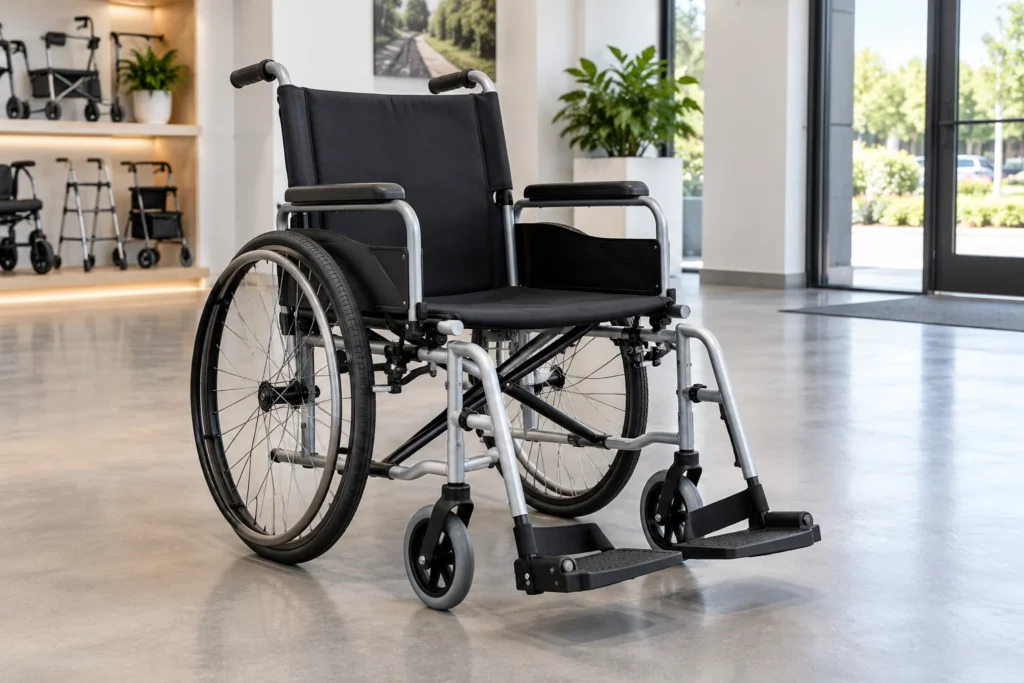
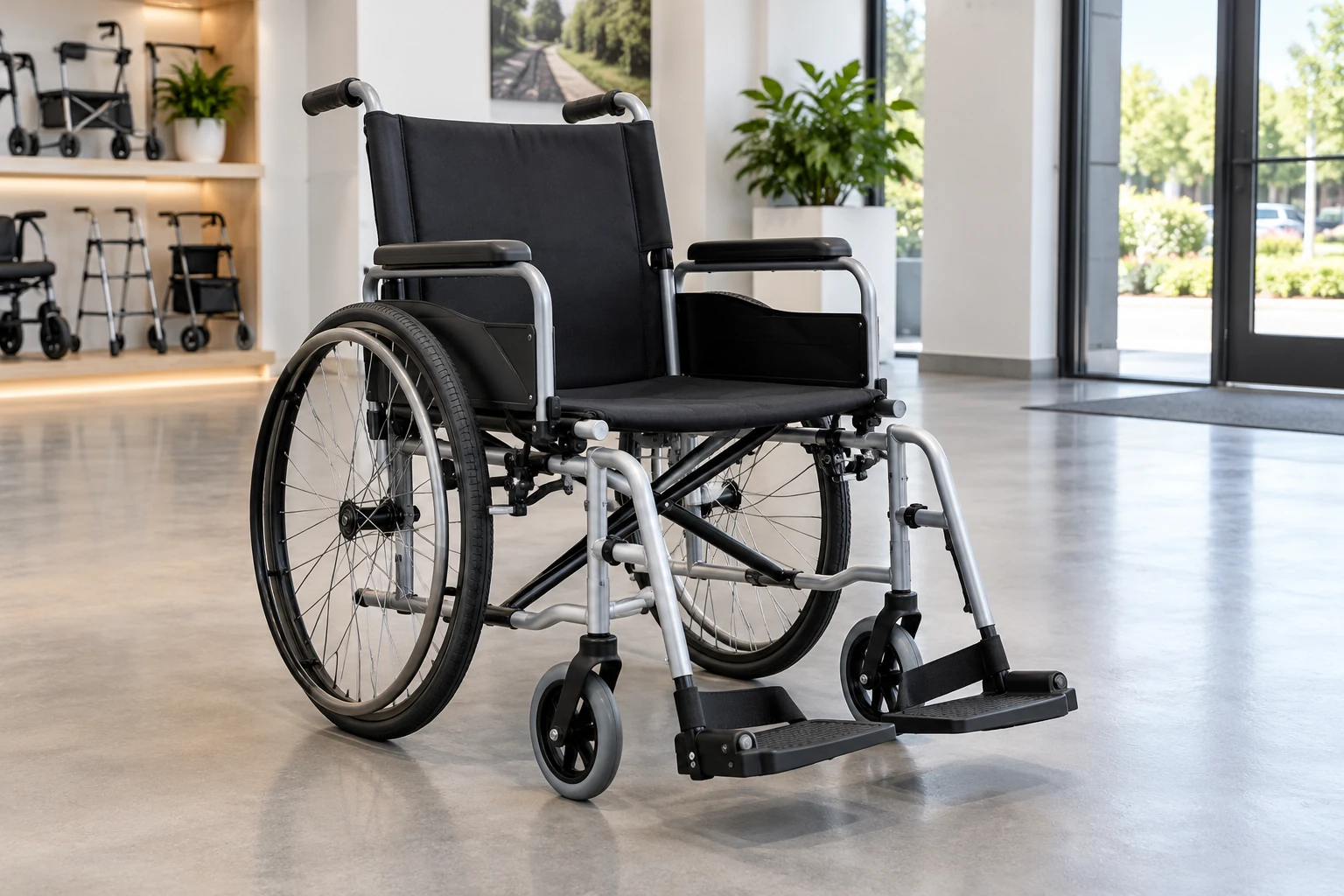
A lightweight folding wheelchair manufacturer should be evaluated against a controlled product specification, intended-user definition and target-market requirements—not against the word “lightweight” alone. Buyers should document dimensions, complete mass, user and attendant roles, folding and locking sequence, seating interfaces, brakes, wheels, footrests, transport and storage envelope, cleaning, labeling, required evidence and sample acceptance. CRF has a real published folding-wheelchair reference, but its page does not establish suitability for every user, journey or jurisdiction.
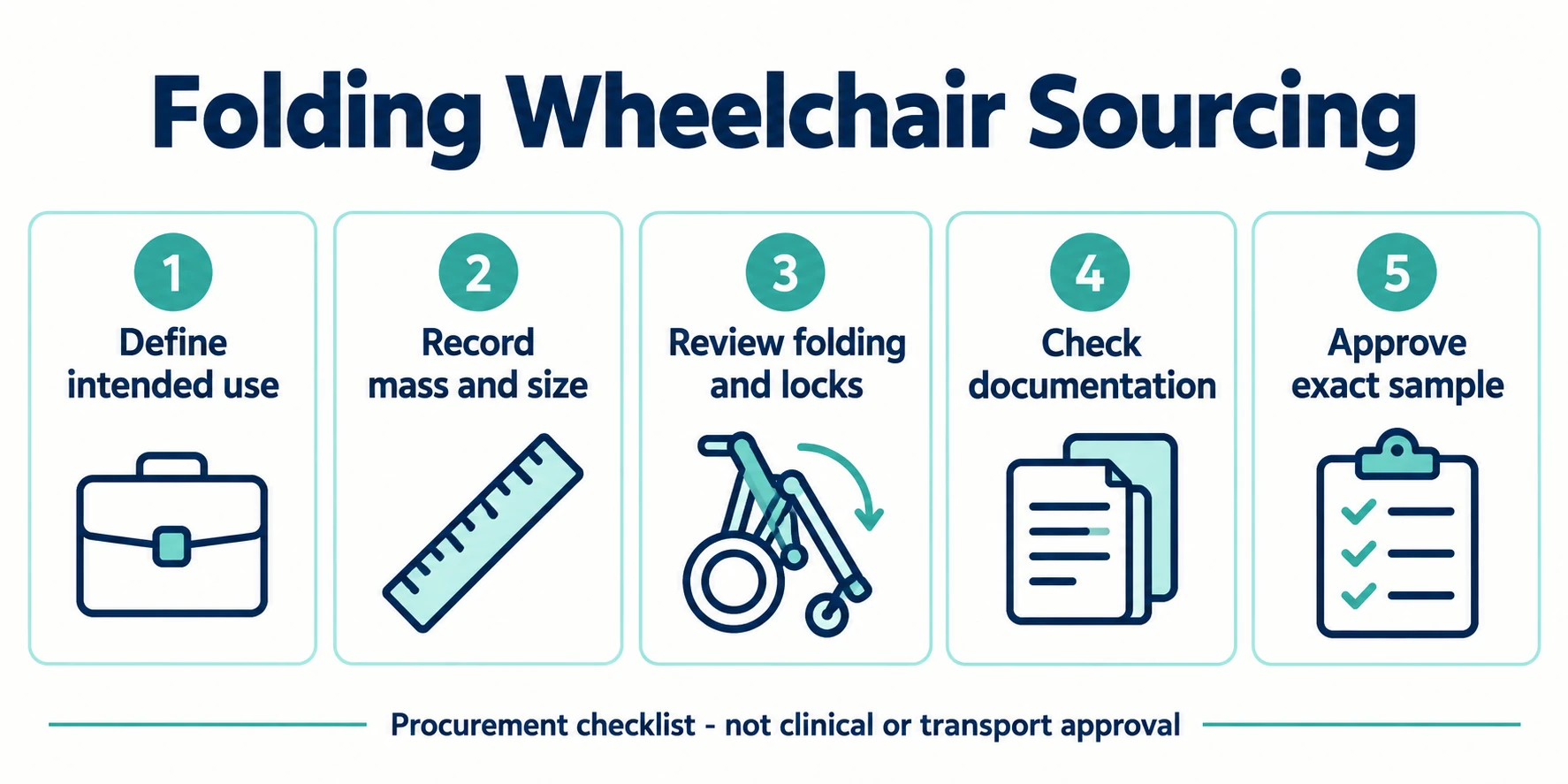
Define the product category before comparing quotes
“Folding wheelchair” can refer to materially different products. The RFQ should state whether the intended configuration is self-propelled, attendant-propelled or another defined design, and whether it is meant for routine indoor movement, transport between locations or another specified context.
Record:
- intended user population and professional assessment process;
- user and attendant roles;
- seating dimensions and required support interfaces;
- route, doorway, vehicle and storage constraints;
- folding and lifting workflow;
- wheel, brake, armrest and footrest arrangement;
- accessories and baggage expectations;
- cleaning and maintenance inputs;
- destination market and required documentation;
- quantity, branding, packaging and spare-parts plan.
Do not substitute a generic age label for a user specification. Fit and suitability require individual and professional review.
Define “lightweight” with measured fields
A supplier’s “lightweight” label is not a comparable specification unless the weighed configuration and method are clear. Ask for:
- complete assembled mass;
- mass of any transportable subassembly;
- whether cushions, footrests, anti-tip devices or accessories are included;
- folded dimensions;
- lifting points and handling method;
- packaging dimensions and gross shipping mass.
The lowest mass is not automatically the best choice. Buyers must balance portability against required structure, fit, interfaces, durability evidence and intended use. Do not publish a load or product mass unless it is tied to the exact approved model and supporting documentation.
Freeze the seating and frame dimensions
A B2B specification should include the dimensions that affect user fit and environmental fit. At minimum, identify the required seat width and depth, seat and back height, armrest arrangement, foot support, overall width, folded width and relevant clearances.
Use controlled drawings
Request a revision-controlled drawing that identifies the frame, cross-brace or folding structure, wheel positions, brakes, armrests, footrests, upholstery interfaces and accessory points. If more than one size is offered, each size should have its own controlled configuration or an explicit size matrix.
Avoid broad claims such as “fits most users.” The buyer’s qualified professionals should match the product to the user and intended environment.
Review the folding mechanism and locks
Folding is a mechanical function, not merely a storage feature. The sample review should check:
- the complete folding and unfolding sequence;
- positive engagement of locks or retainers;
- finger, cable and upholstery pinch areas;
- whether footrests or accessories must be removed;
- whether the chair remains controlled during handling;
- whether repeated assembly can introduce incorrect states;
- how the correct open and locked state is communicated.
Instructions, labels and training responsibilities should correspond to the ordered configuration. Do not infer cycle life from a demonstration; request relevant evidence if durability claims are commercially important.
Specify wheels, brakes and footrests as interfaces
Wheel diameter alone does not establish rolling performance or route suitability. Document front and rear wheel types, tires, axles, handrims where applicable, brakes or wheel locks, footrests and any removable parts.
| System | Buyer input | Sample check |
|---|---|---|
| Rear wheels | propulsion role, removal and route | attachment, clearance and handling |
| Front casters | floor transitions and maneuvering | rotation, clearance and route trial |
| Brakes/locks | operator and use state | reach, engagement and release |
| Footrests | leg-support requirement and transfer workflow | attachment, swing/removal and clearance |
| Armrests | transfer and support requirement | position, attachment and interference |
A parking brake or wheel lock must not be described as a substitute for an attendant’s control or professional operating procedure unless the manufacturer’s validated instructions explicitly support that use.
Map the real route and transport workflow
Before ordering, measure doorways, corridors, lift entries, storage areas, vehicle openings and lifting clearances relevant to the project. Review both the occupied and folded envelopes.
Transport checklist
- overall and folded dimensions;
- parts removed before loading;
- secure handling points;
- storage orientation;
- risk of loose or swinging components;
- protection of brakes, wheels and upholstery;
- packaging for distribution and final delivery;
- responsibility for assembly and pre-use inspection.
Do not make vehicle, public-transport or aircraft compatibility claims without checking the applicable operator rules, product documentation and project-specific requirements. A folding frame is not, by itself, proof of suitability for occupied transport.
Require target-market documentation early
The buyer is responsible for identifying destination-market obligations and involving qualified regulatory professionals. Ask the prospective manufacturer what documents are available for the exact model and revision, but do not accept unrelated certificates or reports.
A documentation request may include:
- controlled specification and drawings;
- material and component declarations;
- risk-management and verification records where applicable;
- inspection and traceability records;
- instructions, labels and language versions;
- test reports relevant to the final configuration;
- packaging specifications;
- warranty and spare-parts policy;
- engineering-change procedure.
Certification, test results and compliance statements should be supported by current evidence for the exact model and destination market.
Plan cleaning, inspection and replacement parts
Provide actual cleaning agents, concentrations, contact times and frequency. Review upholstery, seams, joints, labels, wheel interfaces, removable parts and material transitions. Avoid claiming universal disinfection resistance from material names alone.
Define periodic inspection points and replacement criteria for brakes, tires, caster assemblies, upholstery, fasteners, footrests and folding joints. The order documentation should identify approved parts and revisions so distributors can manage repeat orders and service consistently.
Approve the sample before repeat production
Use a staged process:
- freeze intended use and target-market inputs;
- approve the dimension and interface schedule;
- review controlled drawings and bill of materials;
- review the evidence and documentation plan;
- build a configuration-specific sample;
- check user fit through qualified review;
- check folding, locks, removable parts and transport handling;
- perform the defined route and storage checks;
- review cleaning, labels, instructions and packaging;
- close deviations and freeze the production revision.
A sample with different wheels, upholstery, brakes or footrests is not equivalent to the ordered configuration.
Manufacturer comparison checklist
Compare documented capability rather than marketing superlatives:
- product category and intended use clearly defined;
- measured mass and included components stated;
- seating, frame and folded dimensions controlled;
- folding and locking sequence documented;
- wheels, brakes, footrests and armrests specified;
- target-market evidence mapped to the exact model;
- traceability and incoming/final inspection described;
- cleaning, maintenance and spare parts addressed;
- sample acceptance plan agreed;
- packaging and change control documented.
Limits buyers should keep visible
This guide is procurement education, not medical, clinical, accessibility, regulatory or safety advice. It does not establish user suitability, weight capacity, durability, transport approval, certification or clinical benefit. Those conclusions require the exact product configuration, applicable evidence and review by qualified professionals.
FAQ
What should an RFQ for a lightweight folding wheelchair include?
Include intended use, user and attendant roles, required dimensions, complete and transport mass definitions, folding sequence, wheels, brakes, footrests, armrests, accessories, route, storage, cleaning, destination market, quantity, branding, packaging and documentation requirements.
Does “lightweight” have a standard meaning?
Not by itself. Ask how the mass was measured, which components were included and what the folded and handling workflow will be.
Is a folding wheelchair automatically suitable for travel?
No. Check dimensions, handling mass, loose components, storage space, operator rules and any applicable transport requirements for the exact configuration.
Should a buyer request a sample?
Yes. A configuration-specific sample supports fit, folding, interface, route, cleaning, label, packaging and documentation review before repeat production.
Can certification be inferred from the manufacturer’s other products?
No. Certificates and reports must be relevant, current and traceable to the exact model, manufacturing scope and destination-market requirement.
What should be checked on receipt?
Check model and revision, dimensions, supplied parts, folding and locks, brakes, wheels, footrests, labels, instructions, finish, packaging condition and required records against the approved order.
Discuss a folding-wheelchair sourcing project with CRF
Review the CRF lightweight folding wheelchair product as current catalogue references. Send CRF your intended-use brief, controlled dimensions, required interfaces, target market, documentation list, quantity and packaging needs for a configuration-specific B2B review. Final suitability and claims remain subject to approved documentation, samples and qualified assessment.
Request a B2B RFQ — share your configuration, quantity, destination market and documentation requirements.