
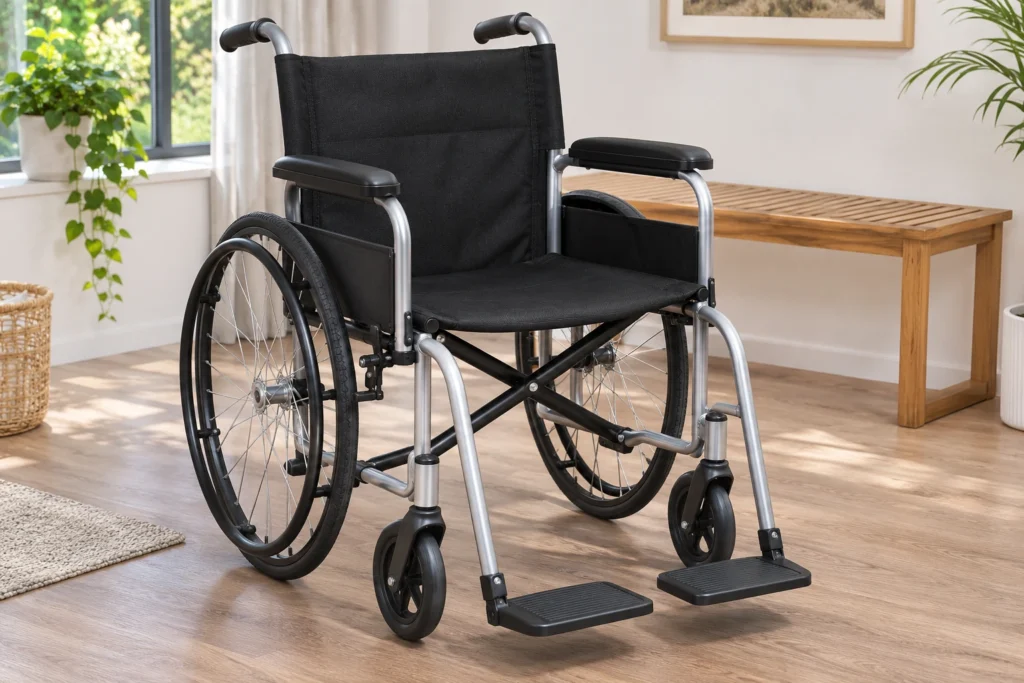
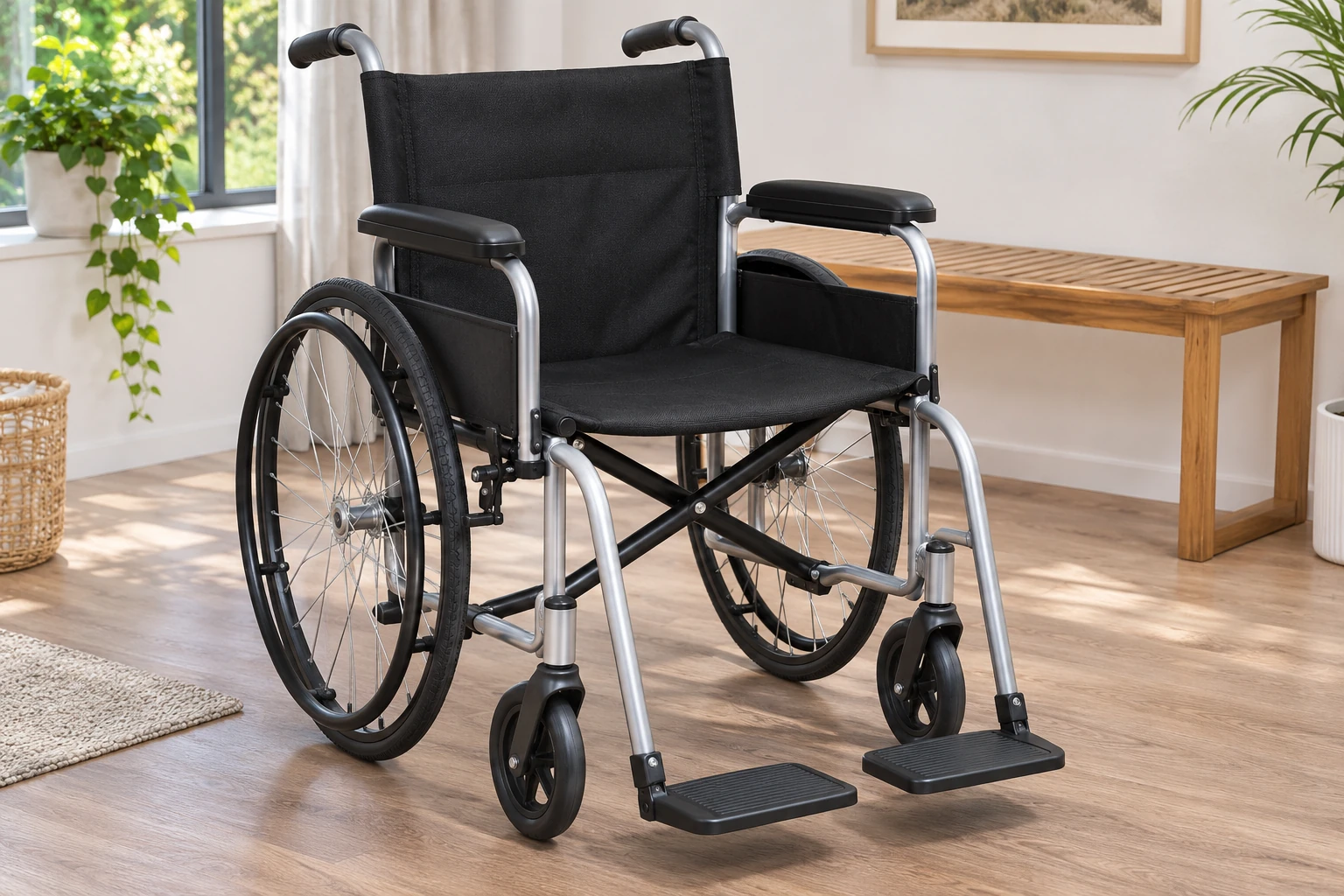
To compare folding wheelchair footrest options, first establish which footrest assembly is actually supplied on the exact chair variant. A folding frame does not prove that its footrests swing away, detach, elevate or adjust. Buyers should request variant-specific drawings, instructions, included-part details and a physical sample before publishing those features or approving a substitution.
This is a distributor and procurement guide to component identification. It does not prescribe foot positioning, clinical selection, transfers, adjustment settings or wheelchair use for an individual.
Start with the real CRF product and an open specification question
CRF lists a lightweight folding wheelchair for portable assisted mobility. The current public listing does not establish the exact footrest type, removal permissions, adjustment range or a replacement-part compatibility matrix. Those are questions for the offered variant, not features to infer from the phrase “folding wheelchair.”
The discussion below explains common procurement distinctions. It does not claim that every option is available from CRF. Confirm feasibility and the supplied configuration directly. Do not carry over broad legacy travel or comfort claims as evidence of a specific component feature.
Separate footplate movement from assembly movement
A folding footplate is not a swing-away hanger
A footplate can move while its supporting assembly remains attached in the same position. A description such as “fold-up” should identify which component moves and refer to the model-specific instructions. It should not silently become “swing-away footrest” in a distributor listing.
Ask for clear views of the complete assembly and an annotated component drawing. A cropped image of a plate is not sufficient to identify the hanger, attachment or permitted operations.
Swing-away and detachable are different claims
An assembly described as swing-away may move aside while remaining connected. A detachable assembly is intended to separate by the procedure in its instructions. One feature does not establish the other. Obtain explicit supplier confirmation rather than applying both terms to any assembly with a visible joint.
Do not improvise removal, loosen structural fasteners or treat a photographed latch as operating instructions. The correct method must come from the documentation for the actual chair and component.
Elevating is a separate option
An elevating legrest is not simply another name for a folding or removable footrest. If a project requires one, it needs its own specification and suitability review. This guide neither confirms that CRF supplies that option nor recommends it for any user.
Compare descriptions by evidence, not sales vocabulary
| Supplier description | What it may describe | What remains to be confirmed |
|---|---|---|
| Folding footplate | Movement of the plate itself | Exact movement and permitted procedure |
| Swing-away footrest | Movement of an attached assembly | Attachment, release and applicable instructions |
| Detachable footrest | A component intended for removal | Exact variant, supplied parts and reattachment instructions |
| Adjustable footrest | A changeable setting | Which feature adjusts and who may adjust it |
| Elevating legrest | A different leg-support configuration | Availability, compatibility and professional suitability |
These are general distinctions, not specifications for the listed CRF wheelchair. Avoid adding numerical angles, dimensions, load ratings or universal fitting claims unless they are confirmed for the ordered configuration.
Identify the full assembly before sourcing spare parts
Record more than a photograph
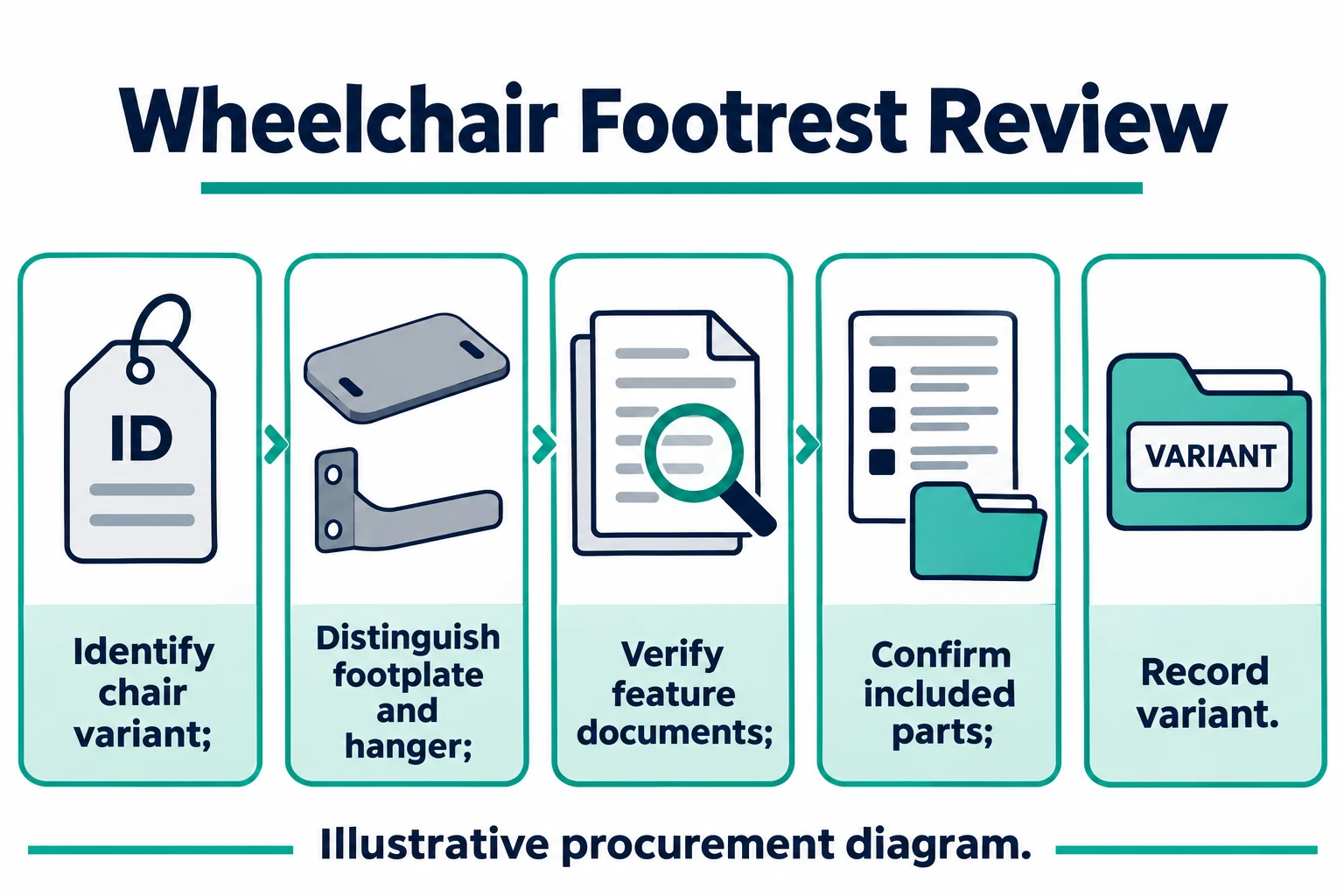
For a replacement or repeat order, identify the chair variant, frame revision, component part number and the supplier’s description of the complete assembly. Ask whether left and right items have different identifiers and how the supplied set is packaged.
Record the attachment interface using the supplier’s approved drawing. A component that looks similar may have a different interface, release arrangement or geometry. A part advertised as “universal” by another seller does not establish compatibility with a CRF chair.
Clarify included items
Ask which plates, hangers, fasteners and other components are included, using the terminology in the actual bill of materials. Do not assume straps, heel loops, tools or replacement hardware are included. If an item is offered separately, document that distinction in the quotation and distributor copy.
Preserve the original supplier’s instructions for inspection, permitted replacement and service. A purchasing checklist should not substitute for those instructions.
Keep folding, transport and user suitability separate
A buyer may need to know whether the chair folds with its specified footrests attached. Request the model-specific permitted storage configuration and sample evidence. Do not derive folded dimensions from an unrelated photo or assume all detachable parts can be removed for transport.
This topic differs from a car-boot fit review: the decision here is which component assembly is offered and how it is identified. A smaller transport envelope does not prove the component is suitable for an individual, approved for occupied vehicle transport or compatible with any particular vehicle.
An appropriately qualified professional should assess individual seating and support requirements. Follow the relevant manufacturer instructions. This article gives no transfer technique or adjustment procedure.
A footrest-focused RFQ checklist
Before asking CRF to quote or confirm a replacement, send:
- The exact wheelchair listing, variant and available identification.
- Photographs of the current complete assembly, without treating images as dimensional evidence.
- The supplier’s existing component number and revision, if available.
- The required feature stated precisely: plate movement, swing-away, removal or another documented requirement.
- The intended original-equipment or replacement scope.
- A request for drawings, included-part details and applicable instructions.
- A request to identify any unresolved compatibility restrictions.
- Quantity, destination market and sample-review needs.
Do not invent a missing part number. Mark it unknown and request identification. Where the supplier cannot confirm compatibility, keep the substitution unapproved.
Check the sample and the sales record together
Ask the responsible reviewer to confirm that the delivered sample matches the quoted component identity and documentation. Record missing items, differences in markings or unapproved substitutions. Operational checks and any required performance verification should follow the applicable instructions and agreed qualified review, not an improvised test from a marketing article.
Before a listing goes live, compare its feature language against the evidence. Remove “detachable,” “swing-away” or “elevating” if the offered variant does not support that term. A clean variant record is more useful to a repeat buyer than a long list of unverified options.
FAQ
Does a folding wheelchair always have detachable footrests?
No. Frame folding and footrest removal are separate features. Confirm the exact chair and instructions.
Are swing-away footrests automatically removable?
No. Ask the supplier to confirm both features independently for the offered assembly.
Can a visually similar replacement be ordered without a drawing?
Visual similarity alone is insufficient. Request component identification, interface information and explicit compatibility confirmation.
Is a footrest option a clinical recommendation?
No. Procurement identification is different from individual suitability. Clinical selection and adjustment require appropriate professional advice and manufacturer instructions.
Which footrest is supplied on CRF’s listed folding wheelchair?
The public listing does not establish a complete verified footrest specification for this article. Ask CRF to confirm the exact offered variant and documentation before ordering.
Request a variant-specific quotation
Start with the CRF lightweight folding wheelchair product reference. Send the variant, current component information and precise option requirements with your RFQ. Ask CRF to confirm availability, compatibility, included items, instructions and sample-review arrangements.
Contact sales@szcrftech.com or +86 18938846756. Final specifications and commercial terms require confirmation; no universal replacement fit or medical outcome is promised.
Request a B2B RFQ for the exact configuration and documentation scope. Images are AI-generated generic concepts, not exact CRF models, factory photographs, customer installations, verified compatibility, approved procedures or performance evidence.