
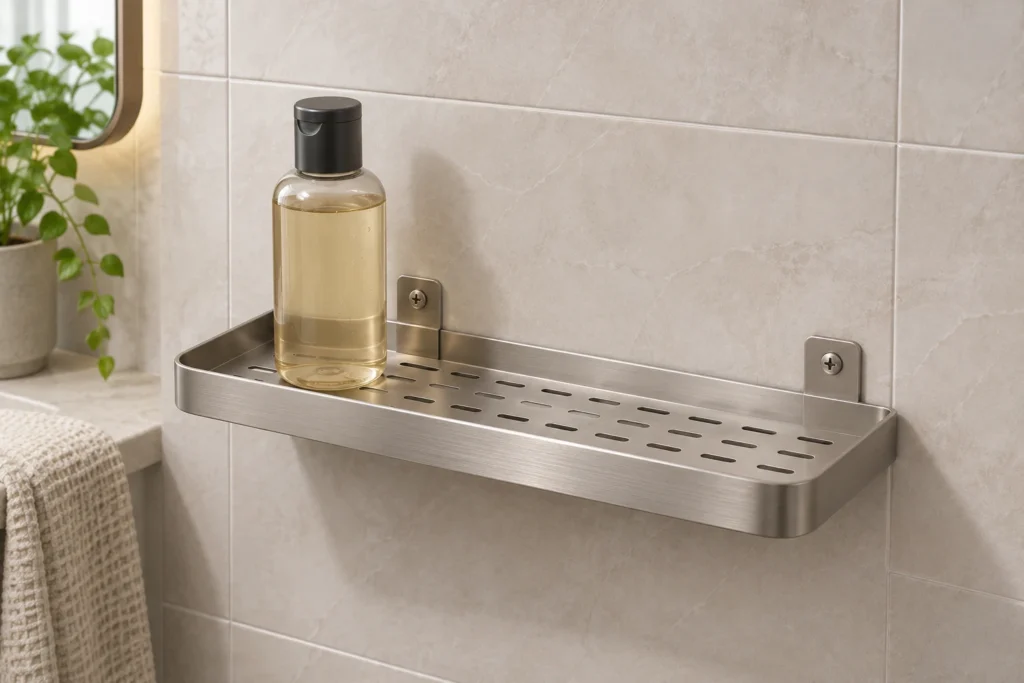
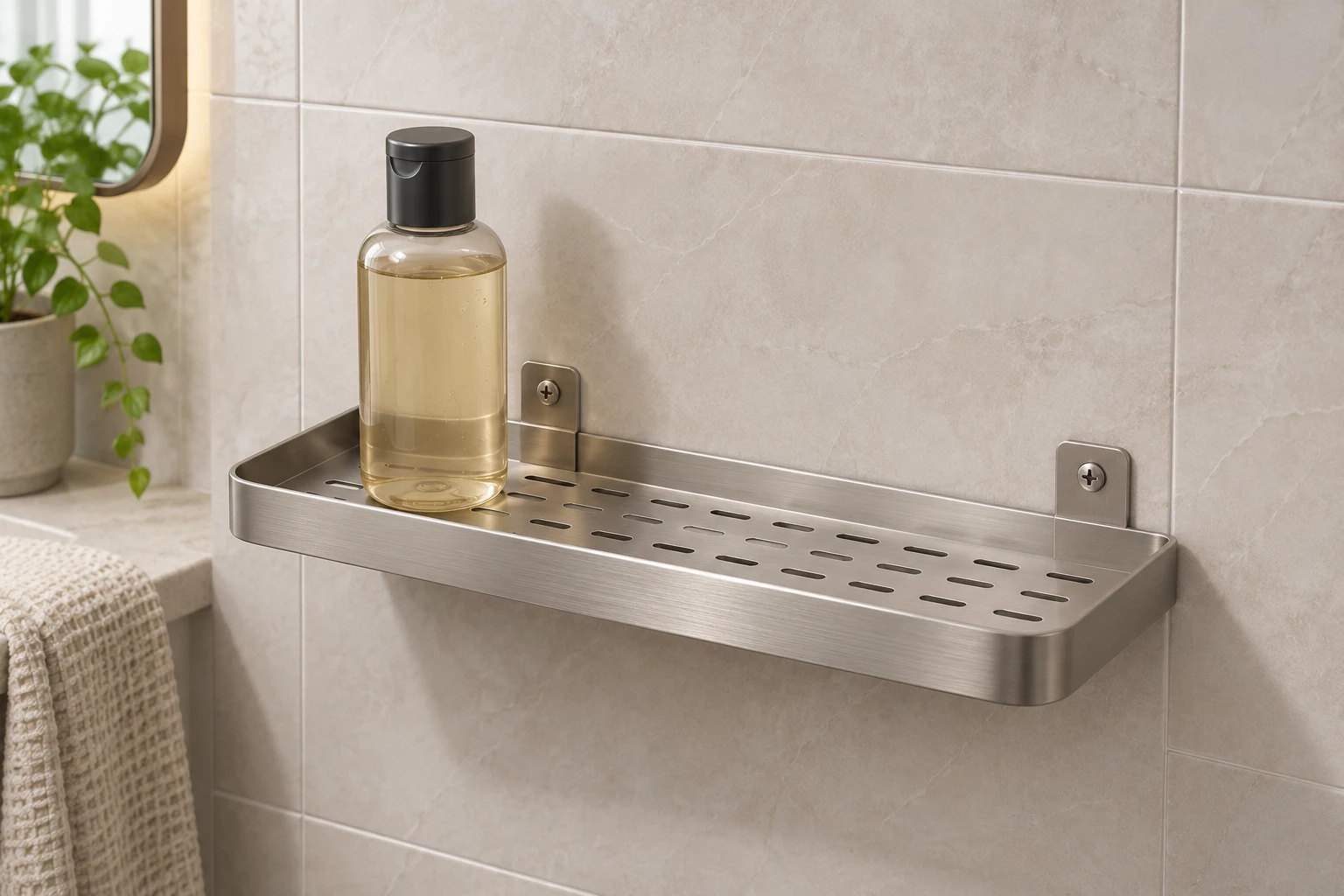
A replacement bathroom shelf should not be ordered on overall width alone. First compare the exact mounting-hole pattern, bracket arrangement and wall condition with the proposed shelf variant. Matching two visible screw positions does not prove that the existing fixings, substrate or waterproofing are suitable for reuse. Obtain a variant-specific drawing and an installer review before committing to a replacement order.
For multi-room refurbishment, the useful deliverable is a replacement-fit record: what is installed, what is proposed, which interfaces match and what still needs approval. This guide explains that procurement record; it is not a drilling or anchor-selection instruction.
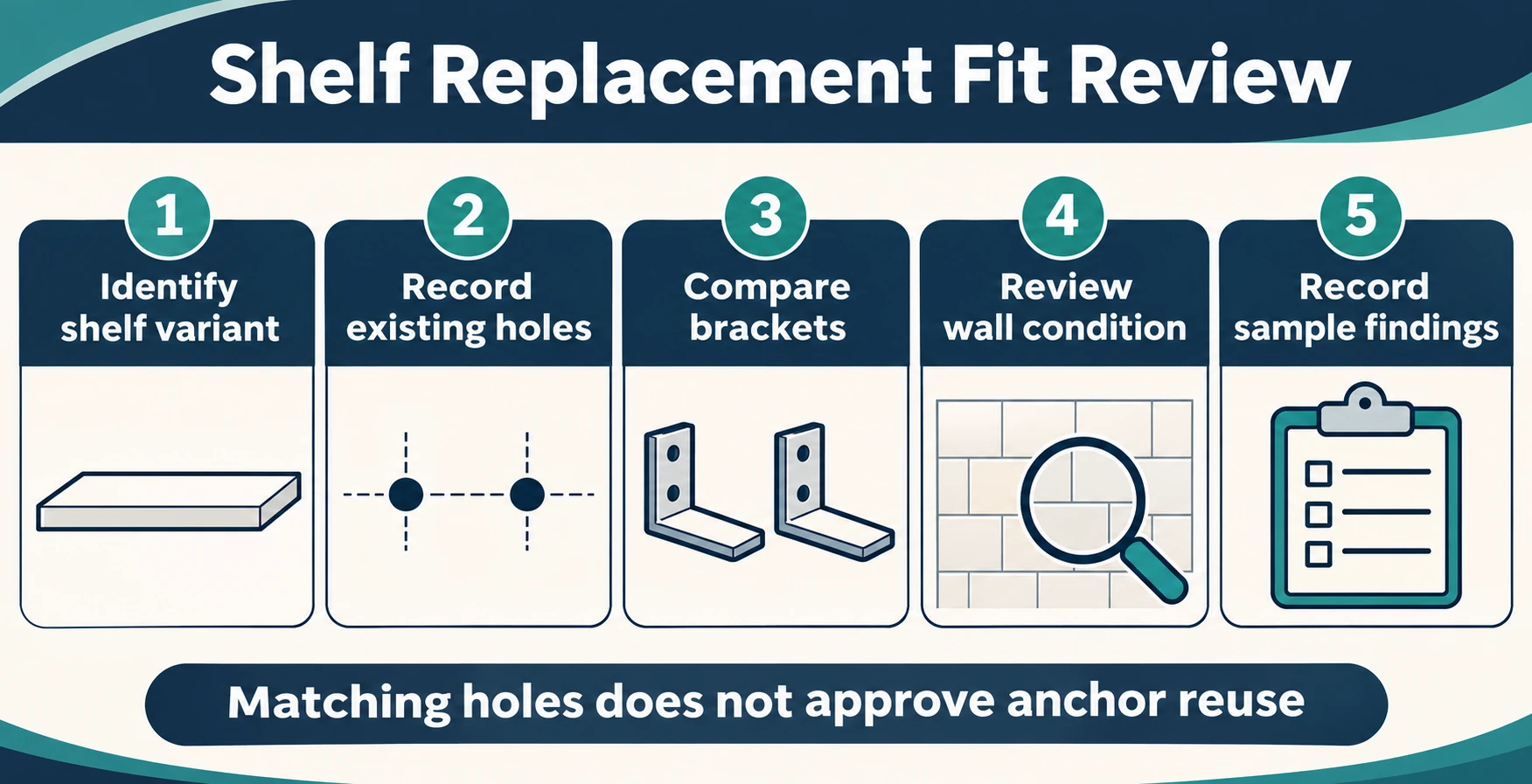
Begin with the exact replacement shelf variant
The CRF stainless steel corner and rectangular bathroom shelf family includes different shapes and listed installation options. It is relevant to a replacement inquiry, but a family page is not a hole-pattern drawing for every variant. Do not assume identical bracket locations across triangular and rectangular shelves, finishes, sizes or mounting kits.
Ask CRF to identify the proposed variant and current fixing arrangement. Confirm whether it uses visible holes, concealed brackets, an adhesive interface or another supplied arrangement. If the required drawing is unavailable, keep retrofit compatibility unconfirmed rather than measuring a perspective product photograph.
Create an existing-installation record
Record geometry without assuming hidden details
Have the responsible site team record overall shelf shape, visible fixing positions, bracket orientation and the available wall area. A front photograph helps identify the arrangement but should not be used as a scale drawing. Include a consistent measurement reference and distinguish measured values from estimated ones.
Describe each fixing position relative to a defined datum rather than supplying only a single spacing number. A two-wall corner installation requires information for both walls and the corner geometry. A flat-wall shelf has a different interface. If the old unit conceals its brackets, mark hidden details as unknown until appropriately inspected.
Keep wall condition separate from product fit
An apparently matching shelf does not validate existing anchors or the wall behind them. The installer should assess the substrate, existing holes, deterioration, concealed services and waterproofing implications. Do not infer suitability from intact-looking tiles. The procurement team should record who is responsible for that assessment and which questions remain open.
There is no universal anchor, screw length or repair method recommended here. Those decisions depend on the selected product instructions and the actual site.
Compare the old and proposed interfaces
| Interface item | Existing installation record | Proposed replacement evidence |
|---|---|---|
| Variant identity | Shape and identifiable old model | Exact new shelf and kit identifier |
| Hole locations | Measured coordinates and datum | Current mounting drawing |
| Bracket arrangement | Orientation and visible parts | Specified bracket and attachment method |
| Wall contact area | Available surface and obstructions | Required contact area and shelf outline |
| Existing holes | Locations and condition, with unknowns marked | Installer assessment of reuse or remediation |
| Included hardware | Identifiable retained components | Explicit supplied-parts list |
| Documentation | Site record and reviewer | Instructions and approved drawing revision |
Treat the comparison as a set of findings, not a single yes/no answer based on appearance. The shelf outline might fit while the fixing pattern does not. The holes might align while the existing wall condition still requires remediation.
Distinguish three replacement scenarios
Same-model replacement
A confirmed same-model replacement may simplify the comparison, but verify the revision and supplied kit. Product names can remain similar while brackets or interfaces change. Obtain written confirmation of the actual replacement configuration and have the installer assess whether retained components are suitable.
Different model with a similar outline
A similar length or triangular shape is weak evidence of retrofit fit. Compare hole locations, contact surfaces and bracket engagement. Do not ask an installer to compensate for a mismatch by improvising hardware or enlarging holes without an approved method. If the pattern differs, record that difference openly before approving the purchase.
Change of mounting method
Replacing a drilled shelf with an adhesive arrangement, or the reverse, is a new installation decision rather than proof that the original interface is reusable. The selected kit’s instructions, surface requirements and site approval must be reviewed. A shelf should not be described as universally no-drill merely because another variant in the family offers that option.
Review a sample before a multi-room order
For a refurbishment program, start with a documented representative installation reviewed by the responsible installer. Confirm the actual variant, kit and drawing used. Record differences among rooms instead of assuming every wall and old shelf is identical.
Keep the sample record focused on observable fit and outstanding approval conditions. A photograph of a newly positioned shelf is not evidence of load capacity, long-term adhesive performance or waterproofing integrity. Do not turn a fit review into an improvised performance test. Ask the relevant supplier and qualified site team to specify the evaluation required.
RFQ checklist for replacement projects
Send CRF the proposed shape and finish, existing shelf identification if available, measured fixing arrangement, site photographs, desired mounting method, quantity and destination. State whether existing holes are to be retained as a project preference, not as an already-approved technical solution.
Request the following before ordering:
- Exact shelf variant and mounting-kit identity.
- Current outline and mounting-interface drawing.
- Included hardware and items to be sourced locally.
- Applicable installation instructions and unresolved substrate questions.
- A sample-review arrangement and documented acceptance conditions.
- Confirmed commercial terms, without assuming stock, MOQ or lead time.
Material grade and finish must be confirmed for the selected variant. A material description does not resolve fixing compatibility, and no independent certification is claimed in this article.
FAQ
Is matching hole spacing enough to reuse old anchors?
No. Geometry is only one part of the review. Existing anchors, substrate condition and the proposed kit require assessment by the responsible installer.
Can I calculate hole spacing from a website photograph?
Do not use a perspective image as a production drawing. Request the current mounting drawing or a measured sample for the exact variant.
Do corner and rectangular shelves share the same brackets?
That is not established by belonging to the same product family. Confirm each variant and its supplied mounting kit separately.
Can an adhesive shelf cover holes left by a drilled shelf?
Visual coverage is not proof of a suitable adhesive surface or an acceptable waterproofing repair. The installer and kit instructions must govern the decision; do not conceal unresolved damage as a procurement shortcut.
Request a replacement-fit review
Use the CRF RFQ contact page or email sales@szcrftech.com with your measured installation record and proposed shelf variant. Ask CRF to review the product interface and provide current documentation. Keep site suitability and installation approval with the qualified project team.