
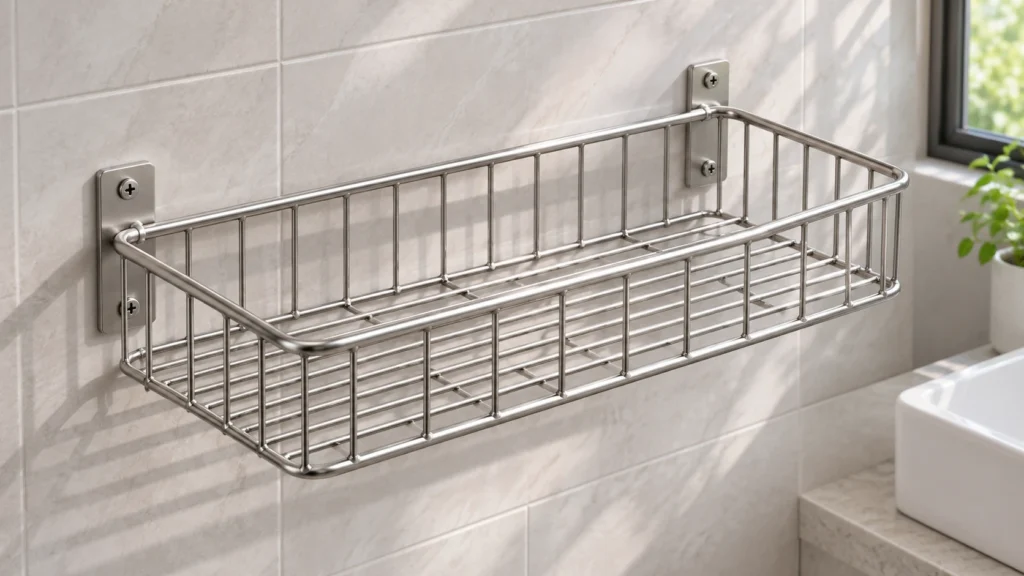

To assess bathroom shelf cleaning access, review the actual sample with its intended bottles removed, inspect the underside, corners and wall-side gaps, and ask for model-specific care instructions. A slotted or open shelf may support drainage, but that does not establish easy access to every surface or compatibility with every cleaning product. Buyers should approve the maintenance arrangement as well as the appearance before placing a volume order.
This is a procurement guide for bathroom storage furniture, not a cleaning-chemical recipe, infection-control protocol or installation instruction.

Start with a real product and a defined maintenance task
The CRF stainless steel corner and rectangular bathroom shelves provide a real product-family reference: wall-mounted shelves with corner and rectangular options and slotted shelf surfaces. The page describes openings for drainage, not proof of a maintenance-free surface.
The family includes different variants. Do not assume identical slot spacing, surface finish, wall clearance or fixing hardware across all of them. Identify the exact sample and configuration in your purchasing record.
For a hotel, apartment or shared washroom project, first describe what the maintenance team needs to do: remove stored items, reach the shelf surfaces, inspect mounting areas and restore the intended storage arrangement. Access expectations should reflect the actual environment rather than a showroom photograph.
Separate cleaning access from bottle fit and finish approval
Bottle fit asks whether containers sit and operate as intended. Finish approval asks whether the selected appearance matches the agreed sample. Cleaning access asks whether the required surfaces and nearby wall can be reached and maintained in the installed arrangement.
These are related but different purchasing decisions. A shelf can pass a bottle-fit check yet leave a wall-side area difficult to reach. An approved finish sample does not establish compatibility with a site’s cleaning products.
Inspect the sample without hiding the hard-to-reach areas
Review the shelf both empty and in the proposed installation setting. Look at the underside, intersections and openings, internal corners, fixing covers and the gap between shelf and wall. Ask the supplier to identify any parts intended to be removed for routine care and provide the relevant instructions.
Do not assume a welded shelf is removable simply because it has visible fixing points. Removing mounting hardware may be an installation or maintenance task rather than an everyday cleaning action. Never advise loosening a load-bearing fixing to gain access without the proper instructions.
| Area to review | Question for the sample check | Record before ordering |
|---|---|---|
| Inner corners | Can the intended cleaning method reach the visible surfaces? | Sample photographs and access limitations |
| Underside | Is routine inspection practical in the planned position? | Proposed placement and access observations |
| Wall-side gap | Can the adjacent wall and rear surfaces be maintained? | Installation drawing or sample arrangement |
| Fixing covers | Are covers removable, and under what instructions? | Supplier’s care or maintenance guidance |
| Intersections and openings | Are there visibly difficult-to-reach junctions? | Close-up sample observations |
| Stored items | Must all containers be removed before care? | Agreed maintenance sequence |
Check the installation context without prescribing it
A corner shelf and a rectangular shelf meet different wall arrangements. Nearby glass, taps, rails or other fittings may affect access. Ask the project team to review a placement drawing before approving the order.
This article does not specify anchors, adhesive curing, waterproofing or a safe load. Those depend on the selected fixing kit, wall substrate and project requirements. A convenient cleaning position cannot override correct installation.
Ask for care guidance tied to the selected variant
Request the supplier’s approved care instructions for the exact material and finish. Compare those instructions with the site’s established products and procedures. If compatibility is unclear, record it as unresolved and request confirmation or an appropriate sample assessment.
Do not infer resistance to a chemical from the words “stainless steel.” Do not generalize a result from one variant to every material or finish in the family. Likewise, a glossy surface in a photograph does not establish corrosion performance, coating durability or cleaning compatibility.
Distinguish drainage from a hygiene claim
Slotted or open construction can allow water to pass through openings. It does not guarantee that every junction stays dry, that water cannot remain near stored items, or that the shelf meets a particular hygiene standard.
Review the sample for the intended setting and request any evidence needed for your purchasing specification. Do not turn a drainage feature into an unsupported antimicrobial, rust-proof or maintenance-free claim.
Compare the maintenance implications before selecting a shape
Corner shelves use an otherwise underused wall junction, but that junction deserves particular attention during an access review. Rectangular shelves offer a different arrangement along a flat wall, yet their rear edge and fixings still need consideration.
Neither shape is universally easier to clean. Shelf placement, nearby obstacles, selected construction and the maintenance method matter more than the shape label alone. Approve the actual arrangement, not a generic category description.
Build a practical RFQ package
Include the required shape, sample or variant reference, planned location, relevant wall arrangement, intended maintenance method and any care-document requirements. Ask which parts are removable, whether removal affects the mounting arrangement, and what instructions are supplied.
Record limitations with the approved sample. A supplier’s confirmation should identify the variant and scope rather than merely say “easy to clean.” Packaging, quantities, documentation and commercial terms remain subject to quotation; no price, stock, MOQ or lead time is implied here.
For the separate storage-capacity question, see the bottle-fit and drainage review. This page focuses on empty-shelf access, care-document matching and maintenance limitations rather than container capacity.
FAQ
Are slotted or open bathroom shelves maintenance-free?
No. Openings may assist drainage, but the shelf and adjacent installation still need suitable care. Follow instructions for the selected variant and setting.
Can I remove the shelf for cleaning?
Only if the specific product and installation instructions allow it. Do not confuse removable storage components with structural fixing hardware.
Is a corner shelf always harder to clean than a rectangular shelf?
No universal comparison is justified. Evaluate the sample, wall-side access, nearby obstacles and intended maintenance process.
Can one cleaning-product approval cover all finishes?
Do not assume so. Obtain guidance for the exact material and finish, and resolve conflicts with site procedures before procurement approval.
Request a bathroom shelf sample review
Send your variant and project requirements through the CRF contact and RFQ page or to sales@szcrftech.com. CRF can review the requested configuration and identify the sample, care information and commercial details that need confirmation before ordering.
Request a B2B RFQ for the exact configuration and documentation scope. Images are AI-generated generic concepts, not exact CRF models, customer installations, approved procedures or performance evidence.