
Primary keyword: air wave therapy cart
Secondary keywords: air compression therapy cart; pneumatic therapy equipment cart; air wave cart manufacturer; therapy device trolley
Intent: Commercial investigation / OEM integration
Funnel: Consideration / decision
Business value: High
Keyword source: Product-specific qualitative expansion; exact volume, KD and CPC are unknown. CRF has one verified live product in the Air Wave Therapy Carts category. Fresh GSC through 2026-10-03 discloses no exact-topic query, so this topic is selected for evidence-backed catalog coverage and OEM business fit rather than claimed search volume.
SEO title: Air Wave Therapy Cart OEM Integration Checklist | CRF
Slug: /air-wave-therapy-cart-oem-integration-checklist/
Meta description: Specify an air wave therapy cart with a controlled device list, mounting interfaces, hose and cable routing, storage, mobility, cleaning and sample acceptance.
H1: Air Wave Therapy Cart OEM Integration: A Buyer’s Checklist
An air wave therapy cart should be specified around the exact therapy device, controller, hoses, garments or accessories, power architecture, workflow and route. The cart is a mobile integration platform; it does not itself establish the therapy device’s clinical performance, indications, electrical classification or target-market compliance.
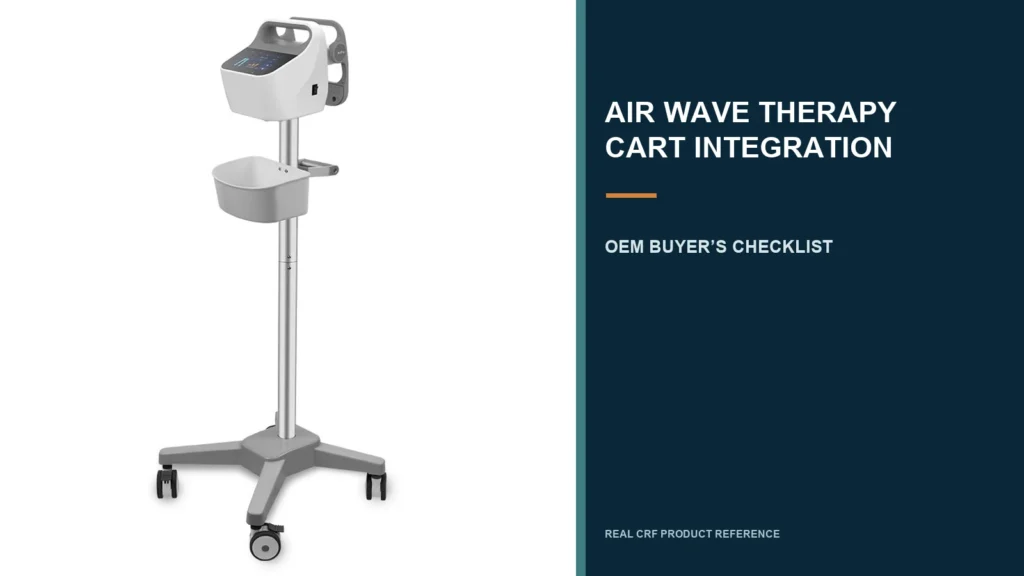
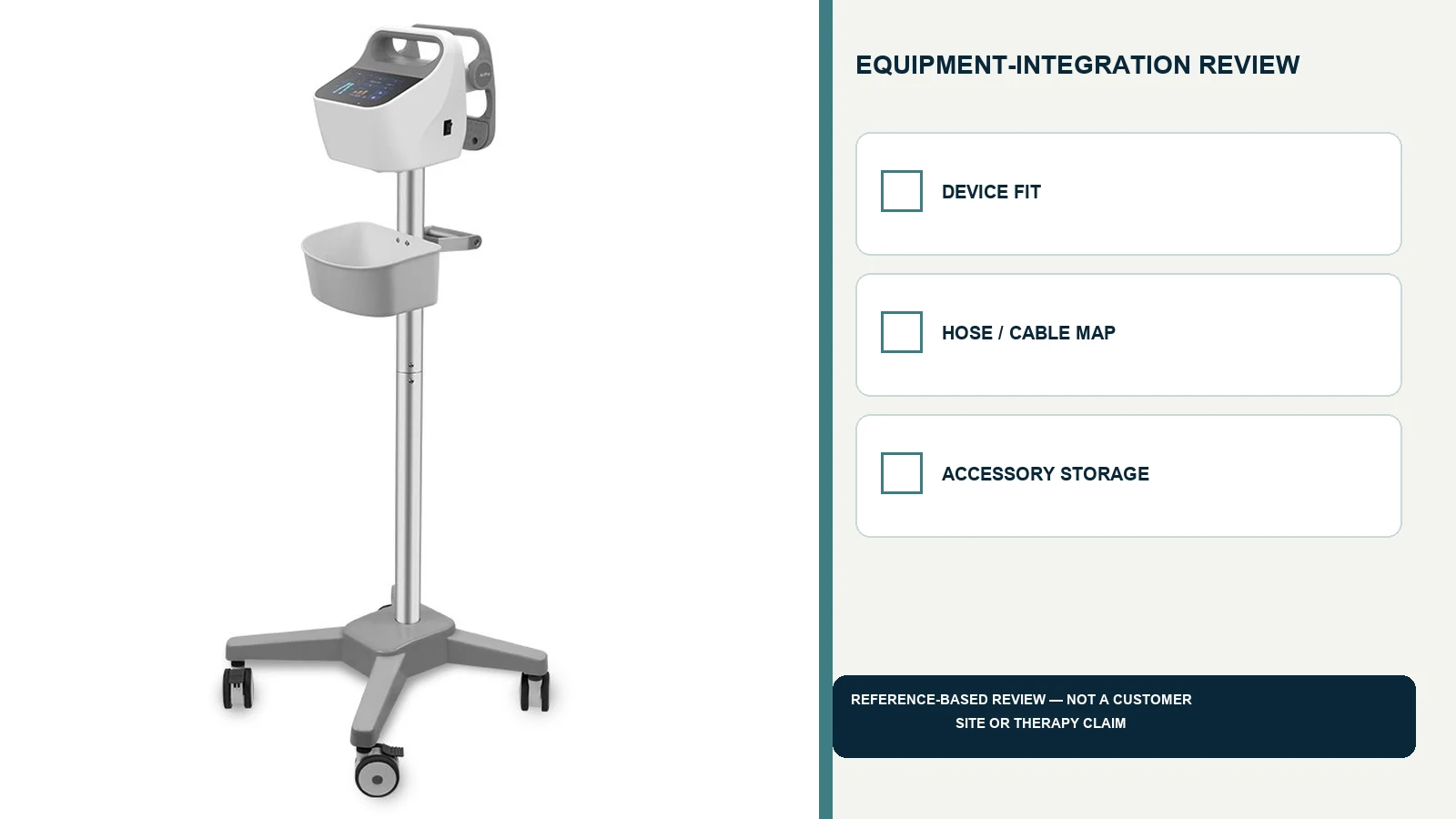
CRF’s live catalog includes Product 3577, a customizable aluminum-alloy air wave cart. This verifies a real product direction and structure for editorial reference. Its product image and legacy text do not prove compatibility with an unspecified pump, controller, cuff, sleeve, cable, battery or clinical protocol. Final fit and evidence must be reviewed for the ordered configuration.
Freeze the Therapy Equipment Package
Begin the RFQ with a controlled equipment schedule. For every device and accessory, provide:
- manufacturer, exact model and revision;
- overall dimensions and mass;
- feet, handles, doors and ventilation zones;
- mounting or retention interface;
- controls, displays and connector locations;
- hose, cable and power exits;
- accessories used during operation;
- items stored between uses; and
- the party responsible for supply, installation and approval.
Do not size the cart from a product family name. Pumps, controllers and therapy accessories can differ in geometry and service requirements.
Define the Workflow Before Designing Storage
Map the sequence from storage to use and back again:
- retrieve and inspect the cart;
- move it to the work point;
- park and apply required controls;
- access the controller and accessories;
- connect power, hoses and patient-use accessories as applicable;
- operate the buyer-approved equipment under its own instructions;
- disconnect and inspect all components;
- clean or segregate items according to the responsible organization’s process; and
- return the cart to storage or charging.
The workflow reveals which items need immediate access, which must remain retained during movement and which require separation after use.
Verify the Device Platform and Retention Method
Provide a device drawing or physical sample. The platform review should include:
| Interface | Input to confirm | Acceptance question |
|---|---|---|
| Device footprint | Feet, underside and projections | Does it sit within the controlled support area? |
| Controls and display | Location and viewing direction | Are they accessible in approved use? |
| Connectors | Type, orientation and clearance | Can hoses and cables connect without strain? |
| Ventilation | Manufacturer-defined zones | Are required clearances unobstructed? |
| Service access | Covers, filters and fasteners | Can approved maintenance be performed? |
| Retention | Bracket, strap, lip or custom fixture | Is movement controlled by an agreed method? |
Do not use adhesive pads or improvised straps as default solutions. Agree on retention, release and inspection requirements before sample production.
Plan Hose Routing Separately From Cable Routing
Hoses and electrical cables have different handling needs. Create a point-to-point map for each item.
Therapy hoses
Record connector orientation, working length, storage method, allowed bend guidance from the device owner and the route during operation. Avoid loops that can enter the caster envelope, drag on the floor or become trapped by drawers and accessories.
Power and data cables
Identify the source, destination, disconnect point, retained sections, moving sections and service loops. Assign responsibility for every cable and power component.
Separation and labeling
Where the buyer requires controlled identification, label both ends and match the labels to drawings and instructions. Define whether clean, used or pending-inspection accessories require separate storage. The responsible healthcare organization must approve the process.
Specify Accessory Storage by State
List accessories for at least three states:
- during movement: components retained inside their approved envelope;
- during use: components accessible without blocking controls or vents; and
- after use: components stored, segregated or removed under the buyer’s process.
A basket, hook or drawer should not be added merely because space is available. Check hose bend, garment bulk, connector protection, cleanability, visibility and removal path.
Open storage
Open baskets or hooks can make contents visible and accessible. They also require retention and contamination-control review for the intended process.
Enclosed storage
Drawers or cabinets can protect contents from incidental contact, but may reduce visibility and create corners that require cleaning access. Confirm internal dimensions and drawer behavior with the real accessory set.
Neither approach is universally superior; select it from the workflow and acceptance method.
Separate Passive Cart Scope From Powered-System Scope
Clarify whether CRF supplies only the mechanical cart and passive fixtures or whether any battery, charger, power strip, inlet, cable or enclosure is included. Record:
- destination voltage and plug requirements;
- equipment input and power-supply geometry;
- operation while plugged in or unplugged;
- responsibility for grounding and protective devices;
- charging and parking workflow;
- ventilation and thermal inputs from component owners; and
- evidence required for the complete system.
A passive cart does not turn an installed device into an approved integrated medical system. Qualified parties must assess the exact electrical and regulatory scope.
Review the Cart in Every Operating State
Create drawings for the cart as moved, parked, used, adjusted, opened and serviced. Evaluate:
- device retention during the approved route;
- access to controls, connectors and emergency functions defined by the device owner;
- hose and cable behavior when accessories are connected;
- drawer, basket, hook and handle interactions;
- caster and brake clearance;
- maximum complete envelope; and
- maintenance access.
If a shelf, column or handle is adjustable, identify permitted positions and the conditions under which adjustment occurs.
Route, Footprint and Parking Survey
Measure the intended environment rather than relying on a generic “hospital use” description.
Route
Record doorway openings, tight turns, thresholds, elevator entries, floor transitions and crowded work areas.
Work point
Measure nearby beds, chairs, therapy equipment, outlets and other carts. Include hose and cable connection space.
Parking and storage
Confirm the cart envelope, brake access, power connection and ventilation requirements in the parked state. Define where loose accessories are stored.
Floor and casters
Provide floor types and the buyer’s required movement and parking method. Wheel count or the word “silent” does not establish route performance; specify measurable criteria and evaluate a sample.
Cleaning, Inspection and Maintenance Inputs
Provide intended cleaning agents, concentrations, contact times and process to the responsible reviewers. Identify materials and surfaces for compatibility review. The sample should allow inspection of:
- device-retention parts;
- hose and cable holders;
- baskets, drawers and corners;
- handles and work surfaces;
- caster forks and brakes;
- column joints and covers; and
- labels and replaceable components.
Define pre-use checks, damage criteria, quarantine process and maintenance records. This article does not prescribe infection-control or clinical practice.
Documentation and Change Control
The quotation and document package should identify:
- controlled cart and fixture drawings;
- bill of materials and included accessories;
- assembly and installation responsibilities;
- labels and user-facing information within scope;
- cleaning and inspection information;
- applicable evidence for the exact configuration;
- replacement-part identification; and
- approval process for changes.
A substitution of the therapy device, power supply, hose set, basket or caster can change fit and workflow. Require documented review before implementation.
Sample Acceptance Plan
Use the actual therapy equipment and accessory set where possible, or controlled interface equivalents approved by the buyer.
Identity and mechanical fit
- Cart, device, fixtures and accessories match controlled drawings.
- Controls, connectors, vents and service points remain accessible.
- Retention releases and re-engages by the approved method.
Hose and cable behavior
- Every item follows the approved point-to-point map.
- No loop enters the floor or caster envelope.
- Connectors are not used as strain relief.
- Stored accessories remain within the approved movement envelope.
Workflow and route
- The complete sequence can be reviewed at the representative work point.
- Drawers, baskets, hooks, handles and brakes remain accessible as specified.
- The configured cart follows the buyer’s representative route.
Cleaning and records
- Required surfaces and joints are accessible under the approved process.
- Inspection points and replaceable parts can be identified.
- Deviations, corrective actions and approval owners are recorded.
Sample acceptance applies only to the controlled configuration and method. It does not establish therapy efficacy or universal suitability.
RFQ Checklist
Send CRF:
- Exact therapy device, controller and power-supply details.
- Device drawings, masses, feet, vents, ports and service zones.
- Hose and cable schedule with connector locations.
- Therapy accessories and storage dimensions.
- Movement, use, cleaning and storage workflow.
- Retention and quick-release requirements.
- Required shelves, baskets, drawers, hooks and handles.
- Route, work-point and parking measurements.
- Power architecture and responsibility matrix.
- Cleaning and maintenance process.
- Destination market and required evidence.
- Prototype quantity, forecast and sample acceptance criteria.
Common Procurement Mistakes
Selecting the cart before the device model
Family names do not define feet, vents, ports or service access. Freeze the exact equipment package first.
Treating a basket as a hose-management system
Storage needs controlled length, bend, retention, separation and removal inputs. An undivided basket may not address them.
Assuming power components are included
Photographs do not define batteries, chargers, strips, plugs or cables. Confirm the bill of materials and responsibilities.
Reusing another device’s evidence
Visually similar carts or therapy devices may have different configurations. Verify document coverage for the exact ordered system.
FAQ
What information does an air wave therapy cart manufacturer need?
Provide the exact device and accessories, dimensions, masses, ports, vents, hoses, cables, power scope, workflow, route, cleaning process and sample criteria.
Can hoses hang from hooks while the cart is moving?
Only if the approved design and evaluation control retention, bend, connector protection and clearance from the floor, casters and obstacles.
Should accessories be stored in drawers or baskets?
It depends on visibility, retention, dimensions, segregation, cleaning and workflow. Compare both approaches against the real accessory set.
Can CRF integrate a battery or power strip?
Feasibility and scope depend on the exact device, power architecture, destination market, responsibilities and required evidence. Confirm all included components in the quotation.
Does the cart determine therapy effectiveness?
No. The cart supports equipment integration and mobility. Clinical performance and suitability belong to the therapy device, intended use and qualified assessment.
Request an Air Wave Cart Configuration Review
Send CRF the controlled device package, hose and cable map, accessory list, route, cleaning process and acceptance plan. CRF can identify missing interfaces and prepare a configuration-specific OEM/ODM quotation path. Request a configuration-specific RFQ.
Internal links
- View the verified CRF customizable air wave cart
- Browse CRF air wave therapy carts
- Browse CRF medical carts
CTA: Request a Quote — include the device drawing, hose/cable schedule and sample acceptance plan.
Editorial limitations: B2B procurement education only, not medical or clinical advice. No therapy effect, indication, load, material grade, electrical classification, certification, price, stock, MOQ or lead-time claim is made.