
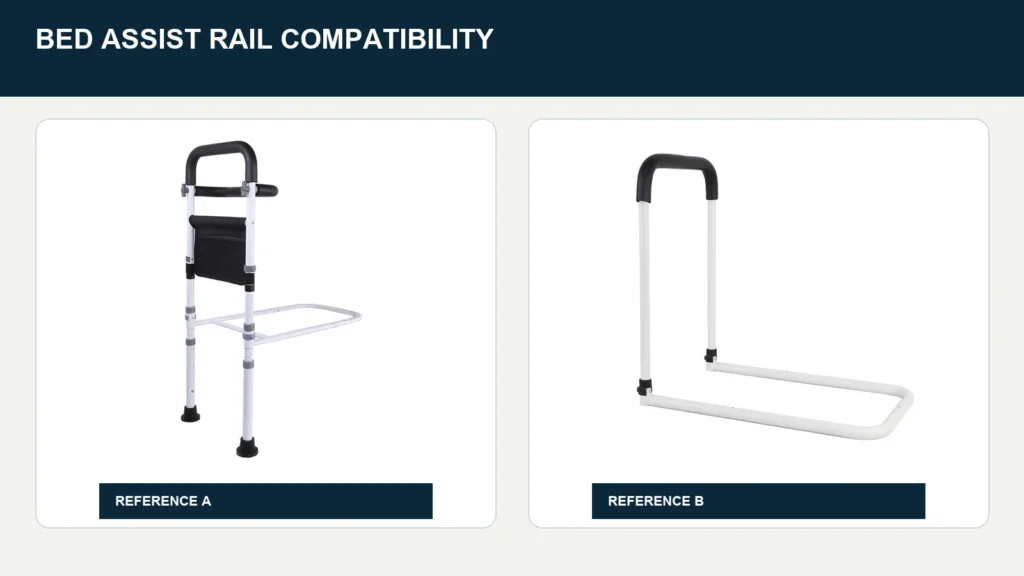
Bed assist rail compatibility cannot be established from mattress size alone. A buyer must review the exact bed frame, mattress construction, rail attachment, surrounding gaps, adjustable-bed movement, user environment and installation method. A rail that appears to fit a static bed may interfere, loosen or create an unacceptable space when the mattress compresses or the bed changes position.
CRF currently lists two bed-assist-rail products with different visible structures. They provide real sourcing references, but their legacy titles and images are not evidence of universal fit, fall prevention, medical grade, pregnancy suitability or a clinical result. Final use requires model-specific evaluation by responsible professionals.
1. Identify the Exact Bed System
Start with a controlled bed record, not a broad label such as “queen bed” or “hospital bed.” Record:
- bed manufacturer, model and revision;
- fixed, profiling, height-adjustable or other movement;
- frame type, side member and deck geometry;
- mattress width, length, depth and edge construction;
- topper, overlay or pressure-management surface;
- headboard, side furniture and nearby equipment;
- permitted attachment areas;
- under-bed clearance; and
- responsible installer and inspection owner.
Two beds with the same nominal mattress dimensions can have different frames, edge support and movement envelopes.
2. Map the Rail Attachment Interface
A bed assist rail may use an under-mattress structure, straps, clamps, frame interfaces or a combination. Confirm the exact supplied configuration rather than assuming from a photo.
Under-mattress components
Record insertion depth, orientation, contact area and interference with mattress supports. Check whether the bed deck, slats, platform or articulation changes the available space.
Straps or retention components
If the selected configuration uses straps or other retention, document routing, anchor location, adjustment and inspection. The route must not contact moving mechanisms or rely on an unsuitable part of the bed.
Frame interfaces
Where a component attaches to a frame, confirm section shape, dimensions, surface condition and available access. Do not substitute fasteners, clamps or padding without review.
The approved installation drawing should identify every interface and prohibited area.
3. Evaluate Mattress Geometry and Compression
Mattress thickness is only one input. Edge shape, firmness, cover, topper and compression can change the relationship between the support handle and sleep surface.
Review the rail with:
- the specified mattress and any overlay installed;
- bedding in its normal arrangement;
- the mattress unloaded and under representative compression;
- the bed in every approved position; and
- the rail at every permitted adjustment.
Measure relevant spaces using an agreed method. Do not assume that an adjustable rail automatically eliminates gaps. The responsible organization must determine applicable requirements and acceptance criteria for the intended environment and user population.
4. Check Adjustable-Bed Movement
A static fit check is not enough for a profiling or height-adjustable bed. Move the bed through every permitted position while observing:
- rail contact with the frame, deck or headboard;
- movement of straps or attachment parts;
- change in handle height and orientation;
- spaces between rail, mattress and bed components;
- pinching, shearing or trapping locations;
- interference with controls or service access; and
- floor or furniture contact during height changes.
If the rail is not intended for a moving bed, that limitation must be explicit in the product selection and instructions.
5. Define the Intended Support Task
Avoid vague promises such as “prevents falls” or “safe for everyone.” Define the actual task and environment:
- repositioning in bed;
- moving from lying to sitting;
- sitting balance at the bedside;
- standing or transfer support;
- access by carers; or
- a limited combination approved by the responsible assessor.
The required geometry depends on hand position, reach, bed height, transfer direction, nearby furniture and user capabilities. A bedside support rail is not automatically a full-length side rail, restraint, lifting device or substitute for professional assessment.
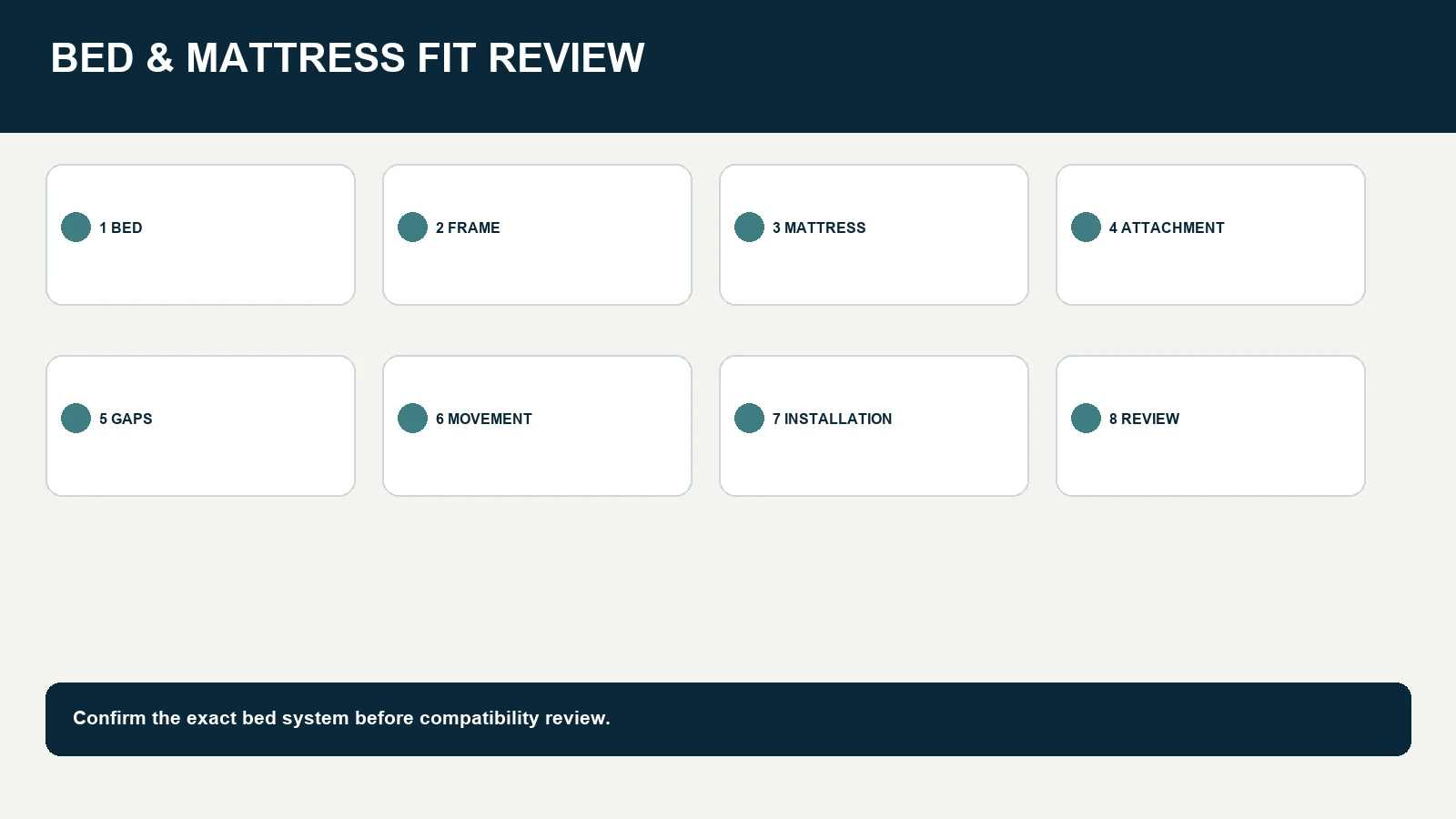
6. Compare Candidate Structures
CRF’s live products show different rail forms. Buyers should compare controlled characteristics rather than product names.
| Review point | Buyer input | Sample question |
|---|---|---|
| Handle geometry | Intended grip and task | Is the approved grip area reachable without obstruction? |
| Height adjustment | Bed and mattress dimensions | Does every permitted setting maintain the approved relationship? |
| Base/interface | Frame, deck and mattress structure | Does it engage the intended bed without uncontrolled movement? |
| Retention | Supplied straps, clamps or hardware | Is the complete retention method installed and inspectable? |
| Bed movement | Static or adjustable positions | Does any position create interference or an unacceptable space? |
| Access | Carer, patient and equipment route | Does the rail block controls, transfers or care tasks? |
| Cleaning | Buyer’s process and agents | Can surfaces and joints be reached and inspected? |
| Packaging | Components and instructions | Are all required parts identifiable on receipt? |
No single structure is universally preferable. Select by the verified bed system and intended task.
7. Review the Complete Bedside Environment
The rail interacts with more than the bed. Survey:
- bedside cabinet or overbed table;
- wall, headboard and power outlets;
- floor lift or transfer equipment;
- wheelchair approach;
- call controls and cables;
- bedding and mattress accessories;
- walking route; and
- cleaning and emergency access.
A rail may fit the frame but obstruct equipment or force an unsuitable transfer direction. Review the complete environment at the representative installation.
8. Control Installation
Use a model-specific installation instruction and checklist. A controlled installation should confirm:
- product and component identity;
- bed and mattress identity;
- correct orientation and adjustment;
- complete attachment or retention;
- fasteners or straps set by the specified method;
- absence of prohibited interference;
- fit through every approved bed position;
- agreed gap and movement checks;
- labels and instructions present; and
- installer, date and acceptance record.
Do not rely on a generic online video if it does not match the supplied rail and bed.
9. Establish Inspection and Reassessment
Define checks before use and at a risk-based interval. Inspection points may include:
- loose, missing or damaged components;
- movement at the attachment;
- strap wear or routing change;
- altered adjustment;
- corrosion or surface damage;
- mattress or topper replacement;
- bed repair or model change;
- changed gaps or interference; and
- legibility of instructions and labels.
Remove the product from service according to the responsible organization’s process when damage, looseness, missing parts or an unapproved configuration is found.
Reassess after a user, bed, mattress, room layout or intended task changes. Compatibility is not permanent when its inputs change.
10. Cleaning and Maintenance Inputs
The buyer should provide the cleaning agents, concentrations, contact times and process. Review access around grips, adjustment holes, joints, clamps, straps and under-mattress components. Cleaning must not hide inspection needs or introduce unapproved chemical exposure.
Request replacement-part identification and instructions for adjustment or reassembly. Do not replace a component with a visually similar part unless the manufacturer confirms the configuration.
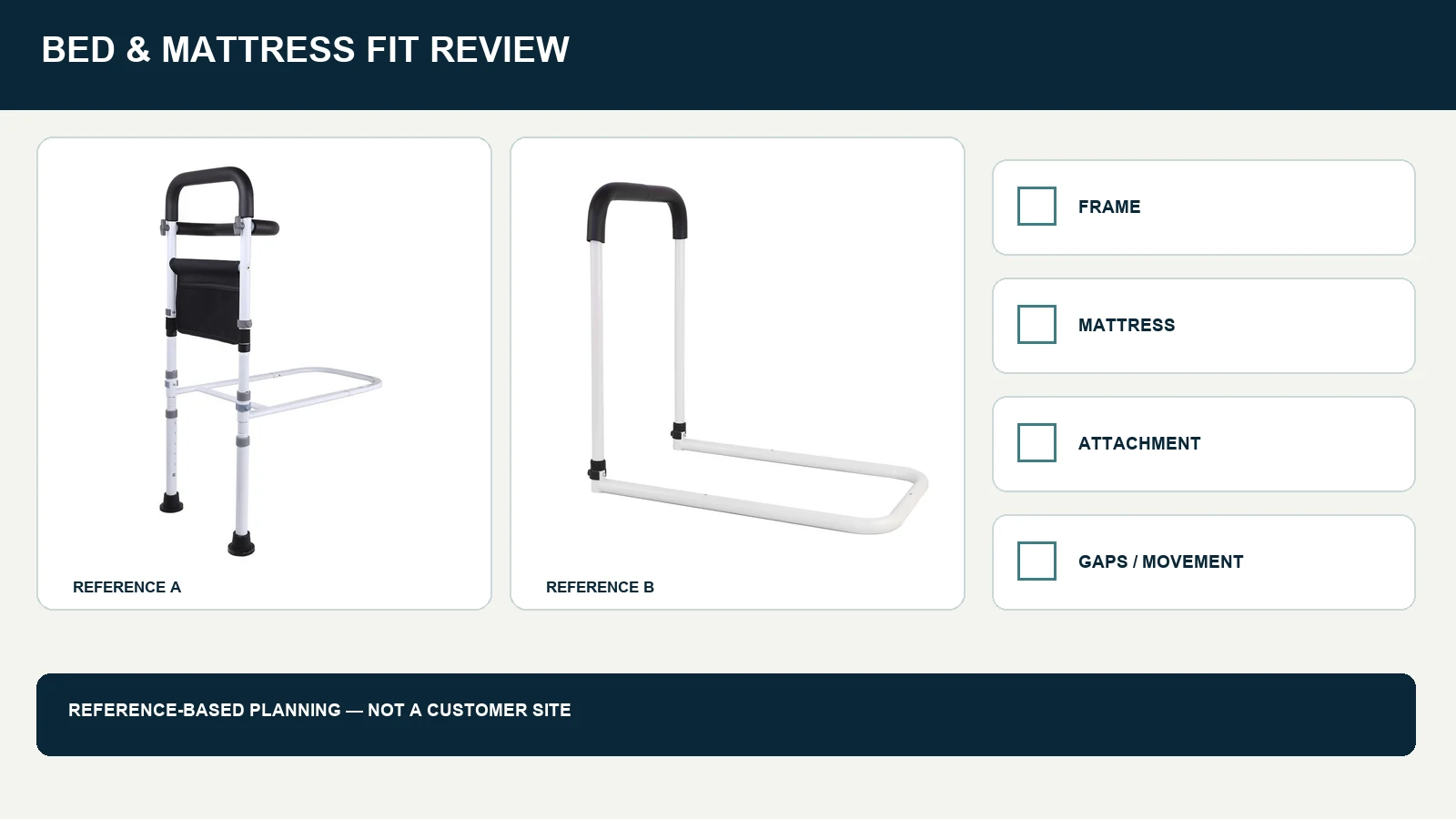
11. Prototype and Sample Acceptance
For B2B purchasing, test a representative sample with the exact bed and mattress or a controlled equivalent approved by the buyer.
Identity and assembly
- Product, components and instructions match the quotation.
- The sample matches the current drawing or approved reference.
- No unlisted substitution is present.
Fit and movement
- Attachment is complete and inspectable.
- The rail remains in the approved position under the agreed method.
- Bed movement produces no prohibited contact or interference.
- Relevant spaces meet buyer-defined acceptance criteria.
Intended task
- The responsible assessor reviews reach, access and task suitability.
- Carer and equipment access remain available.
- Limitations are recorded.
Documentation
- Bed, mattress and rail identities are captured.
- Photos show the approved installation without implying a customer case.
- Deviations are closed before order release.
Sample approval applies only to the documented bed system, user context and method.
12. RFQ Checklist
Send CRF:
- Bed manufacturer, model, revision and photographs.
- Frame, side-member, deck and under-bed dimensions.
- Mattress and topper dimensions and construction.
- Every permitted adjustable-bed position.
- Intended support task and professional-assessment requirements.
- Preferred rail geometry and adjustment range.
- Required attachment or retention method.
- Room layout and nearby equipment.
- Cleaning and maintenance process.
- Destination market and applicable evidence requirements.
- Sample quantity and acceptance method.
- Packaging, labeling, spare parts and change-control expectations.
Common Procurement Errors
Buying by mattress size alone
Nominal mattress size does not define the frame, edge compression, attachment or movement envelope.
Treating “adjustable” as universal
Adjustment range does not prove compatibility with every bed or user. Evaluate every permitted setting.
Approving only a static photograph
A photograph cannot demonstrate attachment, compression, bed articulation, retention or inspection access.
Reusing unsupported marketing claims
Terms such as “medical grade,” “anti-fall” and user-group claims require substantiation and context. This guide does not repeat them as proven performance.
FAQ
Are bed assist rails universal?
No. Compatibility depends on the exact bed frame, mattress, attachment, bed movement, environment and intended support task.
Can a bed assist rail be used with an adjustable bed?
Only after the selected rail and bed are evaluated through every permitted position. Movement can change interfaces, gaps and interference.
Does mattress thickness determine compatibility?
It is one input, but edge construction, compression, topper, frame and attachment geometry also matter.
Is a bed assist rail the same as a full-length bed side rail?
Not necessarily. Product purpose, dimensions and installation differ. Do not treat a support handle as a restraint, lifting device or full-length barrier unless specifically evaluated and documented.
When should compatibility be reassessed?
Reassess when the bed, mattress, topper, rail adjustment, room layout, intended task or user context changes, and when inspection finds damage or looseness.
Request a Bed Assist Rail Fit Review
Send CRF the bed-frame details, mattress stack, movement positions, intended task and sample acceptance criteria. CRF can compare verified product structures and review a configuration-specific quotation. Request a bed assist rail fit RFQ.
Internal links
- View CRF adjustable bedside support rail Product 3739
- View CRF adjustable bedside support rail Product 3731
- Browse CRF bed assist rails
- Browse rehabilitation and bathroom safety products
CTA: Request a Quote — attach the bed model, mattress stack, movement envelope and fit-acceptance checklist.
Editorial limitations: Educational B2B sourcing content only; not medical advice. No universal compatibility, fall prevention, clinical result, load, certification, price, stock, MOQ or lead-time claim is made.