
Primary keyword: ECG medical cart
Secondary keywords: ECG cart procurement; electrocardiograph cart; medical trolley cart; ECG cart fleet
Intent: Commercial investigation / fleet procurement
Funnel: Consideration / decision
Business value: High
Difficulty: Exact fleet-standardization extension metrics are unknown.
Keyword source: The local Semrush/seotools8 library supports the adjacent “medical trolley cart” cluster at US volume 170, KD 14 and CPC USD 1.48. The exact “ECG medical cart fleet” extension has no platform metric and is labeled unknown. Fresh GSC data is available through 2026-10-04; no disclosed exact-topic query was found.
SEO title: ECG Medical Cart Fleet Standardization Guide | CRF
Slug: /ecg-medical-cart-fleet-standardization/
Meta description: Standardize an ECG medical cart fleet by controlling devices, interfaces, cable routes, accessories, mobility, cleaning inputs, samples and change records.
H1: ECG Medical Cart Fleet Standardization: A B2B Rollout Guide
An ECG medical cart fleet should be standardized around the exact electrocardiograph, accessories, cable set, workflow and facility route—not around a generic trolley photograph. A controlled fleet specification identifies each interface, operating state, supplied item, replacement part and acceptance method. That reduces avoidable variation when a buyer moves from one sample to multiple departments or sites.
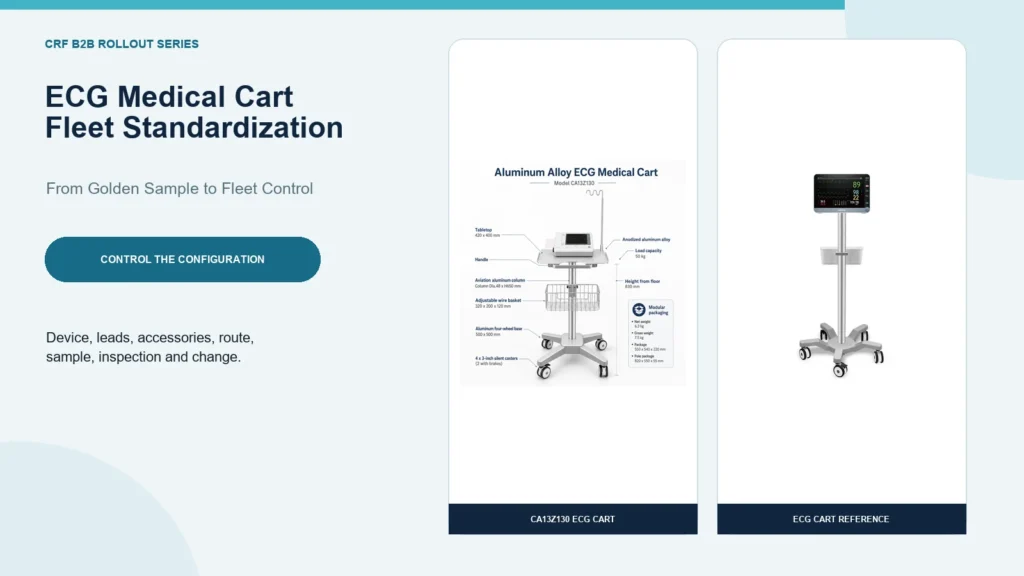
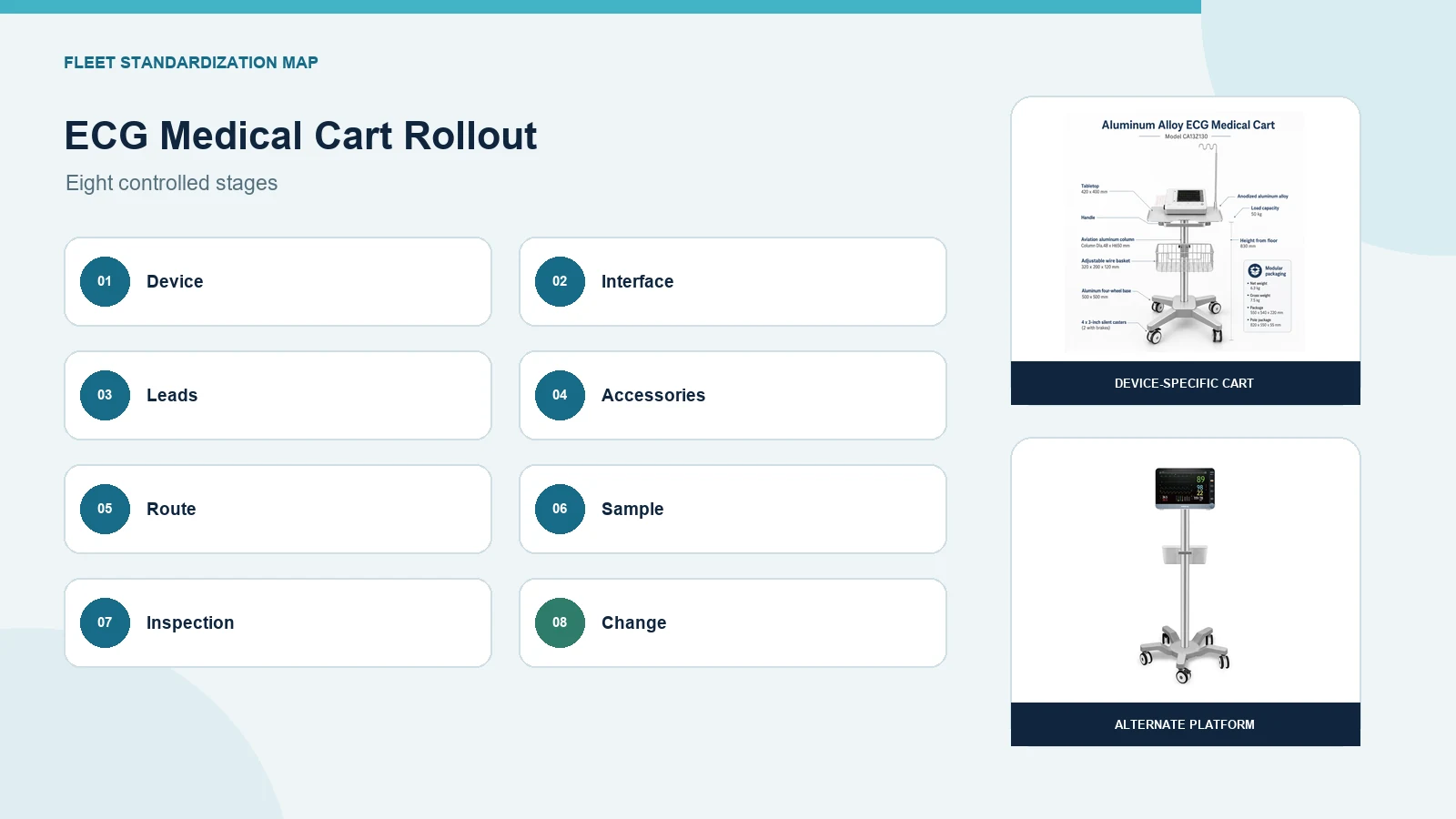
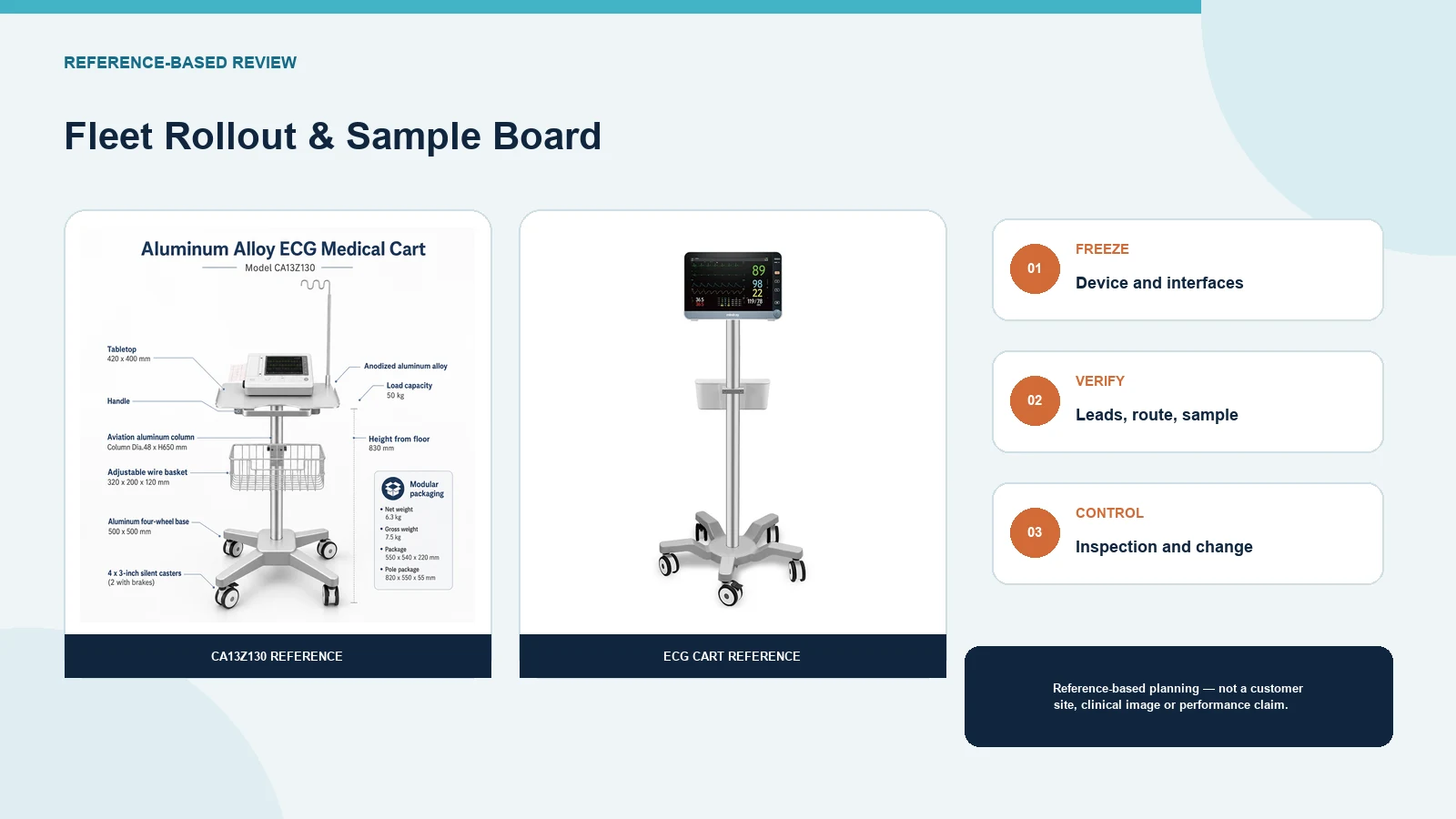
CRF’s live catalog provides two relevant product references: the aluminum-alloy CA13Z130 ECG cart and another ECG cart platform. These demonstrate different physical cart directions; they do not establish universal device compatibility, load capacity, clinical performance or destination compliance. The buyer must validate the completed configuration.
1. Define the Fleet Boundary
Start by deciding what “one fleet” means. It may cover one ECG model in one facility, several device revisions across a hospital group, or a purchasing framework with approved variants.
Create a fleet matrix containing:
- facility and department;
- electrocardiograph manufacturer, model and revision;
- device dimensions, mass, feet and cable exits;
- patient-cable set and storage method;
- power supply, battery or adapter responsibility;
- paper, gel, electrodes and other consumables kept on the cart;
- printer or accessory requirements;
- route, doorway, elevator and parking constraints; and
- local cleaning, inspection and maintenance inputs.
If two departments need materially different devices or workflows, use controlled variants instead of forcing them into one ambiguous configuration.
2. Freeze the Device Interface
A fleet rollout depends on repeatable fit. Record the supported footprint, permitted retention areas, underside features, vents, controls, connectors and service panels of the exact ECG unit.
Platform and retention
Define the usable support area and the approved method for preventing unintended movement. A lip, strap, bracket or custom fixture must not block controls, vents, paper paths or maintenance access. The retention method should be checked in every permitted device orientation.
Device revision control
Two units with similar model names may have different feet, power supplies or connector locations. Tie the cart drawing and sample approval to a controlled device revision. A substitute device triggers an impact review rather than automatic acceptance.
Access and operation
Review screen visibility, keypad reach, paper handling, lead connection and service access at the representative work point. Avoid broad ergonomic claims; specify the actual users, tasks and acceptance method.
3. Control Patient Leads and Cables
Cable storage is a defining requirement for an electrocardiograph cart. Build a point-to-point schedule for patient leads, mains cable, power adapter and any data connection.
For each cable, record:
- source and destination;
- connector and exit direction;
- controlled length;
- fixed and moving sections;
- service loop;
- storage position;
- disconnect point; and
- replacement identifier.
Check the route against platform edges, baskets, drawers, handles, column joints, caster sweep and brake pedals. Connectors should not be used as strain relief. Stored leads must remain within the agreed movement envelope and should be retrievable without tangling with unrelated cables.
A photograph alone is not an approved routing standard. Use a drawing or controlled visual work instruction that identifies retention points and acceptable loops.
4. Standardize Accessories Without Overloading the Cart
List every item expected on the configured cart. Typical project inputs may include a wire basket, document holder, lead organizer, gel or electrode storage, printer provision and waste or consumable container. Inclusion is configuration-specific.
For each accessory, define:
- purpose and contents;
- maximum intended inventory under the buyer’s method;
- mounting interface and location;
- access during operation;
- retention during movement;
- cleaning access;
- interference with controls and cables; and
- replacement part number.
Do not treat empty basket volume as permission to add unlimited supplies. Any mass or position change may affect movement, footprint and stability review.
5. Compare Four-Caster and Other Base Layouts by Use Case
CRF’s catalog includes multiple medical-cart base structures. Base selection must follow the complete configuration and representative route.
| Review point | Procurement question | Acceptance evidence |
|---|---|---|
| Footprint | Does the complete cart fit doors, elevators and parking? | Dimensioned envelope and route trial |
| Turning | Can the cart complete required turns without contact? | Representative configured sample |
| Brakes | Are controls accessible in the parking state? | Inspection and use check |
| Caster sweep | Can cables or accessories enter the wheel path? | Full-turn visual review |
| Thresholds | What transitions exist on the route? | Site survey and agreed test method |
| Extended parts | Do baskets, leads or handles increase the envelope? | Drawing and sample review |
Wheel count by itself does not prove stability, maneuverability or suitability. Evaluate the actual base, casters, equipment and operating states together.
6. Separate Passive Cart and Powered-System Scope
The RFQ must state whether CRF supplies only a passive mechanical cart or also any power strip, inlet, battery, charger, converter, enclosure or wiring. Assign responsibility for:
- destination voltage and plug;
- power-component selection;
- grounding and protective measures;
- ventilation and clearance inputs;
- charging and parking workflow;
- cable labeling and replacement; and
- evaluation of the completed powered assembly.
A cart does not automatically inherit the approvals of the electrocardiograph. Medical, electrical and destination requirements must be assessed for the exact completed configuration by qualified parties.
7. Build a Golden Sample and Acceptance Record
Before a fleet release, assemble a representative sample using the correct device, cables and accessories wherever possible. Verify:
Identity
- Cart model, drawing and bill of materials match.
- ECG device model and revision are recorded.
- Included and excluded accessories are unambiguous.
Fit and access
- The device sits in the approved area.
- Retention engages as specified.
- Controls, vents, connectors and paper path remain accessible.
Cable behavior
- Leads and power cables follow the controlled route.
- Loops remain away from casters and pinch points.
- Stored cables remain inside the movement envelope.
Route and parking
- The configured cart follows the representative route using the agreed method.
- Brakes and handles are accessible.
- Parking does not block required access or create uncontrolled cable placement.
Documentation
- Deviations are recorded and closed.
- Photos correspond to the approved sample.
- Acceptance owners and revision date are documented.
Golden-sample approval applies only to the controlled configuration and method.
8. Prepare Production and Incoming Inspection
Translate sample approval into repeatable inspection points. A practical incoming checklist can cover:
- model and finish identity;
- platform, column and base geometry;
- caster and brake configuration;
- accessory count and position;
- fasteners and retention parts;
- cable-management parts;
- labels and documentation;
- packaging condition; and
- comparison with the approved sample and drawing.
Define which characteristics require measurement and which use visual criteria. Set a process for nonconforming units and concessions; do not resolve discrepancies with undocumented substitutions.
9. Plan Service Parts and Fleet Changes
A standardized fleet needs a service-parts list for wear, damage or loss. Identify caster assemblies, brakes, baskets, holders, fasteners, cable retainers and other replaceable parts by controlled reference.
Trigger a change review when any of the following changes:
- ECG model or revision;
- device mass, feet or connector location;
- platform or retention geometry;
- accessory or inventory;
- cable type or length;
- base or caster;
- cleaning process;
- packaging; or
- destination requirement.
Assess affected drawings, tests, work instructions and installed units before release.
10. RFQ Checklist
Send CRF:
- ECG device make, model, revision and drawings.
- Dimensions, mass, feet and permitted retention areas.
- Patient leads, power and data cable schedule.
- Required basket, holder, printer or consumable storage.
- Full operating, movement and parking workflow.
- Maximum footprint and facility route survey.
- Caster, brake and handle requirements.
- Cleaning and maintenance inputs.
- Passive-cart versus powered-system responsibility matrix.
- Destination market and evidence requirements.
- Prototype acceptance plan and approvers.
- Forecast, packaging, service parts and change-control expectations.
Limitations
This guide does not prescribe clinical use, infection-control procedures or electrical compliance. It does not claim that a referenced CRF cart fits an unspecified ECG device. Final suitability depends on controlled project inputs, representative evaluation and written quotation.
FAQ
What should be standardized first in an ECG medical cart fleet?
Freeze the exact ECG device and revision, interface, cable set, accessories, route and acceptance method before standardizing color or optional storage.
Can one ECG cart fit several electrocardiographs?
Possibly, but compatibility cannot be assumed. Each device needs an interface and operating-state review, followed by controlled sample verification.
Is a product photo enough to approve the cart?
No. A photo does not define supplied accessories, dimensions, retention, cable routing, assembly or acceptance criteria.
How should patient leads be stored?
Define a controlled storage method that protects connectors, avoids caster and pinch zones, stays within the movement envelope and supports the buyer’s workflow.
When should a fleet sample be re-approved?
Re-review affected requirements whenever the device, interface, cable set, accessory, caster, base, cleaning process or destination requirement changes.
Request an ECG Cart Fleet Review
Send CRF the device package, cable schedule, accessory list, route survey and fleet acceptance plan. CRF can compare verified cart platforms and review a configuration-specific OEM/ODM direction. Request a configuration-specific RFQ.
Internal links
- View the verified CRF CA13Z130 ECG medical cart
- View another verified CRF ECG cart platform
- Browse CRF ECG medical carts
CTA: Request a Quote — attach the ECG model, interface drawing, cable list, accessories and route criteria.
Editorial limitations: No load, stability, electrical classification, certification, clinical outcome, price, stock, MOQ or lead-time claim is made.