
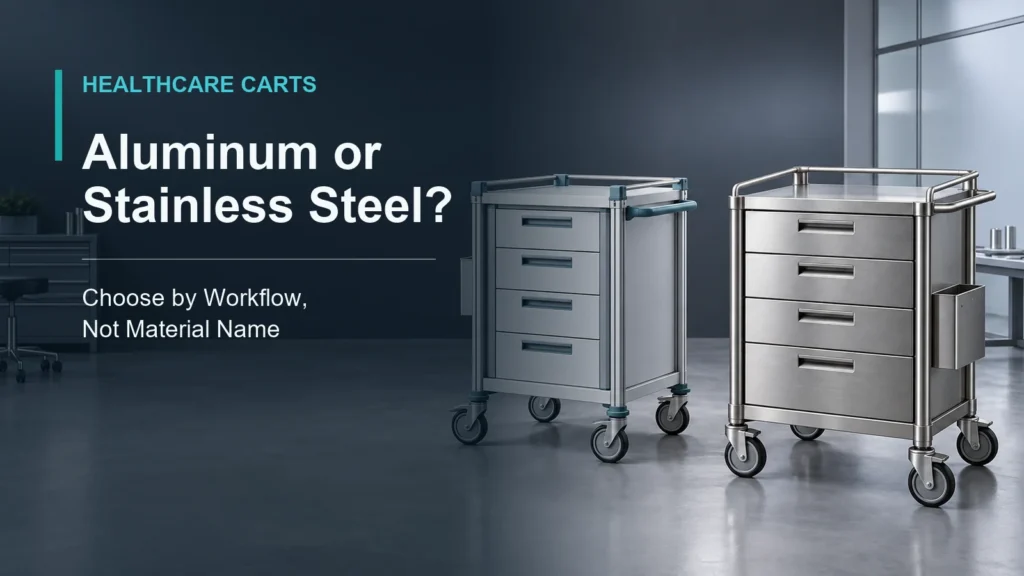
The right material for a healthcare cart depends on the workflow, not on a universal “best” choice. Aluminum is often useful when lower moving mass and frequent repositioning matter. Stainless steel is often considered when buyers prioritize a robust metal surface and corrosion resistance. In either case, the final decision should account for frame geometry, joints, casters, cleaning chemicals, carried equipment and the facility’s own risk assessment—not material name alone.
This guide gives procurement teams, equipment integrators and distributors a practical way to compare both options before requesting a custom quote. It is procurement education, not medical advice, and does not establish that a proposed cart complies with any regulation or clinical protocol.
Start with the healthcare workflow, not the catalog
Healthcare carts can describe many different mobile platforms: a device carrier, a documentation workstation, an organized supply cart or a procedure-support trolley. Those uses create different design inputs.
Before choosing a material, document:
- Primary task: What will happen at the cart?
- Contents: Which devices, consumables and accessories must travel together?
- Movement pattern: Will the cart remain in one room, move between rooms or cross thresholds and elevators?
- Users: What handle positions, working heights and access directions are needed?
- Cleaning process: Which approved products, contact times and wipe-down frequency apply locally?
- Environment: What are the narrowest door, corridor, storage and turning-space constraints?
- Interfaces: Are shelves, drawers, monitor mounts, cable routes, power components or accessory rails required?
This workflow map becomes the basis for comparing aluminum and stainless steel without relying on vague terms such as “medical grade” or “heavy duty.”
Aluminum healthcare carts: where they can fit
Aluminum can support a lightweight, corrosion-resistant cart structure. That can be valuable for carts moved frequently or configured as mobile equipment platforms.
Potential advantages
- Lower material density can help reduce frame mass when geometry and component choices are comparable.
- Extrusions, plates and fabricated parts can support modular mounting arrangements.
- Aluminum naturally forms a protective oxide layer and can receive finishes such as anodizing or coating.
- It can be practical for equipment-cart structures that require brackets, columns, shelves or cable-management features.
Questions and limitations
Aluminum is not automatically the lightest completed cart: drawers, batteries, worktops, casters and mounted equipment may dominate total mass. Alloy, wall thickness, joining method and finish also affect performance. Buyers should request the actual complete-cart mass and documented load conditions rather than infer them from the frame material.
Cleaning compatibility must be checked against the selected finish and the facility’s approved products. Edge protection, fasteners, dissimilar-metal contact and repair of damaged finishes should be addressed in the design review.
Stainless steel healthcare carts: where they can fit
Stainless steel is a common option when buyers need a robust, corrosion-resistant metal structure or work surface. It can suit carts exposed to repeated handling and cleaning, provided the selected grade, finish and construction details match the intended environment.
Potential advantages
- A durable metal surface can be specified for frames, shelves, enclosures and worktops.
- Corrosion resistance can support demanding environments when the correct grade and fabrication practices are used.
- Welded or formed construction can create rigid assemblies.
- Uncoated surfaces can avoid concerns associated with chipped paint, although scratches, residues and fabrication quality still require review.
Questions and limitations
A stainless steel design may be heavier than an otherwise comparable aluminum design, but complete-system mass must still be measured rather than assumed. Surface finish, weld treatment, corners and seams influence cleanability. “Stainless steel” alone does not identify a grade, finish, passivation process or chemical-compatibility profile.
CRF does not claim a particular stainless grade or performance for a cart unless it is confirmed in the project specification. Buyers should state any required grade, finish, test evidence and documentation in the RFQ.
Aluminum vs stainless steel healthcare carts
| Decision factor | Aluminum direction | Stainless steel direction | What to verify in the RFQ |
|---|---|---|---|
| Frequent movement | Can help manage frame mass | Can be suitable with an optimized structure | Complete-cart mass, center of gravity, push/pull evaluation |
| Structural configuration | Useful for modular frames and mounted devices | Useful for formed or welded frames and cabinets | Load locations, test condition, safety factor and deflection criteria |
| Cleaning | Depends on alloy, finish and chemical | Depends on grade, finish and chemical | Approved product list, concentration, contact time and manufacturer instructions |
| Corrosion exposure | Finish and joint details matter | Grade and fabrication details matter | Environment, fasteners, crevices and dissimilar metals |
| Surface appearance | Anodized or coated options | Brushed or other specified finishes | Color, gloss, texture and acceptable cosmetic variation |
| Custom integration | Brackets, extrusions and machined parts | Sheet-metal, tube and welded assemblies | Drawings, interfaces, tolerances and service access |
| Lifecycle service | Replaceable modules should be planned | Replaceable hardware should be planned | Caster, lock, drawer and handle replacement method |
The comparison is directional. A well-engineered cart in either material may outperform a poorly specified cart in the other.
Cleanability is a system requirement
CDC environmental-cleaning guidance emphasizes risk-based procedures, attention to high-touch surfaces, and compatibility with manufacturer instructions. For cart procurement, that means the buyer should define the cleaning process and ask the manufacturer to confirm material compatibility. A smooth-looking rendering is not enough.
Review these details:
- High-touch zones: handles, drawer pulls, worktop edges, control areas and accessory mounts.
- Geometry: exposed threads, deep seams, overlapping panels and inaccessible gaps.
- Liquids: paths where cleaning solution or spills could collect.
- Mixed materials: cart frame, worktop, bumpers, wheels, seals and labels may respond differently.
- Electronics: cleaning access must not conflict with cable openings, power components or ventilation.
- Instructions: responsibilities and procedures should be defined by the facility and the relevant equipment manufacturers.
A cart’s surface material does not by itself make the cart antimicrobial, sterile or suitable for a specific infection-control application.
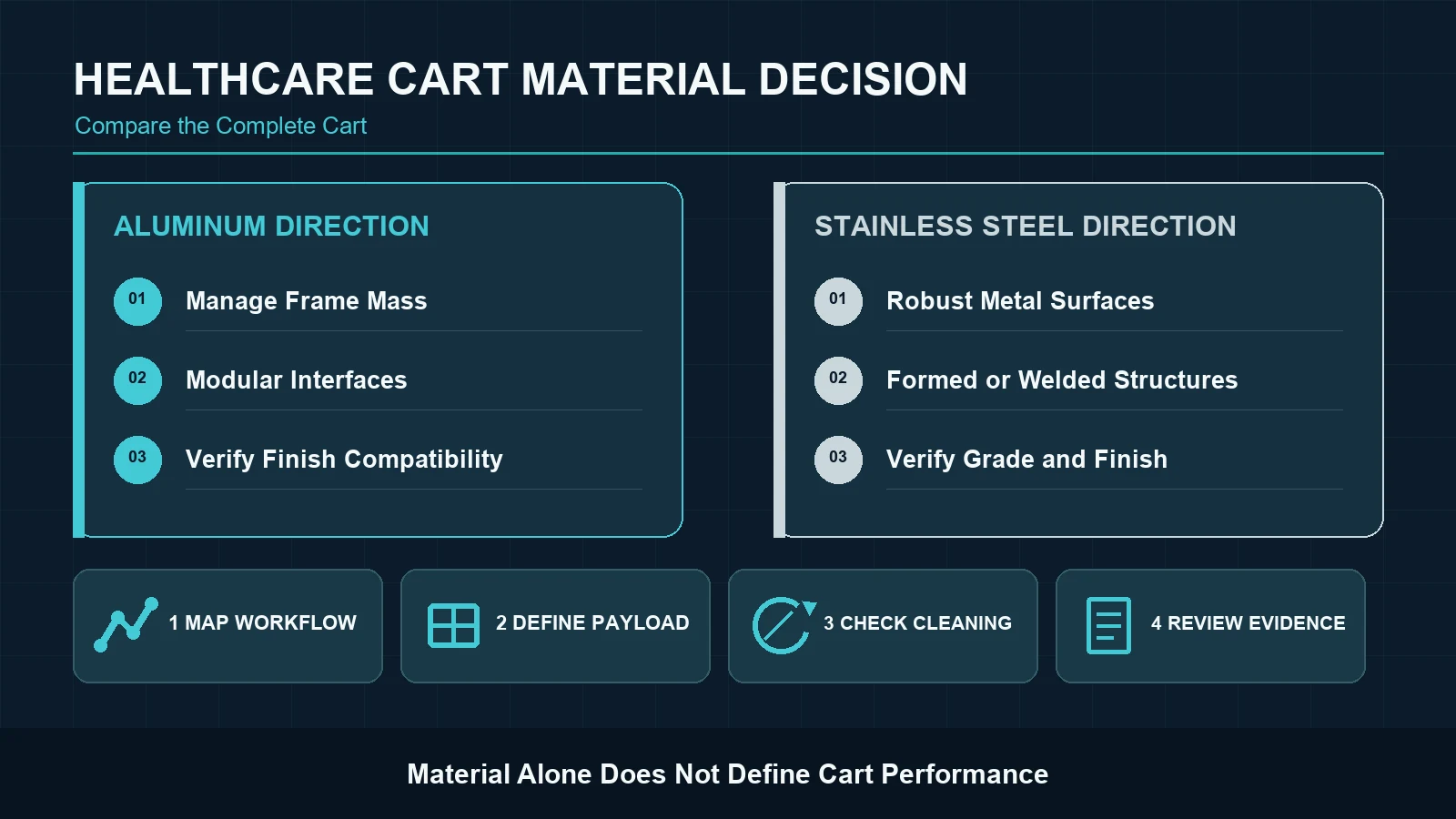
Use a weighted decision process
As with medical equipment cart OEM integration, a simple weighted matrix helps stakeholders compare designs consistently.
Step 1: Set non-negotiable constraints
List doorway envelope, stored footprint, equipment interfaces, required access control, cleaning products and any buyer-mandated standards. A concept that fails a constraint should not advance merely because it looks attractive.
Step 2: Weight the operational criteria
Assign importance to mobility, cleanability, rigidity, modularity, service access, appearance and landed cost. The weights should come from the actual department, not from a generic supplier template.
Step 3: Request evidence
Ask vendors for drawings, a bill of materials at the appropriate level, material declarations, finish details, load assumptions, inspection plan and sample or prototype options. Do not treat an unsupported adjective as evidence.
Step 4: Evaluate the complete cart
Review the cart with its intended payload and accessories installed. Caster behavior, handle placement and stability depend on the complete configuration.
Step 5: Freeze the approved configuration
Record drawings, revision numbers, agreed materials, finishes, accessories, labels, packaging and acceptance checks. This helps prevent configuration drift during repeat orders.
Healthcare cart RFQ checklist
Include the following in a quote request:
- cart purpose, department and expected movement route;
- overall maximum envelope and storage location;
- equipment list, dimensions, masses and mounting points;
- shelf, drawer and compartment map;
- access-control requirement, without assuming a lock technology;
- handle location and intended working-height range;
- floor type, thresholds, caster preferences and braking logic;
- aluminum or stainless preference—or permission for both proposals;
- required material grade and finish if already determined;
- cleaning-product compatibility information to be reviewed;
- cable, power and ventilation needs, if applicable;
- required drawings, samples, inspection records and packaging details;
- quantity, destination and project milestones;
- buyer-required regulatory or compliance evidence for the intended market.
CRF can evaluate a custom aluminum or stainless steel cart from an idea, drawing or sample. Final specifications, claims and compliance evidence must be agreed for the specific project.
Common specification mistakes
Choosing by material name alone
Material does not determine maneuverability, stability or cleanability by itself. Geometry and component selection are equally important.
Omitting the payload layout
A single total-load figure does not show where mass acts. Provide device positions, drawer loads and accessory reach so the structure and base can be reviewed as a system.
Treating all cleaning chemicals as equivalent
Compatibility varies by concentration, contact time, temperature and material finish. Submit the facility’s approved process for review.
Comparing incomplete quotations
One quote may include dividers, mounts, packaging and inspection documentation while another does not. Use a common compliance matrix and list every inclusion and exclusion.
Frequently asked questions
Are aluminum healthcare carts always lighter than stainless steel carts?
Not necessarily. Aluminum has lower density, but total cart mass depends on dimensions, wall thickness, drawers, worktops, wheels, batteries and mounted equipment. Compare the documented complete configurations.
Is stainless steel always easier to clean?
No universal conclusion is valid. Grade, finish, seams, joints and the approved cleaning method all matter. Ask for compatibility information and assess the actual design.
Can one cart use both aluminum and stainless steel?
Yes, a hybrid structure may be appropriate—for example, one material for the frame and another for a work surface or bracket. Dissimilar-metal contact, finish consistency and cleaning compatibility need engineering review.
What should a buyer send for a custom quotation?
Send the use case, dimensional envelope, payload map, mounting interfaces, drawer or shelf layout, movement route, cleaning process, material preference, quantity and destination. Drawings or annotated photos are useful when rights permit.
Does this guide confirm medical-device compliance?
No. Applicable classification, standards, testing and documentation depend on the final cart, integrated equipment and target market. The buyer and qualified compliance specialists should define those requirements.
Request a custom healthcare cart review
Share your workflow, payload, envelope and cleaning requirements with CRF. We can review aluminum and stainless steel manufacturing directions and prepare a project-specific OEM/ODM discussion. Request a custom healthcare cart quote