
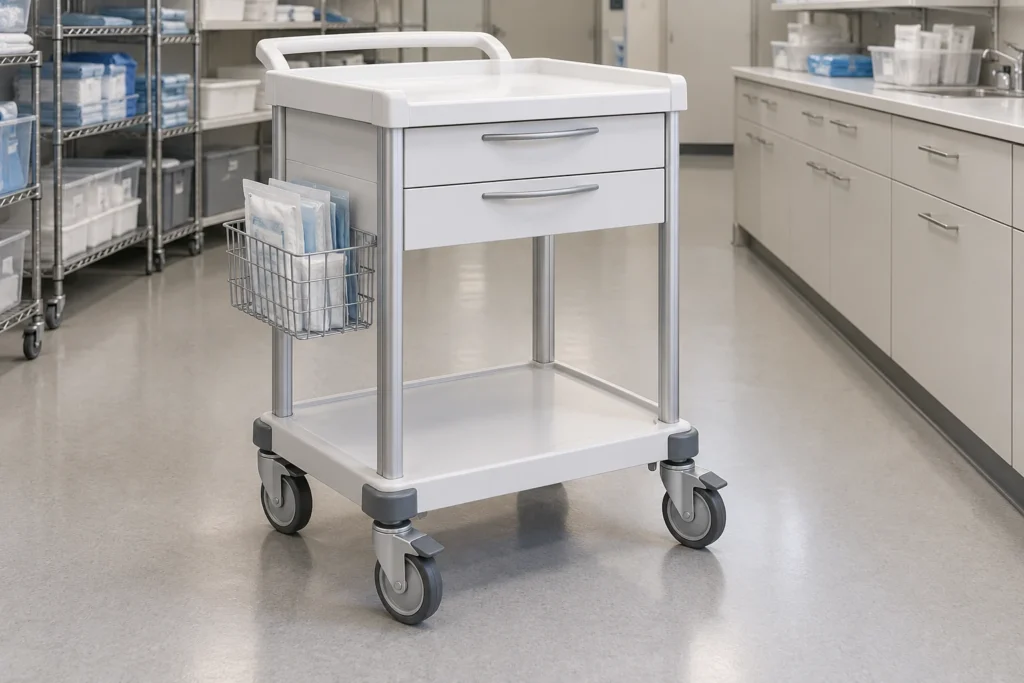
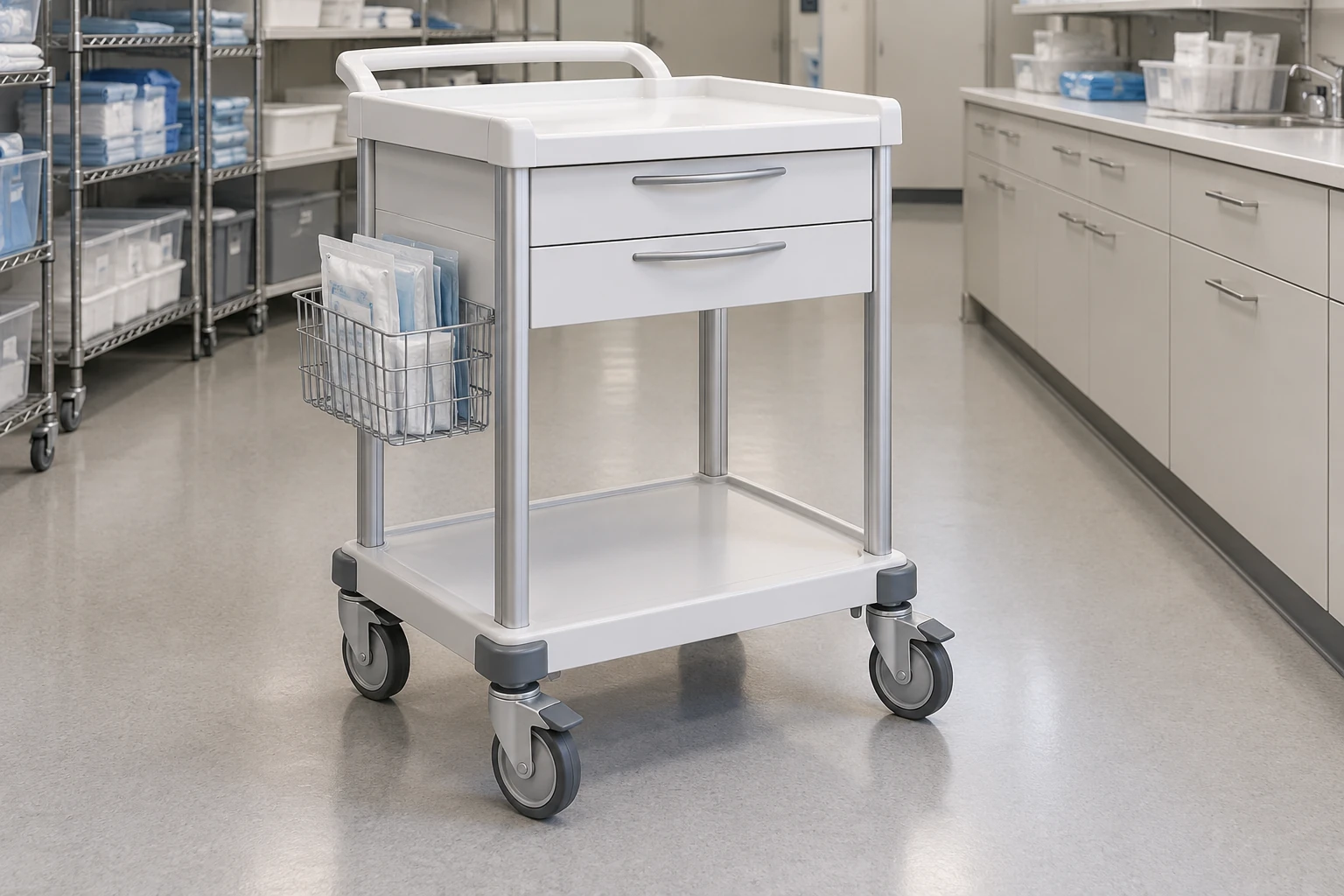
A medical nursing cart should be specified around its supplies, access rules, replenishment process and route—not selected by drawer count or a catalog photograph alone. A quote-ready brief identifies what travels in the cart, who may access it, how contents are separated, the required working envelope, caster and brake needs, cleaning process, labels, packaging and acceptance checks.
CRF lists a customizable medical nursing trolley in its catalog. This is evidence of a real product direction, but not proof of suitability for every ward, item, workflow or market. The ordered configuration must be confirmed in drawings, quotation and a representative sample.
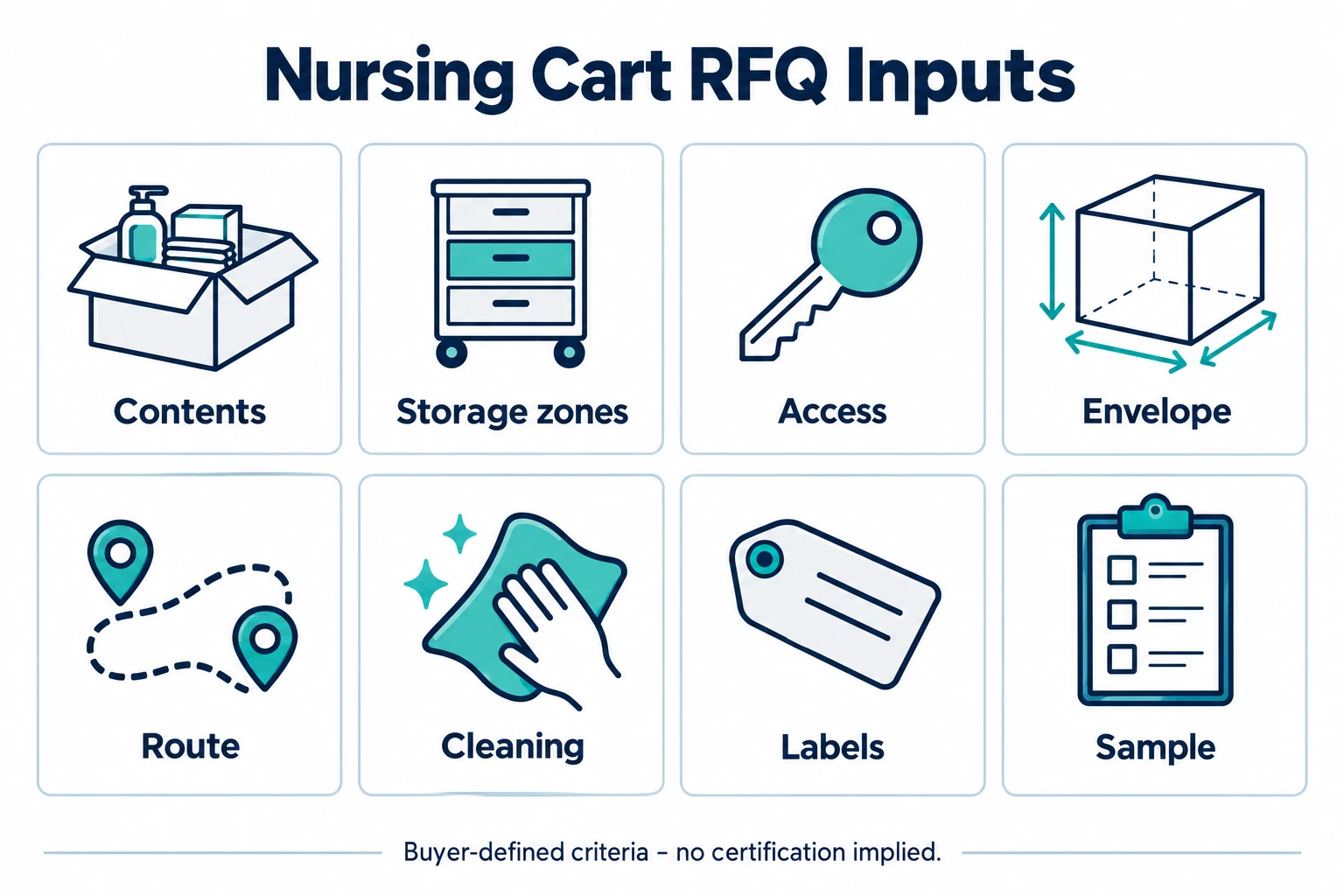
Define the Workflow Before the Cabinet
Start with a controlled workflow description. State where the cart is loaded, parked, moved and used; who accesses it; whether items are replenished by central supply or local staff; and which contents must remain separated.
Build a contents schedule
For every item or item family, record:
- maximum package dimensions and mass;
- planned quantity and replenishment frequency;
- storage orientation and visibility needs;
- whether first-in/first-out rotation matters;
- access restriction or segregation requirement;
- whether the item travels with the cart; and
- any handling or storage instruction supplied by the item owner.
Do not design around nominal drawer volume alone. Dividers, liners, labels and usable internal clearances affect what actually fits.
Map user actions
Describe the sequence from opening a compartment to replacing or documenting an item. Identify where the operator stands, which hand reaches the handle or drawer, what equipment may be nearby and whether another drawer, door or accessory could interfere.
Translate Contents Into Storage Zones
Separate by workflow, not color alone
Create zones for project-defined item groups and document their purpose. Color can support identification, but it is not a substitute for labels, access rules or a controlled replenishment process.
Specify usable dimensions
For each drawer, tray, basket or cabinet, provide usable width, depth and height. Include divider thickness, handle intrusion, slide clearances and the envelope needed to remove packaged items without damaging them.
Review open and closed states
The drawing should show the cart with drawers, doors, bins and accessories in their maximum permitted positions. Check whether opened components conflict with the column, handle, wall, bed, nearby equipment or the user’s path.
Compare Access and Security Options
A nursing-cart project may require open storage, keyed access, seals, controlled compartments or another buyer-defined method. Specify the required behavior instead of requesting a generic “secure cart.”
Ask for:
- access method and authorized-user process;
- key, seal or component management responsibility;
- indicators or labels visible in the parked position;
- override and lost-key procedure, if applicable;
- inspection and replacement method; and
- records required by the buyer.
The cart itself does not establish medication-management compliance or a clinical policy. Responsible organizations must define and approve those controls.
Review Mobility Against the Real Route
Document floor types, thresholds, ramps, elevators, doorway limits, turning areas and parking bays. Record the cart’s maximum configured envelope, including handles, open accessories and protruding labels or holders.
| Route input | Buyer data | Review purpose |
|---|---|---|
| Doorways and lifts | Clear width, depth and sill | Checks configured envelope |
| Floor transitions | Material, gap and threshold | Defines sample-route conditions |
| Turning points | Available sweep and obstacles | Exposes handle and caster conflicts |
| Parking bay | Width, depth and access side | Confirms brake and compartment access |
| Loaded state | Contents and accessory positions | Defines what is actually evaluated |
Wheel count, caster size or “silent” wording does not prove maneuverability, noise or stability. Define an objective route and acceptance method for the loaded sample.
Specify Handles, Casters and Brakes
State intended push direction, handle position, caster requirements and brake interaction. Check that the user can reach brakes without contacting sharp edges or blocking a drawer. Keep loose labels, cables and accessories clear of caster sweep.
The project team should assess the complete loaded cart. Do not infer a stability result from an empty product photograph or a generic rating.
Plan Cleaning and Inspection
Provide the intended cleaning agents, concentrations, contact times and process. Ask the supplier to review disclosed materials, finishes, labels, joints, drawer interiors, handles and caster areas against that process.
Inspect whether users can reach:
- drawer corners and divider interfaces;
- handle and latch recesses;
- underside edges and accessory joints;
- caster forks and brake pedals; and
- removable bins, liners or trays.
This article does not prescribe infection-control practice. The responsible healthcare team must approve the process and any required evidence.
Control Labels, Branding and Documentation
Prepare a label schedule with label text, language, location, material direction, revision owner and replacement method. Separate durable product identification from workflow labels that may change.
The quotation should state which manuals, drawings, packing lists and records are included. Do not claim certification, antimicrobial performance or target-market compliance without configuration-specific evidence.
Approve Packaging and Delivered Contents
Define whether drawers, dividers, handles and accessories ship installed or separately. The packing list should identify every part and its revision. Packaging review should account for protruding handles, caster assemblies, drawer retention and separately packed components.
A received-goods check should compare product identity, finish, labels, supplied accessories, documents and visible transport condition against the approved order.
Sample Acceptance Checklist
Identity and construction
- Product, revision and finish match approved documents.
- Drawer, door, tray, basket and handle arrangement matches the drawing.
- Supplied dividers, labels and accessories match the packing list.
Storage and access
- Controlled sample contents fit in their assigned zones.
- Drawers and doors operate through the approved range.
- Open components do not create unapproved interference.
- Access controls operate according to the agreed method.
Mobility and workflow
- The loaded sample follows the representative route.
- Turning, parking and brake interactions can be evaluated.
- Handles, compartments and frequently used items remain reachable.
- Replenishment steps match the approved sequence.
Cleaning and service
- Intended surfaces can be reached using the disclosed process.
- Removable components can be removed and replaced as documented.
- Inspection points and replacement parts are identified.
Buyer-defined methods and pass/fail criteria must be recorded. A sample review does not create an unstated certification or clinical-performance claim.
Medical Nursing Cart RFQ Checklist
Send CRF:
- Intended workflow and responsible users.
- Complete contents schedule with dimensions, mass and quantities.
- Required drawers, trays, baskets, dividers and usable dimensions.
- Segregation, visibility and access-control requirements.
- Maximum closed, operating and service envelopes.
- Handle, caster, brake and bumper requirements.
- Route, doorway, elevator, threshold and parking constraints.
- Cleaning agents and process.
- Label, language and branding schedule.
- Required drawings, manuals and records.
- Packaging and delivered-parts requirements.
- Prototype, pilot and forecast quantities.
- Destination market and buyer-required evidence.
- Sample acceptance methods and approval owners.
Common Sourcing Mistakes
Ordering by drawer count
Two carts with the same drawer count can have different usable dimensions and access behavior. Specify actual contents and internal clearances.
Adding accessories after drawing approval
A holder, bin or side basket can change width, balance, cleaning access and route clearance. Process additions through documented change review.
Treating a product photo as the bill of materials
A photograph does not define included accessories, revisions or internal dimensions. Use controlled documents and a packing list.
Using “hospital grade” as a specification
Marketing language cannot replace material, finish, cleaning, documentation and acceptance requirements.
FAQ
What should a medical nursing cart specification include?
Include the contents schedule, usable storage dimensions, access method, loaded envelope, route, cleaning process, labels, packaging, required evidence and sample acceptance criteria.
How many drawers should a nursing trolley have?
There is no universal count. Determine the number and usable size from verified contents, segregation, access sequence and replenishment process.
Does a nursing cart include medical supplies?
Treat supplies as separate unless the quotation explicitly lists them. Confirm every included component in writing.
Can CRF customize a medical nursing trolley?
CRF accepts OEM/ODM inquiries. Feasibility depends on the storage layout, contents, access method, route, cleaning, documentation, quantities and target market.
Does a mobile nursing cart automatically meet hospital regulations?
No. Requirements depend on the market, intended use and complete configuration. Responsible parties must define applicable obligations and verify evidence.
Request an OEM Configuration Review
Send CRF the workflow, contents schedule, storage map, route, cleaning process, labels, destination, quantity and acceptance criteria. CRF can review missing inputs and prepare a configuration-specific quotation path.
Related Resources
Request a B2B RFQ — include your configuration inputs and acceptance criteria.
This guide provides B2B procurement education, not clinical or electrical approval. Final requirements and evidence must be agreed for the ordered configuration.