
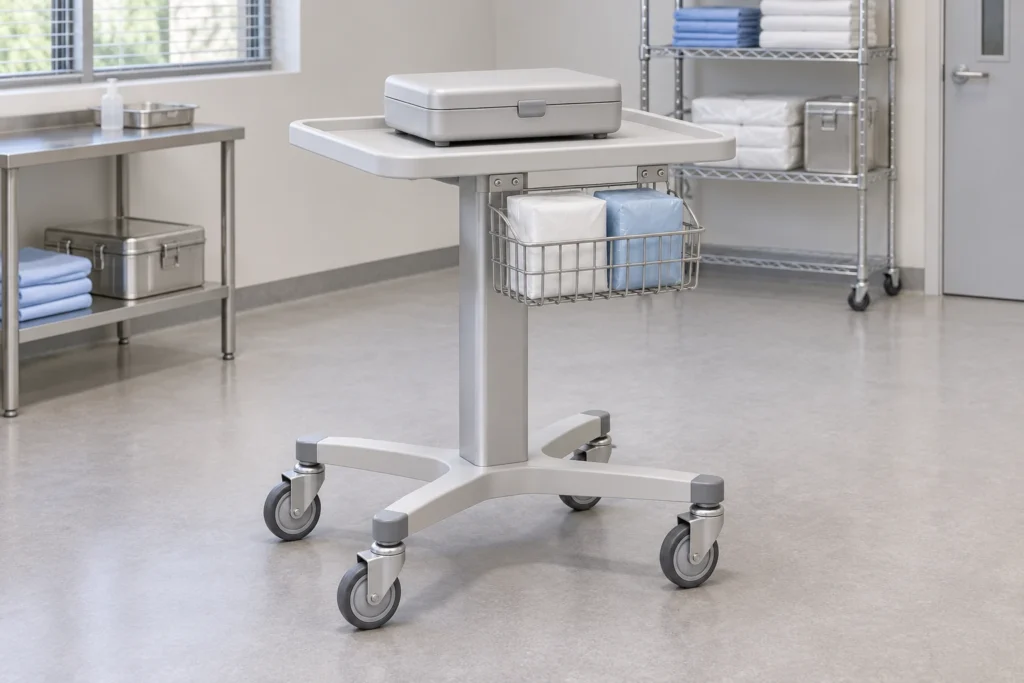
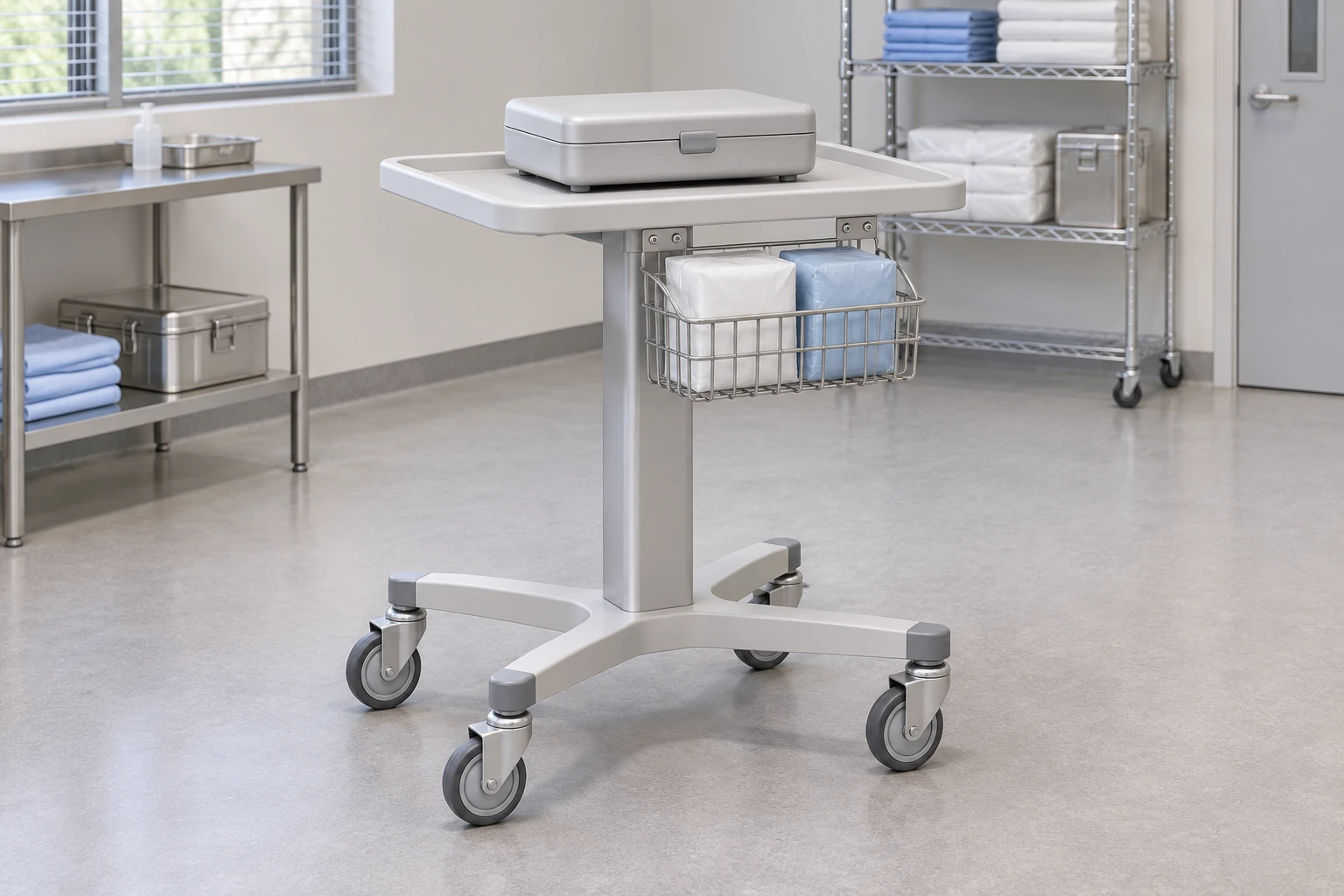
Choose a medical cart wire basket or solid-sided open bin by checking the actual accessory set, retrieval route, containment needs and cleaning access—not appearance alone. An open wire basket exposes its contents through the sides; a solid-sided open bin provides a different containment boundary but is not a sealed or sterile compartment. Neither format establishes a load rating, infection-control outcome or universal equipment compatibility.
For an OEM project, approve the storage arrangement together with the device, cables and adjacent shelves. A container that looks adequate on an empty trolley may obstruct a connector or become difficult to reach after integration.
Define what belongs in the container
Make an accessory inventory
List the items intended for storage, their dimensions, shape, mass and condition during use. Separate packaged consumables from leads, adapters, probes and equipment that needs a dedicated bracket. Identify fragile connectors and surfaces that must not contact rough edges. State whether items are returned to the container during normal work or only transported between work locations.
Do not assume a general basket is suitable for sharps, contaminated instruments, liquids or medication. Those uses require their own container selection, procedures and qualified review. This article is procurement education, not a clinical handling protocol.
Define the retrieval route
Describe who accesses the contents, from which side and with what equipment already fitted. Include the occupied worktop, printer, handles and cable loops in the review. A nominally large opening does not guarantee usable access when the operator approaches from a different side.
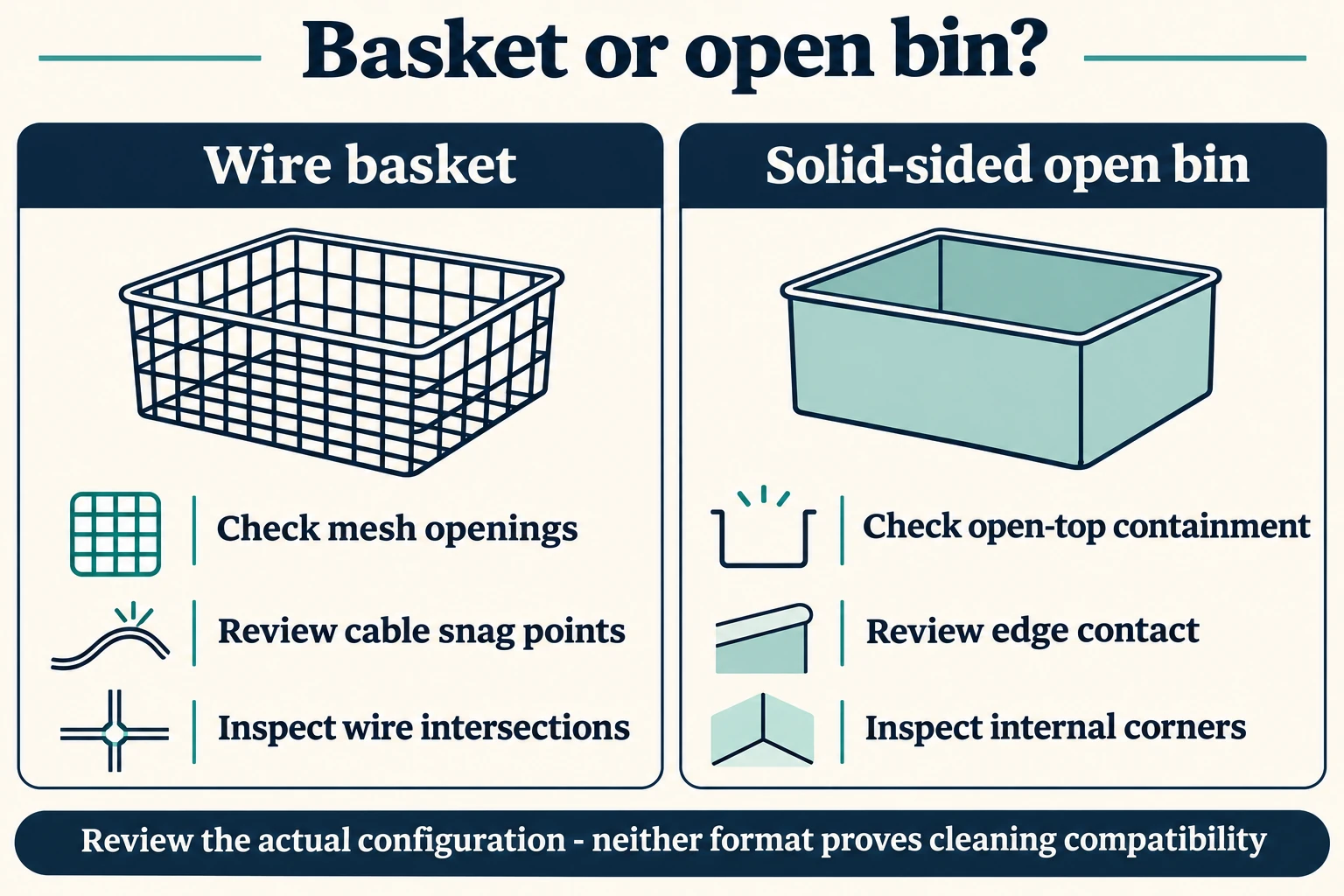
Compare wire baskets and solid-sided open bins
| Review item | Wire basket | Solid-sided open bin |
|---|---|---|
| Small-item containment | Check openings against the smallest item and loose connector | Check the opening, depth and edge geometry; an open top still permits displacement |
| Visibility | Contents may be visible through the sides | Side walls can obscure contents; check access from the working position |
| Cable interaction | Check whether connectors can enter or snag on openings | Check cable exit routes and edge contact |
| Cleaning access | Review wire intersections, mounting points and access behind the basket | Review internal corners, bottom surfaces and removal access |
| Integration envelope | Include basket corners, brackets and retrieval space | Include bin walls, brackets and retrieval space |
| Approval evidence | Configuration drawing and representative sample review | Configuration drawing and representative sample review |
These are questions for evaluation, not a claim that one format is inherently safer, cleaner or stronger. Removable liners, dividers or covers must be confirmed for the selected configuration rather than assumed from another cart.
Two CRF configurations to discuss
The CA13Z020 ultrasound cart with wire basket and small printer shelf is listed with a handled worktop, a wire basket and a small low equipment shelf. Review the basket and shelf as one occupied layout, particularly when an attached printer changes the retrieval path.
The CA13Z007 ultrasound cart with molded tray and solid storage bin is listed with a solid-sided open storage bin and a front foot pedal. Its available storage arrangement should be reviewed against the accessory inventory and operator approach.
These are different cart configurations, not evidence of interchangeable basket and bin modules. Their product pages identify the displayed images as AI reference-guided visualizations. They help identify a proposed configuration but are not documentary product photographs, dimensional drawings or engineering compatibility evidence. Request current genuine sample photographs and configuration-specific drawings before approval.
Build a storage review sample
Check fit with representative items
Use the intended accessories or representative objects with agreed dimensions and mass. Record the smallest item, the largest connector and anything requiring a dedicated holder. Check placement and retrieval without forcing cables through openings or putting a lead under tension.
Review adjacent functions
Show the worktop populated with the intended device and the printer shelf occupied where relevant. Check clearance to the foot pedal, handle and connectors. Confirm that basket access does not require removing equipment or reaching through a moving mechanism. Any movement trial needs an agreed safe method; this checklist does not prescribe a load, incline or impact test.
Agree maintenance and cleaning review
Ask whether the storage component is removable, what tools are required and which surfaces become accessible after removal. Obtain cleaning-compatibility instructions for the exact materials and finishes. Qualified facility personnel should assess the proposed arrangement against local procedures; neither mesh nor solid walls prove disinfection compatibility.
Put acceptance questions in the RFQ
- Identify the complete cart model and revision.
- Attach the accessory inventory, dimensions and intended storage positions.
- Mark the required retrieval direction and adjacent device envelope.
- Identify prohibited contents and items requiring separate holders.
- Request the storage attachment drawing and configuration-specific limits.
- Confirm removal, replacement and cleaning instructions.
- Agree sample review criteria and how configuration changes will be recorded.
A useful supplier response answers those questions for the selected assembly. A photograph or generic catalogue description alone is insufficient to approve the installation.
FAQ
Is a solid-sided open bin a closed compartment?
No. Solid side walls do not make an open-top bin sealed, lockable, sterile or spillproof. Confirm any separate enclosure requirement explicitly.
Can CRF swap a basket for a bin on any cart?
Do not assume interchangeability. Ask CRF to review the attachment interface, clearance and complete configuration before requesting a substitution.
Which option is easier to clean?
That depends on the exact geometry, materials, mounting and approved cleaning process. Review the actual sample and manufacturer instructions rather than making a universal comparison.
Can a basket hold a power supply or medical device?
Only after equipment-specific support, retention, ventilation and cable requirements are reviewed. A general storage description is not approval for supporting powered equipment.
Request a configuration-specific RFQ
Send CRF your cart reference, accessory inventory, device layout, quantity and destination. Include any storage access and documentation requirements so the proposed basket or bin can be reviewed with the complete assembly. Request a B2B configuration review or contact sales@szcrftech.com. Final specifications and commercial terms require quotation confirmation.