
Primary keyword: IV stand medical cart
Keyword source: Product-specific qualitative expansion; exact platform metrics unknown. Related measured keyword “medical equipment cart,” Semrush via seotools8 US, library ID 206: US volume 140, KD 14, CPC USD 2.01.
Intent: Commercial investigation
Funnel: Consideration
Business value: High—directly relevant to CRF’s aluminum medical-equipment cart line
SEO Title: IV Stand Medical Cart OEM Checklist | CRF
URL slug: /iv-stand-medical-cart-oem-checklist/
Meta Description: Specify an IV stand medical cart by defining the pole, hooks, equipment, worktop, storage, base, casters, route, cleaning and sample approval.
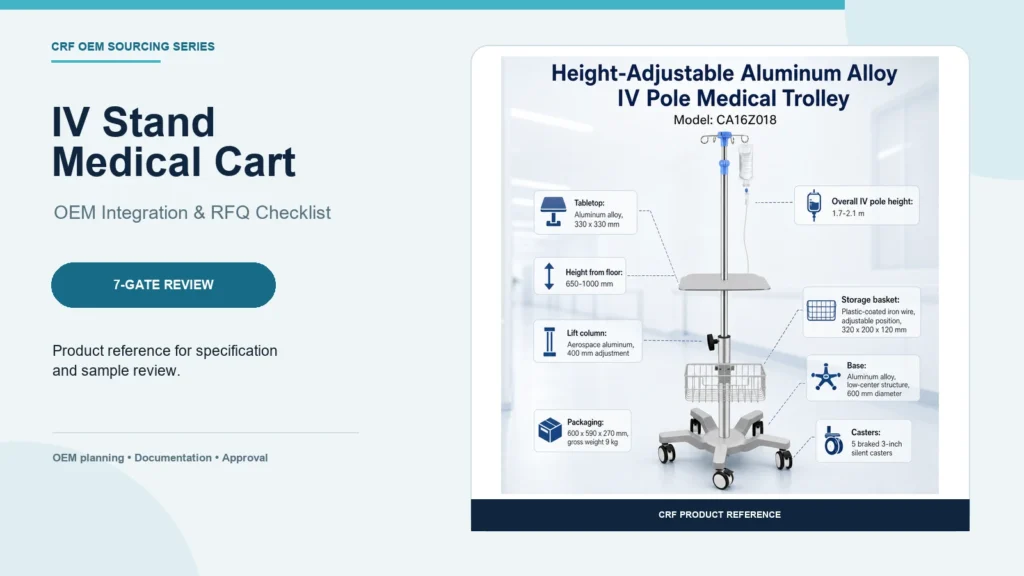
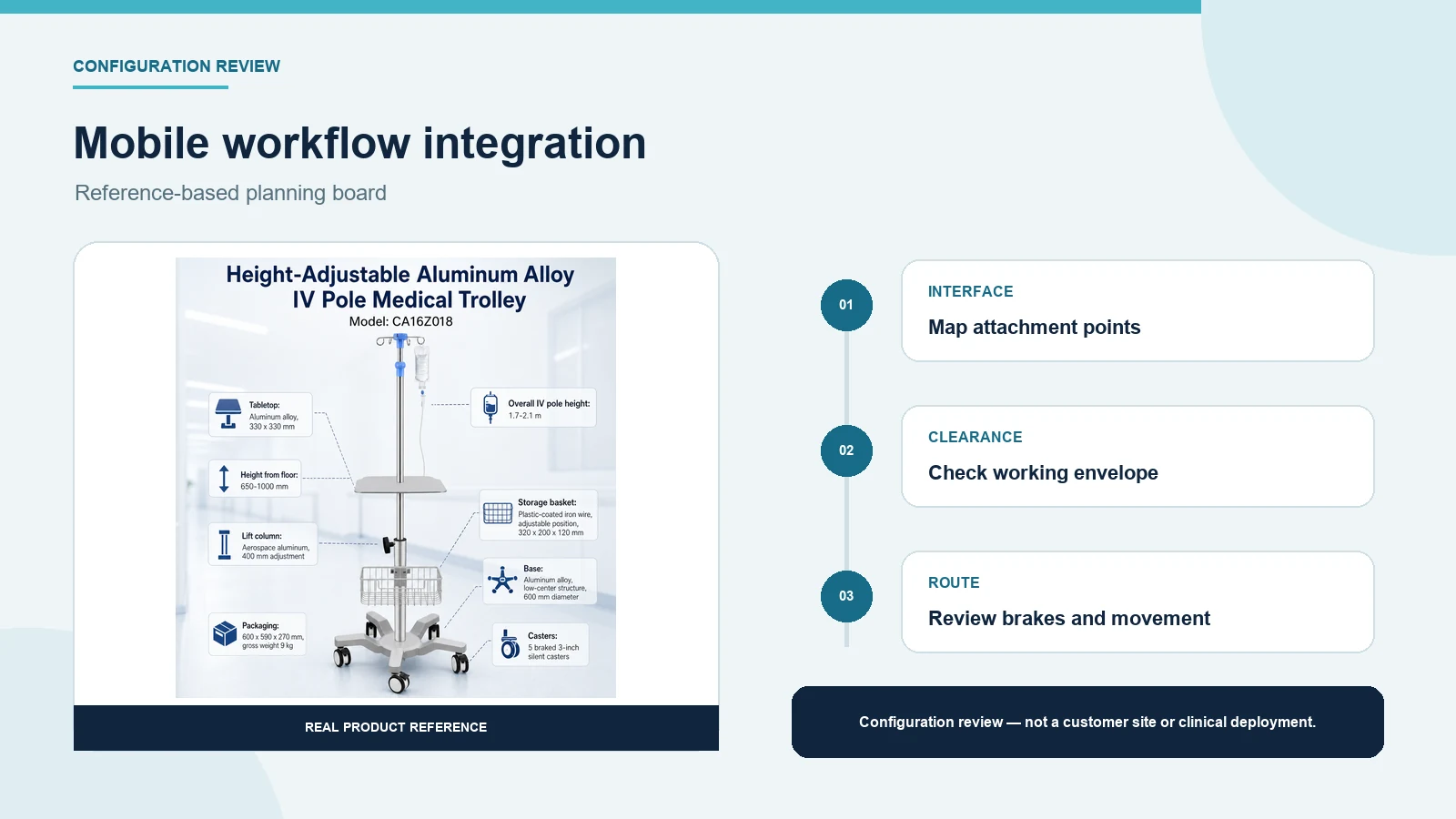
An IV stand medical cart should be specified as one complete mobile assembly, not as a pole added to a generic trolley. Before requesting a quote, define the intended equipment, pole and hook arrangement, work surface, storage, height positions, base and caster layout, movement route, cleaning process and sample-approval plan. CRF’s CA16Z018 is a real five-caster aluminum-base reference, but the public product page does not prove suitability for every device, load, infusion workflow or market.
Start with the use case and responsibility matrix
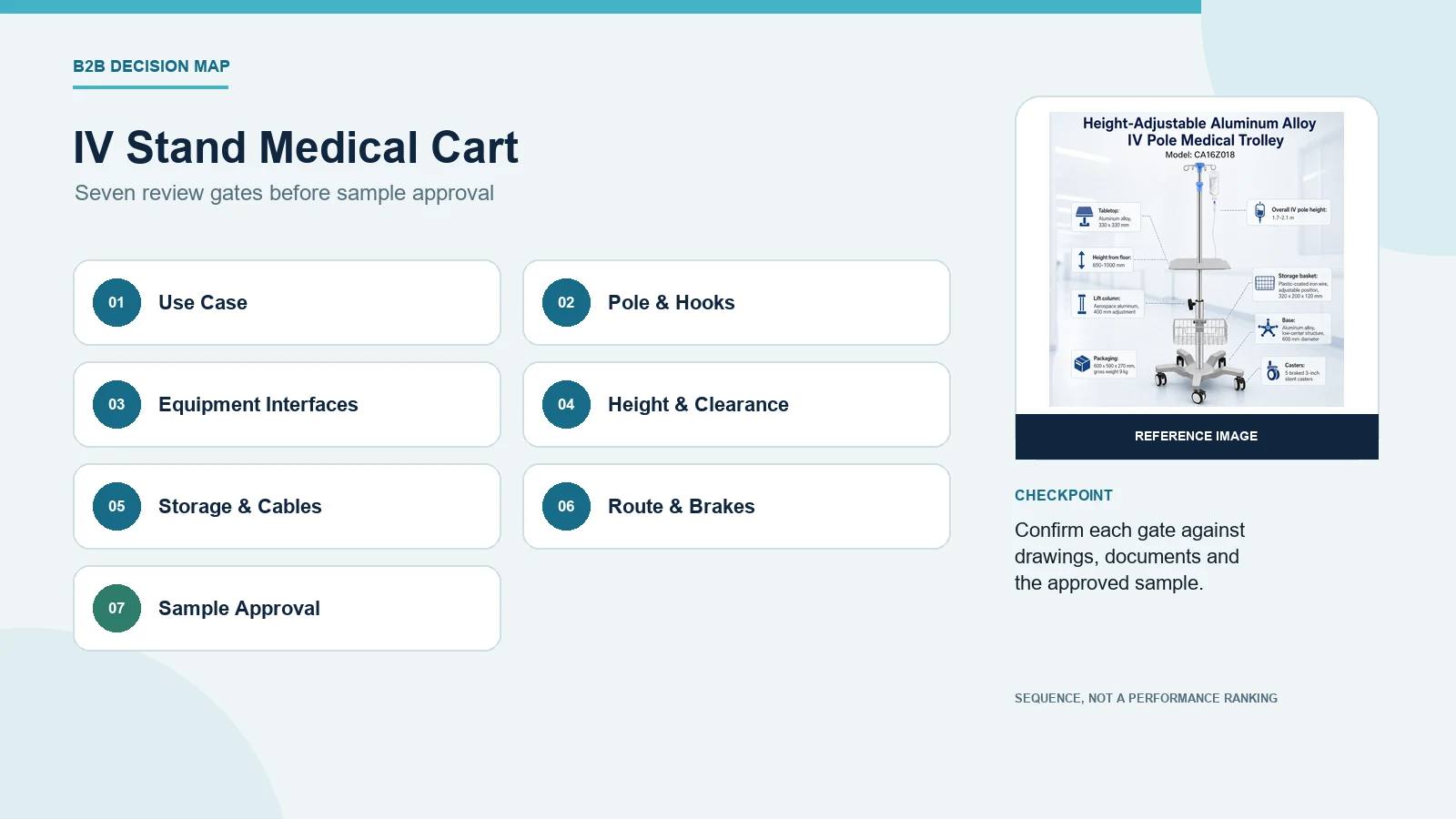
Identify what the cart must support and who supplies each item. The RFQ should state:
- intended equipment and accessory list;
- device dimensions, mass and center-of-gravity information when available;
- pole, hook and attachment requirements;
- worktop and basket contents;
- fixed and adjustable working positions;
- power and cable responsibilities;
- movement, parking and storage routes;
- cleaning agents and frequency;
- target quantity, destination and packaging needs.
Do not use a catalogue image as the specification. A pictured accessory may be contextual, optional or configured for another project. Link every quoted item to a drawing and bill of materials.
Define the IV pole and attachment interfaces
Record the pole envelope
State the required minimum and maximum positions, pole diameter or interface requirement, number and orientation of hooks, and clearance around the supported equipment. If the pole adjusts, define how it locks and when users need to change its position.
The buyer should review the complete envelope at every approved position. Hooks, containers and accessories must not collide with the worktop, basket, handle, cables or nearby equipment. Do not infer a safe load or compatibility from appearance; request configuration-specific evidence and professional review.
Control supplied and buyer-installed components
Clarify whether the supplier provides only the cart and pole or also provides clamps, pumps, holders, power components or cables. For buyer-installed equipment, supply controlled drawings or physical samples and identify mounting points, fasteners, tool access and service clearance.
An “adjustable IV pole” statement does not establish compatibility with an unspecified clamp or device. Final fit must be checked against the exact ordered assembly.
Treat height adjustment as an integration issue
Height affects reach, visibility, clearance and balance. Specify reference positions rather than asking only for “height adjustable.” Review:
- pole and worktop positions used during setup, movement and use;
- access to the adjustment and lock controls;
- clearance for attachments and cables throughout travel;
- whether an adjustment can be made with equipment installed;
- pinch, snag and collision points;
- how the approved position is recorded for repeat orders.
CRF’s CA16Z018 page identifies a height-adjustable column and IV pole, but project dimensions must be confirmed in the quotation and approved drawing. Do not copy dimensions from one configuration into another without review.
Compare worktop and storage by function
A worktop, basket or holder changes the space envelope and the assembled balance. Define what each element carries and how it is accessed.
| Element | Buyer input | Approval evidence |
|---|---|---|
| Worktop | Equipment footprint and access direction | Controlled layout drawing and sample fit |
| Basket | Contents, size envelope and retrieval direction | Clearance review at all positions |
| Pole and hooks | Interfaces and intended attachments | Assembly drawing and configured sample |
| Cable features | Cable list and moving segments | Routing map and movement review |
| Handle or push zone | Operator reach and route | Route trial with full assembly |
Keep optional items separate from standard inclusions. A clear bill of materials prevents two suppliers from quoting visually similar but functionally different assemblies.
Review the five-caster base as a complete system
The CA16Z018 reference shows a five-caster aluminum-base structure. Wheel count alone does not prove stability, maneuverability, noise performance or suitability for a route. Review the complete assembly with representative equipment and accessories installed.
Route and parking checklist
- doors, lifts and bedside approach zones;
- turning and parking envelope;
- floor transitions, thresholds and ramps;
- caster clearance from cables and hanging items;
- access to brakes and adjustment controls;
- storage footprint and transport restraints;
- risks created by uneven accessory loading.
Do not describe a cart as “tip-proof,” universally stable or safe for every route without applicable configuration-specific evidence. The acceptance method should be agreed by the buyer’s engineering, safety and clinical stakeholders.
Plan cables and powered accessories explicitly
If pumps, monitors or other powered devices may be integrated, separate the mechanical cart from the electrical system. State which party supplies chargers, power strips, batteries, cables, connectors and protective devices.
Document fixed and moving cable segments, service loops, strain relief, connector access, bend allowance and removal procedure. Route cables away from casters, brakes, adjustment joints and pinch zones. The supplier should not claim electrical classification or system compliance merely because a passive cart carries powered equipment.
Document cleaning and service inputs
Provide the actual cleaning agents, concentrations, contact times and frequency used by the buyer. Ask the supplier to identify joints, fasteners, labels, basket wires, caster interfaces and material transitions that require review.
Avoid unsupported phrases such as “infection-control compliant,” “medical grade” or “disinfection proof.” Suitability depends on the final materials, finish, assembly and evidence relevant to the target market.
For service planning, define inspection access, replacement parts, approved fasteners and revision control. Repeat orders should use the same controlled configuration unless an engineering change is reviewed and accepted.
Approve a configuration-specific sample
A practical approval sequence is:
- freeze the equipment and accessory register;
- approve pole, worktop, basket and device interfaces;
- approve the complete envelope drawing;
- confirm the bill of materials and responsibilities;
- build a representative sample;
- check all adjustment, access and cable positions;
- run the movement, parking and storage route;
- review cleaning, labels and packaging;
- record deviations and freeze the production revision.
A photo, unloaded frame or sample with different accessories is not equivalent to approval of the ordered assembly.
Quote-comparison checklist
Compare suppliers using documented evidence:
- exact pole and attachment configuration defined;
- device and accessory interfaces controlled;
- working and transport envelopes reviewed;
- base and caster arrangement shown on the drawing;
- power and cable responsibilities assigned;
- worktop, basket and optional items listed;
- cleaning inputs acknowledged;
- sample and acceptance plan agreed;
- packaging and labels specified;
- change control and replacement parts addressed.
Limits buyers should keep visible
This guide does not establish a universal load, stability result, hook capacity, electrical classification, cleaning resistance, medical certification or clinical outcome. CRF’s public product is a structural reference only. Final suitability depends on the ordered configuration, applicable requirements, approved drawings, samples and qualified review.
FAQ
What information is needed to quote an IV stand medical cart?
Send the intended equipment list, device dimensions and mass, pole and hook arrangement, clamp interfaces, worktop and basket contents, adjustment positions, cable and power plan, route, cleaning inputs, quantity, destination and packaging requirements.
Is an IV stand medical cart the same as a simple IV pole?
No. A cart may combine a pole with a work surface, storage, adjustable column and mobile base. The complete assembly and its interfaces must be reviewed together.
Does a five-caster base guarantee stability?
No. Suitability depends on geometry, equipment placement, accessories, adjustment positions, route and validation of the final assembly. Wheel count alone is not proof.
Can pumps or other devices be added later?
Only after their interfaces, mass, position, cables and effect on the complete assembly are reviewed. Uncontrolled additions can invalidate the approved configuration.
Should powered equipment be assumed to be included?
No. Identify every powered component and assign supply, integration, testing and documentation responsibility in the quotation and bill of materials.
What should be checked on the sample?
Check interfaces, locks, adjustment, access, clearances, cables, movement, parking, cleaning access, labels, packaging and the complete bill of materials.
Discuss an IV stand medical cart configuration with CRF
Review the CRF CA16Z018 height-adjustable IV pole medical trolley and the CRF medical carts category as real references. Then send CRF the exact device and attachment files, workflow, route, cleaning inputs, quantity and destination. CRF can review OEM/ODM feasibility and prepare a configuration-specific B2B quotation; final specifications remain subject to approved documentation and samples.