
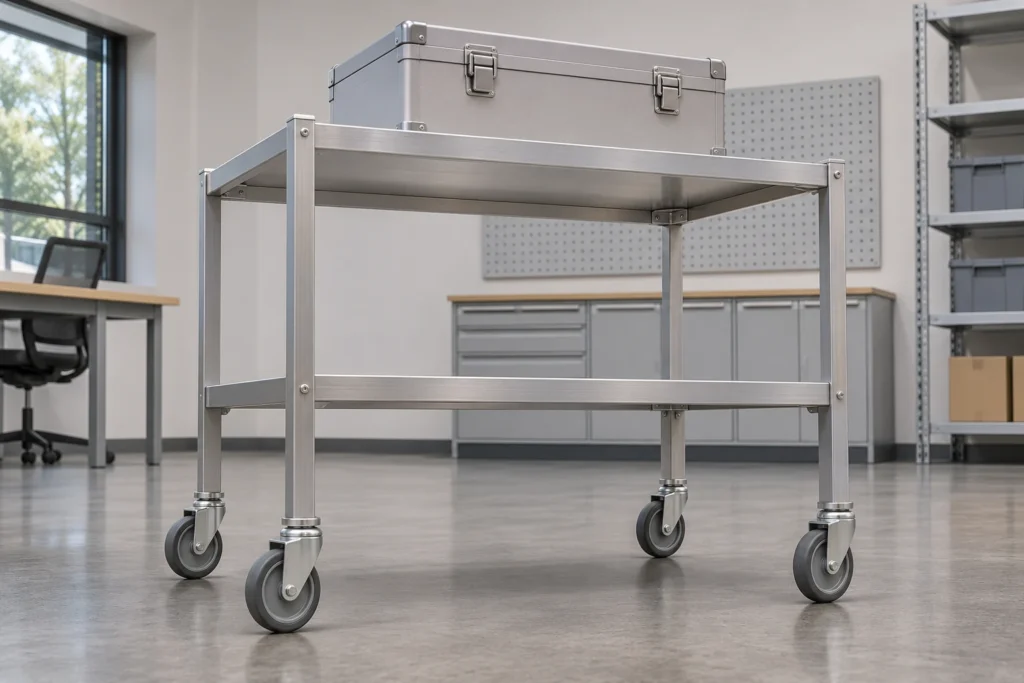
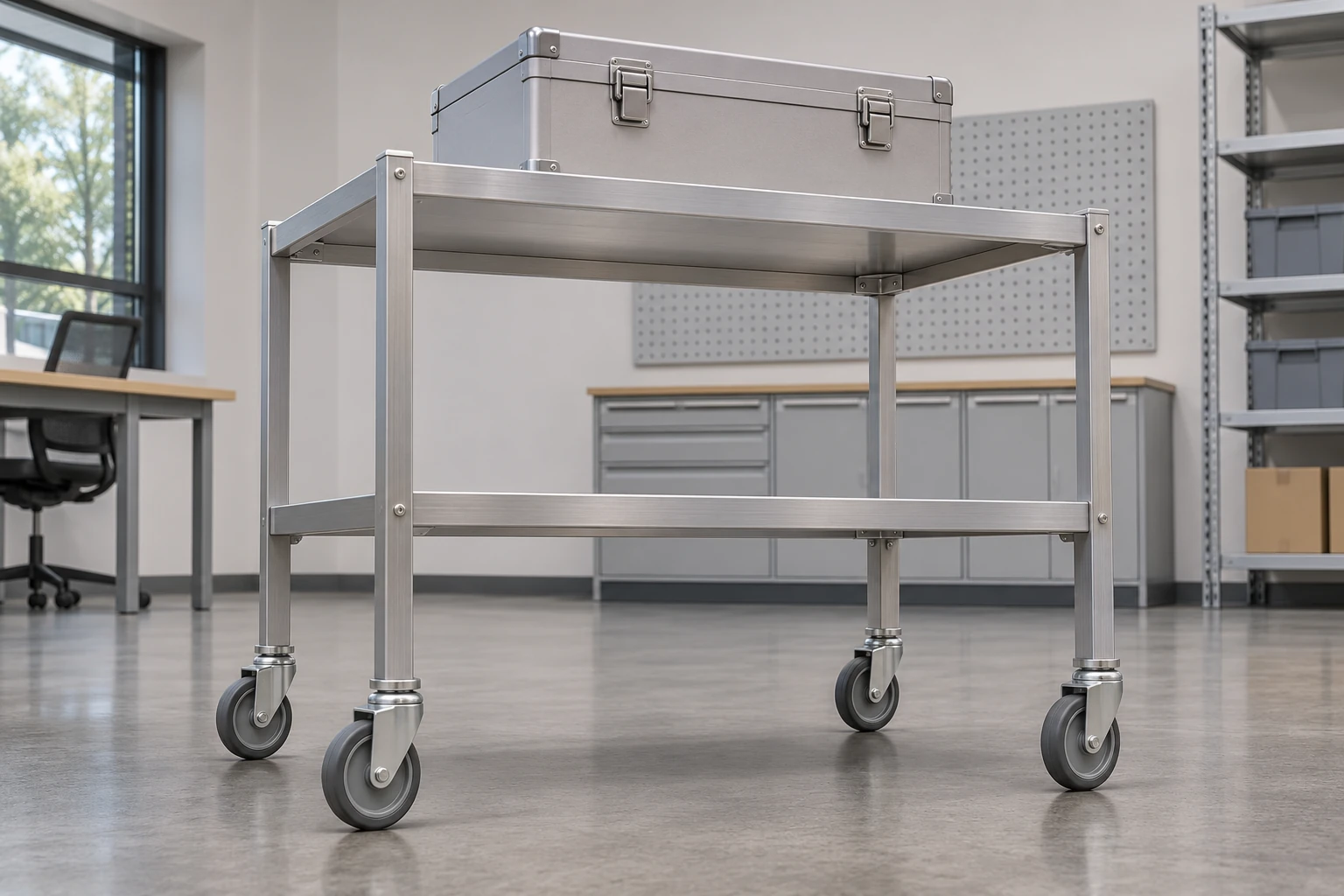
An instrument cart can mean an open trolley for moving trays, an enclosed storage cart, or a platform carrying an electronic instrument. Choose the architecture by what needs protection, how items are retrieved, and whether equipment stays attached during use. These are different purchasing requirements, even when the carts have similar footprints. An open aluminum-look frame should not be treated as sterile storage, and a shelf that accepts a device footprint does not establish device retention or system compatibility.
For B2B buyers, the useful first question is not “How many shelves?” It is “What happens to the contents between loading, transport, use and return?” Answering that question prevents a low-cost open trolley from being compared with a secure cabinet or integrated equipment workstation as though the quotations describe equivalent products.
Three instrument-cart architectures
| Architecture | Most useful starting point | Main trade-off | What the quotation should define |
|---|---|---|---|
| Open shelf trolley | Frequent access to separately contained items | Easy access versus exposure and containment needs | Shelf area, contents, retention and handling method |
| Enclosed storage cart | Organized storage with defined access restrictions | Protection and organization versus retrieval and service complexity | Drawers, doors, locking scope and internal layout |
| Device platform | An instrument that remains mounted during operation | Dedicated fit versus flexibility for future equipment | Mounting, controls, cables, service and integrated review |
These are selection directions, not claims that a particular cart meets a clinical or contamination-control requirement. The responsible organization determines the handling process and applicable acceptance criteria.
When open shelves are the right starting point
Open shelves are worth considering when contents are already contained and users need straightforward access from an agreed direction. A closed case moving between work areas presents a different design problem from loose components requiring separation. List the real containers, their handles and their loaded sizes before comparing shelf dimensions.
Usable area can be smaller than the outside dimensions of a tray. Rails, corner posts and handles can obstruct placement. A case may sit on a shelf but become difficult to lift because a rail blocks its grip. Test the loading and removal motion, rather than approving a photograph with the case already in place.
Shelf position also affects replenishment. A lower shelf may be convenient for reserve items but awkward for frequent retrieval. If users must remove an upper case to reach the lower contents, the apparent storage capacity overstates the practical capacity. Compare the actual sequence and the number of separate handling steps.
When enclosed storage changes the purchase
Choose an enclosed direction when organization, separation or controlled access is central to the task. However, a door or drawer does not by itself establish security, environmental protection, cleanliness or suitability for sterile contents. Define the required function instead of relying on the word “enclosed.”
Ask which items must be separated, who retrieves them, and whether access should be restricted during parking or movement. Specify whether the buyer needs removable bins, a particular drawer arrangement, identification labels or a controlled key process. These details affect replenishment as well as first purchase.
Check drawers and doors in their operating positions. An assembly that fits through a doorway with everything closed may consume much more space during retrieval. Evaluate access beside surrounding equipment and confirm that an open component does not obstruct the designated working area. Stability questions must be reviewed for the actual loaded configuration, not inferred from appearance.
When the instrument stays on the cart
An electronic instrument turns the cart into an equipment-support platform. The important inputs become device feet, permitted support areas, retention points, vents, controls, connector locations and service access. A deeper shelf is not a substitute for understanding those interfaces.
Separate transport and operating arrangements. Some equipment may require a specific orientation, restrictions on movement, or a manufacturer-defined shutdown sequence. Obtain those requirements from the equipment owner. This article does not provide device-specific operating or electrical instructions.
The quotation should distinguish the mechanical cart from any supplied instrument, power component, cable or mount. A concept image showing a device is not a bill of materials. Ask for an itemized configuration and identify who reviews the completed assembly if power or multiple interconnected devices are involved.
Compare the complete handling cycle
Use one representative scenario for all candidates:
- Load the identified cases, trays or equipment in the agreed arrangement.
- Check access to intended handling points without lifting by accessories.
- Move along the representative route under the organization’s procedure.
- Park and access the contents in the available work area.
- Return items to their designated positions and remove the load.
- Review cleaning access, inspection and replenishment requirements.
Record where a candidate creates an extra handling step or requires repositioning. These observations are more useful than an unsupported promise of efficiency. If time savings matter, define a comparable trial and measure the actual workflow rather than estimating a percentage from a product photograph.
Materials and cleaning: compare the final assembly
CRF’s business includes aluminum-alloy medical equipment carts, but selecting aluminum as a structural direction does not establish the material of every component. Worktops, fasteners, coatings, joints and accessories need their own configuration description. Do not copy a stainless-steel grade or cleaning-resistance claim from another trolley.
The buyer should provide the relevant cleaning process and agents. Review access around rails, shelf corners, drawer runners and caster assemblies. Removable components may help inspection, but removal also adds handling and reassembly work. Decide which parts need routine access and which require service personnel.
If sterile instruments or controlled environments are involved, the responsible professional must assess the full storage and handling system. A general equipment trolley is not a sterilizer, sterile barrier or proof of compliance with a clinical process.
How to compare quotations without false equivalence
Create a comparison sheet with one row for each included function. An open trolley quote and a cabinet quote may differ because one includes containers, locks or assembly while the other excludes them. Normalize the scope before comparing totals.
Request the general arrangement, usable storage dimensions, configuration list, packaging approach and replacement-part identification. Ask which drawings and sample revision the quote covers. Do not assume a photographed accessory, device or container is included unless it appears in the agreed supply list.
A practical order review should also identify unresolved requirements. An unknown load limit, cleaning-agent compatibility or retention arrangement is not a field to fill with a generic industry number. Resolve the specific requirement with the supplier and appropriate reviewer before committing to that use.
FAQ
Is an instrument cart the same as a medical equipment cart?
The terms overlap, but the intended contents matter. “Instrument cart” may describe a tray trolley, storage cabinet or device platform. Specify the actual contents and handling task so suppliers quote the same architecture.
Are enclosed drawers automatically suitable for sterile storage?
No. A drawer alone does not establish a sterile barrier or an approved handling process. The responsible organization must define and assess the complete storage and use requirements.
Can one platform serve several instruments?
Possibly, but each device needs an interface and workflow review. Shared shelf space does not prove retention, control access, service clearance or compatibility across different instruments.
Should aluminum or stainless steel be selected first?
Start with the use, cleaning inputs and complete configuration. Material is one design choice, not a substitute for usable storage, appropriate interfaces or evidence for the final assembly.
Discuss the configuration with CRF
Explore CRF medical-cart configurations and the equipment-cart project planning guide. These references help frame a discussion; they do not establish a ready-made solution for every instrument.
Please contact us with the instrument or container list, handling sequence, available space, cleaning requirements, destination and order scope. Request an RFQ and configuration review so the quotation can distinguish an open trolley, enclosed storage requirement and integrated device platform.