
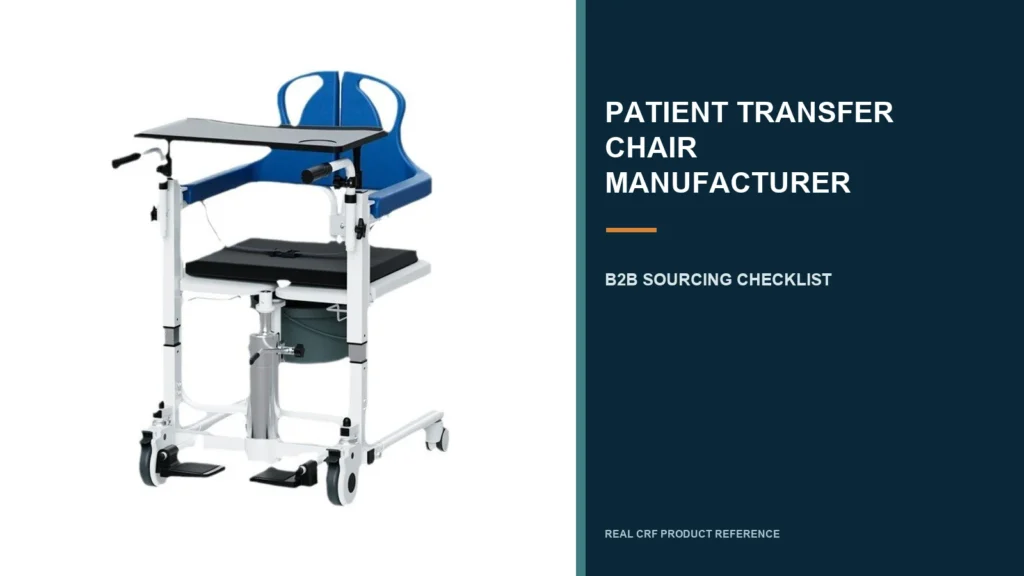
Primary keyword: patient transfer chair manufacturer
Secondary keywords: patient transfer chair with commode manufacturers; commode lift transfer chair manufacturers; transfer lift chair supplier
Intent: Commercial investigation / supplier evaluation
Funnel: Consideration / decision
Business value: High
Keyword source: Semrush via seotools8 local library: “patient transfer chair with commode manufacturers” and “commode lift transfer chair manufacturers” each show historical US volume 10, unknown KD and CPC $0.00. The shorter primary term is a qualitative intent normalization; exact metrics are unknown. Fresh GSC through 2026-10-02 discloses no exact-topic query.
SEO title: Patient Transfer Chair Manufacturer Sourcing Checklist | CRF
Slug: /patient-transfer-chair-manufacturer-sourcing-checklist/
Meta description: Evaluate a patient transfer chair manufacturer by defining users, transfer sequence, fit, interfaces, brakes, cleaning, documents and sample acceptance.
H1: Patient Transfer Chair Manufacturer: A B2B Sourcing Checklist
A patient transfer chair manufacturer should be evaluated against a controlled transfer workflow, user range, environment, chair-to-surface interfaces, operating sequence, cleaning process and sample acceptance plan—not against promotional feature counts alone. Buyers should first define who may use and operate the chair, where transfers occur, which functions are required and which claims require configuration-specific evidence.
CRF has a verified patient transfer lift chair, Product 3481, in its live catalog. That confirms a real product direction but does not prove suitability for a particular person, transfer, bathroom, bed, toilet, vehicle or jurisdiction. Assessment by qualified care, safety and regulatory professionals is required for the exact configuration and intended use.
Define the Intended Transfer Workflow
Document the complete sequence before requesting a quote:
- where the chair starts and is parked;
- how it approaches the origin surface;
- which components open, move or adjust;
- how the person enters or is positioned;
- which locks, supports or restraints are engaged;
- how the chair moves to the destination;
- how alignment and transfer are completed; and
- how the chair is cleaned, inspected and stored.
State whether the project requires transfer, commode, shower or seated-transport functions. Do not assume one configuration is approved for every function shown in a marketplace image.
Provide a Controlled User and Operator Range
The manufacturer needs buyer-approved design inputs, not generic labels such as “elderly” or “disabled.” Relevant inputs may include:
- controlled anthropometric range;
- required seat width and depth;
- foot, leg, trunk and arm support needs;
- ability to follow instructions or assist with movement;
- number and training level of operators;
- foreseeable movement or posture changes; and
- exclusions defined by qualified professionals.
Do not publish or rely on a load rating, diagnosis-based recommendation or fall-prevention claim without evidence for the exact model and configuration.
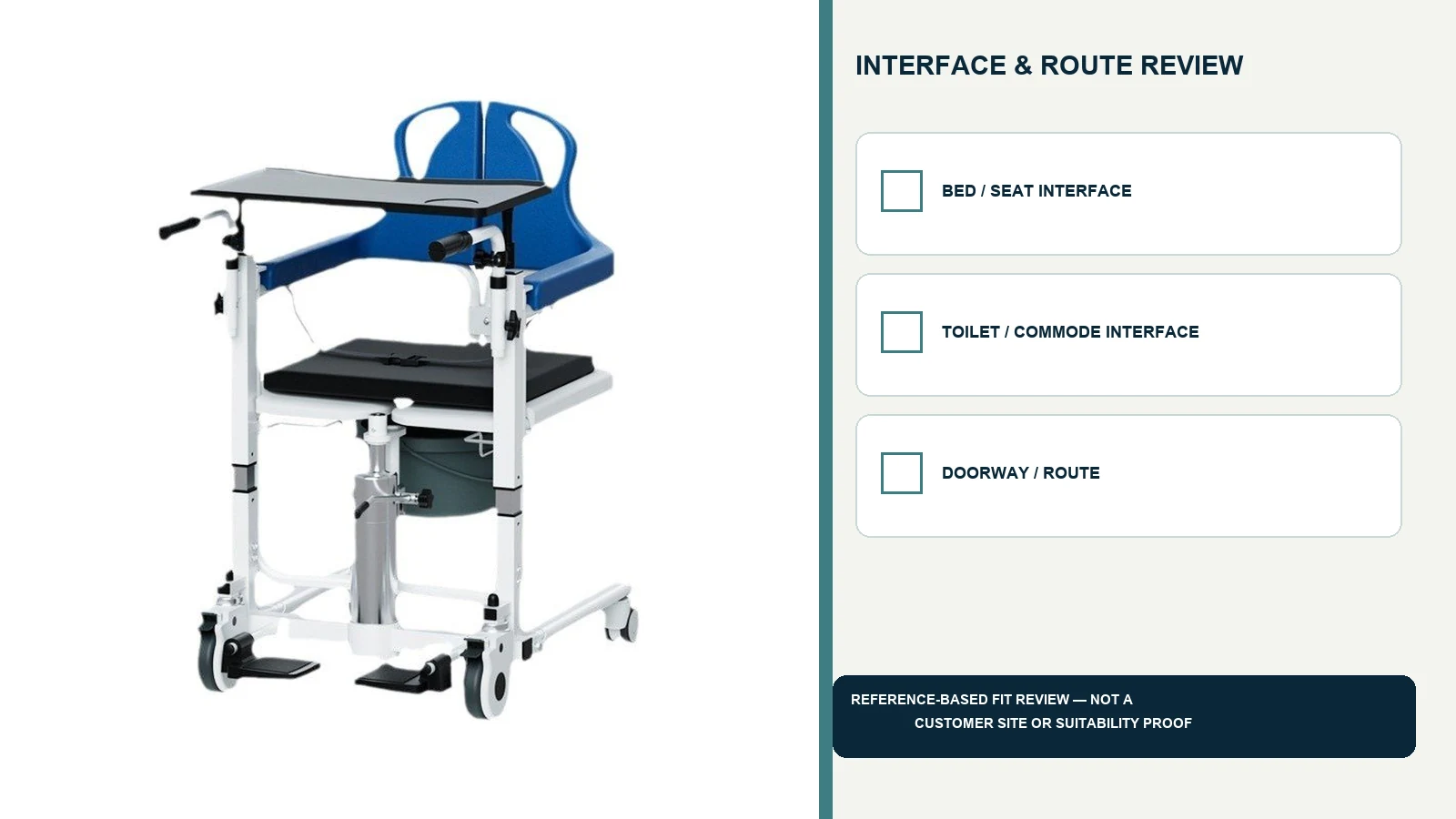
Measure Every Origin and Destination Interface
A transfer chair interacts with beds, toilets, shower areas, floor surfaces, doors and surrounding furniture. Measure the real environments.
| Interface | Buyer input | Review purpose |
|---|---|---|
| Bed or seat | Height range, under-clearance, edge geometry | Checks approach and overlap |
| Toilet | Bowl and seat dimensions, surrounding clearance | Checks commode alignment |
| Shower area | Entry width, threshold, drainage and floor | Defines environmental limits |
| Doorway | Clear width and hardware intrusion | Checks complete chair envelope |
| Route | Turns, ramps, gaps and floor transitions | Defines sample-route review |
| Parking | Space and access side | Confirms storage and brake access |
Dimensions should include tolerances and obstructions. A nominal seat height alone cannot establish compatibility.
Review the Structure in Every Operating State
Ask for controlled drawings showing closed, open, adjusted, transfer, occupied-assessment and service states as applicable. Identify the maximum envelope and all moving joints.
Opening and closing sequence
Record the required order for armrests, back supports, seat sections, foot supports, latches and locks. Check whether one action can release another component unintentionally and whether hands can remain clear of defined pinch zones.
Height and alignment adjustment
If height adjustment is offered, define its range, actuation method, locked states and the conditions under which adjustment is permitted. Do not assume a stated range fits the target beds or toilets; verify interfaces using controlled measurements and a representative sample.
Base and caster geometry
Review the base at the origin and destination surfaces. Check whether legs, casters or pedals can approach without collision and whether the floor supports the intended operation. Wheel count does not establish stability or route suitability.
Specify Brakes, Locks and Position Indicators
List every brake, latch, lock and retention point. The instructions and sample plan should define:
- when each control is applied and released;
- how the operator confirms engagement;
- what visual or tactile indication is required;
- access from the approved operating position;
- inspection and replacement procedure; and
- response to a damaged or incomplete component.
Marketing descriptions such as “secure,” “anti-fall” or “military grade” do not replace a controlled requirement and test method.
Evaluate Seating and Support Interfaces
Define the required seat, back, arm, foot and leg support configuration. Confirm removable parts, upholstery or surface materials, drainage features and attachment methods in the quotation.
Buyer review should cover:
- pressure and contact areas identified by qualified professionals;
- gaps that may create entrapment or pinch concerns;
- component movement during the complete sequence;
- support continuity between surfaces;
- cleaning access around seams and joints; and
- replacement-part identification.
This article cannot determine individual clinical suitability or prescribe transfer technique.
Separate Transfer, Commode and Shower Requirements
A chair marketed with multiple functions needs a separate requirement set for each intended function.
Transfer function
Define origin and destination surfaces, alignment, operator actions, route and emergency response. Verify the complete sequence with the approved evaluation method.
Commode function
Confirm opening geometry, pan or toilet interface, splash management, removal route, cleaning process and privacy workflow. Clarify which components are included.
Shower function
Review the wet-area environment, floor, drainage, corrosion and material evidence, cleaning process and storage. A product photograph in a bathroom does not prove shower suitability.
Do not include a function in marketing or instructions unless the exact configuration and evidence support it.
Review Cleaning, Inspection and Maintenance
Provide intended agents, concentrations, contact times and process. Ask the manufacturer to identify disclosed materials, finishes, upholstery, fasteners, casters, brakes and joints for compatibility review.
Require access to inspect:
- latches and moving joints;
- seat and commode interfaces;
- back and arm supports;
- caster forks and brake pedals;
- adjustment mechanisms; and
- labels and replaceable components.
The responsible organization should define pre-use checks, scheduled inspection, quarantine criteria and maintenance records.
Require Configuration-Specific Documents
The documentation package may need controlled drawings, bill of materials, instructions, labels, cleaning guidance, inspection procedures, packing list, traceability records and evidence required by the destination market.
Ask the supplier to mark:
- what is included in the quoted configuration;
- which statements apply only to another variant;
- who owns regulatory and clinical decisions;
- what testing is complete versus proposed; and
- how changes are reviewed after approval.
Do not transfer a certificate, test report or load statement from a visually similar model without confirming configuration coverage.
Sample Acceptance Plan
A representative sample should be reviewed by the buyer’s qualified stakeholders before production approval.
Identity and assembly
- Model, revision and supplied parts match controlled documents.
- Fasteners, labels and instructions match the bill of materials.
- No required part is inferred from a promotional image.
Fit and operation
- The chair fits the measured origin, destination, doorway and parking interfaces.
- Adjustments, latches, armrests and supports follow the approved sequence.
- Controls are accessible to the intended operator.
- Pinch, collision and entrapment concerns are reviewed in every state.
Route and cleaning
- The complete configured chair follows the representative route.
- Brakes and parking interactions can be evaluated.
- Intended surfaces and joints are accessible for the disclosed cleaning process.
- Removable components can be identified, removed and replaced as documented.
Evidence and records
- Buyer-required reports and declarations cover the exact configuration.
- Inspection results, deviations and corrective actions are recorded.
- Approval owners sign the agreed acceptance record.
A sample pass applies only to the controlled method and configuration; it is not a universal safety or clinical claim.
Manufacturer RFQ Checklist
Send the supplier:
- Intended functions and explicit exclusions.
- User and operator design inputs approved by qualified reviewers.
- Origin, destination, toilet, shower and route measurements.
- Required adjustment ranges and complete operating sequence.
- Seat, back, arm, foot and leg support requirements.
- Brake, latch, lock and indicator requirements.
- Cleaning agents, inspection and maintenance process.
- Required documents, labels and destination-market evidence.
- Packaging, assembly and replacement-part requirements.
- Prototype, pilot and forecast quantities.
- Sample methods, pass/fail criteria and approval owners.
Common Sourcing Mistakes
Buying from a feature list
“4-in-1” does not define interfaces, included parts, operating sequence or evidence. Specify each intended function separately.
Treating load capacity as user suitability
A load statement alone does not establish fit, posture, stability, transfer suitability or clinical appropriateness.
Skipping environmental measurements
Beds, toilets, thresholds and doors vary. Measure the target environment before freezing the design.
Assuming care claims from product imagery
Images cannot prove fall prevention, caregiver injury reduction, corrosion resistance or target-market compliance. Request applicable evidence.
FAQ
What should buyers send a patient transfer chair manufacturer?
Send the intended functions, user and operator design inputs, interface measurements, operating sequence, cleaning process, target market, required documents and sample criteria.
Is a patient transfer chair the same as a wheelchair?
Not necessarily. Product purpose, operating method and evidence differ. Do not substitute one category for another without qualified review of the exact product and use.
Can one chair be used for transfers, toileting and showering?
Only when the exact configuration, instructions, environment and applicable evidence support each function. Evaluate every function separately.
How should a buyer verify bed and toilet compatibility?
Measure heights, under-clearances, surrounding obstacles and approach space, then review controlled drawings and a representative sample using an approved method.
Can CRF customize a transfer lift chair?
CRF accepts OEM/ODM inquiries. Feasibility depends on interfaces, operating sequence, configuration, evidence, quantities and destination requirements.
Request a Configuration Review
Send CRF the transfer workflow, interface measurements, required functions, controlled user/operator inputs, cleaning process, destination and acceptance plan. CRF can identify missing inputs and prepare a configuration-specific quotation path. Request a configuration-specific RFQ.
Internal links
- View the verified CRF patient transfer lift chair
- Browse CRF patient transfer lifts
- Browse rehabilitation and bathroom safety products
CTA: Request a Quote — include the workflow, interface measurements and sample acceptance plan.
Editorial limitations: Procurement education only, not medical, clinical, transfer, safety or regulatory advice. No load, material grade, performance, certification, price, stock, MOQ or lead-time claim is made.