
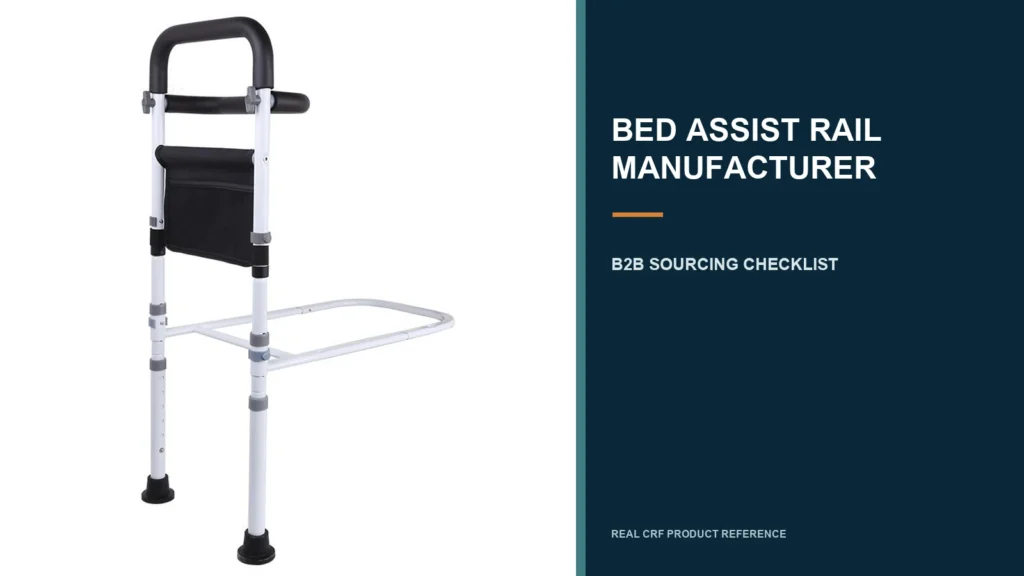
Primary keyword: bed assist rail manufacturer
Intent: Commercial investigation
Funnel: Consideration / decision
Business value: Medium
Keyword source: Qualitative product-specific expansion from CRF’s verified live Bed Assist Rails series; exact platform volume, difficulty and CPC are unknown. The local keyword library has no clean exact term. Fresh GSC data through 2026-09-28 contains no disclosed exact-topic query.
SEO title: Bed Assist Rail Manufacturer Sourcing Checklist | CRF
Slug: /bed-assist-rail-manufacturer-sourcing-checklist/
Meta description: Evaluate a bed assist rail manufacturer by checking intended use, bed and mattress fit, attachment, gaps, adjustment, documents, labels, packaging and samples.
H1: Bed Assist Rail Manufacturer: A B2B Sourcing Checklist
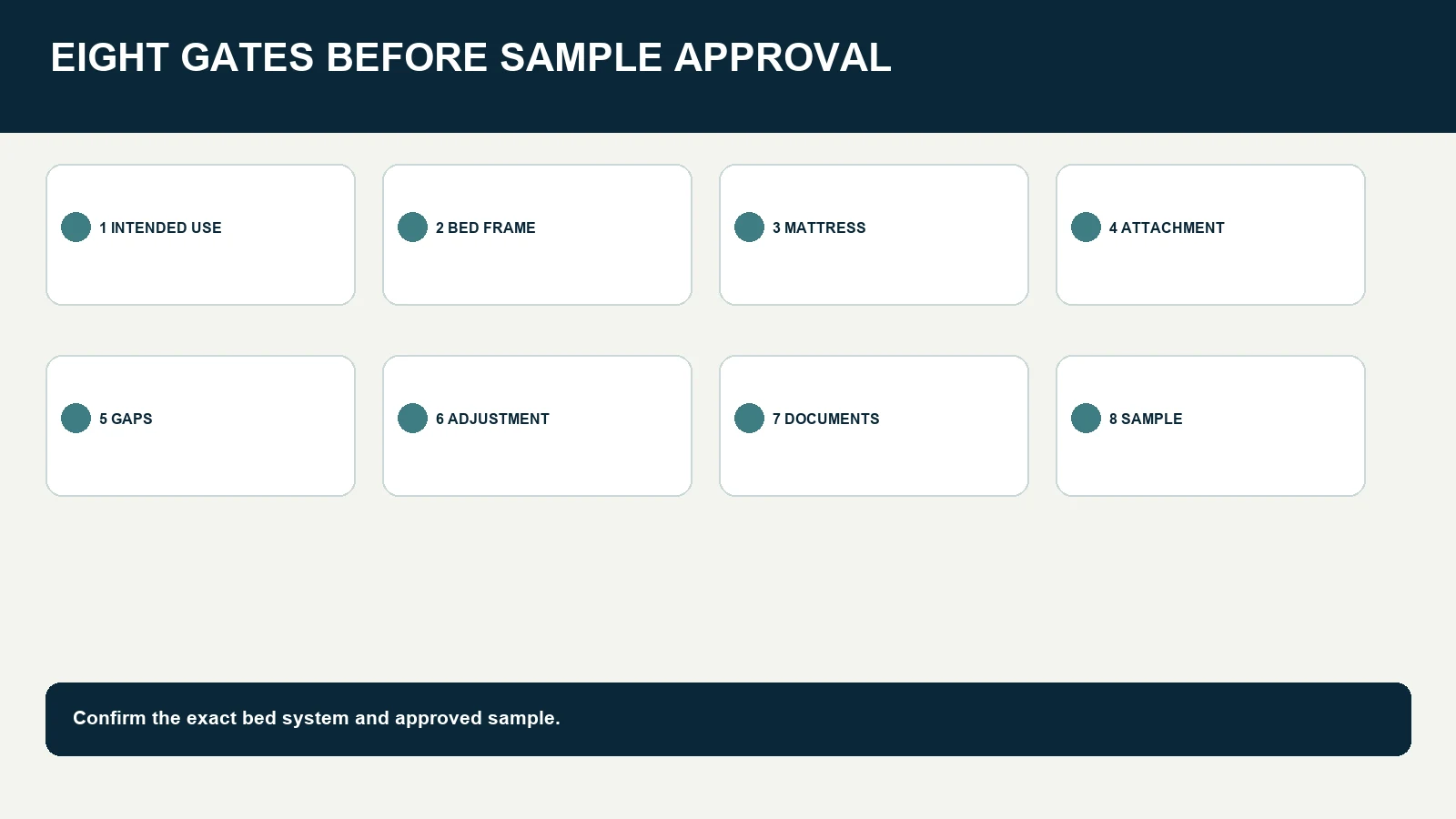
A bed assist rail manufacturer should be evaluated on configuration control, bed-and-mattress compatibility inputs, attachment details, dimensional drawings, adjustment and locking review, user instructions, target-market documentation, packaging and sample approval. Do not source from a generic “fits most beds” statement. Fit and risk depend on the complete bed system, mattress, mounting position and intended use.
CRF currently lists bed assist rails, including a verified adjustable bedside-support product. That listing supports this sourcing topic, but it does not prove universal compatibility, a particular load rating, fall-prevention performance or compliance for every market. Those points must be defined and supported for the exact quoted model.
First Decide What Product You Are Buying
“Bed rail” can refer to different products:
- an assist handle intended to support repositioning or getting in and out of bed;
- a bedside rail that covers a limited portion of the bed edge;
- a longer guard or side-rail component integrated with a bed system; or
- an accessory supplied for a specific hospital or care-bed platform.
These terms should not be treated as interchangeable. State the intended function, user environment and bed system in the RFQ. The responsible buyer and qualified safety or regulatory personnel should determine the applicable product classification, claims, instructions and market requirements.
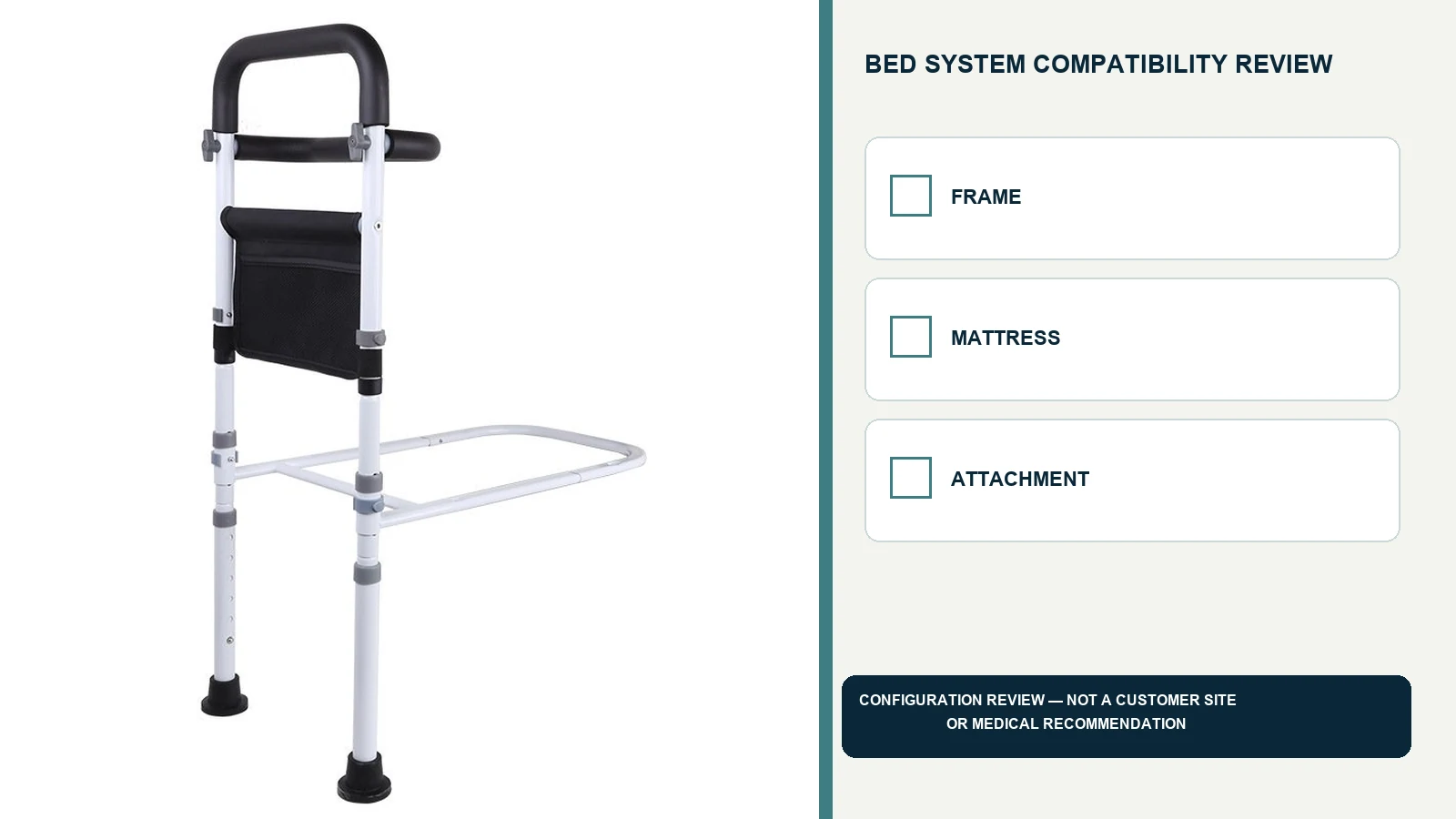
Map the Complete Bed System
Identify the bed or platform
Provide the bed manufacturer, model, deck type, frame dimensions and whether the bed is fixed, articulated, adjustable or powered. Show the potential attachment area from above, below and the side. If several bed models are in scope, list each one rather than describing an average bed.
Define the mattress
Provide mattress width, length, thickness, edge construction and compression behavior where relevant. Record overlays, toppers or powered surfaces that may change the effective geometry. Compatibility cannot be established from frame dimensions alone because the mattress changes rail height and gaps.
Show moving zones
For adjustable beds, document the range of deck articulation and the relative movement between the rail, frame and mattress. Check whether a mounting strap, bracket or support passes near motors, linkages, cables or moving sections.
Review Attachment and Retention
Request the actual mounting detail
Ask the manufacturer for drawings or clear controlled instructions showing:
- the attachment method;
- permitted frame or deck dimensions;
- bracket, plate, strap or fastener positions;
- contact surfaces and protective pads;
- tool requirements;
- adjustment increments; and
- the method used to prevent unintended movement or release.
A product image is not enough to verify fit. “Tool-free” or “universal” should be supported by a defined compatibility range and installation method.
Check installation repeatability
A sample should be installed by people representative of the intended installer using the supplied instructions. Confirm that the final position can be reproduced, that fasteners are accessible and that the installation does not rely on improvised parts.
Define inspection and maintenance
The buyer should know which attachment points, locks, straps, grips and fasteners require routine inspection, what wear or damage triggers removal from service and which replacement parts are available. These instructions should match the final shipped configuration.
Control Dimensions and Gaps
The sourcing pack should include a dimensioned drawing of the rail in its installed position. At minimum, identify:
- overall rail width and height;
- height relative to the top of the installed mattress;
- distance from the mattress edge;
- openings within the rail structure;
- gaps between the rail, mattress, bed deck, headboard or footboard;
- under-mattress or frame engagement dimensions; and
- adjustment and locked positions.
The presence, size and location of gaps can change when the mattress compresses or the bed articulates. Qualified personnel must evaluate entrapment and other hazards for the intended system and population. Do not infer safety from a single static photograph.
Separate Assistive Use from Restraint or Fall Claims
A bedside assist handle may support an intended movement, but that does not automatically make it a fall-prevention barrier, restraint or full-length guard. Marketing claims, labels and instructions must accurately reflect the evaluated intended use.
Avoid unsupported phrases such as “prevents all falls,” “safe for every elderly user” or “medical grade.” Suitability can depend on cognition, mobility, strength, supervision, bed setup and local care policies. Product selection should involve the responsible care or clinical team where appropriate.
Evaluate Structure, Adjustment and User Contact
Frame and joints
Ask for the listed materials and finish for the exact model, but do not use material name alone as a quality conclusion. Review tubing, welds or joints, brackets, fasteners, pivots and end closures as a complete structure.
Adjustment and locks
If height, width or mounting position is adjustable, confirm the available settings and how each position is secured. During sample review, check for clear engagement, unintended release, inaccessible controls and pinch points. Testing methods and acceptance limits should be set by qualified project personnel.
Hand contact areas
Review the grip location, shape, surface and clearance from adjacent structures. Confirm that covers, foam or sleeves—if present in the quoted configuration—are replaceable or cleanable as required. Do not assume comfort or usability for every user; evaluate the target population and workflow.
Compare Manufacturer Evidence
| Evidence area | Request from supplier | Buyer review question |
|---|---|---|
| Configuration | Model code, revision and bill of materials | Does the sample match the quoted production unit? |
| Compatibility | Bed, frame and mattress range with exclusions | Are the boundaries explicit rather than “universal”? |
| Drawings | Installed and component dimensions | Can fit and gap review be completed? |
| Attachment | Instructions, hardware and lock detail | Is installation repeatable and inspectable? |
| Verification | Applicable test reports and methods for the exact model | Do scope, configuration and acceptance criteria match the claim? |
| Documentation | Labels, warnings, instructions and maintenance | Are they appropriate for the destination and user? |
| Traceability | Lot, batch or serial approach where required | Can affected production be identified? |
| Change control | Process for material, hardware or supplier changes | Will changes be disclosed and re-reviewed? |
| Packaging | Pack-out, protection and hardware control | Does the unit arrive complete and identifiable? |
Do not accept a certificate, report or logo merely because it appears in a sales deck. Verify the document owner, model scope, issue date, issuing body where applicable and relevance to the destination market.
Plan Cleaning and Material Compatibility
Provide the intended cleaning products, concentrations, contact times and frequency. Ask the manufacturer to identify the materials and finishes exposed to that process. Inspect seams, grips, adjustment holes and attachment components for cleaning access.
Claims such as “rustproof,” “antibacterial” or “compatible with all disinfectants” require specific evidence. In the absence of verified evidence, use factual construction descriptions and request project-specific review.
Approve Labels and Instructions
The production sample should carry the labels intended for shipment. Depending on the product and market, the controlled documentation may need to address:
- intended use and foreseeable misuse;
- compatible bed and mattress conditions;
- excluded configurations;
- installation and tightening sequence;
- gap and position checks;
- adjustment and locking confirmation;
- inspection before use;
- cleaning and maintenance;
- replacement parts;
- warnings and removal-from-service criteria; and
- manufacturer or responsible economic-operator information where required.
Translation should be reviewed by a qualified person. A well-built product can still be unsuitable for sale if the instructions or claims do not meet destination requirements.
Sample Approval Checklist
Fit and installation
- Correct model and revision received.
- All listed hardware and tools are present.
- Installation matches the controlled instructions.
- Attachment fits the declared bed-frame condition.
- Mattress and bed articulation are included in the review.
Function and hazards
- Adjustment positions engage as designed.
- Locks and fasteners are accessible for inspection.
- User contact areas and clearances are reviewed.
- Pinch, snag and gap conditions are documented across intended positions.
- The responsible team completes required structural, durability and system-level evaluations.
Documentation and packaging
- Labels, instructions and warnings match the sample.
- Model and lot identification are legible.
- Packaging protects the finish and keeps hardware together.
- Carton markings and manuals match the destination-language plan.
- Any buyer-required reports correspond to the approved configuration.
Record deviations and approve corrections before mass production. Keep a signed or otherwise controlled golden sample and drawing revision for production comparison.
Bed Assist Rail RFQ Checklist
Send the manufacturer:
- Product function and intended-use statement.
- Destination markets and sales channels.
- Target user and care environment, without making unsupported medical claims.
- Bed manufacturer/model or complete frame drawings.
- Mattress dimensions, construction and overlays.
- Bed articulation and moving-zone information.
- Required rail envelope and installed positions.
- Attachment preference and permitted contact zones.
- Required adjustment range and control location.
- Cleaning products and process.
- Buyer-required tests, reports and documents.
- Label languages, branding and packaging format.
- Replacement-part and maintenance expectations.
- Sample, pilot and forecast quantities.
- Inspection plan and sample acceptance criteria.
- Change-control and traceability requirements.
Common Sourcing Mistakes
Treating “universal” as a specification
Universal-fit language hides boundaries. Require a defined frame, mattress and attachment range plus exclusions.
Reviewing the rail without the mattress
Mattress thickness and compression affect installed height and gaps. Review the complete system.
Confusing an assist handle with a full guard
Different functions create different claims, risks and documentation needs. Name the intended function accurately.
Copying an unverified load claim
A load number is meaningful only with the test method, direction, setup, acceptance criteria and exact product configuration. Do not repeat a number without evidence.
Approving cosmetics before instructions
Finish and branding matter, but unclear installation or warnings can create larger commercial and safety risks. Approve documentation with the sample.
FAQ
What should I send a bed assist rail manufacturer for a quote?
Send the intended function, bed and mattress details, frame drawings or attachment photos with measurements, required dimensions, adjustment needs, destination, documentation requirements, quantities, branding and packaging plan.
Is a bed assist rail compatible with every bed?
No. Compatibility depends on frame geometry, mattress, moving parts, attachment method and the manufacturer’s declared limits. Confirm the exact bed system.
Is a bed assist rail the same as a hospital bed side rail?
Not necessarily. An assist rail or handle may support transfers, while a side rail or guard may have a different extent, integration and intended function. Use the supplier’s controlled intended-use description.
What evidence should a B2B buyer request?
Request configuration-controlled drawings, installation instructions, compatibility limits, relevant reports for the exact model, labels, warnings, maintenance information, traceability details and change-control procedures.
Can CRF provide OEM or private-label options?
CRF accepts OEM/ODM inquiries. Feasibility, branding, quantities, documents and configuration must be confirmed in the quotation. No specific MOQ, lead time or certification is assumed here.
Request a Product and Documentation Review
Send CRF the bed-frame and mattress details, intended function, destination market, quantities, label languages and required verification. CRF can review the configuration and identify missing inputs before quotation and sample work.
Internal links
- View the verified CRF adjustable bed assist rail
- Browse CRF Bed Assist Rails
- Browse Rehabilitation & Bathroom Safety products
CTA: Request a Quote — include the exact bed frame, mattress and destination-market requirements.
Editorial limitations: Educational procurement content, not medical advice. It does not establish compatibility, compliance, fall prevention or performance for a specific user or bed system.