
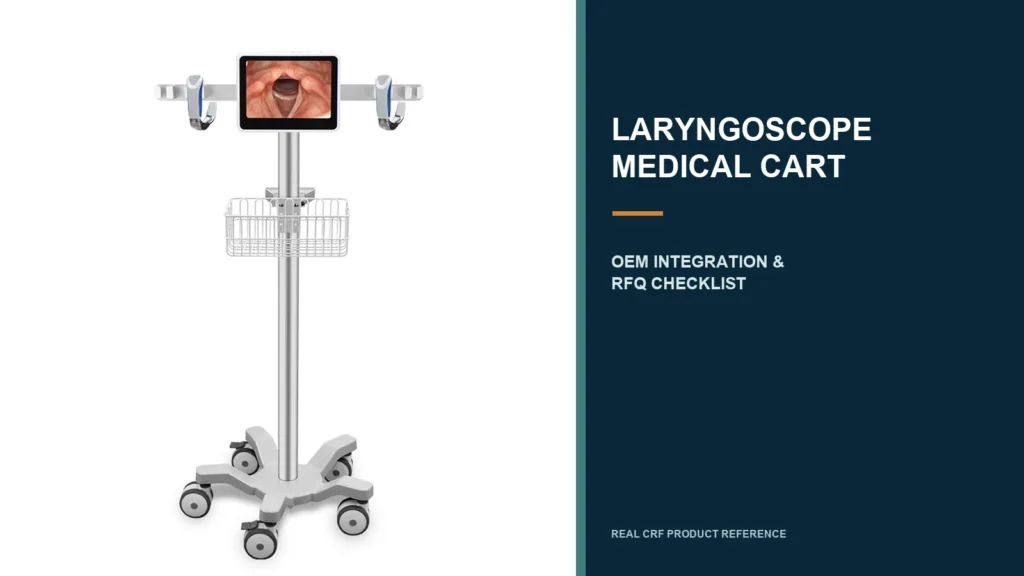
Primary keyword: laryngoscope medical cart
Intent: Commercial investigation
Funnel: Consideration / decision
Business value: High
Keyword source: Qualitative product-specific expansion from CRF’s verified live product; exact platform volume, difficulty and CPC are unknown. The local keyword library contains no exact laryngoscope-cart term. Fresh GSC data through 2026-09-28 contains no disclosed exact-topic query.
SEO title: Laryngoscope Medical Cart OEM Checklist | CRF
Slug: /laryngoscope-medical-cart-oem-checklist/
Meta description: Specify a laryngoscope medical cart by mapping equipment, interfaces, work surface, storage, cables, cleaning, route, casters and sample approval.
H1: Laryngoscope Medical Cart: An OEM Integration and RFQ Checklist
A laryngoscope medical cart should be specified around the equipment that will actually be carried, connected, accessed, cleaned and moved. For a quote-ready OEM project, provide the equipment envelope, interface details, accessory list, cable and power needs, work-surface and storage requirements, travel route, cleaning process, target market and sample acceptance plan. A product name alone is not enough to confirm compatibility.
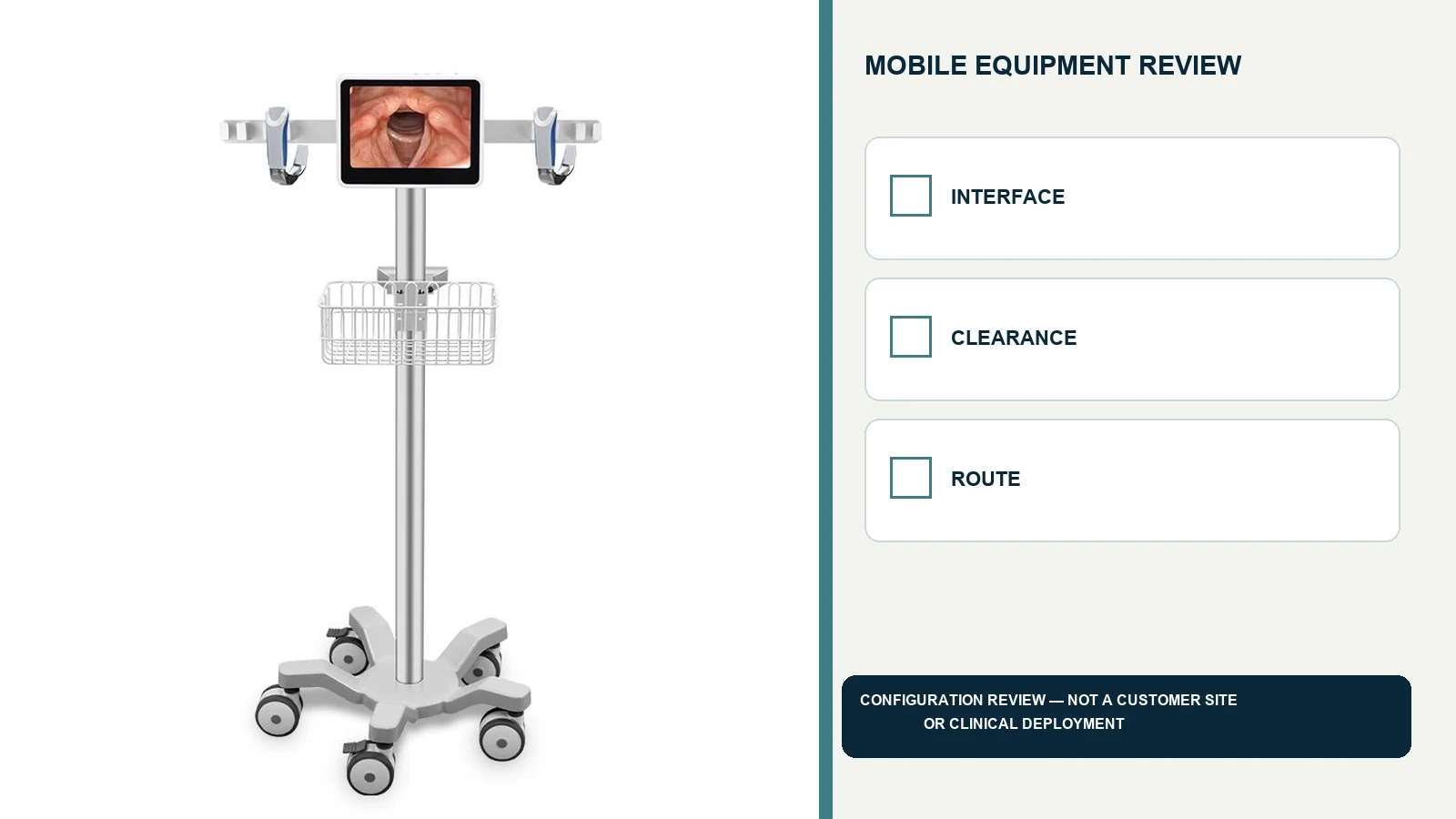
CRF has a verified five-caster laryngoscope medical cart in its current catalog. That product is evidence that this product direction exists; it is not proof that one configuration fits every laryngoscope, video system, accessory set or clinical workflow. Buyers should approve each project against controlled drawings and a configured sample.
What Is a Laryngoscope Medical Cart?
A laryngoscope medical cart is a mobile support platform intended to position and organize a laryngoscope system and its project-defined accessories. Depending on the equipment, a configuration may need a work surface, display or device interface, shelves, baskets, drawers, cable routing, power-component space, handles and braking casters.
It is different from a pre-stocked difficult-airway or emergency cart. Those carts are usually governed by facility protocols and may contain multiple airway devices, consumables and rescue supplies. CRF’s product evidence here supports a mobile equipment-cart discussion, not a claim that the cart is supplied as a complete clinical airway system.
Start with the Equipment, Not the Cart Photograph
Define the complete equipment envelope
Record the maximum width, depth and height of every installed item. Include protruding connectors, handles, opened covers, removable modules and cable bend space. If a screen tilts or a component is removed for service, show both operating and service envelopes.
A photograph cannot establish mounting dimensions or clearance. Two visually similar devices can use different interfaces and connector locations.
Record mass and load position
List the mass of the main device, displays, batteries, power supplies, baskets, accessories and stored items. Identify where each item sits in normal use and transport. Ask the responsible engineering team to review the configured load case; do not treat empty-cart appearance as stability evidence.
Map controls, ports and ventilation
Identify controls that must remain visible, connectors that users must reach, ventilation openings that cannot be blocked and panels needed for maintenance. Note connector insertion direction and the space required to disconnect a cable without removing unrelated components.
Choose the Interface and Work Surface
Direct mount, platform or retention fixture
The interface may be a device-specific mount, a flat platform, a shelf with retention features or another approved fixture. The RFQ should state:
- hole pattern, contact surfaces and fasteners;
- permitted clamp or attachment zones;
- tolerances and alignment references;
- whether tool-free removal is required;
- the locked transport condition; and
- who is responsible for final integration verification.
Do not call an interface “universal” unless the approved dimensional and load ranges are defined.
Work-surface access
Define the task performed on the cart and the usable surface required around the device. Check whether the user can reach controls without leaning around the column, whether accessories interfere with the work zone and whether the surface remains accessible when cables are connected.
Accessory positions
Create a controlled accessory list. Possible project items include holders, baskets, shelves, handles or device-specific components, but every item must be confirmed for the actual project. Adding an accessory after the structural and mobility review can change the envelope and load position.
Plan Storage, Cables and Power Components
Storage should follow the approved workflow
State what must be stored, its package size, how often it is accessed and whether clean and used items require separation under the buyer’s process. Drawer or basket layouts should be based on the approved inventory—not on generic assumptions about clinical contents.
Make a cable schedule
For every cable, record endpoints, connector dimensions, practical bend space, movement during adjustment and replacement access. Routing should avoid unintended pinch points, sharp edges, caster paths and user grips. Specify strain relief and service loops where the project requires them.
Treat power integration as a separate workstream
If the project includes power supplies, batteries, strips or charging components, provide their envelopes, heat or airflow needs, mounting method and service access. Qualified parties must define electrical integration, applicable verification and target-market responsibilities. A cart does not automatically inherit the approvals of equipment placed on it.
Compare Base and Caster Requirements
CRF’s referenced product uses a five-caster base. Buyers should still evaluate the complete configured cart against the intended route rather than assuming a wheel count guarantees a particular result.
| Review area | What to provide | Why it matters |
|---|---|---|
| Base geometry | Footprint and required clear zones | Relates the support envelope to equipment position |
| Casters | Diameter, material direction and brake requirement | Affects route behavior and user interaction |
| Travel route | Doors, elevators, thresholds, ramps and turning space | Reveals clearance and mobility constraints |
| Transport state | Device, accessories and cables in travel position | Defines the configuration that is actually moved |
| Storage bay | Available width, depth and nearby obstructions | Prevents a cart that cannot be parked as intended |
Caster terminology such as “silent” appears in the verified product name, but project noise, rolling and braking expectations still need objective acceptance criteria agreed by the buyer and supplier.
Review Cleaning and Service Access
Provide the cleaning products, concentrations, contact times and process used by the intended organization. Ask the supplier to review disclosed materials, finishes, joints, covers and removable parts against that process. Avoid broad claims such as “compatible with all disinfectants.”
A service review should confirm access to fasteners, connectors, cable covers and replaceable components. Document which tasks can be completed in place and which require device removal. The approved design should not force unrelated parts to be dismantled for routine access.
Build a Sample Acceptance Plan
A useful sample review checks the configured system, not only the fabricated frame.
Mechanical and interface checks
- Equipment and accessories fit without unintended interference.
- Mounting features match the approved drawing.
- Controls, ports, vents and service panels remain accessible.
- Fasteners and retention features match the agreed configuration.
Workflow and mobility checks
- The work surface and storage can be used in the intended sequence.
- Cables avoid visible pinch, abrasion and caster conflicts.
- Handles, adjustments and brakes are reachable in intended positions.
- The loaded sample can be evaluated on the real or representative route.
Cleaning, service and packaging checks
- Disclosed cleaning access can be reviewed on the sample.
- Agreed replaceable parts can be reached.
- The shipping configuration protects the cart and separately packed accessories.
- Labels, manuals and the configuration list match the approved revision.
The responsible teams should define test methods, loads and pass/fail criteria. CRF should not infer a test result, certification or clinical suitability that has not been supplied and verified for the final configuration.
Laryngoscope Medical Cart RFQ Checklist
Send these inputs with the inquiry:
- Intended application, users and workflow.
- Equipment names, model references and controlled drawing revisions.
- Equipment and accessory envelopes.
- Mass and load positions; center-of-gravity data when available.
- Mounting patterns, fasteners, permitted attachment zones and tolerances.
- Controls, ports, ventilation and service clearances.
- Complete accessory and storage inventory.
- Cable endpoints, connector sizes, routing and strain-relief needs.
- Power-component envelopes, mounting and service requirements.
- Work-surface and adjustment requirements.
- Overall envelope and storage-bay limits.
- Route, floor, threshold, doorway, elevator and turning constraints.
- Caster, brake, handle and bumper requirements.
- Cleaning products and process.
- Target market and buyer-required documents or verification.
- Prototype, pilot and forecast quantities.
- Branding, labeling, manuals and packaging requirements.
- Sample acceptance criteria and approval owners.
Common Specification Mistakes
Using only the nominal device dimensions
Connectors, moving panels and cable bends can extend beyond the enclosure. Use a functional envelope.
Selecting from a product image
An image can support concept selection but cannot confirm hole patterns, fasteners or service zones. Request drawings and approve the interface.
Defining storage after the structure is frozen
Late baskets or drawers can change reach, cleaning access, outer dimensions and load position. Include them in the configured review.
Ignoring the route
A cart that fits the equipment may still fail to clear a doorway, turn beside a bed or enter its storage bay. Measure the route early.
Treating the cart as a complete clinical protocol
The cart can organize approved equipment, but stocking, training, clinical use and readiness procedures belong to the responsible healthcare organization and device instructions.
FAQ
What information does a manufacturer need for a custom laryngoscope medical cart?
Provide equipment drawings, dimensions, mass, mounting points, controls, ports, ventilation, cables, accessories, storage list, workflow, route, cleaning process, quantities, destination and required verification.
Can one cart support several laryngoscope systems?
Possibly, if the complete interface, envelope, load and accessory ranges are defined. Each approved configuration should be reviewed rather than assuming interchangeability.
Is a five-caster base always required?
No universal wheel-count rule should be inferred. CRF has a five-caster reference product, but the final base should be evaluated against the configured equipment, envelope, route and acceptance plan.
Does the cart include laryngoscope equipment or clinical supplies?
That depends on the quotation. The referenced CRF page evidences a cart direction; buyers must confirm all included equipment, accessories and supplies in writing.
Can CRF customize the cart?
CRF accepts OEM/ODM inquiries. Feasibility depends on the device interface, configured loads, quantities, target market, documentation and verification requirements. Final details belong in the approved quotation and drawings.
Request an OEM Review
Send CRF the laryngoscope-system drawings, equipment list, interface details, cables, storage map, route constraints, target market and quantity. CRF can review the inputs and respond with configuration questions and a quotation path.
Internal links
- View the verified CRF 5-caster laryngoscope medical cart
- Browse CRF medical carts
- Read the medical equipment cart OEM integration guide
CTA: Request a Quote — include controlled equipment drawings and the full configured accessory list.
Editorial limitations: Educational B2B procurement content only. It does not provide clinical guidance, certify compatibility, or claim medical performance.