
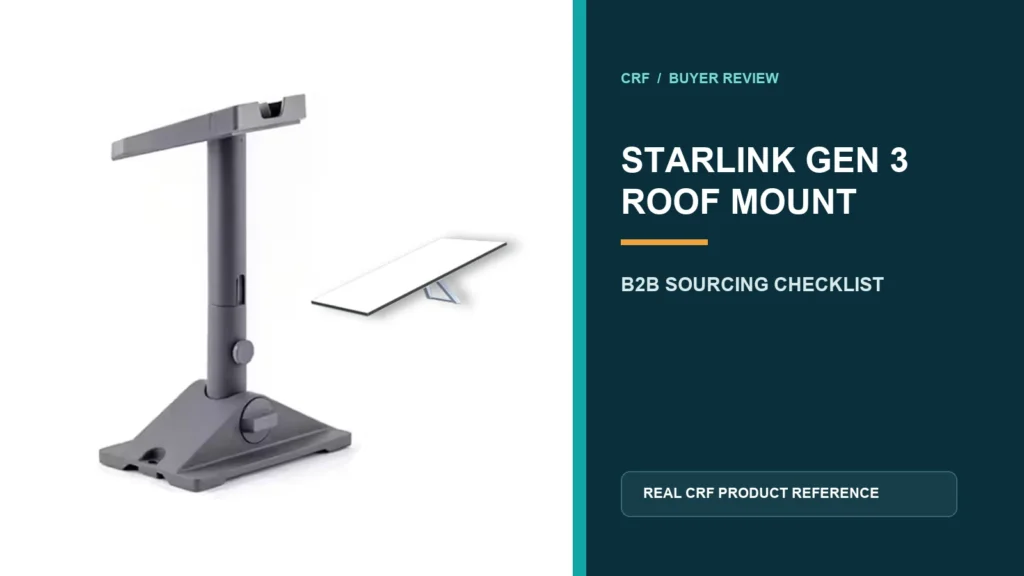
Primary keyword: starlink roof mount
Keyword source: Semrush via seotools8, US database, library ID 8: US volume 4,400, KD 30, CPC USD 0.68.
Intent: Transactional
Funnel: Decision
Business value: Medium—verified CRF metal-mount product with direct sourcing relevance
SEO Title: Starlink Gen 3 Roof Mount Sourcing Checklist | CRF
URL slug: /starlink-gen-3-roof-mount-sourcing-checklist/
Meta Description: Source a Starlink Gen 3 roof mount by checking terminal version, substrate, interface, angle, cable route, hardware, weather sealing and sample approval.
A Starlink Gen 3 roof mount should be sourced against the exact terminal version, roof or wall substrate, support structure, installation angle, cable route, hardware plan and local requirements. “For Starlink Gen 3” does not prove that a bracket is suitable for every roof, wall, wind environment or installation. CRF has a real aluminum-alloy wall and roof mounting kit, but project compatibility and installation responsibility must be confirmed for each order.
Freeze the terminal and installation scenario first
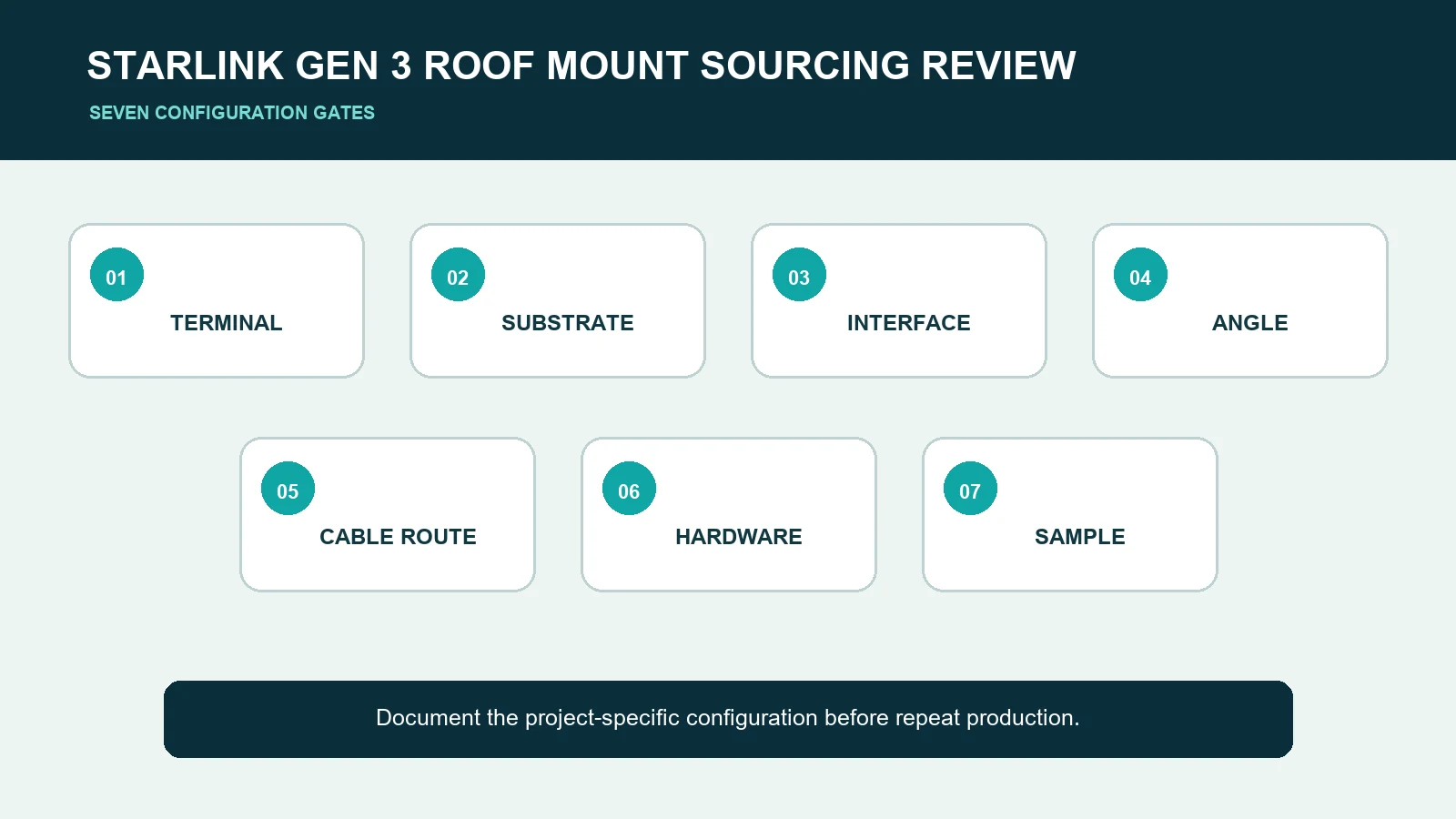
Begin the RFQ with a controlled application brief:
- exact Starlink terminal version and current interface information;
- roof, fascia or wall installation;
- substrate type and supporting structure;
- roof pitch or mounting orientation;
- required stand-off and clearance;
- cable exit and building-entry route;
- expected outdoor environment;
- applicable building, electrical and waterproofing requirements;
- required kit contents, packaging and labeling;
- quantity and destination market.
Third-party naming varies. Do not approve a mount from “Gen 3” wording alone; compare the actual terminal interface and current manufacturer documentation.
Distinguish product compatibility from site suitability
A compatible terminal interface is only one layer of the decision. Site suitability also depends on the supporting structure, fasteners, penetrations, waterproofing, clearances, environmental loads and installer competence.
The official Starlink Standard accessories guide separates accessories by terminal compatibility and kit contents. Use current official documentation to identify the target terminal and interface, but do not imply that a third-party CRF mount is an official Starlink accessory or approved by Starlink.
Build a compatibility record
Record:
- terminal name and version;
- interface drawing or measured sample;
- pipe adapter or mast dimensions;
- insertion depth and retention method;
- cable connector clearance;
- adjustment range required by the site;
- final orientation and obstruction review;
- approved drawing revision.
A product photo cannot replace these checks.
Match the mount to the substrate
Roof installation
Document the roof construction, pitch, waterproofing system and location of structural support. The party responsible for the installation should specify fasteners, penetration treatment, flashing or sealant method, edge distances and inspection requirements.
Do not assume supplied fasteners suit every roof. A lag screw shown in a kit image does not prove suitability for a particular deck, rafter, concrete slab, metal panel or waterproofing assembly.
Wall or fascia installation
Confirm the support material, cavity conditions, cladding stand-off, drainage path and required clearance from the building. Account for the complete mast and terminal envelope, not only the bracket footprint.
CRF’s product page describes its product as a wall and roof mounting kit. That versatility still requires a configuration-specific installation plan.
Review the complete kit and interface chain
The verified CRF product page identifies a pivot mount, pipe adapter, mast and installation hardware in supplier imagery. It also notes that the final bill of materials must be confirmed for each order.
Use a kit-content table:
| Component | Buyer must confirm | Approval evidence |
|---|---|---|
| Pivot base | Footprint, hole pattern and angle | Controlled drawing |
| Mast | Diameter, length and finish | Drawing and sample |
| Pipe adapter | Terminal interface and retention | Fit check with exact terminal |
| Fasteners | Substrate-specific selection | Installer/engineer specification |
| Cable clips | Cable size, spacing and exposure | Route plan |
| Sealing materials | Roof-system compatibility | Installer/waterproofing approval |
Separate product dimensions from shipping-package dimensions and net product weight from gross package weight. If source information conflicts, resolve it in the quotation rather than repeating both values as equivalent.
Treat adjustment as a controlled feature
An adjustable pivot can help accommodate different orientations, but the buyer must define the required position and locking method. Ask for:
- adjustment range on the quoted revision;
- hardware and tightening procedure;
- interference checks at each required angle;
- terminal and cable clearance;
- inspection and maintenance access;
- measures preventing unintended movement where required.
An angle shown in supplier imagery is not proof of wind performance, long-term locking performance or suitability on every pitch.
Plan cable routing and weather sealing together
Cable routing affects connector stress, water paths, penetration locations and service access. The project plan should identify:
- connector clearance at the terminal;
- bend radius and strain relief;
- exposed and protected cable sections;
- drip loops where appropriate;
- clips or conduits;
- building-entry method;
- separation from sharp edges and moving joints;
- access for replacement.
Waterproofing and cable entry should be specified by responsible site professionals for the actual roof or wall system. Do not present a generic sealant strip as universal waterproofing proof.
Evaluate outdoor requirements with evidence
Before approval, define the environment and request evidence appropriate to the project. Possible inputs include wind conditions, corrosion exposure, temperature range, UV exposure, precipitation, coastal salt and maintenance frequency.
The current CRF product page explicitly states that no numerical wind rating, load test, IP rating or official Starlink certification was visible in the source listing. Therefore, the article and quotation must not invent those values. Where a project requires rated performance, agree on the relevant calculation or test method for the final assembly and substrate.
Compare mounting options by installation need
| Mounting approach | Useful when | Key checks |
|---|---|---|
| Roof pivot mount | A fixed roof location is structurally and waterproofing-compatible | Pitch, support, penetrations, sealing, cable route |
| Wall mount | A wall provides suitable support and sky clearance | Overhang, stand-off, anchors, cable entry |
| Pole or pipe interface | A compatible support already exists or is specified | Diameters, adapter, retention, bending loads |
| Portable stand | Temporary placement is intended | Surface, retention, trip risk, storage, operating limits |
| Vehicle mount | The project is vehicle-specific | Host interface, operating state, retention, legal and safety review |
Do not merge these product types in one image or imply that one bracket supports every scenario.
Sample and approval workflow
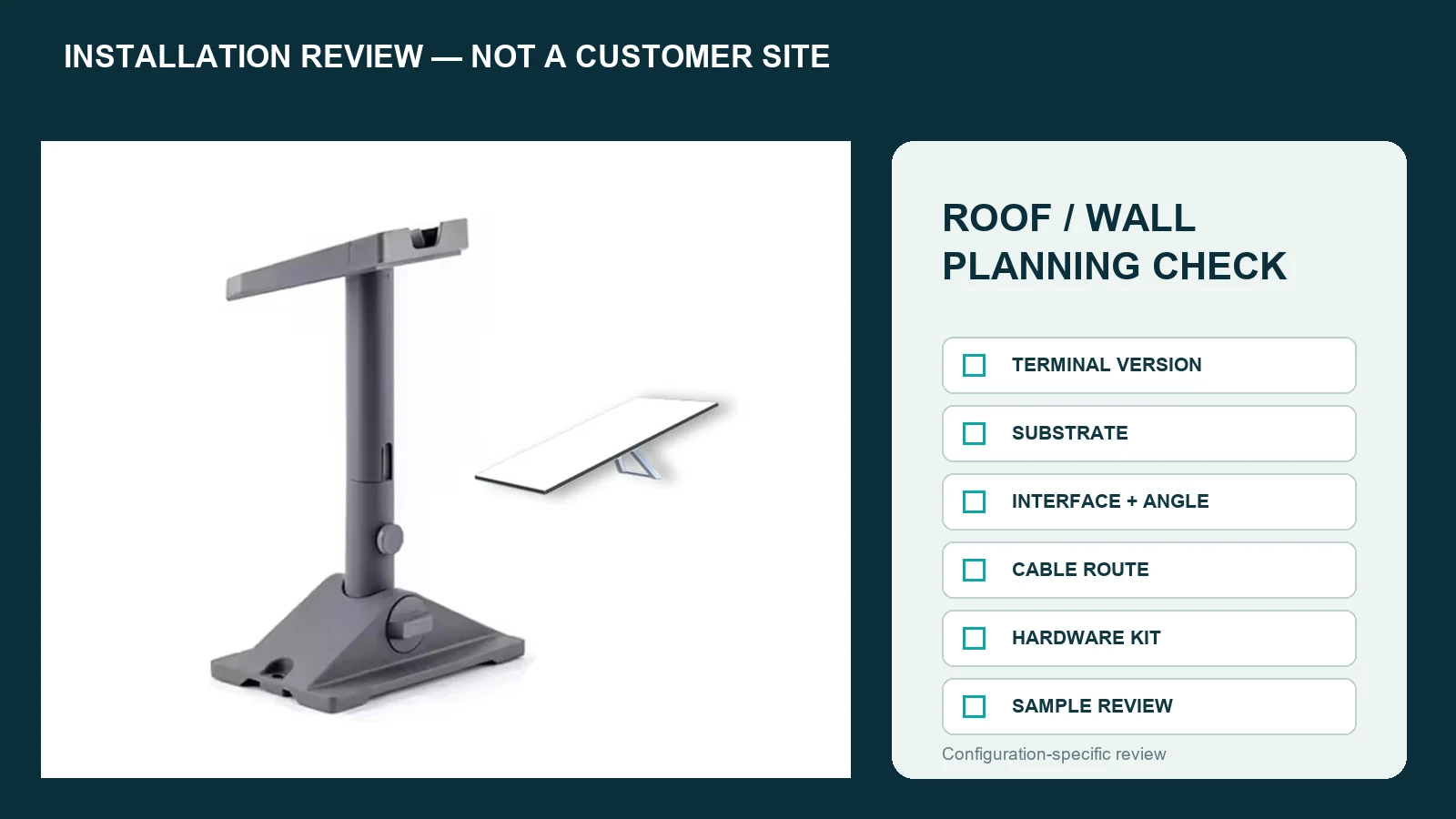
A B2B sourcing project should use controlled gates:
- confirm terminal version and site scenario;
- approve interface and bracket drawings;
- approve the kit bill of materials;
- verify material and finish documentation required by the order;
- fit the exact terminal or representative interface sample;
- review orientation, cable route and service access;
- review packaging, labels and installation documents;
- approve the final revision and production change-control process.
Site installation should be reviewed separately by qualified responsible parties. Product sample approval does not validate a building structure or waterproofing system.
Starlink Gen 3 roof mount RFQ checklist
Send suppliers:
- terminal version and interface evidence;
- application: roof, wall or another support;
- substrate and support details;
- pitch, orientation and clearance drawing;
- required mast and adapter dimensions;
- cable route and entry requirements;
- environment and any required verification;
- exact kit contents;
- finish, color, packaging and labeling requirements;
- sample quantity and acceptance criteria;
- production quantity and destination.
Ask the quotation to reference the approved drawing and bill-of-material revision.
Limits and brand disclosure
Starlink is a third-party brand. CRF’s mount is an accessory product; it is not evidence of affiliation, endorsement, satellite performance or service approval. This guide is not structural, roofing, electrical or installation advice. Final safety and compliance depend on the terminal, mount, substrate, fasteners, environment, installation and applicable requirements.
FAQ
Does “Starlink Gen 3 compatible” guarantee fit?
No. Confirm the exact terminal version, interface dimensions, adapter and retention method using current documentation and a sample fit check.
Can the same bracket be used on any roof?
No. Roof construction, structural support, pitch, waterproofing and fastener requirements vary. A responsible installer or engineer must assess the actual site.
Are fasteners and sealing materials always included?
Do not assume so. Confirm the final bill of materials and distinguish product-kit items from substrate-specific installation materials.
Does an adjustable pivot prove wind resistance?
No. Adjustment range and wind performance are different issues. Wind suitability requires project-specific evidence for the final assembly and installation.
Is the CRF mount an official Starlink accessory?
No official affiliation or approval is claimed. It is a CRF third-party mounting accessory intended for compatibility review with the specified terminal.
What should be checked on a pre-production sample?
Check terminal fit, retention, adjustment, fastener interfaces, cable clearance, complete kit contents, finish, labels, packaging and drawing consistency. Site suitability remains a separate review.
Request a configuration-specific CRF quote
Review the CRF aluminum-alloy wall and roof mount for Starlink Gen 3 as a real product reference. Then send CRF the terminal version, interface, substrate, pitch, route, environment, required kit contents, quantity and destination. CRF can review manufacturing and OEM/ODM requirements and prepare a configuration-specific B2B quotation; final suitability remains subject to approved documentation, samples and site-professional review.